
Understanding Research During Residency in Pediatrics-Psychiatry
For an MD graduate entering pediatrics-psychiatry (peds psych) or a combined triple board (Pediatrics–General Psychiatry–Child & Adolescent Psychiatry) program, research during residency is more than a “nice extra.” It’s a strategic tool that can:
- Deepen your understanding of child development and psychopathology
- Distinguish you in a competitive allopathic medical school match environment
- Open doors to academic medicine, leadership positions, and fellowships
- Directly improve care for children with complex medical and psychiatric conditions
Residency is busy, but it is also one of the best times to learn how to ask good clinical questions, test them rigorously, and translate findings into practice. This article outlines how to approach research during residency in pediatrics-psychiatry, whether you’re in a categorical peds psych program, a triple board pathway, or another combined track.
We will cover how to choose a focus, find mentors, build feasible resident research projects, navigate the academic residency track, and set yourself up for a sustainable academic career.
Why Research Matters in Pediatrics-Psychiatry and Triple Board Training
Pediatrics-psychiatry and triple board residencies place you at the interface of medicine, mental health, and child development. Your patients often have:
- Chronic medical conditions with behavioral or emotional complications
- Neurodevelopmental disorders with complex medical comorbidities
- Family and social stressors impacting both physical and mental health
This intersection naturally generates research questions. For example:
- How does early intervention for anxiety in children with asthma affect ED utilization?
- What screening tools best detect depression in adolescents with Type 1 diabetes?
- How do trauma-informed pediatric practices change psychotropic prescribing patterns?
Key Reasons to Engage in Research During Residency
- Sharpen Clinical Reasoning
Research trains you to frame focused clinical questions, evaluate evidence, and avoid cognitive biases. In peds psych and triple board, where guidelines may be less clear for medically complex kids, this skill is critical.
- Improve Career Flexibility
Experience with research during residency signals that you can:
- Handle complex projects over time
- Work collaboratively across disciplines
- Contribute to scholarship in your field
This is valuable whether you plan for a clinician-educator role, a community practice with QI responsibilities, or a full academic career.
- Strengthen Your Academic Profile
If you are considering a formal academic residency track, child and adolescent psychiatry fellowship, or a future faculty role, having:
- Abstracts
- Posters
- Manuscripts
- QI project outcomes
…demonstrates commitment to scholarly work and can set you apart.
- Influence System-Level Care
Peds psych and triple board residents are uniquely positioned to design projects that affect hospital policy, screening protocols, and integrated care models. A single well-designed QI project can lead to new workflows that improve care for thousands of children.
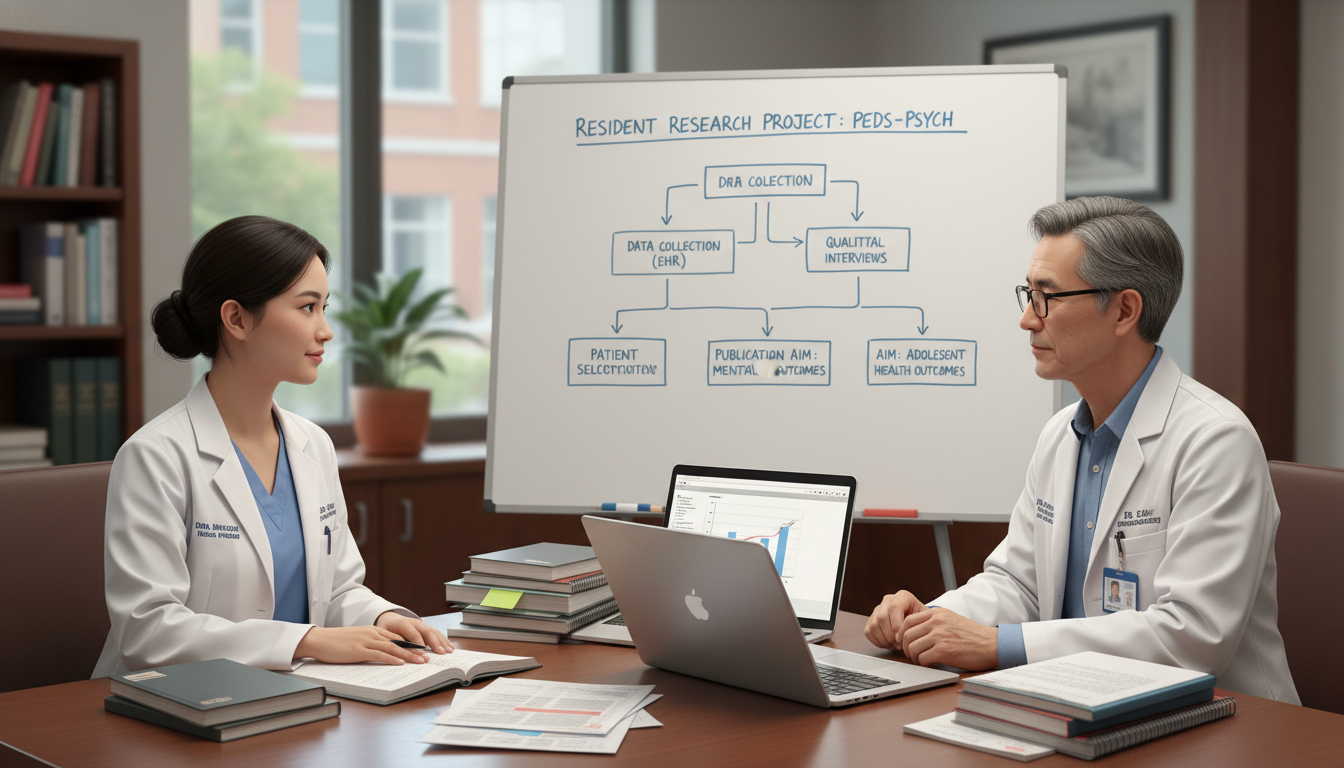
Types of Research Projects Feasible During Residency
You do not need to design a randomized controlled trial to have meaningful research during residency. The key is feasibility. Aim for projects that you can start, complete, and ideally disseminate within 1–3 years.
1. Quality Improvement (QI) Projects
QI is often the most realistic and directly impactful research format for residents.
Examples in Pediatrics-Psychiatry:
- Implementing a standardized suicide risk screening tool on pediatric inpatient units
- Improving follow-up rates after emergency department visits for suicidal ideation
- Reducing antipsychotic polypharmacy in youth with developmental disabilities
- Increasing rates of trauma screening in primary care pediatrics
Why QI Works for Residents:
- Aligned with ACGME requirements
- Typically uses existing clinical data
- Limited need for complex IRB processes (often QI-exempt, though this must be verified)
- Results can be presented at conferences and sometimes published as QI studies
2. Retrospective Chart Reviews
Retrospective studies are a staple of resident research projects and can be highly productive.
Peds Psych / Triple Board Examples:
- Characteristics and outcomes of children admitted to pediatric medical floors with psychiatric boarding
- Patterns of psychotropic prescribing in children with chronic medical conditions (e.g., epilepsy, diabetes, CF)
- ED utilization before and after initiation of integrated behavioral health in a pediatric clinic
Pros:
- Use existing data; no need to recruit new participants
- Relatively quick once data extraction plans and IRB approval are in place
- Good introduction to study design, data management, and basic statistics
Cons:
- Limited by data quality and documentation
- Risk of bias and confounding variables
3. Prospective Observational Studies
These are more challenging but feasible with the right mentorship and scope.
Examples:
- Implementing a brief screening tool for sleep problems in children with ADHD and tracking acceptability and outcomes
- Piloting a parent-focused psychoeducation curriculum in a pediatric subspecialty clinic (e.g., oncology, rheumatology) and measuring engagement and satisfaction
These projects often serve as pilot data for a larger grant or a faculty member’s long-term research agenda.
4. Educational Research
As a resident, you are both a learner and a teacher. Educational research can fit particularly well if you are drawn to academic teaching roles.
Examples:
- Assessing the impact of a new peds psych curriculum on pediatric residents’ comfort with prescribing SSRIs
- Evaluating simulations for managing pediatric behavioral emergencies on med-surg floors
5. Mixed-Methods and Qualitative Studies
Not all research is numeric. Understanding patient, caregiver, or clinician experience can be critical in pediatrics-psychiatry.
Examples:
- Interviewing parents of medically complex children about barriers to accessing mental health care
- Focus groups with residents or nurses about implementing a new agitation management protocol
These methods can be particularly resonant in child psychiatry and integrated care research.
Choosing a Research Focus: Strategic Alignment with Your Career
When starting residency, you don’t need a fully formed research “career plan,” but you should think strategically about where to invest your limited time.
Step 1: Clarify Your Long-Term Interests
Ask yourself:
- Do I see myself mainly in:
- Academic medicine?
- Community integrated care?
- Subspecialty pediatrics or subspecialty psychiatry?
- Am I more drawn to:
- Systems of care and integrated models?
- Psychopharmacology and neurobiology?
- Psychotherapy and family interventions?
- Education and curriculum design?
If you are aiming for an academic residency track, start getting involved in research early, ideally PGY-1 or PGY-2.
Step 2: Identify Overlap Between Clinical Rotations and Research
You’ll likely rotate through:
- General pediatrics (inpatient and outpatient)
- General psychiatry
- Child and adolescent psychiatry
- PICU/NICU or subspecialty pediatrics
- Consultation-liaison psychiatry
- Emergency psychiatry
Each block can surface a researchable problem. For example:
- On pediatric wards: “We’re seeing frequent readmissions for functional abdominal pain—how are we managing these kids?”
- On child psych: “Are we systematically screening for trauma in youth with chronic pain?”
- On CL service: “What are the characteristics of kids who require 1:1 sitters due to behavioral risk?”
Write these questions down. When seeking resident research projects, these lived clinical observations can be the seed.
Step 3: Match Your Research to a Mentor’s Program
Your chances of successful publication and presentation are much higher if your project fits into an existing research stream rather than starting from scratch.
Look for faculty whose interests overlap with:
- Integrated pediatric-primary care and behavioral health
- Chronic illness and mental health
- Developmental disabilities and psychopharmacology
- Trauma, adversity, and health outcomes
- Systems of care, telepsychiatry, or school-based mental health
Ask how your idea could plug into their ongoing data collection or proposals.

Finding Mentorship and Research Infrastructure in Residency
Your greatest asset is not your idea; it’s your mentorship and infrastructure. This is where being in an academic or research-rich MD graduate residency program offers a major advantage.
Identifying the Right Mentors
Ideally, you will have more than one:
- Content Mentor – Expert in child psychiatry, pediatrics, or a specific topic (e.g., autism, adolescent depression, foster care).
- Methodology Mentor – Familiar with study design, epidemiology, QI methodology, or statistics.
- Career Mentor – Helps you make decisions about balancing clinical training, exams, fellowship, and academic goals.
Where to Find Them:
- Departmental research directories or websites
- Faculty giving grand rounds or M&M presentations on topics you find compelling
- Your program director or associate program director (ask, “Who mentors resident research in X?”)
- Division of Child & Adolescent Psychiatry, Developmental & Behavioral Pediatrics, or Pediatric Hospital Medicine
Approaching a Potential Mentor
When you email, be clear and concise:
- Who you are (PGY level, program, track)
- Your general interests (e.g., peds psych integrated care, trauma, ADHD)
- Whether you are seeking:
- A defined role in an existing project
- Help shaping your own project idea
- Your available time (e.g., half-day per week during research block; interest in summer or elective time)
- Any prior research experience (or lack thereof—honesty is fine)
Offer to read one or two of their recent papers before meeting. Come prepared with questions and a rough sense of what you’re hoping to achieve.
Understanding Program and Institutional Resources
Ask early:
- Does your residency offer a formal academic residency track with protected time?
- Are there resources through the GME office, such as:
- Biostatistics support
- Research navigators
- Grant-writing workshops
- Are there resident-specific funds for:
- Poster printing
- Conference travel
- Small project costs (e.g., survey tools, incentives)
Knowing what’s available early will help you design a feasible project.
Practical Steps to Launch and Complete a Resident Research Project
Residency is time-limited, so efficiency and structure are critical.
1. Start Small and Scoped
Aim for a project that:
- Uses data you can realistically access
- Has clear, measurable outcomes
- Can reach a presentable endpoint (poster or abstract) within 12–18 months
Examples of well-scoped questions:
- “Among children with Type 1 diabetes seen in our hospital’s endocrine clinic, what proportion have documented depression screening in the past 12 months?”
- “Does implementing a standardized screening checklist in our pediatric ED reduce time to psychiatric consultation?”
2. Solidify the Question and Design Early
With your mentor, define:
- Primary objective and 1–2 secondary objectives
- Inclusion and exclusion criteria (for chart reviews or prospective cohorts)
- Data points you will collect
- Analysis plan (even if basic—e.g., descriptive statistics, pre-post comparisons)
Get this written in a 1–2 page proposal. This document will anchor IRB applications and help keep the project focused.
3. Navigate the IRB and Approvals
Depending on the project type (QI vs. human subjects research), processes differ:
- For QI: You may need a QI exemption from IRB or an internal review; policies vary by institution.
- For research: Prepare an IRB submission, which typically includes:
- Background and rationale
- Objectives and hypothesis
- Methods and recruitment procedures
- Data management and confidentiality plan
Leverage templates from your institution and ask co-residents who have submitted IRBs to share their materials.
4. Data Collection and Management
Plan for:
- Secure data storage (HIPAA-compliant systems, REDCap, or institutional tools)
- A clear data dictionary so terms are consistently defined
- Realistic time allocation (e.g., 2–4 hours per week over several months)
If possible, develop a pilot dataset (e.g., first 10–20 charts) to test your collection process and refine variables before going full-scale.
5. Analysis and Interpretation
You don’t need to be a biostatistician, but you should understand:
- What statistical tests are appropriate for your design
- The limitations of your data (sample size, missingness, selection bias)
Work with a biostatistician or methodologist if available. Use this as a learning opportunity rather than outsourcing blindly.
6. Dissemination: Posters, Presentations, and Publications
Plan early for where you might present:
- National conferences (AACAP, APA, APSA, PAS, AAP Sections, Academy of Consultation-Liaison Psychiatry)
- Regional society meetings
- Departmental research days
For publications, QI work and descriptive studies can often find homes in:
- Pediatrics, psychiatry, or child psychiatry journals
- Education journals (for curriculum-oriented work)
- Specialty journals in integrated care or hospital medicine
Even if the project is small, a thoughtful manuscript reinforces your academic trajectory.
Balancing Clinical Duties and Research During Residency
Time is your scarcest resource. The most common barrier to research during residency is not lack of interest; it’s lack of time management structures.
Strategies to Protect Research Time
- Use Electives Wisely
- Choose research electives that are truly protected from clinical work.
- Clarify expectations: number of hours per week, deliverables, check-ins with your mentor.
- Block Scheduling
- Reserve predictable blocks (e.g., Friday afternoons) for research, even on non-elective rotations when feasible and approved.
- Treat these like non-negotiable meetings with yourself.
- Micro-Tasks
Break big tasks into 30–60 minute segments:
- Draft background paragraphs
- Extract 10 charts
- Update your data dictionary
- Write conference abstract outlines
This allows meaningful progress during lighter days or weekends without overwhelming you.
- Co-Resident Collaboration
Partnering with another resident or fellow can:
- Share workload
- Create peer accountability
- Allow division of tasks (e.g., one leads data collection, another leads manuscript drafting)
Avoiding Common Pitfalls
- Overly ambitious design: Narrow the question instead of trying to answer everything at once.
- Late start: Waiting until PGY-3 or PGY-4 can compress timelines too much, especially in triple board programs. Aim to identify a mentor and preliminary idea by late PGY-1 or early PGY-2.
- No endpoint goal: From the outset, define what “success” looks like (e.g., “Present at at least one national meeting and submit a manuscript”).
Positioning Yourself for an Academic Future After Residency
If you are serious about an academic path, your residency research can be the foundation of your scholarly identity.
Building a Coherent “Story”
Fellowship directors and future employers in academic centers often ask:
“How has this resident’s work evolved over time?”
Even if your projects are varied, look for a unifying theme:
- Integrated care for medically complex youth
- Trauma-informed pediatrics and psychiatry
- Psychopharmacology in neurodevelopmental disorders
- Suicide risk identification across pediatric settings
In your CV and personal statements, connect your rotations, resident research projects, and conference presentations within that narrative.
Leveraging the Academic Residency Track
Some programs offer a formal academic residency track, which may include:
- Additional protected research time
- Structured research curriculum
- Mentoring committees
- Opportunities for pilot funding
If your MD graduate residency has such a track, consider applying early. Even without a formal track, you can “build your own” academic experience by:
- Joining ongoing faculty studies
- Pursuing multi-year projects that span peds and psych training years
- Taking electives in biostatistics, epidemiology, or medical education
Transition to Fellowship or Junior Faculty
Use your residency years to:
- Accumulate at least 1–2 first-author posters and ideally 1–2 publications
- Learn the basics of grant writing (small internal awards, foundation grants)
- Network at conferences with faculty who share your interests
When applying to child and adolescent psychiatry fellowship or early faculty positions, emphasize:
- Your specific research focus and how it addresses gaps in pediatric-psychiatric care
- Your experience balancing clinical loads with scholarly productivity
- Future questions you’d like to pursue with stronger research infrastructure
FAQs: Research During Residency for MD Graduates in Pediatrics-Psychiatry
1. Do I need prior research experience from medical school to be successful with research during residency?
No. Prior experience helps, particularly for conceptualizing projects and writing, but it is not mandatory. As an MD graduate, your most important assets are curiosity, reliability, and willingness to learn. Strong mentorship and a well-scoped project can compensate for limited prior experience. If you lack experience, be upfront and ask for explicit guidance on each step of the process.
2. How much research is “enough” if I want a future academic career?
There is no single threshold, but a strong profile by the end of residency typically includes:
- Meaningful involvement in at least one multi-year project
- 1–3 posters or oral presentations at regional or national meetings
- 1–2 peer-reviewed publications (not necessarily all first-author)
For highly research-intensive careers (e.g., R01-funded investigator roles), additional training—such as a research-focused fellowship, MPH/MS, or T32 research track—may be expected.
3. Can I still do research if I am in a busy triple board program with intense clinical requirements?
Yes, but planning is essential. Triple board residents often have very clinically dense schedules. To make research feasible:
- Start planning early (PGY-1) and integrate projects across multiple rotations
- Choose projects that align closely with your clinical settings (e.g., CL psych on pediatric floors, ED psych, primary care peds)
- Use research electives or lighter rotations for intensive bursts of project work
- Collaborate with faculty whose projects already span pediatrics and psychiatry settings
4. Will research experience help my chances in the allopathic medical school match for fellowship or future positions?
Yes. For MD graduates in pediatrics-psychiatry and triple board, a track record of scholarly productivity:
- Strengthens your application for competitive child and adolescent psychiatry fellowships or subspecialty pediatrics paths
- Signals to academic employers that you can contribute to the department’s research mission
- Demonstrates that you can think critically, manage longitudinal projects, and participate in evidence-based innovation
While clinical performance and professionalism remain paramount, research is an increasingly important differentiator for those pursuing academic or leadership-oriented careers.
Engaging in research during residency as a pediatrics-psychiatry or triple board trainee is not just a checkbox—it can be the cornerstone of a career that combines compassionate clinical care with meaningful contributions to the science of child mental and physical health. With strategic focus, thoughtful mentorship, and realistic project design, your residency years can yield scholarship that shapes your trajectory for years to come.