Understanding Research During a Preliminary Medicine Year
A preliminary medicine year (prelim IM) is often viewed as a one-year stepping stone to advanced specialties such as neurology, anesthesiology, radiology, dermatology, physical medicine & rehabilitation, radiation oncology, or ophthalmology. Because it is only one year and often extremely busy clinically, many applicants assume that research during residency is not realistic in a prelim IM setting.
In reality, thoughtfully planned resident research projects during a preliminary year can:
- Strengthen your fellowship or advanced residency applications
- Build skills in critical appraisal, data interpretation, and scholarly writing
- Connect you with mentors and an academic residency track trajectory
- Position you for future academic, QI, or leadership roles
This guide walks you through why and how to do research in a preliminary medicine year, what’s realistic, and how to set yourself up for success without burning out.
Why Research Matters in a Preliminary Medicine Year
1. The Misconception: “One Year Is Too Short to Matter”
Many prelim residents feel their year is “too short” to make research meaningful. While longitudinal projects (e.g., large prospective trials) are usually out of reach, short-cycle, high-yield projects are absolutely feasible when you:
- Join an existing project that already has IRB approval
- Work with a mentor who has a well-defined dataset or registry
- Contribute to a specific piece (literature review, data abstraction, analysis segment, or a case series)
You are not trying to build a five-year research program; you’re trying to create tangible scholarly output and skills that will:
- Strengthen your CV
- Show sustained interest in your future specialty
- Demonstrate that you can juggle clinical and scholarly responsibilities
2. The Value for Advanced Specialties and Fellowships
Many competitive advanced programs and fellowships expect some evidence of research productivity or at least meaningful scholarly engagement.
Examples:
- Neurology applicant: A prelim IM resident who participates in a stroke outcomes project (e.g., door-to-needle times before and after a QI intervention) can present a poster at AAN or a regional meeting.
- Anesthesiology applicant: Participating in perioperative medicine or postoperative pain-control outcomes analysis during the prelim year signals sustained interest.
- Radiology applicant: Engaging in imaging-based case series or chart reviews in collaboration with radiology faculty highlights alignment with your future field.
For those considering an academic residency track, your prelim IM year is an early signal to programs that you can function as a clinician-scholar, even in a demanding clinical environment.
Types of Research Feasible During a Preliminary Year
Not all research is equally realistic in a one-year, clinically intense setting. Choosing the right type of project is critical.
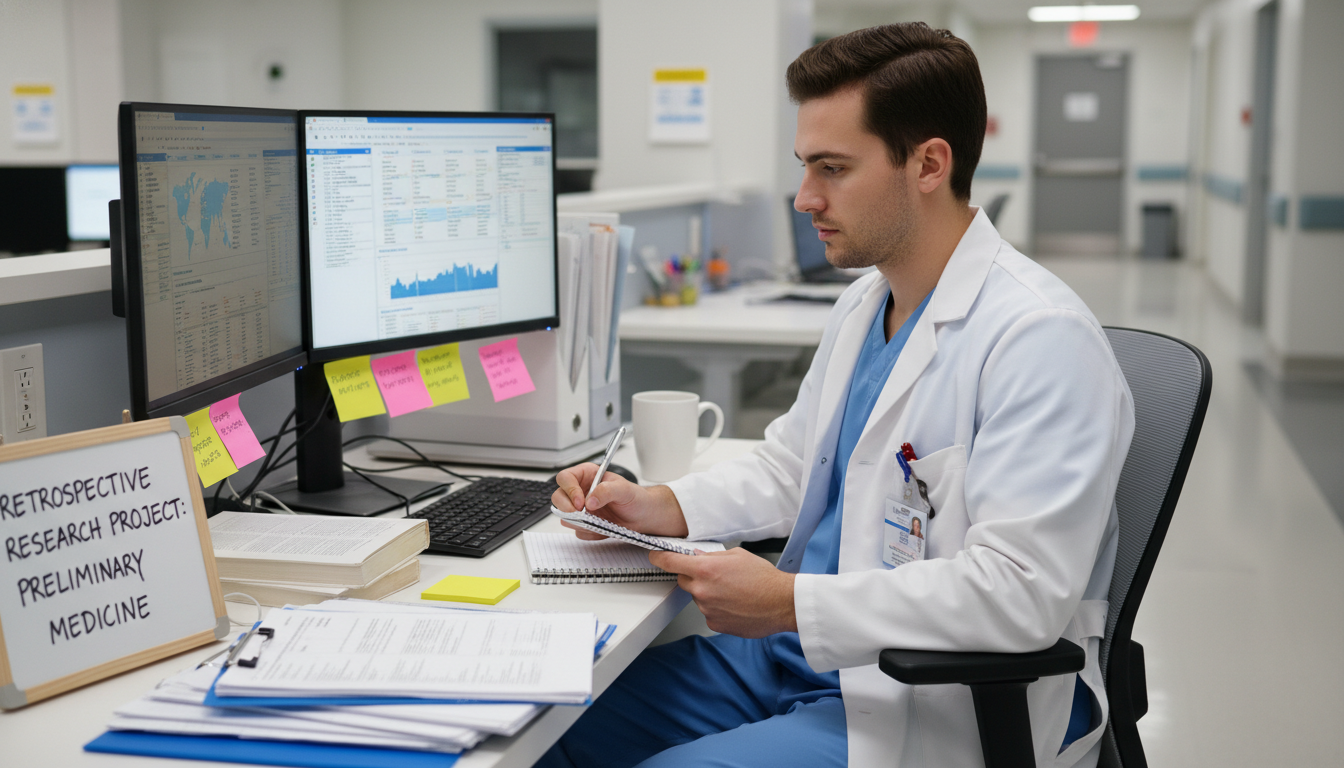
1. Retrospective Chart Review Projects
Why it works:
- Typically already under an existing IRB protocol or easy to obtain expedited review
- Data often available in the EHR or established databases
- Analysis can be scoped to what is feasible in a few months
Sample projects for a prelim IM resident:
- 30-day readmission rates for patients admitted with COPD exacerbation and factors associated with readmission
- Predictors of prolonged length of stay in patients admitted with heart failure
- Outcomes of patients with sepsis receiving early vs. delayed antibiotics in your institution
Actionable tip: Ask faculty specifically:
“Do you have an ongoing or recently completed IRB-approved project where I could help with data extraction or analysis and realistically aim for a poster or abstract within one year?”
2. Quality Improvement (QI) and Patient Safety Projects
QI projects are often built into residency programs, making them particularly accessible in a preliminary medicine year. They also align strongly with ACGME and institutional priorities.
Examples of QI projects:
- Reducing inappropriate daily labs (CBC, BMP) in stable inpatients
- Improving medication reconciliation at admission or discharge
- Increasing vaccination rates (e.g., influenza, pneumococcal) on inpatient floors
- Standardizing delirium screening in older hospitalized patients
Many programs have an institutional framework for QI:
- Pre-existing QI committee or resident QI curriculum
- Templates for project design: PDSA cycles, run charts
- Opportunities to present at local QI symposia or submit to QI-focused journals
QI work can be classified as scholarly activity and often translates into abstracts, posters, or brief reports, a realistic output within one year.
3. Case Reports and Case Series
Case reports are among the most achievable forms of scholarship during a short, intense year.
Ideal cases for prelim IM residents:
- Rare diseases (e.g., vasculitis with unusual presentation, paraneoplastic syndromes)
- Unexpected drug reactions or toxicities
- Classic disease with highly instructive physical exam findings
- Complex diagnostic “zebra” cases with learning points
Case series (2–10 or more patients) become feasible if you or your mentor can identify multiple similar cases from institutional records.
Practical steps:
- Identify an interesting case with clear teaching value.
- Discuss with attending if they think it’s publishable or presentable.
- Confirm no one is already writing it up.
- Obtain patient consent and institutional permissions as required.
- Aim for a poster or brief case report in a specialty or general medical journal.
4. Systematic Reviews, Narrative Reviews, and Educational Projects
While more time-consuming, reviews can work very well if:
- You have prior experience with literature review or meta-analysis
- You partner with a faculty mentor who has a track record of publishing reviews
- You choose a narrow, focused question
Examples:
- Narrative review on inpatient management of hyponatremia for neurologically vulnerable patients (useful for future neurology or neurosurgery applicants)
- Review on perioperative management of anticoagulation (relevant to anesthesiology and internal medicine)
Educational research might include:
- Evaluating a new resident simulation curriculum (e.g., for rapid response teams)
- Developing and assessing impact of a brief teaching module on sepsis recognition
How to Find Research Opportunities in a Prelim IM Program
1. Start Before Match Day (If Possible)
During application season and interviews, ask programs:
- “How do preliminary medicine residents typically participate in resident research projects?”
- “Are there structured opportunities for research during the preliminary medicine year, or is it mostly informal?”
- “Do you have an academic residency track or scholar pathway that prelim residents can tap into, even in a limited way?”
Take notes on:
- Whether the program has a robust research culture
- How many prelim residents in the past have presented abstracts or co-authored papers
- Access to research resources (biostatistics support, research databases, IRB assistance)
These data help you prioritize programs where research engagement is realistic, underlining the importance of program fit for your long-term goals.
2. Move Quickly Early in the Year
Your prelim IM year will be front-loaded with orientation, new responsibilities, and long hours. Still, the first 2–3 months are critical for setting up research:
July–August:
- Meet with your assigned mentor or adviser.
- Ask explicitly about short-term, feasible projects.
- Identify 1–2 potential projects (primary + backup).
September–October:
- Finalize project scope and your role.
- If needed, complete IRB paperwork with your mentor.
- Begin data extraction, literature review, or case identification.
If you wait until January to start thinking about research, you will be fighting time as application cycles and clinical demands ramp up.
3. Use Existing Institutional Infrastructure
Most teaching hospitals have more potential projects than people to work on them. Look for:
- Departmental research meetings or conference series in Internal Medicine
- Division-based projects (e.g., cardiology, pulmonary/critical care, hospital medicine)
- Institutional centers: clinical outcomes units, patient safety offices, population health teams
Send concise inquiry emails, for example:
“I’m a preliminary internal medicine resident planning to pursue [specialty]. I’m very interested in getting involved in a focused project that could lead to an abstract or poster within this academic year. Do you have any ongoing projects where a resident could contribute meaningfully in a limited timeframe?”
Attach a brief CV highlighting any prior research or data skills.
Balancing Clinical Work and Research in a One-Year Program

1. Be Honest About Time and Energy
A preliminary medicine year is often one of the most intense training periods you will experience. You may have:
- Long ward rotations with q4 call or night float
- Demanding ICU rotations
- Limited elective time
Before you commit to a project, ask yourself:
- Can I realistically protect 2–4 hours per week for research on average?
- Are there parts of the year (e.g., lighter rotations, outpatient blocks) where I can do more concentrated work (e.g., 6–8 hours/week)?
- Will this project add stress or burnout, or does it feel energizing and aligned with my goals?
It is better to complete one small, concrete project than to overcommit to three that never get finished.
2. Strategically Use Electives and Lighter Rotations
When planning your schedule (if you have any control):
- Front-load some heavier inpatient rotations early if possible, freeing up slightly more manageable blocks later for research.
- Use outpatient, consult, or research-focused electives to meet regularly with your mentor, finalize data, and prepare abstracts or manuscripts.
During lighter blocks, treat research time like any other scheduled responsibility:
- Block off 2-hour chunks on multiple days.
- Use a to-do list to split work into discrete tasks: data cleaning, literature search, drafting introduction, making figures, etc.
3. Clarify Expectations with Mentors
To avoid misalignment:
- Explicitly state your one-year constraint:
“Because I’m in a preliminary program, I’m here for July–June only. I’m hoping to complete [abstract/poster/draft manuscript] within that timeframe.”
- Ask about anticipated timeline:
“What pieces of this project could I take responsibility for and reasonably complete this year?”
- Confirm authorship expectations early. Be professional but clear that you want meaningful contribution and recognition.
4. Leverage Prior Experience and Skills
If you already have:
- Programming skills (R, Python, Stata, SPSS, SAS)
- Experience with meta-analysis or systematic reviews
- Prior publications or abstracts
Highlight these when talking to potential mentors. You may be able to step into specific roles (data analysis, methods design) that produce scholarly output faster than learning everything from scratch.
How Research During a Prelim IM Year Fits Your Long-Term Plan
1. For Applicants to Competitive Advanced Specialties
If you’re using prelim IM as a doorway into a competitive specialty:
- Use research to demonstrate sustained interest beyond medical school.
- Align projects with that specialty whenever possible.
Examples:
- Dermatology-bound resident: Work on inpatient consult dermatology cases as a case series or collaborate with derm faculty on complex inflammatory or autoimmune cases.
- Radiology-bound resident: Participate in projects involving imaging utility (e.g., CT pulmonary angiography yield, MRI use in stroke pathways).
- Neurology-bound resident: Join stroke or epilepsy outcomes work, or develop case reports of neurologic complications in hospitalized patients.
When you apply or re-apply, you can highlight:
- “During my preliminary medicine year, I deepened my interest in [specialty] by engaging in [project] that examined [brief description]. This work was presented at [meeting/submitted to journal].”
2. For Those Considering an Academic Career
If you are considering an academic residency track or future faculty roles, your prelim year is an early opportunity to:
- Build long-term mentorship relationships
- Learn the full life-cycle of a project (design, IRB, data, write-up)
- Gather small but accumulating scholarly products: posters, case reports, small original studies
These can serve as a foundation for:
- Research electives in your advanced residency
- More ambitious multi-year projects
- K-type grant aspirations (for physician-scientists) down the line
3. For Residents Focused on Clinical Excellence
Even if you are primarily clinically oriented and not aiming for heavy research:
- A single QI project or case report can still be valuable.
- Scholarship strengthens your understanding of EBM (evidence-based medicine) and systems improvement.
- It demonstrates professionalism, curiosity, and commitment to patient care—qualities all programs and employers respect.
Practical Roadmap: A 12-Month Timeline for Research in Prelim IM
Below is a realistic structure for research during residency in a one-year preliminary medicine program.
Months 1–2: Exploration and Commitment
- Meet with program leadership/assigned mentor.
- Attend departmental or divisional research meetings.
- Narrow to 1–2 feasible projects.
- Confirm your role, timeline, and expected scholarly output.
Months 3–5: Data Gathering and Early Analysis
- Complete necessary IRB steps (if applicable, usually guided by mentor).
- Begin chart reviews, data extraction, or case identification.
- Conduct literature review and build a reference library (e.g., in Zotero, EndNote, Mendeley).
- Begin constructing tables or initial figures.
Months 6–8: Synthesis and Drafting
- Analyze data (with biostatistics support if needed).
- Draft abstract, introduction, and methods sections.
- If case report: write up clinical course, discussion, and teaching points.
Months 9–10: Submission and Presentation
- Submit abstract to a local/regional/national meeting.
- Prepare poster or oral presentation slides.
- Seek feedback from mentor and co-authors.
Months 11–12: Manuscript and Hand-Off
- Convert poster into a brief manuscript, case report, or QI report if feasible.
- Discuss long-term follow-up:
- If the project continues, clarify whether you will remain as a co-author for future outputs.
- If you change institutions, ensure you still receive appropriate credit.
Even if you only fully complete the abstract and poster, you have tangible output to show for your work, which is meaningful and often sufficient at this stage.
Common Pitfalls and How to Avoid Them
Pitfall 1: Overcommitting to Multiple Projects
Accepting three or four projects “just in case” frequently means none get finished.
Solution:
- Commit to one main project and, at most, one very small side project (e.g., a single case report).
- Reassess mid-year and adjust if necessary.
Pitfall 2: Vague or Unclear Roles
Joining a loosely defined project with many people can lead to you becoming “free labor” without clear authorship.
Solution:
- Clarify what specific tasks you own.
- Ask where you would fall in the author order if all goes well.
- Put timelines and roles in writing (even an email summary).
Pitfall 3: Ignoring Burnout
Trying to push through research on every post-call day or all your weekends is unsustainable.
Solution:
- Protect sleep and mental health first.
- Use natural lulls in the schedule (electives, outpatient weeks) for more intensive research work.
- Be transparent with mentors about your rotation schedule and limitations.
Pitfall 4: Waiting Until You “Have Time”
There is no such thing as a perfectly calm period in residency.
Solution:
- Start small and early.
- Even 30–60 minutes weekly for literature review or data cleaning adds up over months.
- Use task lists and micro-goals (e.g., “Abstract 20 charts this week”).
FAQs About Research During a Preliminary Medicine Year
1. Is it realistic to publish a paper during a single prelim IM year?
Yes, but it depends on the type of project and your starting point. The most realistic publication goals include:
- Case reports or small case series
- Brief QI reports
- Short original research using pre-existing datasets or completed projects
You’re more likely to complete an abstract and poster within the year and then convert it into a manuscript with your mentor’s help. Full original publications are possible but not guaranteed in a 12-month window, especially with heavy clinical demands.
2. Will research during residency in a prelim IM program significantly help my fellowship or advanced residency applications?
It can help, especially if:
- The project is aligned with your target specialty (e.g., neuro, derm, rads, anesthesia).
- You achieve concrete outputs like abstracts, posters, or accepted manuscripts.
- You can articulate what you learned and how it shaped your interests.
Programs value evidence of curiosity, follow-through, and scholarship, particularly for applicants targeting competitive fields or academic tracks.
3. How do I handle research when I’m switching institutions after my prelim year?
When you know you’ll only be at the institution for one year:
- Discuss timelines and authorship early.
- Use cloud-based tools (e.g., shared drives, reference managers) to collaborate.
- Before you leave, clarify how future drafts and submissions will be handled.
- Stay in touch with mentors via email/virtual meetings; many projects can be completed remotely as long as there is a local PI.
You can maintain an ongoing scholarly relationship even after you’ve moved to your advanced residency program.
4. I had little or no research in medical school. Is prelim IM too late to start?
No. A preliminary medicine year can be a fresh start:
- Begin with a QI project or a case report to learn the process.
- Seek mentors who are comfortable guiding early-career trainees.
- Build core skills: literature searching, data abstraction, basic statistics, scientific writing.
Even one well-executed project can transform your CV and open doors for more research during residency in your advanced program or future fellowship.
By approaching your preliminary medicine year with a clear, realistic plan, you can integrate research during residency into your training in a way that complements—not competes with—your clinical growth. Thoughtfully chosen resident research projects, aligned with your career goals and supported by good mentorship, can turn a single intense year into a springboard for an academic residency track, competitive advanced specialty applications, and a sustainable career as a clinician-scholar.