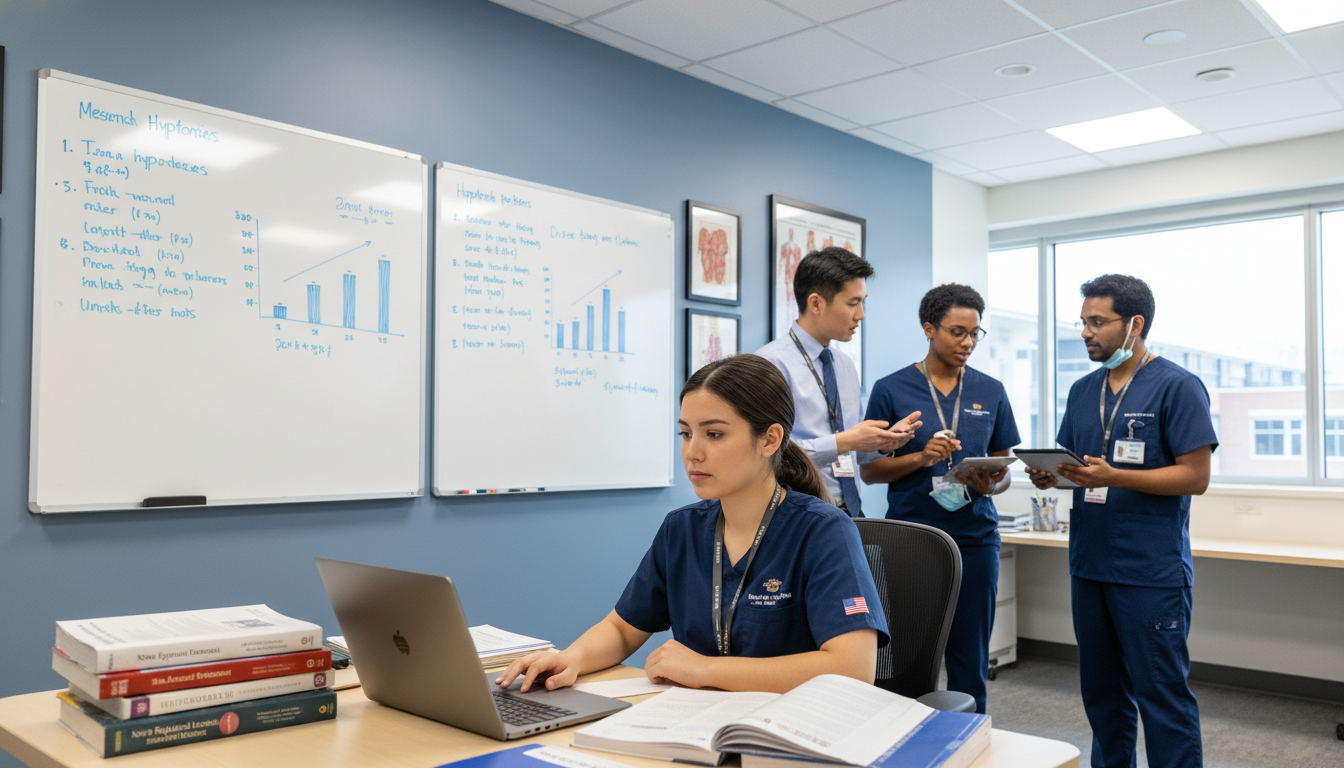
Understanding Research During a Preliminary Surgery Year
For many residents, a preliminary surgery year is a pivotal, high-stakes step on the path to categorical surgery, another invasive specialty, or a different field entirely. In a year packed with call, cases, and constant adaptation, the idea of “doing research during residency” can feel nearly impossible.
Yet for applicants targeting academic surgery, competitive specialties (e.g., integrated plastics, ENT, urology, radiology, anesthesia), or a strong academic residency track, resident research projects during a prelim surgery residency can significantly strengthen your application, sharpen your skills, and open doors to mentors and future positions.
This guide explains:
- What research realistically looks like during a preliminary surgery year
- How to choose the right type of project for your goals and schedule
- How to find mentors and opportunities in an unfamiliar department
- How to balance research with a demanding clinical workload
- How to turn short-term work into long-term academic growth
Throughout, the focus is practical: what you can actually do during a busy prelim surgery residency year and how to make it count.
1. Why Research Matters in a Preliminary Surgery Residency
1.1 The unique nature of a preliminary surgery year
A preliminary surgery year is typically:
- One-year, non-categorical training in general surgery
- Often used by:
- Applicants planning to reapply to categorical general surgery
- Those pursuing competitive specialties (e.g., radiology, anesthesia, IR, plastics, neurosurgery, etc.)
- International medical graduates seeking U.S. clinical experience
- Trainees filling a gap between medical school and a categorical spot
Key features that shape your research options:
- You may not be guaranteed a second year at the same institution
- You might rotate on multiple services with varying cultures and expectations
- Your schedule can be heavy on call, nights, and off-service rotations
- You’re often under scrutiny as you seek letters, support, and potential advancement
All of this makes research more challenging—but also higher yield. You’re building your academic “profile” in just 12 months.
1.2 How research strengthens your trajectory
Research during residency, even in small amounts, can:
- Differentiate you among applicants
- Programs see hundreds of personal statements; published or presented work stands out.
- Signal commitment to academic medicine
- For those targeting an academic residency track or academic surgery career.
- Support transition to another specialty
- A prelim surgery resident applying to radiology or anesthesia with trauma or quality improvement research shows initiative and depth.
- Build a network
- Working closely with faculty on resident research projects creates strong, specific letters of recommendation.
- Develop transferable skills
- Data literacy, critical appraisal, scientific writing, teamwork, and project management—all valued in any specialty.
Think of research as one more way to communicate: “Here’s who I am, what I’m interested in, and how I add value to an academic environment.”
2. Types of Feasible Research During a Prelim Surgery Year
Not all research is equally feasible in a one-year, high-intensity program. Understanding your options helps you choose projects that can realistically reach completion.
2.1 Retrospective chart reviews and database studies
For most preliminary surgery residents, retrospective studies are the most practical option.
What it involves:
- Using existing patient records or institutional databases
- Asking focused questions, such as:
- Outcomes after a particular procedure
- Readmission rates following certain discharge pathways
- Complication profiles in specific patient populations
- Extracting and analyzing data under IRB approval
Why this works during a prelim year:
- No need to recruit patients prospectively
- You can work during off-hours with flexible pacing
- The timeline is compressible: design → IRB → data collection → analysis → abstract → manuscript
Example:
A prelim surgery resident on a vascular rotation works with an attending on a retrospective study of outcomes following endovascular versus open repair of a specific pathology at the institution over the last 5 years. The goal: submit an abstract to a regional surgery meeting before the end of the year.
2.2 Quality improvement (QI) and patient safety projects
Quality improvement projects can be particularly well-suited to a prelim surgery residency:
- Often exempt or expedited by IRB
- Directly connected to your day-to-day clinical work
- Highly valued by many programs and hospital systems
- Feasible to start and complete within a year
Examples of QI or patient safety topics:
- Reducing postoperative urinary catheter days
- Improving timely completion of surgical checklists
- Decreasing unnecessary lab tests in post-op patients
- Standardizing VTE prophylaxis documentation
QI work can yield:
- Posters at institutional or regional QI symposia
- Inclusion in program or hospital annual QI reports
- Manuscripts in QI- or education-focused journals
2.3 Case reports and case series
Case-based work is classic for early-stage residents, especially in a short time frame.
Advantages:
- Often minimal IRB barriers (depending on institution policy)
- Can originate from interesting cases you encounter on call or in the OR
- Teachable structure that helps you learn scientific writing
High-yield approach:
- Identify an unusual or instructive case (rare pathology, unique complication, innovative treatment).
- Discuss it early with an attending who might co-author.
- Review the literature thoroughly to find the gap your report addresses.
- Target a journal that accepts case reports in surgery or your intended specialty.
Case series can be more impactful than single case reports if you can identify multiple similar patients over time, often via a retrospective chart review.
2.4 Educational research and curriculum projects
If you enjoy teaching or simulation, resident research projects in medical education can be an excellent fit:
- Designing a new intern bootcamp module
- Testing a simulation-based curriculum for procedural skills
- Evaluating the impact of checklists or standardized notes on learner performance
These may especially appeal if you see yourself on an academic residency track with future roles as a program educator, APD, or clerkship director.
2.5 Bench or translational research: Be realistic
Basic science, lab-based, or translational projects are typically difficult to start and finish within a single, clinically heavy prelim year:
- Long start-up time
- Need for wet lab training and close supervision
- More vulnerable to schedule disruptions
However, bench research can still be feasible in two scenarios:
- You continue a project from medical school at the same institution.
- You contribute a small, discrete task to an ongoing project (e.g., chart abstraction, data organization, literature review) where the main bench work is already underway.
If your long-term goal is a research-heavy academic surgery career, you may later pursue a dedicated research fellowship, but during your prelim surgery residency, focus on projects that fit your time constraints and call schedule.

3. Finding Mentors and Opportunities Quickly
You have only one year. You cannot wait six months to “see what appears.” You must be intentional and proactive.
3.1 Mapping the research landscape in your first 4–6 weeks
In your first month or so:
Ask program leadership directly
- “Are there active projects that would be appropriate for a prelim surgery resident?”
- “Which faculty are most invested in resident research projects?”
Identify the ‘research-active’ surgeons
- Check the department website and PubMed for frequent authors.
- Note faculty who mention research in conferences or M&M.
Attend research conferences if available
- Department research meetings
- Division-specific research updates (trauma, vascular, colorectal, etc.)
- Hospital QI meetings
Watch for quick-win projects
- Abstracts needing final data
- Manuscripts that need editing or additional analysis
- Case reports where most of the data are already collected
3.2 Approaching potential mentors as a prelim resident
You may feel on the margins as a prelim, but many faculty are willing to help if you are professional and reliable.
When reaching out, be:
Explicit about your status and timeline
- “I’m a preliminary surgery resident here for one year and I’m very interested in working on research, ideally something that could produce an abstract or manuscript within this timeframe.”
Specific about your interests and skills
- “I’m particularly interested in acute care surgery and critical care, and I have experience with basic statistics and manuscript writing.”
Clear about your commitment level
- Be realistic about call, nights, and rotations with overwhelming volume.
Sample email structure:
Dear Dr. [Name],
I am a PGY-1 preliminary surgery resident on [service]. I’m very interested in getting involved in clinical outcomes or quality improvement research during my year here, especially related to [trauma/vascular/colorectal, etc.].
I have previous experience with [brief description of prior research, if any]. Given my one-year timeline, I’d especially value opportunities to contribute to ongoing projects or shorter-term studies that might lead to an abstract or publication.
Would you be willing to meet briefly to discuss whether there are projects where I might be helpful?
Sincerely,
[Name], MD
PGY-1 Preliminary Surgery
3.3 Leveraging chiefs, seniors, and co-residents
Your co-residents are often the best gateway to research during residency:
Ask senior residents:
- “Which attendings are good mentors?”
- “Are there ongoing projects where they need help with chart review or data cleaning?”
Offer help on existing projects:
- Many resident research projects stall because of time constraints. A motivated prelim can help push them across the finish line and earn authorship.
Identify residents on the academic residency track:
- These residents often know about funded projects, institutional databases, and core resources you wouldn’t otherwise hear about.
4. Designing a Research Strategy That Fits a One-Year Timeline
You have limited bandwidth; you need a focused plan, not scattered efforts.
4.1 Clarifying your goals early
Ask yourself honestly:
- Am I aiming for:
- A categorical general surgery position (here or elsewhere)?
- A different specialty (e.g., anesthesia, IR, radiology, ENT, etc.)?
- A future academic career with possible fellowship and long-term research?
Your answers affect your research strategy:
If targeting categorical general surgery:
- Prioritize projects with general surgery attendings or subspecialists (e.g., trauma, colorectal, vascular).
- Emphasize outcomes, quality, or education—areas typical for early surgical academics.
If pivoting to another specialty:
- Map research to that field when possible (e.g., perioperative imaging questions for radiology; airway or hemodynamics for anesthesia).
- Or at least show strong, generalizable academic habits: productivity, collaboration, and initiative.
If planning a research-heavy career:
- Focus on mentorship quality and long-term relationships rather than sheer project count.
- Aim for at least one robust project that can continue beyond your prelim year if you transition to that institution or mentor later.
4.2 Choosing 1–3 projects, not 10
A high-yield portfolio for a one-year prelim usually looks like:
One primary project
- Highest priority, higher impact (e.g., retrospective outcomes study, robust QI initiative)
- Goal: at least abstract submission, ideally manuscript draft by year’s end.
One secondary project
- Smaller scope, quicker turnaround (e.g., case report/series, educational project, contribution to a senior’s study).
Optional one “stretch” project
- Early-stage collaboration you might continue if you stay at the institution or maintain remote collaboration after leaving.
Spreading yourself over many tiny starts without finishes is lower yield. Completion is what counts.
4.3 Understanding timelines and milestones
Create a rough timeline for your main project:
Project conception and mentor agreement (Month 1–2)
- Define research question and study design.
- Clarify authorship expectations and your role.
IRB submission and approval (Month 2–4)
- Varies widely; factor in the time needed for institutional review.
- For QI, consider whether formal IRB is required or if QI board approval suffices.
Data collection and cleaning (Month 4–7)
- Aim to complete chart review early in the second half of your year.
Data analysis and interpretation (Month 6–9)
- Collaborate with a statistician or experienced resident/faculty.
Abstract preparation and submission (Month 8–11)
- Target local, regional, or national surgical meetings.
- Keep track of abstract deadlines early.
Manuscript drafting and submission (Month 10–12 and beyond)
- Even if the final submission occurs after you leave, ensure your mentor is committed to completing it and keeping you as an author.

5. Balancing Clinical Demands and Research Productivity
A preliminary surgery year can be punishing in terms of workload. Sustainable habits and strategies are essential.
5.1 Protecting small blocks of time
You are unlikely to get an entire “research month” as a prelim. Instead:
Use micro-blocks of time
- 30–60 minutes after sign-out (when not post-call)
- Quiet periods on night float
- Weekends when not post-call or on heavy rotations
Treat research like a standing appointment:
- “Every Saturday morning from 8–10am is research time.”
Use online tools to maximize efficiency:
- Citation managers (Zotero, Mendeley, EndNote)
- Cloud storage (Google Drive, OneDrive) for shared documents
- Task managers (Todoist, Notion, Trello) to track steps and deadlines
5.2 Collaborating to divide the workload
Work with co-residents or students to share tasks:
- One person leads IRB and data dictionary.
- Another focuses on chart review.
- Another helps with statistical analysis or writing.
As a prelim, you can:
- Offer to perform labor-intensive data collection
- Contribute first-draft writing or literature review
- Trade help on each other’s projects
Clear communication about roles and authorship is vital from the beginning.
5.3 Setting expectations with mentors
Be upfront about your schedule and limitations:
- “I’m on night float in March and April; my availability will be limited to emails and weekends.”
- “I will no longer be at this institution after June 30, but I’m willing to continue writing and revising remotely.”
Ask mentors for:
- Realistic project scopes
- Clear deadlines
- Alignment with abstract or conference targets
A respectful but candid conversation early on prevents frustration later.
5.4 Avoiding common pitfalls
Frequent problems for prelim surgery residents pursuing research:
Overcommitting early
- Accepting multiple projects and completing none.
Waiting for “free time”
- There is rarely a totally free week; progress must be incremental.
Poor communication
- Disappearing for weeks during busy rotations without updating your mentor; this can harm your reputation.
Lack of backup plan
- Relying on a single project that never gets IRB approval or fizzles out.
Solution: choose a mix of project types (e.g., a retrospective study plus a case report) and maintain regular communication.
6. Turning a One-Year Experience into Long-Term Academic Momentum
Even if you never return to that same hospital or department, your preliminary surgery year can be the foundation of your academic identity.
6.1 Showcasing your work in applications
When applying for categorical positions or other specialties, highlight:
Outputs
- Abstracts, posters, oral presentations
- Submitted or accepted manuscripts
- QI project implementations and measurable outcomes
Process
- Initiative in finding and leading projects despite time constraints
- Collaboration with different departments
- Skills gained (data analysis, literature review, writing)
Concrete descriptions are powerful:
“During my preliminary surgery residency, I led a retrospective study examining postoperative complications in emergent laparotomies (n=350). I developed the data dictionary, completed the chart review, coordinated statistical analysis, and presented our findings at the regional ACS meeting.”
6.2 Maintaining mentorship relationships after you leave
Do not let relationships die after June 30:
Collect personal contact information (professional email, LinkedIn, etc.).
Schedule a final “exit meeting” with mentors:
- Review project status
- Clarify who will drive the project forward
- Confirm authorship order and expectations
Offer continued involvement:
- “I’m happy to revise drafts or coordinate responses to reviewers as needed.”
These mentors may also:
- Write future letters of recommendation
- Provide connections for fellowships or faculty positions
- Collaborate on multi-institutional projects down the line
6.3 Building an academic narrative
Across your CV, personal statement, and interviews, weave a consistent story:
- What topics interest you? (e.g., trauma systems, surgical outcomes, perioperative care)
- How did your preliminary surgery year shape these interests?
- How do your resident research projects connect to your long-term goals?
Programs seeking candidates for an academic residency track look for coherence over time, not just isolated publications.
6.4 Planning your next research steps
Depending on your path:
If you secure a categorical surgery spot:
- Continue or expand your prelim-year projects.
- Consider more ambitious multi-year studies or formal research time.
If you change specialties:
- Frame your surgical research as evidence of academic engagement and follow with specialty-specific projects.
- Reach out early in your new program to continue research momentum.
If you’re aiming for a research-focused fellowship or career:
- Consider dedicated research time later (e.g., 1–2 years in a lab or outcomes center).
- Use your prelim-year outputs to demonstrate your potential to future mentors and funders.
Frequently Asked Questions (FAQ)
1. Is it realistic to do research during a busy preliminary surgery year?
Yes, if you choose the right type of project and are strategic. Retrospective chart reviews, QI initiatives, and case reports are the most feasible. Large prospective clinical trials or lab-based bench projects are usually not realistic to start from scratch and complete within a single prelim year with heavy clinical responsibilities.
2. How many research projects should I aim for as a prelim surgery resident?
Aim for 1–3 well-chosen projects:
- One main project with potential for a presentation and manuscript
- One smaller, quicker project (e.g., case report, QI study, or contribution to another resident’s project)
- Optional third “stretch” project that may continue beyond the year
Completion and quality matter far more than sheer number.
3. Will my research during a preliminary surgery residency help me get a categorical spot?
Well-executed research can absolutely strengthen your application:
- It demonstrates initiative, academic curiosity, and follow-through.
- It often leads to stronger, more detailed letters from faculty.
- It differentiates you from other applicants with similar board scores or grades.
However, it complements—rather than replaces—strong clinical performance, professionalism, and teamwork.
4. What if my prelim program doesn’t emphasize research or offer protected time?
This is common. You can still succeed by:
- Proactively approaching interested faculty and residents
- Focusing on smaller-scope, high-yield projects (retrospective studies, QI, case reports)
- Using evenings, weekends, and quieter rotations as dedicated research time
- Leveraging prior mentors or remote collaborations when possible
You may not have an “academic residency track” built into the prelim program, but you can still create a meaningful research experience that advances your goals.
By approaching your preliminary surgery year with a clear research strategy, realistic project choices, and proactive mentorship building, you can transform a short, intense year into a powerful academic springboard. Whether you ultimately pursue categorical surgery, another specialty, or a long-term academic career, the habits, skills, and connections you build through research during residency will serve you for decades to come.