
Psychiatry residency is an intense period of clinical growth—but it is also one of the best times to build a research foundation that can shape your entire career. Whether you envision yourself as a future clinician-educator, academic psychiatrist, or primarily a clinician who wants to stay current with evidence-based care, engaging in research during residency can significantly expand your opportunities.
This guide walks you through why research matters in psychiatry residency, how to realistically integrate it into your training, common project types, and strategic approaches to choosing mentors and academic residency tracks. It is written for medical students planning for the psych match and current psychiatry residents trying to navigate research expectations.
Why Research Matters in Psychiatry Residency
Research can feel optional when you are balancing long call shifts, therapy cases, and didactics. Yet, in psychiatry, scholarly work is deeply intertwined with clinical practice and future career advancement.
1. Enhancing Your Clinical Skills
Research is not just about publications—it is structured curiosity. When you engage in resident research projects, you learn to:
- Formulate answerable clinical questions (e.g., “Does adding CBT-I to SSRI treatment improve sleep outcomes in depressed patients?”)
- Critically evaluate literature before changing your practice
- Understand the strengths and limits of diagnostic tools, rating scales, and treatments
- Recognize bias and confounding in the studies you read and cite
For example, a resident who participates in a study on clozapine monitoring will develop a deeper understanding of side-effect profiles, lab interpretation, and real-world barriers to treatment than someone who only reads a guideline.
2. Boosting Competitiveness for Fellowship and Academic Positions
If you are even mildly interested in:
- Child and adolescent psychiatry
- Addiction psychiatry
- Geriatric psychiatry
- Forensic psychiatry
- Consultation-liaison psychiatry
- Research fellowships (e.g., NIMH-funded T32 programs)
then having meaningful research during residency—especially first-authored or substantial contributions—can strongly differentiate you in a competitive applicant pool.
Program directors for academic tracks and fellowships tend to look for:
- Evidence of sustained interest (multiple projects, not one-off)
- Increasing responsibility (poster → paper → leading a study)
- Ability to see projects through to completion (submitted manuscripts, not only “in progress”)
- Fit with their existing research portfolio
3. Flexible Future Career Options
You might start residency thinking you want purely clinical work and later discover an interest in health services research, psychopharmacology, or implementation science. Early research exposure gives you:
- A network of mentors across departments
- Experience with IRB protocols, data handling, and publication processes
- Enough background to pivot into an academic or hybrid role later
Even if you choose a mostly clinical career, your research experience will help you:
- Lead quality improvement (QI) initiatives in your practice or hospital
- Better understand new psychiatric medications and therapies
- Communicate evidence more clearly to patients and colleagues
Understanding the Research Landscape in Psychiatry Residency
Not all psychiatry residency programs are structured the same way. Your research opportunities will depend heavily on your training environment, but almost every program offers some path to scholarly work.
Common Models for Research During Residency
Standard Clinical Residency with Optional Research
- Research is encouraged but not guaranteed; residents find their own mentors.
- Protected research time, if any, is usually limited (e.g., half-day per week).
- Scholarships, posters, and small projects are common, especially QI-based.
Academic Residency Track / Research Track
- Designed for residents with strong interest in academic psychiatry.
- Formal protected research time (e.g., 20–50% during PGY3–4).
- Embedded mentorship, often with structured coursework in statistics or clinical research methods.
- May be linked to NIH-funded T32 fellowships or MSTP/MD-PhD pipelines.
Research-Intensive Programs
- Strong institutional emphasis on resident research projects.
- Dedicated research rotations, research chiefs, formal expectations for scholarly output.
- Often affiliated with large research universities, VA systems, or NIMH-funded centers.
Where Psychiatry Research Happens
Psychiatry offers a wide range of research domains that intersect with neuroscience, psychology, sociology, and public health. Common areas include:
- Clinical trials (e.g., new antidepressants, antipsychotic strategies)
- Psychotherapy research (e.g., adaptations of CBT, DBT, MBT)
- Neuroimaging and neurobiology (e.g., fMRI studies of mood disorders)
- Addiction and substance use research
- Child and adolescent psychiatry, autism spectrum disorders
- Health services research and policy (e.g., access to care, telepsychiatry)
- Global mental health and implementation science
- Digital psychiatry (apps, wearables, telehealth interventions)
- Cultural psychiatry and disparities research
Because psychiatry is so interdisciplinary, you can work with mentors from psychology, neurology, public health, or data science while still building a coherent psychiatric research narrative.
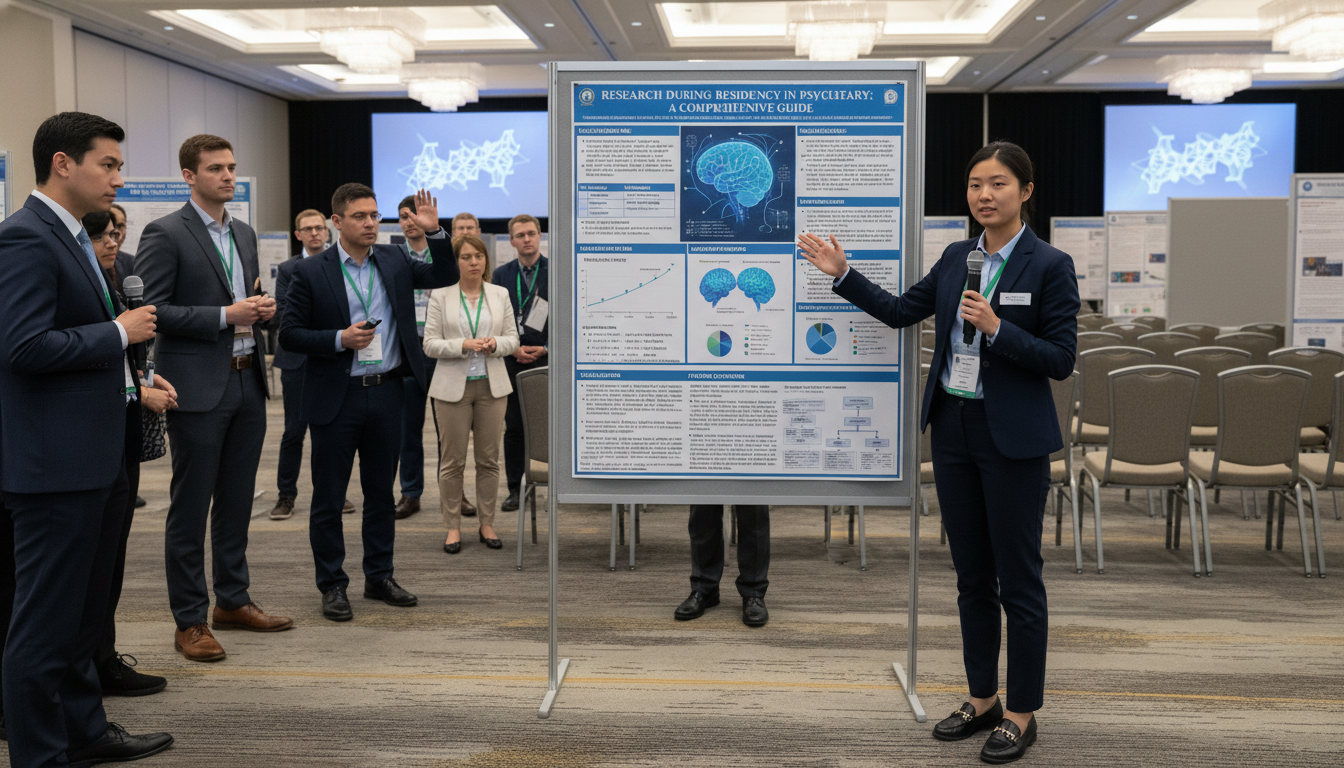
Getting Started: First Steps in Resident Research Projects
The most critical decision you will make is not the topic, but the mentor and the scope of your first project. A well-structured small project under a supportive mentor is worth far more than a huge, unfocused one with poor supervision.
Clarify Your Goals and Constraints
Before you commit, ask yourself:
What is my primary goal?
- Strengthen fellowship application?
- Explore if I like research?
- Build a long-term academic profile?
- Fulfill a graduation requirement?
How much time can I realistically commit?
- During PGY1–2, time is limited by inpatient demands.
- PGY3–4 usually offer more outpatient-based schedules with consistent time blocks.
What are my skills and gaps?
- Comfortable with statistics or completely new to it?
- Prior experience from med school or undergraduate research?
- Comfort with writing, presenting, and managing deadlines?
Being honest about these will help you pick appropriate projects.
How to Find a Research Mentor in Psychiatry
Start with your program’s resources
- Review faculty interests on the department website.
- Ask your program director or research director, “Who is actively working with residents? Who is good at helping projects get to publication?”
- Talk to senior residents: “Which faculty are responsive? Who helps residents publish?”
Look beyond your department if needed
- Public health or epidemiology departments for health services research.
- Psychology or neuroscience labs for experimental or imaging work.
- VA or community partners for health policy, addiction, or implementation projects.
Assess mentorship style and expectations In your first meeting, clarify:
- What roles do residents usually play on their projects?
- How often will you meet?
- Is the project feasible given your schedule?
- What is a realistic deliverable in 12–18 months (poster, manuscript, QI implementation)?
You want someone who is responsive, realistic, and invested in your development—not just in advancing their own agenda.
Choosing the Right Type of Project for Your Stage
Different kinds of research projects fit different residency years and time constraints:
PGY1–Early PGY2: Low-barrier entry projects
- Case reports or case series
- Literature reviews or narrative reviews
- Joining an existing study in a narrow role (e.g., data collection, chart review)
These help you learn the process: IRB basics, ethics, literature searches, and basic scientific writing.
Late PGY2–PGY3: Intermediate projects
- Retrospective chart reviews
- Secondary data analysis of existing datasets
- QI projects that can generate both scholarly products and local change
- Collaborating on manuscripts as a co-author
These are often the most practical for psychiatry residents because they do not require long prospective follow-up.
PGY3–PGY4: Higher-impact or independent projects
- Designing and implementing a small clinical study or pilot intervention
- Leading a multi-site QI or implementation project
- First-author original research papers
- Starting a longitudinal research focus that can extend into fellowship or faculty work
At this stage, think about continuity: can this project evolve into future work?
Types of Psychiatry Resident Research Projects (With Examples)
Psychiatry is well-suited to multiple methodologies. Understanding your options helps you pick something feasible and aligned with your interests.
1. Clinical Research
Focus: Diagnosis, treatment, course, and outcomes of psychiatric disorders.
Examples:
- Comparing remission rates in patients with major depressive disorder treated with SSRI alone vs. SSRI + group CBT in your clinic.
- Evaluating side-effect burden and adherence in patients switched from first- to second-generation antipsychotics.
Advantages:
- Direct clinical relevance.
- Easier to present as posters and manuscripts.
- Ideal if you want to emphasize evidence-based treatment in your career.
Challenges:
- Requires careful attention to inclusion criteria, consent, and confounders.
- Prospective trials can be time-consuming; consider observational designs or retrospective chart reviews for feasibility.
2. Psychotherapy and Behavioral Research
Focus: Psychotherapeutic interventions, behavior change, and psychological mechanisms.
Examples:
- Pilot study of a brief CBT-I group for insomnia in patients with comorbid depression.
- Feasibility study of a mindfulness-based relapse prevention group in an outpatient addiction program.
- Evaluating outcomes of DBT skills groups in a residency clinic.
Advantages:
- Aligns closely with core psychiatry competencies.
- Often lower cost; can be done with small samples and pragmatic designs.
- Great for residents interested in psychotherapy or academic psychology-psychiatry interfaces.
3. Health Services and Policy Research
Focus: Systems of care, access, cost, quality, and disparities.
Examples:
- Studying no-show rates in your outpatient clinic and identifying predictors (e.g., distance, insurance type, diagnosis).
- Evaluating the impact of telepsychiatry implementation at a community clinic on follow-up rates.
- Assessing racial and ethnic disparities in involuntary commitment rates in your hospital system.
Advantages:
- Timely, impactful, and often publishable in high-visibility journals.
- Often uses existing data sources (EHR, administrative databases).
- Highly valued in academic residency tracks and leadership pathways.
Challenges:
- May require collaboration with statisticians and health services experts.
- Complex data management and need for methodological rigor.
4. Neuroscience, Neuroimaging, and Biomarker Research
Focus: Biological underpinnings of mental illness and treatment.
Examples:
- fMRI study examining emotional processing in patients with PTSD vs. controls.
- EEG-based study of sleep architecture in patients with treatment-resistant depression.
- Biomarker analysis (e.g., inflammatory markers) in patients starting SSRIs.
Advantages:
- Strongly aligned with cutting-edge psychiatric science.
- Valuable background for research-intense academic careers.
Challenges:
- Time- and resource-intensive.
- Often better for residents with prior research experience or those in formal research/academic tracks.
5. Quality Improvement (QI) with Scholarly Output
Focus: Improving processes of care in a measurable and sustainable way.
Examples:
- Implementing a standardized suicide risk assessment tool and tracking completion documentation.
- Reducing antipsychotic polypharmacy rates on inpatient units through education and audit-feedback cycles.
- Improving metabolic monitoring for patients on antipsychotics.
Advantages:
- Often required by programs as part of ACGME expectations.
- Practical, time-limited, and can generate posters and publications.
- Directly improves patient care in your setting.
Challenges:
- Methodological rigor is essential if you want to publish QI work.
- Requires attention to implementation and sustainability.

Making Research Fit: Time Management, Protected Time, and Practical Tips
Research during residency requires deliberate planning. Even the most enthusiastic resident can burn out if expectations are unrealistic.
Understanding “Protected Time”
Protected time for research during residency may be:
- Formal: written into your schedule (e.g., Friday afternoons in PGY3).
- Informal: negotiated with your program director and rotation supervisors.
- Block rotations: dedicated 1–2 month research electives.
Clarify:
- How much time is truly protected (not taken by clinical emergencies)?
- Are there limits on how many research electives you can take?
- Are there requirements to produce specific deliverables (e.g., a poster) for that time?
Practical Time Management Strategies
Start Small, Start Early
- Initiate a manageable project PGY1–early PGY2 (e.g., case report, review).
- This teaches process and builds confidence before larger projects.
Use a Project Timeline Break your project into phases:
- Literature review and question refinement
- IRB submission and approval
- Data collection
- Data analysis
- Abstract/poster
- Manuscript writing and submission
Set realistic deadlines with your mentor at each phase.
Batch Your Work
- Reserve consistent weekly blocks (even 2–3 hours) for research.
- Use call-free weekends to push forward key milestones (e.g., drafting the introduction).
Leverage Existing Infrastructure
- Use institutional biostatistics support or research cores.
- Take advantage of templates (IRB, data collection forms, poster templates).
- Attend resident research seminars or workshops; they often focus on practical skills.
Plan for Conferences and Presentations
- Aim for at least one poster at a regional or national meeting (e.g., APA, AACAP, ASAM).
- Know abstract deadlines early (some are months in advance).
- Presenting helps you network, refine your ideas, and demonstrate productivity.
Research Track vs Standard Track: Strategic Considerations
Many psychiatry residencies now offer some version of an academic residency track or dedicated research track. Deciding whether to pursue one is a major question for students preparing for the psych match and for early residents.
What Is an Academic or Research Track?
While structures vary, these tracks usually include:
- Increased protected research time, often starting PGY2 or PGY3.
- Assignment to a primary research mentor and sometimes a mentorship committee.
- Formal expectations for scholarly output (papers, grants, conference presentations).
- Possible integration with master’s-level coursework (e.g., MPH, Masters in Clinical Investigation).
- Sometimes, built-in pathways to NIMH-funded research fellowships.
Who Should Consider a Research Track?
You might be a good fit if:
- You already have strong research experience (e.g., MD-PhD, multiple med school publications).
- You can clearly articulate a research interest area (even if broad).
- You realistically want 20–50% of your residency time devoted to research during the later years.
- You see yourself in academic psychiatry, research leadership, or as a clinician-researcher.
If you are not sure, some programs allow you to join the track after starting residency, usually based on demonstrated interest and productivity.
Questions to Ask During Interviews and Site Visits
When evaluating programs for the psych match, ask targeted questions:
- How many residents actually complete the research/academic track each year?
- What proportion of track residents publish or present by graduation?
- Is protected time truly protected, or is it often compromised by clinical needs?
- Are there funded T32 or K12 research training programs associated with the department?
- What kinds of resident research projects have been successful here recently?
Ask specifically, “Can I talk with current or recent residents on the research track?” Their experiences are often more revealing than brochures.
Balancing Clinical Training and Research Depth
One common concern: “Will a research track compromise my clinical training?” Generally:
- Strong academic programs emphasize that research-track residents still meet, and usually exceed, clinical competency standards.
- Research can deepen understanding of specific clinical areas (e.g., psychosis, mood disorders, addiction).
- However, if you concentrate heavily in one domain, be sure you still get sufficient breadth (e.g., enough psychotherapy volume, exposure to different populations).
If your program is flexible, you can often craft a balanced path: robust research in a focused area with strong general psychiatry training.
Frequently Asked Questions (FAQ)
1. Do I need research experience in residency if I already did research in medical school?
Prior research helps, but residency research is viewed differently:
- It shows you can do scholarly work alongside real clinical responsibilities.
- It lets you build relationships with psychiatry-specific mentors.
- It helps align your research narrative with your chosen subspecialty (e.g., child, addiction, C-L).
If your med school research was in a different field (e.g., cardiology), residency research in psychiatry helps reorient your profile.
2. How many publications do I “need” for a competitive academic or fellowship application?
There is no magic number. Programs look more at trajectory and depth than raw counts. As a rough guideline:
- 1–2 posters and at least one publication (especially as first author) is very strong for most clinical fellowships.
- For highly research-focused fellowships or T32 positions, a stronger portfolio (multiple publications, some in psychiatry or your subspecialty) is helpful.
Even one well-executed project—taken from idea to publication—can be extremely powerful if it aligns with your stated career goals.
3. What if my program has limited research opportunities?
You still have options:
- Seek mentors at affiliated institutions (VA, university departments, public health schools).
- Collaborate remotely—many projects (reviews, secondary analyses, multicenter QI) can be done with off-site mentors.
- Focus on QI with scholarly output (conference abstracts, practice improvement papers).
- Join national organizations’ resident research networks or workgroups.
If you are early (MS3/MS4), consider program research infrastructure as an important factor when ranking programs for the psych match.
4. Is it too late to start research if I only get interested in PGY3?
Not at all. Many residents start serious research during PGY3:
- Focus on feasible projects, often retrospective or QI-based.
- Consider projects that can be carried into fellowship.
- Lean on experienced mentors who can help accelerate IRB, analysis, and writing.
You might not build a large portfolio, but a couple of well-executed projects can still strengthen your fellowship or early faculty applications—and clarify whether academic psychiatry is right for you.
Engaging in research during psychiatry residency is both challenging and deeply rewarding. It requires honest self-assessment, strategic mentorship, and disciplined time management—but it also opens doors to academic residency tracks, enriches your clinical practice, and shapes the way you think about mental health for the rest of your career. Whether you aim to become a leading investigator or an evidence-driven clinician, deliberate involvement in resident research projects can be one of the most formative parts of your psychiatry training.