
Why Research During Residency Matters for Caribbean IMGs in General Surgery
For a Caribbean medical school graduate in a U.S. general surgery residency, research is not just a “nice-to-have.” It is a strategic tool that can:
- Strengthen your position for fellowships and academic jobs
- Differentiate you from other residents in competitive environments
- Expand your professional network beyond your home institution
- Help overcome bias some programs may hold about Caribbean medical school residency backgrounds
Historically, Caribbean IMGs often feel they must “catch up” or prove themselves compared with U.S. MD/DO graduates. Doing meaningful research during residency is one of the most visible ways to demonstrate academic seriousness, intellectual curiosity, and leadership potential.
In general surgery, the bar for academic activity is high. Competitive fellowships (surgical oncology, vascular, trauma/critical care, pediatric surgery, MIS, colorectal) frequently favor residents with:
- Multiple peer‑reviewed publications
- National conference presentations
- Involvement in clinical trials, outcomes research, or quality improvement
- Clear evidence of an academic residency track mindset
If you trained at a Caribbean school like SGU, AUC, Ross, or Saba, you may already know the importance of the SGU residency match or similar pathways. That same strategic mindset now applies inside residency: research becomes your next differentiator.
This article will walk you through how to think about, choose, and execute research during residency as a Caribbean IMG in general surgery—while protecting your time, sanity, and career goals.
Understanding the Landscape: Research Expectations in General Surgery
The Culture of Research in Surgery Residency
General surgery is inherently procedural, but the culture is also deeply academic. Even in community-based programs, residents are often:
- Expected to present at a department research day or regional conference
- Encouraged (or required) to complete at least one scholarly project
- Evaluated on “scholarly activity” in semi-annual reviews
Academic surgery programs may have:
- Protected research years (often between PGY-2 and PGY-3)
- Formal research tracks leading to MPH, MS, or PhD degrees
- Dedicated research labs and funded faculty projects
Community or hybrid programs may focus more on:
- Clinical outcomes research
- Quality improvement (QI) and patient safety projects
- Case series, case reports, and retrospective chart reviews
As a Caribbean IMG, either setting can work for you. What matters is understanding the expectations and opportunities where you matched and then building a deliberate plan.
How Program Type Shapes Your Research Path
1. University / Academic Programs
- Typically more infrastructure: biostatistics support, IRB office, databases, research coordinators
- Easier to join existing projects or clinical trials
- Stronger pathway to an academic residency track and future faculty positions
- Often more competitive for Caribbean IMGs to enter; once in, strong research performance can be career-transforming
2. Community-Based / Hybrid Programs
- Less formal infrastructure, but often more flexible clinically oriented projects
- Great environment for outcomes, QI, and resident-led resident research projects
- May require more self-direction and initiative to identify mentors and resources
Regardless of your program, your goal is the same: produce credible, publishable work that aligns with your long-term goals and shows that you can contribute to the academic mission of surgery.

Getting Started: Building a Research Strategy as a PGY-1 or PGY-2
Step 1: Clarify Your Career Goals Early
Your research during residency should match where you want to be after training. Ask yourself:
- Do I want a fellowship in a competitive subspecialty (e.g., surgical oncology, colorectal)?
- Am I drawn to an academic career, teaching residents/med students and publishing regularly?
- Do I envision a community-based practice where QI and outcomes research are more relevant than lab work?
If you are targeting an academic residency track or a highly competitive fellowship, you should aim for:
- Multiple first‑author or co‑first‑author publications
- National presentations (e.g., ACS, SAGES, AAST, SSAT)
- Sustained mentorship relationships with academically active surgeons
If you see yourself in community practice, focus more on:
- Practical clinical projects that improve patient care
- Quality improvement and systems-based work
- A few solid publications that show you can complete projects, even if you’re not producing a high volume of papers
Step 2: Assess Your Program’s Research Ecosystem
As soon as you start residency:
- Review your program’s website and faculty profiles. Who is publishing? In what areas?
- Ask your co-residents:
- “Which attendings are actually productive in research and approachable?”
- “Which projects moved fast and led to papers?”
- Talk to your program director or associate PD:
- “What are the program’s research expectations?”
- “Are there protected research blocks, or is everything done on your own time?”
- “Is there any internal funding, database access, or statistician support?”
You are trying to map:
- Key mentors (high-yield, supportive faculty)
- Typical research pathways at your institution
- Low-barrier projects where a Caribbean medical school residency graduate like you can quickly get involved and build momentum
Step 3: Find the Right Mentors as a Caribbean IMG
Your status as a Caribbean IMG means you benefit even more from strong champions.
Look for mentors who:
- Have a regular track record of publications (at least 1–2 per year)
- Are known among residents for being fair with authorship
- Give clear, timely feedback
- Are open to supporting Caribbean IMGs and other non-traditional paths
Concrete ways to approach potential mentors:
- After a grand rounds, email:
- “I enjoyed your talk on [topic]. I’m a PGY-1 interested in [related field] and would appreciate the chance to learn more about your ongoing projects and discuss how I might help.”
- Ask senior residents:
- “If I’m interested in [e.g., trauma, MIS, vascular], who should I be talking to for research?”
Once you meet:
- Come prepared with your CV, prior research experience (if any), and a short, honest statement:
- “I’m a Caribbean IMG in general surgery with a strong interest in [X]. I’d like to build a solid research portfolio for [fellowship/academic career/community practice with some academic involvement]. What kinds of projects might fit that path?”
Remember: mentors choose mentees who show reliability, initiative, and follow-through. Your goal is to be the resident who does what they say they will do.
Types of Research You Can Do During General Surgery Residency
Research is not limited to basic science or bench work. Especially for Caribbean IMGs trying to balance clinical demands, certain project types are more feasible and impactful.
1. Clinical Outcomes Research
Examples:
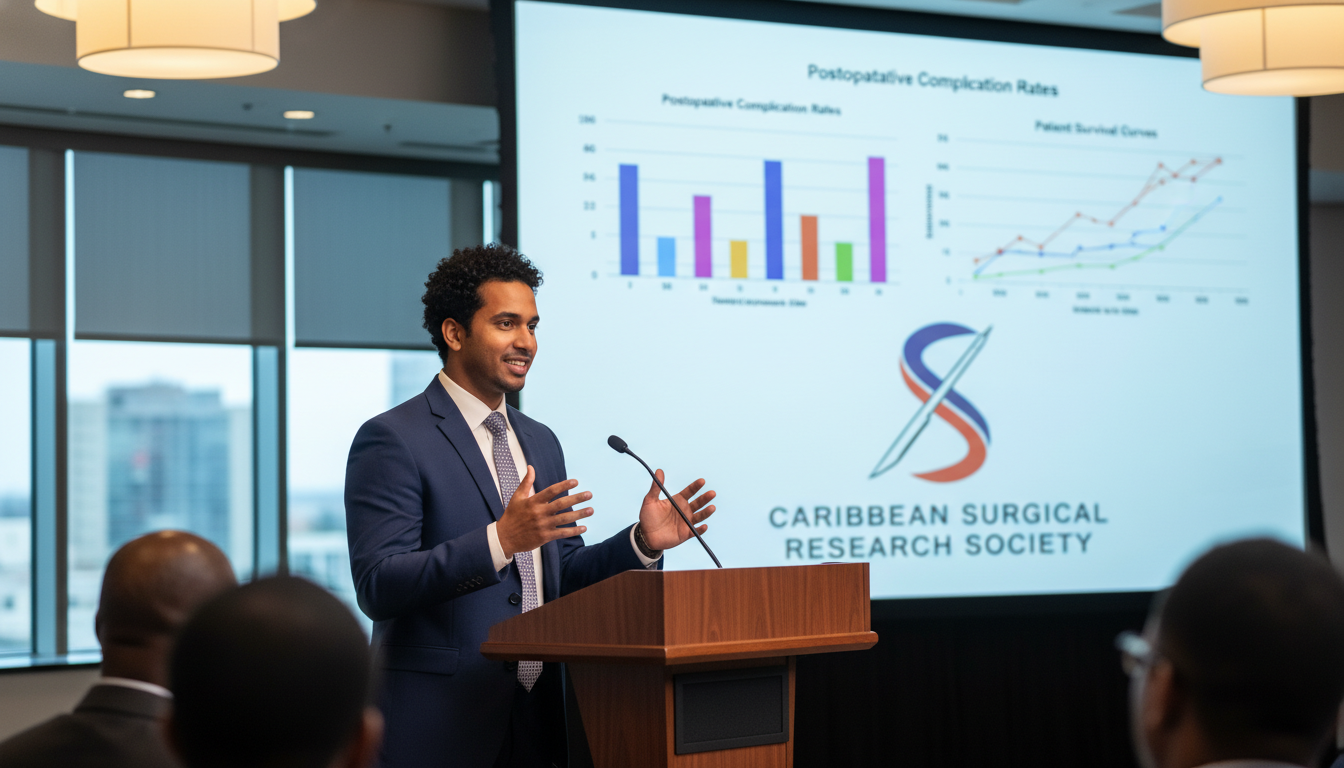
- Comparing postoperative complication rates before and after a new ERAS (Enhanced Recovery After Surgery) protocol
- Evaluating readmission rates after ventral hernia repair with different mesh materials
- Studying predictors of leak after colorectal anastomosis
Why it’s high-yield:
- Closely connected to patient care
- Often uses existing data (charts, databases)
- More accessible in community and hybrid programs
Actionable tip:
Ask your trauma, colorectal, or MIS attendings if they have access to institutional databases (NSQIP, trauma registries) and if there are unused questions/projects that a motivated resident could take on.
2. Quality Improvement (QI) and Patient Safety Projects
Examples:
- Reducing CLABSI (central line-associated bloodstream infection) rates in the SICU
- Improving on-time antibiotic prophylaxis before incision in general surgery cases
- Streamlining postoperative pain management protocols to reduce opioid use
QI projects are often required for ACGME and hospital accreditation and can easily turn into:
- Posters at local or regional meetings
- Short publications in QI or surgical education journals
For a Caribbean IMG, QI work also demonstrates your ability to improve systems of care—an attractive skill in both academic and community settings.
3. Case Reports and Case Series
Examples:
- Rare presentation of small bowel obstruction in a patient with unusual anatomy
- Unique complication of a common procedure with a teaching point
- A series of complex abdominal wall reconstructions with novel techniques
Case reports are often the easiest entry point if you have minimal prior research experience. They:
- Help you learn the structure of scientific writing
- Build an early publication record
- Foster habits of recognizing publishable cases
However, they carry less weight than robust clinical studies. Use case reports and case series to build confidence, then aim for more substantial resident research projects.
4. Basic/Translational Science (if available)
If your program has labs:
- Projects might involve animal models, cell lines, or molecular pathways relevant to cancer, wound healing, immunology, etc.
- These often require protected research time (6–24 months) and strong mentorship.
This track is especially relevant if you want a highly academic career and to be on an NIH-funded, research-heavy academic residency track. As a Caribbean IMG, doing successful bench research can significantly strengthen your academic credibility—but you must be realistic about time and support.
5. Educational and Workforce Research
You can also study:
- Simulation training effectiveness in laparoscopic skills
- Burnout and wellness among surgery residents
- Matching outcomes for Caribbean medical school residency graduates in surgery
These often fit well with educational committees and academic offices of graduate medical education (GME) and can be very relevant if you see yourself as a future program director or surgical educator.
Making Research Fit Into a Busy Surgical Residency
Time Management and Protecting Your Bandwidth
Balancing long hours, call, and research is one of the hardest parts of residency. You must be deliberate.
Practical strategies:
- Start small, then scale.
- Begin with one manageable project (a chart review or QI project) rather than trying to juggle five at once.
- Use “micro-blocks” of time.
- 20–30 minutes during a lighter call day can be enough to clean data, format references, or revise a paragraph.
- Set weekly, concrete goals.
- Example: “This week, I will complete the introduction draft and send it to my mentor by Friday.”
Working Efficiently With Co-Residents and Teams
Collaborate strategically:
- Join projects with senior residents who know the process and can guide you
- Offer to handle tangible tasks: data collection, reference management, figure creation
- Negotiate authorship transparently at the outset (e.g., “If I do X, Y, and Z, would this qualify me for second author?”)
As a Caribbean IMG, building a reputation as a reliable research collaborator helps counter any stereotype and may open doors to more projects and mentors.
Leveraging Institutional Resources
Even smaller programs often have:
- An IRB office willing to guide your application
- A librarian who can help with systematic searches
- A statistician—sometimes shared across departments—who can advise on methods
Questions to ask:
- “Is there a standard IRB template residents can use for retrospective clinical projects?”
- “Who typically helps with biostatistics for resident research projects?”
- “Does the department sponsor travel for residents who present at conferences?”
Use these resources; they exist partly to help residents succeed.
Building a Research Portfolio That Supports Your Next Step
For Fellowship Applications
If you aim for a competitive fellowship after your general surgery residency, your research should:
- Align with your target field (e.g., oncologic, hepatobiliary, colorectal, trauma, MIS, vascular)
- Show depth (multiple projects or a theme) rather than just scattershot case reports
- Include at least some first‑author work
Examples:
A Caribbean IMG interested in HPB surgery:
- Projects on liver resection outcomes, biliary complications, or cholangiocarcinoma
- Presentations at SSAT, AHPBA, or SSO meetings
A Caribbean IMG targeting trauma/critical care:
- Use your trauma registry to study predictors of mortality, time to OR, or transfusion protocols
- Present at EAST, AAST, or SCCM meetings
Remember: fellowship directors look for evidence that you will be productive and academically engaged in their program. Research during residency is their best proxy.
For an Academic Surgery Career
If you want an academic faculty role:
- Consider an academic residency track if your program offers one (dedicated scholar track, research years, etc.)
- Accumulate a consistent publication record—not just during a research year, but across PGY-1 to PGY-5
- Build relationships with mentors who are known nationally; their letters matter
Academic surgery often expects a trajectory:
medical student research → residency projects → fellowship work → early faculty grants or collaborations.
As a Caribbean IMG, each of these steps helps neutralize initial bias and reframe you as a serious, evidence-driven surgeon.
For Community Practice With Academic Involvement
You may plan to:
- Work in a community hospital
- Occasionally teach residents/medical students
- Participate in QI committees and clinical projects
In that case, your goals are:
- A small but solid set of publications and presentations
- Demonstrated involvement in local or regional surgery societies
- A reputation for improving patient care through data-driven changes
Your research doesn’t need to be high-volume; it just needs to show maturity, teamwork, and real-world impact.
Special Considerations for Caribbean IMGs
Overcoming Bias and Amplifying Your Strengths
You may encounter implicit bias about your Caribbean medical school residency background. Research is one of the most powerful ways to counter that:
- Publications and presentations are objective achievements
- Strong letters from academic mentors can reframe your profile
- A cohesive research narrative demonstrates rigor and resilience
Capitalize on your unique strengths:
- Many Caribbean IMGs have rich clinical experiences from multiple health systems
- You can bring global health, health equity, or access-to-care perspectives into your resident research projects
- This diversity of experience is valued increasingly in academic medicine
Using Your Caribbean Networks
If you trained at a school like SGU, leverage the alumni network:
- SGU residency match and similar networks often include surgeons now in academic roles across the U.S.
- Reach out to alumni in general surgery:
- Ask about multi-institutional projects, mentorship, or joint publications
- Invite them to co-mentor a project or give a talk at your institution
Collaborating with other Caribbean IMG surgeons expands your reach beyond your current residency program.
Documenting and Showcasing Your Work
Keep a running record of:
- All research projects (title, role, status)
- Abstracts submitted and accepted
- Posters, podium talks, and invited presentations
- Manuscripts under review and in press
Update your CV regularly and maintain a simple spreadsheet to track where each project stands. When it comes time for fellowship or job applications, you’ll be ready.
Frequently Asked Questions (FAQ)
1. I had little or no research in medical school. Is it too late to start during residency?
No. Many residents start research only once they’re in training. Begin with:
- A case report or small retrospective review
- A QI project with a clear clinical question
- Joining an ongoing study with a senior resident
Show consistent progress and reliability. Even 2–4 solid projects over residency can significantly improve your academic profile, especially if you are thoughtful about aligning them with your career goals.
2. How many publications do I need for a competitive surgery fellowship?
There is no absolute number, but competitive programs often expect:
- Multiple total publications (5–10 is common among strong applicants), with at least a few in the target subspecialty
- Some first‑author work
- Evidence of conference presentations
As a Caribbean IMG, incremental progress matters: each added abstract, poster, and paper improves your position. Quality and relevance are as important as quantity.
3. Can quality improvement projects really help my career, or do journals only care about traditional research?
QI projects absolutely help, particularly for:
- Demonstrating impact on real-world patient care
- Showing leadership and systems-based practice skills
- Building early publications when traditional RCTs or large prospective studies are not feasible
Many reputable journals publish QI work in surgery, and fellowship directors recognize its value. Structure your QI project rigorously (clear baseline, intervention, outcome measures), and treat it with the same seriousness as any research study.
4. Is it worth taking dedicated research years as a Caribbean IMG in general surgery?
If your long-term goal is an academic career or a top-tier subspecialty fellowship, dedicated research years can be highly beneficial, provided that:
- You have a strong mentor and a clear research plan
- You are placed in a productive environment (labs or groups with a history of publishing)
- You are ready to commit fully to research and not treat it as a “vacation”
However, if you are primarily aiming for community practice, you may get more value by building a focused but sustainable research portfolio alongside clinical training rather than stepping away for full-time research. The decision should be individualized based on your goals, financial situation, and opportunities available.
By approaching research during residency strategically—choosing the right mentors, focusing on feasible project types, and aligning your work with future goals—you can transform your Caribbean IMG background from a perceived liability into a powerful story of resilience, growth, and academic contribution in general surgery.