Why Research During Residency Matters for Caribbean IMGs in Global Health
For a Caribbean international medical graduate (IMG), residency is more than clinical training—it is your launchpad into global health, academic medicine, and leadership roles. Research during residency is one of the most powerful ways to shape that trajectory.
Whether you trained at a Caribbean medical school and are now in the U.S., Canada, or the U.K., you are competing in environments where program directors value scholarship, quality improvement, and health systems thinking. This is especially true for anyone pursuing:
- A global health residency track
- An academic residency track
- Fellowships in infectious diseases, global emergency medicine, maternal-child health, health policy, or similar fields
- Careers in international medicine, NGOs, public health agencies, or academic global health centers
Research experience can help you:
- Stand out for global health opportunities and fellowships
- Develop critical thinking and data literacy
- Build a professional network with mentors and collaborators
- Demonstrate commitment to underserved populations and international medicine
- Compensate, in part, for perceived disadvantages of a Caribbean medical school background
If you came from an institution like SGU, AUC, or Ross, you may have heard about the SGU residency match success stories and their emphasis on scholarly engagement. The same principle applies once you are in residency: those who actively seek out resident research projects during training often open doors to global health careers that others do not even know exist.
This article will walk you through how to approach research during residency as a Caribbean IMG specifically interested in global health: what types of projects are realistic, how to find mentors, build a portfolio, and align your scholarly work with your long-term global health goals.
Choosing the Right Residency Setting for Global Health–Focused Research
Your research opportunities during residency will depend heavily on your training environment. If you are still applying or comparing offers, this is the time to be strategic.
1. Look for Programs with a Global Health Residency Track
Residency programs with a formal global health residency track or pathway usually offer:
- Structured global health curricula (lectures, seminars, workshops)
- Protected time for global health electives and research
- Partnerships with international sites (Africa, Latin America, Asia, Caribbean)
- Faculty whose primary interest is international medicine and health equity
- Support for travel, IRB approvals across institutions, and project design
Examples include global health tracks in internal medicine, pediatrics, family medicine, emergency medicine, and OB/GYN at many academic centers. These programs are often very receptive to residents who trained at Caribbean schools but show strong initiative and a clear global health vision.
Actionable advice:
When researching or interviewing for programs, ask:
- “Does your program have a global health or health equity track?”
- “What percentage of residents participate in global health research?”
- “Do residents commonly publish or present research from international electives?”
- “Is there funding for global health resident research projects?”
2. Academic vs. Community Programs: Which Is Better for Research?
Academic residency track / academic medical centers
- More faculty involved in research
- Established IRBs and research infrastructure
- Dedicated research offices, statisticians, and librarians
- Easier to join existing projects as a junior member
- Often have global health centers, MPH programs, or affiliated schools of public health
Community-based programs
- Less formal research infrastructure, but
- Increasingly focused on quality improvement and health equity
- Many have partnerships with academic centers or NGOs
- May allow you to create your own projects with more flexibility
As a Caribbean IMG, you may not always match into the most research-intensive institutions initially. That is okay. You can still build a meaningful research portfolio by:
- Tapping into quality improvement (QI) and clinical audit projects
- Collaborating with academic partners or virtual research groups
- Using rotation time at tertiary/academic sites to connect with global health faculty
Key point:
You do not need a “perfect” research environment; you need one or two committed mentors and the ability to follow through on realistic, focused projects.
Types of Research Projects That Work Well for Global Health–Oriented Residents
Global health research during residency does not necessarily mean flying overseas for months. You can contribute meaningfully to international medicine and health equity from your home institution, and then extend that work globally over time.
Below are realistic project types that fit a resident’s busy schedule.
1. Quality Improvement (QI) with Global Health Relevance
QI projects are often the easiest entry into research during residency because:
- They are embedded in clinical care
- Often required by your program or the ACGME
- Usually have simpler approval pathways than full research protocols
Examples with global health or equity themes:
- Improving vaccination rates among immigrant or refugee populations in your clinic
- Reducing missed follow-up among limited-English-proficiency patients with chronic diseases
- Increasing HIV or TB screening in high-risk groups
- Standardizing hypertension and diabetes management using evidence-based protocols in underserved settings
These projects mimic global health challenges—resource constraints, systems inefficiencies, health literacy barriers—while remaining feasible in a residency schedule.
Actionable first step:
Ask your program director or clinic director:
“Are there ongoing QI projects related to immigrant, refugee, or underserved populations that I could join or help lead?”
2. Retrospective Chart Reviews with an International or Immigrant Focus
Retrospective studies analyze existing patient records and can answer important questions with relatively low cost.
Examples:
- Comparing disease presentations (e.g., TB, HIV, sickle cell disease) in foreign-born vs. U.S.-born patients
- Evaluating obstetric outcomes in recent immigrants vs. long-term residents
- Characterizing emergency department utilization among uninsured or undocumented patients
- Describing patterns of neglected tropical diseases in your region
For a Caribbean IMG, projects that involve Caribbean-origin populations can be particularly impactful, linking your personal background to your scholarly contributions.
Pro tip:
Partner with a faculty member already doing health disparities or immigrant health research to strengthen your methodology and chances of publication.
3. International Elective–Based Research
If your residency offers international electives, you can design or join a project tied to your time abroad. Types of feasible projects:
- Descriptive studies: prevalence of certain conditions, patterns of presentation, system-level barriers
- Implementation research: evaluating a new protocol, screening tool, or health education intervention
- Observational projects: workflow analysis, referral patterns, barriers to care
Because time on international rotations is often limited (2–8 weeks), plan for:
- Pre-approval of protocols and IRB before travel
- Data collection tools ready in advance (REDCap, Excel, paper forms)
- Realistic sample sizes and outcomes
- Local collaboration to continue data collection or follow-up after you return
Working with an established partner site—often part of a global health residency track—greatly increases feasibility.
4. Education and Curriculum Research in Global Health
If you enjoy teaching or curriculum design, educational research can be an excellent, understudied path, especially for those in an academic residency track.
Possible projects:
- Designing and evaluating a global health simulation, such as managing a cholera outbreak in a resource-limited setting
- Assessing the impact of a new cultural humility and structural competency curriculum
- Developing tele-education modules for partner hospitals in low- and middle-income countries (LMICs)
- Evaluating learner outcomes (knowledge, attitudes, skills) before and after global health workshops
These projects are highly publishable in medical education journals and can support a future role as a global health educator.
5. Policy and Health Systems–Focused Scholarship
Not all global health research is about bedside medicine. You can contribute to:
- Policy briefs on migrant health, climate change and health, or non-communicable disease burdens
- Health systems analyses of referral patterns, workforce shortages, or financing barriers
- Mixed-methods studies combining quantitative data with patient or provider interviews
These skills are valuable if you aim to work with ministries of health, WHO, PAHO, or large NGOs.
Getting Started: Step-by-Step Plan for Caribbean IMGs in Residency
Many residents—especially those who feel “behind” due to a demanding Caribbean medical school residency search or adjustment to a new healthcare system—struggle with where to begin. Use this structured approach.
Step 1: Define Your Long-Term Global Health Vision
Clarify your direction before committing to projects.
Ask yourself:
- Do I see myself primarily as a clinician, educator, researcher, or policy leader in global health?
- Am I more interested in infectious diseases, maternal-child health, non-communicable diseases, emergency care, or mental health?
- Do I want to work primarily abroad, in Caribbean or LMIC settings, or within immigrant communities in high-income countries?
Write a short “mission statement,” for example:
“I want to become a global health internist focused on non-communicable disease management and health systems strengthening in the Caribbean and migrant populations.”
This will help you select research that builds toward that identity.
Step 2: Audit Your Current Skills and Gaps
List your strengths and weaknesses:
- Strengths: clinical interest, bilingual/multilingual skills, experience in Caribbean health systems, prior small research projects
- Gaps: statistics, study design, manuscript writing, IRB processes, time management
Then create a plan to fill those gaps through:
- Online courses (Coursera, edX, NIH, university offerings)
- Institutional workshops on biostatistics, epidemiology, and QI
- One-on-one mentorship with research-active faculty
- Global health or clinical research certificate programs
Step 3: Find and Evaluate Potential Mentors
Strong mentorship is the most critical element for a successful research experience.
Look for:
- Faculty involved in global health, immigrant health, health disparities, or international collaborations
- Researchers who have a track record of publishing with residents
- People who are responsive, organized, and invested in teaching
How to find them:
- Check your institution’s global health center or office website
- Review faculty publication lists on PubMed, focusing on global health–related topics
- Ask senior residents: “Who is good for resident research projects?”
- Attend global health or research seminars and follow up with speakers
Step 4: Start Small and Strategic
Instead of trying to design a large, complex study from scratch:
- Join an existing project and take responsibility for a defined component (data collection, chart review, analysis of a subset, drafting a section of the manuscript)
- Propose a focused QI project in your continuity clinic or hospital service
- Collaborate with another resident or fellow already active in research
Ensure that your role is clearly defined and that authorship expectations are discussed early.
Step 5: Protect Time and Build Consistent Habits
Residency is demanding; you must schedule research intentionally.
- Block 1–2 hours weekly for research (early mornings, post-call afternoons, or scheduled academic half-days)
- Use tools like Trello, Notion, or a simple spreadsheet to track tasks and deadlines
- Set micro-goals: “Complete IRB draft by next Friday,” “Review 20 charts this week,” “Finish introduction section by the 15th”
Discuss with your program:
- Whether protected research time is available
- How global health track residents structure their schedules
- Opportunities for elective blocks dedicated to research and global health

Building a Global Health–Oriented Research Portfolio During Residency
Your goal is not just “doing research,” but creating a coherent body of work that tells a story about who you are as a global health physician.
1. Aim for a Mix of Outputs
Try to graduate residency with:
- 1–2 peer-reviewed publications (original research, case series, or educational projects)
- 2–4 conference presentations (posters or oral presentations, local or national)
- Quality improvement projects with documented impact and completion
- Possibly one review article, blog, policy brief, or book chapter related to global or international medicine
For Caribbean IMGs, this kind of portfolio can substantially boost competitiveness for:
- Global health fellowships
- Academic faculty positions
- NGO or public health roles
- Leadership positions in international collaborations
2. Leverage Conferences and Networking
Presenting your work is critical:
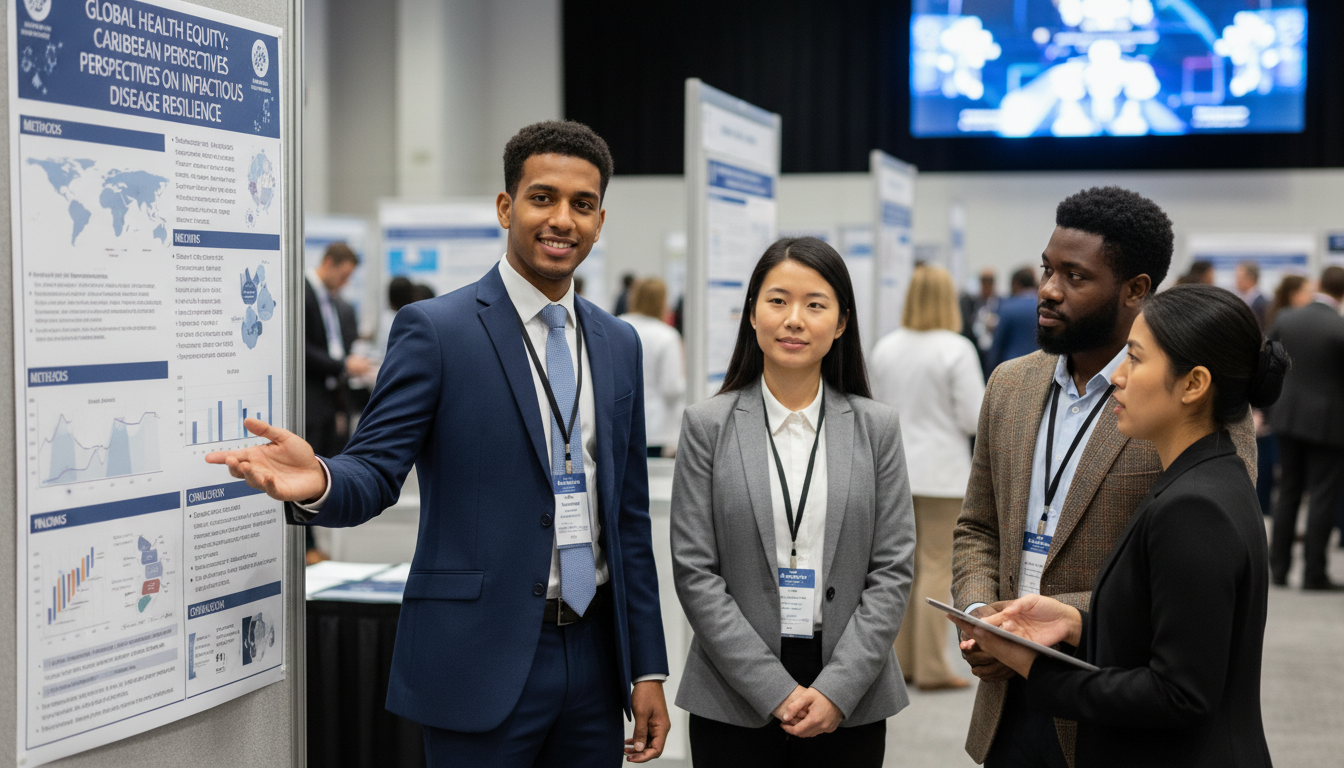
- Submit abstracts to meetings focused on global health, tropical medicine, infectious diseases, primary care, emergency medicine, or medical education
- Examples: CUGH (Consortium of Universities for Global Health), ASTMH, regional immigrant health conferences, specialty-specific global health meetings
Use these venues to:
- Meet potential future collaborators and mentors
- Identify institutions with strong global health or academic residency tracks
- Learn how others structure resident research projects in international contexts
If funding is an issue, ask about travel grants, trainee awards, or institutional support.
3. Maintain a Research CV and Narrative
Update your CV regularly with:
- Publications and manuscripts in progress
- Abstracts and posters
- Research roles and responsibilities
- Awards or grants
Also maintain a short “research narrative” that:
- Summarizes your main themes (e.g., global non-communicable diseases, maternal health in LMICs, immigrant health, health systems)
- Connects your Caribbean background and training to your research focus
- Explains how your work supports your long-term global health goals
This will be invaluable for fellowship, job applications, and future grant submissions.
4. Collaborate Across Borders—Responsibly
As someone interested in global health, you may have connections in the Caribbean or other LMIC settings. Use these responsibly:
- Support bidirectional partnerships and shared authorship with local collaborators
- Ensure that projects address locally identified priorities, not just your own interests
- Provide tangible benefits to the partner site (training, capacity building, tools, or data they can use)
Ethical, equitable collaboration is increasingly recognized as a core competency in global health research.
Overcoming Common Challenges for Caribbean IMGs in Research
Time Constraints
- Integrate research into mandatory QI requirements or elective time
- Co-lead projects with co-residents to share workload
- Choose projects that align closely with your daily clinical environment (e.g., clinic-based QI rather than starting a distant, unrelated project)
Limited Experience or Confidence
- Start with smaller roles (data collection, case reports, literature reviews)
- Take advantage of institutional resources—librarians, research offices, global health centers
- Ask your mentor for reading lists or short courses to build your foundation
Impostor Syndrome as a Caribbean IMG
Many Caribbean graduates feel they must “prove themselves” more than U.S. grads. Research can amplify this anxiety—but it can also be your strength.
- Your background gives you insight into Caribbean health systems, migration, and cross-cultural care
- You may be uniquely positioned to bridge academic and Caribbean clinical environments
- Let your lived experience inform your choice of research questions; this authenticity is valued in global health
Matching or Transitioning into More Academic/Global Roles
If your current residency is not heavily research-oriented:
- Build a modest, well-executed portfolio now—one or two solid projects are better than many incomplete ideas
- Use these to apply for global health fellowships, MPH programs, or post-residency research roles
- Consider additional training (e.g., one-year research fellowships, certificate programs) after residency to deepen your expertise
This path is common among Caribbean IMGs: a solid but non-academic residency, followed by a more research-intensive fellowship or global health program.
Frequently Asked Questions (FAQ)
1. I graduated from a Caribbean medical school with little research. Is it too late to start during residency?
No. Residency is a very common time to begin serious research, especially for Caribbean IMGs who focused primarily on board exams and the Caribbean medical school residency application earlier. If you commit to 1–2 high-quality projects, you can still build a competitive global health–oriented CV by the end of training.
2. How can I do research in global health if my residency program does not have a formal global health residency track?
You can:
- Focus on immigrant, refugee, or underserved populations in your local community
- Join QI or disparities-focused projects with a global health lens
- Seek external mentors through online networks, conferences, or global health organizations
- Partner with academic centers or NGOs that are willing to collaborate virtually
Formal tracks help, but they are not strictly necessary if you have initiative and mentorship.
3. How important is research for getting into a global health fellowship?
Research is strongly valued. Programs look for:
- Demonstrated commitment to global or international medicine
- Ability to carry a project from design to completion and dissemination
- Experience with methods relevant to global health (epidemiology, implementation science, health systems, education research)
You do not need dozens of publications, but having at least one or two meaningful resident research projects—especially directly related to global health—will significantly strengthen your application.
4. Can I tie my research during residency back to the Caribbean specifically?
Absolutely—and it can be a major asset. Options include:
- Studying health disparities among Caribbean-origin populations in your host country
- Collaborating with hospitals, clinics, or ministries of health in the Caribbean on shared projects
- Comparing health outcomes or disease patterns between Caribbean and non-Caribbean groups
- Developing or evaluating telehealth, education, or implementation strategies designed for Caribbean settings
This creates a powerful narrative connecting your identity, your training, and your long-term vision for global health in the region.
By approaching research during residency with intention, even a busy Caribbean IMG can develop a focused, impactful scholarly portfolio in global health. Strategic project selection, strong mentorship, and consistent effort will not only enhance your clinical training but open doors in academic medicine, international organizations, and leadership roles across the global health landscape.