Why Research During Residency Matters for Caribbean IMGs in EM-IM
For a Caribbean medical school graduate pursuing an Emergency Medicine–Internal Medicine (EM-IM) combined residency, research can be the difference between a standard training experience and a career-opening one. Whether you trained at SGU or another Caribbean school, your status as an international medical graduate makes it especially important to demonstrate academic engagement, curiosity, and leadership.
Research during residency is not only about publications—it’s about learning how to ask questions, evaluate evidence, improve systems, and position yourself for fellowships, academic careers, or leadership roles. For EM-IM residents, who straddle high-acuity emergency care and longitudinal internal medicine, research opportunities are particularly rich: sepsis, chest pain risk stratification, ED flow, ultrasound use, social determinants of health, and more.
This article will walk you through how to approach research during residency as a Caribbean IMG in an EM-IM combined program: what’s realistic, how to get started, how to find mentors, what kinds of projects to choose, and how to leverage your work for the next step in your career.
Understanding the Landscape: EM-IM Combined Residency and Research
Emergency Medicine-Internal Medicine combined programs are uniquely positioned at the interface of acute and chronic care. That intersection creates powerful opportunities for research during residency.
What Is EM IM Combined and Why It Matters for Research
EM-IM combined training prepares you to:
- Manage undifferentiated emergencies in the ED
- Provide longitudinal care to medically complex patients on wards and in clinic
- Understand systems of care from ED triage to inpatient discharge and follow-up
From a research standpoint, this means:
- Large, diverse patient populations in both ED and inpatient settings
- High-yield clinical questions (e.g., sepsis bundles, chest pain pathways, COPD exacerbations, anticoagulation, heart failure, substance use, ED readmissions)
- Systems-based projects across departments (e.g., ED-to-ward handoffs, observation units, care transitions)
For Caribbean IMGs, these combined programs can be particularly valuable because they offer broad clinical exposure and multiple niches for scholarly activity.
The Caribbean IMG Context: Why Research Is Especially Important
As a graduate of a Caribbean medical school, you may already recognize some of the perceptions and biases you’re working against. Research during residency can help counter those by showing that you:
- Can perform at the level of U.S. MD/DO grads in academic environments
- Contribute meaningfully to the department’s scholarly mission
- Are capable of critical thinking, data interpretation, and quality improvement
Strong SGU residency match outcomes and similar Caribbean medical school residency successes often highlight graduates who have combined solid clinical performance with scholarly work. If you didn’t have extensive research in medical school, residency is your opportunity to build that track record.
Research vs. Quality Improvement vs. Scholarly Activity
Programs may use different terms:
- Clinical or translational research: Hypothesis-driven studies, often IRB-approved, involving data collection and analysis
- Quality Improvement (QI): Projects designed to improve care processes (e.g., door-to-needle times, sepsis protocol adherence)
- Educational research: Studies on teaching methods, simulation, curriculum outcomes
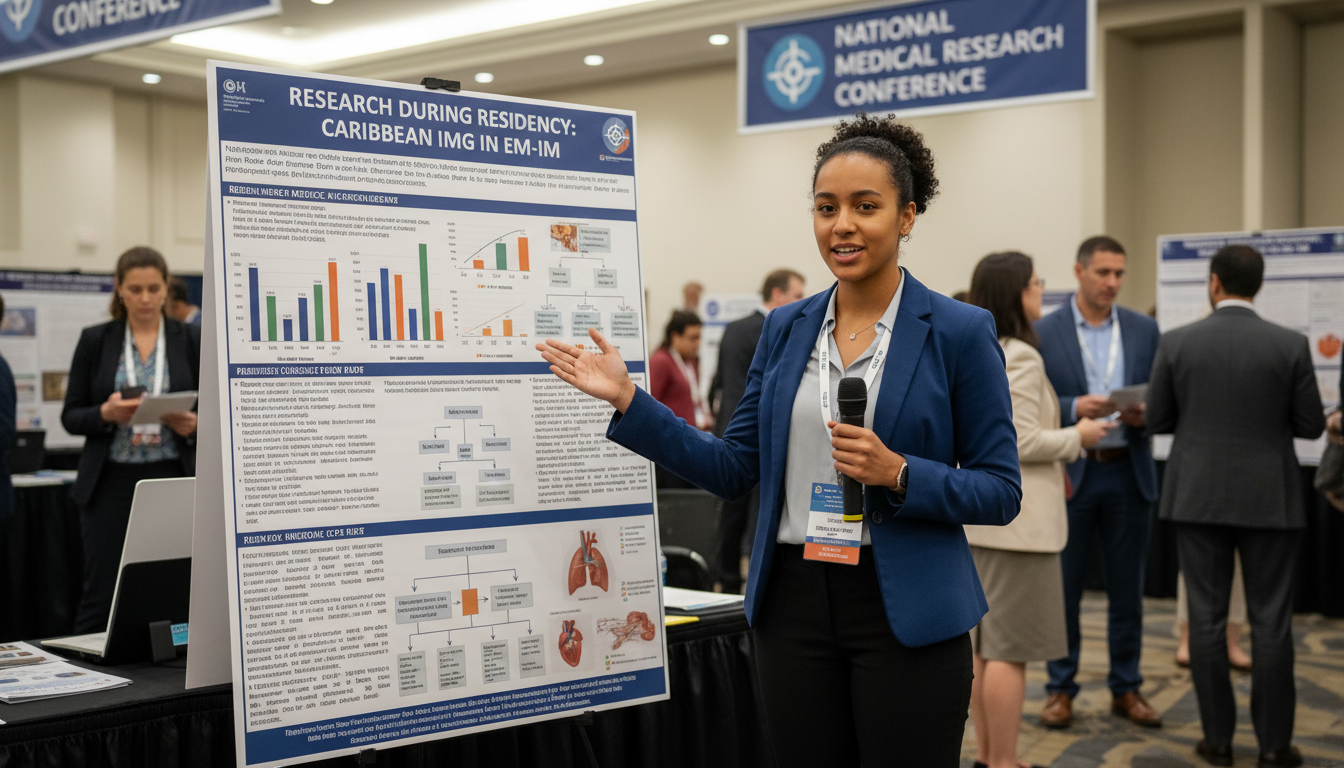
- Other scholarly activity: Case reports, narrative reviews, clinical guidelines, book chapters, conference posters
For many EM-IM residents, QI and clinical research blend naturally. A project improving ED management of heart failure patients, for example, might both improve care (QI) and produce analyzable data (research).
Getting Started: Finding Your Niche and Your Mentors
You do not need to arrive at residency with a fully developed research agenda. You do need curiosity, humility, and a strategy.
Step 1: Assess Your Baseline and Time Constraints
During EM-IM residency, your biggest limitation is time. EM shifts, inpatient rotations, and exams leave limited bandwidth. Before jumping in, ask:
- How many hours per week can I realistically devote to research during residency?
- What rotations or blocks are typically lighter (e.g., some outpatient, elective, or research blocks)?
- Does my program have protected resident research time?
If you have minimal prior experience, aim for projects with clear structure, a committed mentor, and achievable deadlines.
Step 2: Identify Your Areas of Interest
As an EM-IM resident, consider questions at the interface of emergency medicine internal medicine:
- Acute on chronic disease management: COPD, heart failure, diabetes, CKD, cirrhosis
- Transitions of care: ED discharge vs. admission decisions, follow-up adherence, 30-day readmissions
- Critical care: Sepsis, shock, early resuscitation strategies
- Diagnostics and imaging: Ultrasound in sepsis or dyspnea, CT utilization, decision rules
- Social determinants of health: Frequent ED utilizers, housing instability, substance use, insurance status
You don’t need a perfect topic on day one. Start with a broad domain (e.g., sepsis, chest pain, or ED readmissions) and refine as you talk to faculty.
Step 3: Find the Right Mentors
Mentorship is crucial, especially if you trained outside the U.S. system. Look for:
- Track record: Faculty with prior publications, funded projects, or known involvement in resident research projects
- Availability: People who respond to emails, meet regularly, and follow through
- Compatibility: Someone who understands your EM-IM schedule and Caribbean IMG background
Practical steps:
Ask your program leadership:
- “Which faculty are most active in emergency medicine internal medicine research?”
- “Who has experience working with residents on publishable projects?”
Review departmental websites and PubMed:
- Search your institution’s name + keywords like “emergency medicine,” “sepsis,” “readmission,” “ultrasound,” “heart failure,” etc.
- Identify faculty with recent publications.
Set up short meetings:
- Prepare a brief intro: “I’m an EM-IM resident, Caribbean IMG, interested in getting involved in research during residency, especially around [your topic].”
- Ask what projects are ongoing and where a resident could plug in.
Approach 2–3 potential mentors rather than putting all your hopes on one person. You may end up with a primary mentor and a secondary collaborator.
Step 4: Start Small but Strategic
As an early PGY-1 or PGY-2, good first steps are:
- Case reports of interesting EM-IM interface issues (e.g., unusual presentations of chronic disease in the ED)
- Retrospective chart reviews on focused questions
- QI projects with measurable outcomes (e.g., time-to-antibiotics in sepsis, adherence to chest pain protocols)
- Joining existing multi-resident projects rather than building from scratch
The goal is to gain momentum, understand the research process, and build your CV. Once you’ve completed one or two smaller projects, you can consider more ambitious work.
Types of Resident Research Projects That Fit EM-IM and Caribbean IMGs
Not all projects are equally realistic for an EM-IM resident’s schedule. The best resident research projects align with your clinical rotations, can be chunked into manageable tasks, and have high educational and career value.
1. Retrospective Chart Reviews
Why they work well:
- You can work on them outside of strict clinical hours
- No need to intervene directly with patients
- Common and well-understood methodology
Examples tailored to EM IM combined training:
- Sepsis bundle compliance across ED and inpatient units:
- Question: Does ED initiation of sepsis bundles improve inpatient mortality or LOS for septic shock patients?
- ED disposition and internal medicine outcomes:
- Question: Among patients discharged vs admitted with chest pain or syncope, what are the 30-day return rates or adverse events?
- Frequent ED admissions for chronic diseases:
- Question: What factors predict repeat admission within 30 days for heart failure or COPD?
Key steps:
- Identify a specific question and primary outcome (e.g., 30-day readmission, ICU admission, length of stay).
- Meet with a mentor to refine the question and feasibility.
- Submit an IRB application (often expedited for retrospective studies).
- Create a data collection tool (Excel or REDCap).
- Abstract data in small, consistent chunks (1–2 hours at a time).
2. Quality Improvement (QI) Projects with Research Rigor
QI is often more achievable within residency constraints and can be framed in academically rigorous ways.
Examples:
Improving sepsis care across ED and medicine wards
- Baseline: Time to antibiotics and fluid resuscitation before intervention
- Intervention: New sepsis protocol, order sets, or triage alerts
- Outcome: Changes in process metrics and patient outcomes
Reducing 72-hour ED returns for discharged heart failure patients
- Identify current discharge planning process
- Implement improved education or follow-up scheduling
- Measure return visit and readmission rates
Standardizing ED-to-inpatient handoffs
- Implement an EM-IM joint handoff template
- Track paging errors, missed information, or adverse events
QI can often fulfill both residency program “scholarly activity” requirements and generate a poster or manuscript.
3. Educational Research in EM-IM
If you’re interested in medical education or an academic residency track:
- Evaluate a new EM-IM boot camp curriculum
- Study the impact of simulation on cross-cover skills
- Investigate how combined residents perform on certain milestones compared to categorical EM or IM residents
These are especially valuable if your long-term goal is to stay in academic medicine.
4. Multi-Center or Collaborative Projects
Depending on your program’s network, you might join:
- Multi-center ED sepsis registries
- Regional chest pain or stroke protocol studies
- National EM-IM collaborative initiatives (e.g., education, outcomes, or workforce research)
These often have more complex data infrastructure but can lead to higher-impact publications. As a Caribbean IMG, being part of national-level work can strongly reinforce your academic profile.
Building a Sustainable Research Plan Across PGY-1 to PGY-5
EM-IM training is typically 5 years. That gives you more time than most categorical residents, but also more competing demands. A structured plan helps you avoid last-minute scrambling.
PGY-1: Exposure and Foundation
Primary goals:
- Learn your hospital’s systems and EM-IM workflow
- Identify at least one research mentor
- Join or initiate one small, manageable project
Action steps:
- Attend any departmental research or journal clubs.
- Ask senior residents which faculty are most supportive with resident research projects.
- Start with a limited-scope chart review or QI project that a senior resident or fellow is already working on.
- Aim for your first poster abstract submission by the end of PGY-1 or early PGY-2.
PGY-2: Productivity and Skills Building
Primary goals:
- Take ownership of at least one project
- Gain basic skills in statistics and manuscript structure
- Present at a regional or national conference
Action steps:
- Negotiate elective time (if available) to focus on research during residency.
- Learn the basics of statistical software (R, SPSS, Stata) or work closely with a biostatistician.
- Target EM-IM relevant conferences (ACEP, SAEM, SHM, SCCM, regional IM or EM meetings).
- Aim for at least one abstract submitted and potentially one manuscript drafted.
PGY-3: Refinement and Academic Positioning
Primary goals:
- Complete and submit at least one manuscript
- Consider longer-term projects or fellowships
- Start defining your academic residency track interests (e.g., ED operations, critical care, ultrasound, medical education)
Action steps:
- Evaluate your research portfolio: Are you building coherence (e.g., multiple sepsis or readmission projects) or scattered topics?
- Seek opportunities for cross-department collaboration (e.g., cardiology, pulmonary, hospital medicine, ICU).
- For Caribbean IMGs interested in U.S. academic positions, discuss with mentors what expectations exist for junior faculty in your field.
PGY-4–5: Consolidation and Next-Step Preparation
Primary goals:
- Establish a clear scholarly narrative (“I focus on X within EM-IM”)
- Publish 1–3 manuscripts if possible
- Use your research to strengthen fellowship or job applications
Action steps:
- Take leadership roles in ongoing projects or mentor junior residents and students.
- If you plan to apply for fellowships (e.g., critical care, ultrasound, research fellowships, hospital medicine), align your final projects with your intended path.
- Present at national meetings consistently, and start networking with leaders in your niche.
Practical Tips for Caribbean IMGs: Standing Out Through Research
Your background as a Caribbean IMG in an EM-IM program is an asset if you know how to frame it. Research allows you to tell a story of resilience, adaptability, and academic commitment.
Leverage Your Unique Perspective
Draw on your experiences:
- Understanding resource-limited settings can inform ED triage and utilization research.
- Exposure to diverse patient populations can inform cultural competency or communication projects.
- Global health interest can translate to ED care of immigrant populations, health access, or telemedicine.
These angles can be compelling for academic programs and funding opportunities.
Communicate Clearly and Professionally
For Caribbean IMGs, professional communication can strongly influence how faculty perceive your readiness for academic work:
- Send concise, well-structured emails to potential mentors.
- Prepare agendas for meetings (e.g., project updates, questions, next steps).
- Meet deadlines or communicate early if you need extensions.
This reliability often matters more than raw research brilliance.
Align Your Work With Career Goals
Some examples:
- Interested in ED or ICU critical care? Focus on sepsis, shock, ARDS, code blue systems.
- Interested in hospital medicine or ED flow? Study admission criteria, observation unit outcomes, throughput metrics.
- Interested in academic residency track or medical education? Work on simulation, curriculum development, resident performance evaluation.
EM-IM residents have flexibility; use it to create a coherent academic identity.
Target Appropriate Journals and Conferences
You don’t have to aim only for the top-tier journals. Consider:
- Emergency medicine journals (Annals of Emergency Medicine, Academic Emergency Medicine, American Journal of Emergency Medicine)
- Internal medicine or hospital medicine journals (Journal of Hospital Medicine, Journal of General Internal Medicine)
- Specialty-specific outlets (Critical Care Medicine, Chest, Circulation, etc.)
For abstracts and posters:
- ACEP, SAEM, CHEST, SCCM, SHM, ACP, regional EM and IM meetings
- Combined EM-IM or dual-board interest groups if available
Being consistently visible in these communities can mitigate some of the disadvantages Caribbean graduates may face.
Frequently Asked Questions (FAQ)
1. I had little or no research in medical school. Is it too late to start during residency?
No. Many successful EM-IM physicians began serious research work only in residency. Start with:
- A manageable project (small chart review or QI)
- A reliable mentor
- Clear, realistic goals
Your PGY-1 and PGY-2 years are ideal for learning foundational skills and building your first abstracts or manuscripts.
2. How many publications do I need for an academic career after an EM-IM residency?
There is no strict number, but for a competitive academic position or research-oriented fellowship, having:
- 1–3 peer-reviewed publications (even as co-author)
- Several abstracts or posters
- A consistent theme (e.g., sepsis, ED operations, readmissions, education)
is generally sufficient to demonstrate that you can be a productive academic physician. More is always helpful, but quality and coherence matter more than sheer quantity.
3. Do I need formal research training (like a MPH or certificate) during residency?
Not necessarily. Many EM-IM residents successfully participate in research during residency without an advanced degree. However, if you’re strongly interested in a research-intensive career, options include:
- Institution-sponsored research certificates or short courses
- Online biostatistics or epidemiology coursework
- A dedicated research or MPH year (less common, but possible in some programs)
Discuss your long-term goals with mentors to decide whether additional formal training is worthwhile.
4. How can I balance EM shifts, ward months, and research without burning out?
Strategies include:
- Choosing projects with flexible timelines (e.g., retrospective studies)
- Scheduling research tasks in small, regular blocks (1–2 hours, 2–3 times per week)
- Using lighter rotations or elective time for concentrated project work
- Sharing the workload on multi-resident projects
- Being realistic about your capacity and saying “no” to extra projects that don’t align with your goals
Sustainable pacing is more important than overcommitting and stalling out.
By approaching research during residency with a clear plan, strong mentorship, and a focus on feasible, high-yield projects, a Caribbean IMG in an Emergency Medicine–Internal Medicine combined program can build a powerful academic profile. Your dual training offers a natural platform for impactful resident research projects—use it to shape a career that spans acute care, longitudinal medicine, and meaningful contributions to the scientific and educational community.