
Why Research During Residency Matters for MD Graduates
For an MD graduate, residency can feel overwhelmingly clinical—long hours, steep learning curves, packed call schedules. It’s tempting to postpone research goals until “things calm down.” However, for many career paths, research during residency is not a luxury; it is a strategic necessity.
Whether you trained at an allopathic medical school aiming for an academic career, or you’re still undecided, engaging in resident research projects will:
- Strengthen your fellowship and job applications
- Build skills in critical appraisal and evidence-based medicine
- Help you stand out within your program and specialty
- Expand your professional network and mentorship relationships
- Open doors to an academic residency track and future promotion
Even if your long-term goal is predominantly clinical practice with minimal research, learning how to generate, interpret, and apply data will make you a stronger physician.
This guide is designed specifically for the MD graduate in residency—especially those coming from allopathic schools and interested in carving out a meaningful, realistic, and sustainable research path during busy training years.
Clarifying Your Research Goals in Residency
Not every resident needs to become a high‑volume, R01‑funded investigator. Before you commit to projects, clarify what research should accomplish for you.
1. Identify Your Career Trajectory
Ask yourself:
- Do I ultimately see myself in academic medicine, community practice, industry, or public health?
- Am I aiming for a competitive fellowship (e.g., cardiology, GI, heme/onc, surgical subspecialties, dermatology, radiation oncology, etc.)?
- How much time do I realistically want to devote to research 5–10 years from now?
Your answers help determine how deeply to invest in research during residency:
- Research-light trajectory
- Goal: Strong clinician, maybe some occasional QI or case reports
- Strategy: 1–2 small, well-completed projects; aim for at least one publication or presentation
- Balanced academic-clinical trajectory
- Goal: Academic hospitalist, subspecialist, or clinician-educator
- Strategy: Multiple projects (case series, QI, retrospective studies); clear research niche; several abstracts and 1–3 publications
- Research-heavy trajectory
- Goal: Physician-scientist, tenure-track, or highly competitive academic roles
- Strategy: Early alignment with a research mentor; substantial productivity (multi-year projects); possibly research block, research track, or post-residency research fellowship
2. Understand Specialty-Specific Expectations
Different specialties and fellowships view research differently:
Highly competitive specialties/fellowships (dermatology, plastics, ortho subspecialties, GI, cardiology, heme/onc, radiation oncology, rheumatology, etc.)
- Expectation: Multiple scholarly products; often first-author work; clear alignment with specialty
- Value: Publications, national conference presentations, sometimes grant involvement
Moderately research-oriented specialties (general surgery, internal medicine, pediatrics, neurology, anesthesiology, EM)
- Expectation: Some research is very helpful, especially for academic careers or fellowships
- Value: At least a few tangible products; QI, education research, and clinical studies all count
Less research-intensive specialties for community paths
- Expectation: Limited, but at least one meaningful project still boosts your profile
- Value: Demonstrates initiative, critical thinking, understanding of evidence-based practice
If you’re unsure, talk to recent graduates of your specialty who successfully matched into fellowships or jobs you are considering. Ask what role research during residency played in their trajectory.
Finding and Choosing the Right Resident Research Projects
You will be bombarded with possible projects. Choosing strategically is essential to avoid overcommitting and underdelivering.
1. Seek a Strong Mentor (Not Just a Famous Name)
A productive research experience is far more about the mentor–mentee relationship than the prestige of the lab or PI.
Look for mentors who:
- Have a track record of publishing with residents or fellows
- Offer clear expectations and timelines
- Provide structured guidance on study design, analysis, and writing
- Are responsive by email and willing to meet regularly
- Support your specific goals (fellowship, academic track, etc.)
Ask potential mentors:
- “How many residents have you worked with in the past 3–5 years, and what did they complete?”
- “What typical roles do residents play on your projects?”
- “How often do you meet with trainees working on research with you?”
Red flags: vague answers, no recent resident co-authors, or a pattern of unfinished projects.
2. Match the Project Scope to Your Schedule
Classic mistake: a PGY‑1 agrees to help with a large, multi-year prospective cohort study and a complex RCT analysis and a curriculum design project, then finishes none of them.
Instead, aim for a portfolio of projects with varied time horizons:
Short-term wins (weeks–3 months)
- Case reports and case series
- Narrative or systematic reviews (if well-scoped and supported)
- Conference abstracts/posters using existing data
- Simple QI projects or educational interventions with limited data
Medium-term (3–12 months)
- Retrospective chart reviews
- Secondary analysis of existing datasets
- QI studies with multiple PDSA cycles
- Pilot educational research projects
Long-term (1–3+ years)
- Prospective studies
- Grant-funded projects
- Large database studies
- Multi-institutional collaborations
As a busy MD graduate in residency, focus on at least one short-term and one medium-term project early in training. Consider long-term projects if your program offers research time or an academic track.
3. Prioritize Feasibility and Clear Deliverables
Before agreeing to a project, clarify:
- What is the primary deliverable? (Abstract, poster, oral presentation, manuscript, curriculum, database)
- What is your explicit role? (Literature review, data collection, analysis, drafting sections, leading the manuscript)
- What is the timeline for each step?
- How will authorship be determined?
A feasible resident research project for a PGY‑1 might be:
- Retrospective chart review on outcomes of a common condition seen on your service
- Your role: IRB drafting, data extraction for a sample of charts, preliminary analysis input, first draft of Introduction/Methods
- Deliverables: Abstract for specialty’s annual national meeting plus a manuscript submission
Say no to projects that are:
- Poorly defined with no clear endpoint
- Dependent on resources your program doesn’t have
- Led by a mentor with a known track record of stalled projects

Time Management: Integrating Research into a Busy Residency
The reality of MD graduate residency training is that clinical work will dominate your schedule. Your strategy is not to find “free time” but to design structure around your obligations.
1. Use Rotations Strategically
Not all months are created equal. Map your year:
- Heavy rotations: ICU, night float, trauma, high-volume ED, busy inpatient services
- Moderate: consult services, some electives, ambulatory blocks
- Light: research electives, outpatient rotations with predictable hours, vacation-adjacent months
Assign tasks logically:
Heavy rotations
- Realistic research goals: reading literature, answering mentor emails, minor edits on drafts, brief data entry
- Focus on staying engaged without new commitments
Moderate rotations
- Best for: data collection, meetings with biostatisticians, revising manuscripts, drafting abstracts
Light rotations or dedicated research time
- Best for: deep work—analysis, manuscript drafting, IRB full submissions, finalizing presentations
Create a 12-month calendar and block out tentative research milestones: IRB submission, data collection windows, abstract deadlines, conference dates, and manuscript drafts.
2. Protect Regular Research Time
Even without formal research blocks, you can carve out small, consistent intervals:
- 1–2 early mornings per week (e.g., 6–7 am) on non-call days
- A fixed 2–3-hour block on one weekend day for deeper tasks
- A monthly meeting with your mentor, scheduled like a patient appointment
Treat research time as non-negotiable, like clinic. Turn off notifications, close EHR, and focus only on the next actionable task: one section of a manuscript, five more charts, one set of figure revisions.
3. Apply Efficiency Tools and Habits
Practical tactics:
- Task breakdown: Turn “finish research project” into micro-tasks:
- Draft IRB background
- Update literature search
- Enter data for 10 charts
- Create first draft of Table 1
- Use reference managers: Zotero, EndNote, Mendeley to handle citations
- Create templates: Standard formats for data extraction sheets, IRB sections, and manuscript introductions
- Batch similar tasks: Do all data extraction in one block, all figure generation in another, instead of switching constantly between tasks
Remember: Slow, steady progress almost always outperforms occasional research “sprints” that only happen when a rotation is easy.
Building Skills and a Scholarly Identity
Research during residency is not merely about adding lines to your CV. It’s your opportunity to learn how to ask good questions, analyze systematically, and communicate clearly.
1. Strengthen Core Research Skills
Even in a busy allopathic medical school match environment, many MD graduates didn’t receive rigorous training in study design or statistics. Residency is a chance to address that.
Key skill domains:
Study Design & Methods
- Understand basics of cross-sectional, cohort, case-control, RCTs, and QI methodologies
- Learn about common biases and confounders
Biostatistics Literacy
- Know when to use t-tests, chi-square, regression, survival analysis
- Be able to discuss power, sample size, and p-values versus confidence intervals
Data Management
- Basic competence in REDCap or similar tools
- Understanding of secure data handling and PHI protection
Scientific Writing
- Structure: IMRAD (Introduction, Methods, Results, Discussion)
- Clear, concise style; adherence to target journal guidelines
- Responding to peer-review comments effectively
Practical ways to build these skills:
- Attend your institution’s research workshops and journal clubs
- Complete short online courses (e.g., Coursera, edX, NIH, IHI for QI)
- Read high-quality articles in your specialty regularly—not just for content, but for structure and methods
2. Develop a Research “Niche” During Residency
You don’t need a fully defined lifelong niche in PGY‑1, but some thematic consistency is valuable, especially for those considering an academic residency track.
Possible focus areas:
- A specific disease or organ system (e.g., heart failure, inflammatory bowel disease, epilepsy)
- A population (e.g., older adults, pediatric oncology, women’s health, underserved communities)
- A methodological focus (e.g., QI, health services research, medical education, implementation science, bioethics)
For example:
An internal medicine resident considering cardiology:
- Projects on hospital readmissions in heart failure
- QI to improve evidence-based HF therapies at discharge
- Retrospective study on predictors of cardiogenic shock outcomes
A pediatrics resident leaning towards academic general pediatrics:
- Work on vaccine hesitancy interventions
- Parent education materials and outcomes
- Medical education research on communication training
When fellowship or job applications appear, your resident research projects will tell a coherent story: “I’m building toward expertise in X.”
3. Plug into an Academic Residency Track (When Available)
Many programs now offer an academic residency track or “research pathway” that provides:
- Protected research time (e.g., 3–6 months total over residency)
- Formal mentorship committees
- Coursework in clinical research, epidemiology, or education
- Expectations for a capstone project, thesis, or multiple publications
If your MD graduate residency program offers this:
- Ask about eligibility (often application during PGY‑1).
- Determine requirements, such as abstracts, manuscripts, or grant involvement.
- Identify a primary research mentor early to maximize the benefit of protected time.
If your program lacks a formal track, you can still create a de facto academic track:
- Negotiate elective time for research blocks
- Combine QI expectations with publishable designs
- Seek multi-institution collaborations through specialty societies
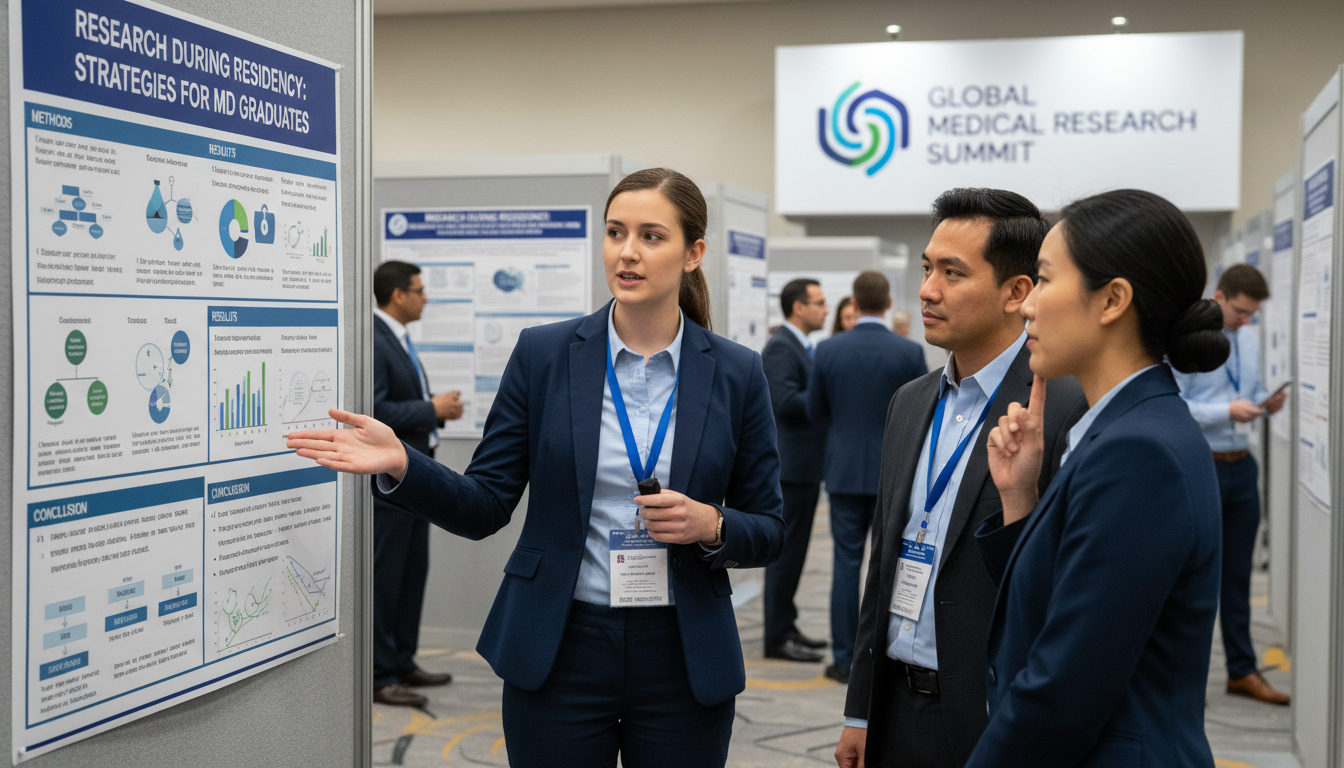
Converting Work into Tangible Academic Output
A critical distinction: working hard on research versus producing visible, citable outcomes. Programs, fellowship directors, and employers care about the latter.
1. Plan for Multiple Levels of Output
From the outset of each project, think in layers:
Level 1: Internal Products
- Department or residency conference presentations
- Morbidity & mortality (M&M) conferences
- Grand rounds, noon conferences, teaching sessions
These build your teaching profile and prepare content for external venues.
Level 2: Regional/National Outputs
- Abstracts for specialty society annual meetings
- Posters and short oral presentations
- Workshops (especially for education or QI work)
These are often more attainable in the short term and show early productivity.
Level 3: Peer-Reviewed Publications
- Original research, reviews, case series, educational innovations
- Priority for projects where you have significant intellectual contribution
Manuscripts are the highest-yield academic currency for fellowship and academic hiring committees.
Aim for a mixture: for example, one or two abstracts annually plus one manuscript every 1–2 years, adjusting for specialty and career goals.
2. Authorship, Ethics, and Professional Reputation
Research during residency is also where your professional integrity is forged.
Key points:
- Discuss authorship order early. Clarify what is required to be first, second, or middle author.
- Follow ICMJE authorship criteria: substantial contribution, drafting/revising, and approval of final version.
- Respect IRB approvals, data use agreements, and HIPAA requirements strictly.
- Avoid “guest authorship” or including names without real contribution; this can harm your reputation.
Your reputation as reliable, ethical, and thorough will follow you well beyond residency. Mentors talk. Fellowship directors and department chairs often know each other.
3. Writing and Revising Efficiently
To move projects from “data collected” to “paper accepted,” you must navigate the writing and revision process efficiently.
Strategies:
- Use a manuscript outline early, even before data are final
- Write methods and background sections while data collection is ongoing
- Set internal deadlines: draft introduction by X date, send first full draft to co-authors by Y date
- Expect at least one rejection; have a backup journal list prepared
- Learn from reviews: incorporate constructive feedback to strengthen your work and writing
Consider forming a small peer group of residents to exchange drafts and provide feedback. This improves quality and accountability.
Research During Residency and Your Long-Term Career
Your research activity as a resident will influence your trajectory in several ways.
1. For Fellowship Applications
For many specialties, fellowship program directors look closely at:
- Number and quality of publications and presentations
- Whether your research aligns with the fellowship’s focus
- Letters from research mentors describing your potential
If you are aiming for a competitive fellowship:
- Start relevant projects by mid‑PGY‑1 or early PGY‑2
- Try to have at least some accepted or in-press work by the time you apply
- Ask your mentor to explicitly address your research skills and potential in their letter
2. For Academic Jobs After Residency
If you’re seeking an academic clinician or clinician–educator role:
- Emphasize your scholarly themes (e.g., QI, education, health disparities)
- Highlight leadership roles in projects and any cross-disciplinary collaborations
- Show a trajectory: from early, small projects to increasingly independent, grant-applicable work
Residency is when you build the foundation that can later support intramural grants, K awards, and larger externally-funded endeavors, if that’s your path.
3. For Clinically Focused Careers
Even if you end up in a predominantly clinical setting:
- Your research background equips you to interpret evidence more critically
- You can lead practice improvement initiatives, protocol development, or guideline implementation
- You remain more competitive for leadership roles (medical director, quality director, department chair)
In short, research during residency expands rather than narrows your options—even if you ultimately decide not to pursue a research-intensive career.
Frequently Asked Questions (FAQ)
1. How many research projects should I do during residency?
There is no magic number. For most MD graduates:
- Minimum: 1–2 meaningful projects leading to at least one abstract or publication
- Academic/fellowship-focused: multiple projects across PGY‑1 to PGY‑3, with several presentations and ideally 2–4 peer-reviewed publications
Depth and completion matter more than raw quantity. It is better to fully complete 2 projects with solid outputs than to partially contribute to 8 unfinished ones.
2. Is QI work considered “real” research?
Yes, if done rigorously. Quality improvement projects are highly valued, especially when they:
- Use structured methodologies (PDSA cycles, run charts, clear measures)
- Demonstrate measurable change in process or outcomes
- Are framed with literature context and appropriate methods
Many programs, journals, and conferences explicitly welcome QI projects, and they can count as legitimate scholarly output.
3. When should I start research during residency?
Ideally as early as possible, especially if targeting competitive fellowships or an academic career:
- Begin exploring mentors and attending research meetings during PGY‑1
- Aim to have at least one project underway by mid‑PGY‑1 to early PGY‑2
- Use PGY‑2 and PGY‑3 for deeper involvement, leadership roles, and manuscript completion
However, it is never too late to start; even PGY‑3 projects can translate into meaningful abstracts and in-progress manuscripts that support your next steps.
4. I feel overwhelmed—how do I balance research with residency burnout risk?
Recognize that you can’t (and shouldn’t) do everything. To maintain balance:
- Limit yourself to a manageable number of projects (often 1–3 active at a time)
- Focus on roles where your contribution is clear and feasible
- Choose supportive mentors who respect your clinical and personal limits
- Build in rest and recovery—your well-being is essential for sustainable productivity
If you are experiencing significant burnout, prioritize health and safety first. Research can be paused and resumed; your well-being cannot be compromised.
Engaging in research during residency as an MD graduate is challenging but profoundly rewarding. With strategic project selection, deliberate mentorship, consistent time management, and a focus on tangible outputs, you can emerge from residency not only as a strong clinician, but also as a physician who moves the field forward through inquiry and scholarship.