Why Research During Residency Matters for Caribbean IMGs in Med-Peds
For a Caribbean international medical graduate (IMG) entering a Medicine-Pediatrics (Med-Peds) residency, “just surviving” training can feel like enough of a challenge. Yet increasingly, program directors and academic leaders expect residents to be involved in scholarly work. Research during residency is no longer a bonus; it’s part of what defines a strong, well-rounded Med-Peds physician.
For Caribbean IMGs—whether you trained at SGU, Ross, AUC, Saba, or another Caribbean school—research can be a powerful equalizer. Even if your Caribbean medical school residency application felt like an uphill battle, residency is a fresh start. You now have access to faculty, patient populations, and institutional resources that can support meaningful resident research projects.
In Medicine-Pediatrics, research is especially relevant because the field spans two disciplines, crosses developmental stages, and often focuses on transitions of care, chronic illness management, and health systems. Engaging in research can:
- Strengthen your CV for fellowships and academic positions
- Build your reputation within your program and institution
- Help you stand out if your SGU residency match (or similar pathway) began with perceived disadvantages
- Improve your clinical reasoning through critical appraisal of evidence
- Open doors to leadership, QI, and education roles
This article will walk you through how to approach research during residency as a Caribbean IMG in Med-Peds: where to start, how to choose projects, how to balance time, and how to leverage your unique background to build an academic profile.
Understanding the Landscape: Research in Med-Peds Residency
Med-Peds offers broad opportunities for research because it spans both internal medicine and pediatrics, and frequently interfaces with public health, transitions of care, and chronic disease across the lifespan.
Common Types of Resident Research Projects in Med-Peds
You don’t need to design a randomized controlled trial to be “doing research.” For busy residents—especially IMGs building credibility—smaller, focused projects are often ideal. Common forms include:
Clinical research
- Retrospective chart reviews (e.g., asthma readmissions in adolescents vs. adults)
- Observational cohort studies (e.g., outcomes in youth with type 1 diabetes transitioning to adult care)
- Secondary data analyses using existing institutional or national databases
Quality improvement (QI) projects
- Reducing 30-day readmissions in sickle cell disease
- Improving guideline-based management of hypertension in young adults
- Standardizing handoff processes for Med-Peds patients transitioning between services
Educational research
- Evaluating a new Med-Peds curriculum on transitions of care
- Studying the effectiveness of resident boot camps or simulation training
Case reports and case series
- Rare or unusual presentations in patients bridging pediatrics and adult medicine
- Complex chronic illness management across the lifespan (e.g., congenital heart disease in adulthood)
Health services and population health projects
- Access to primary care in young adults with childhood-onset conditions
- Disparities in vaccination uptake among adolescents transitioning to adult clinics
For Caribbean IMGs, QI, secondary data analysis, and case-based projects are usually the most accessible entry points, requiring less advanced statistical experience and fewer regulatory hurdles.
Academic vs. Community Programs: What Changes?
Your ability to engage in research during residency depends in part on program setting:
Academic Med-Peds programs
- Usually have an established scholarly track or academic residency track
- Access to biostatisticians, research mentors, and IRB support
- Clear expectations for resident scholarly output (posters, publications, QI projects)
Community-based programs affiliated with academic centers
- Often focus on QI, education projects, and smaller clinical studies
- May offer mentorship through affiliated universities
- Less infrastructure, but sometimes more flexibility if you’re proactive
Primarily community programs
- Limited research infrastructure, but often eager to support motivated residents
- QI projects, chart reviews, and case reports can be very feasible
- Creativity and self-direction are essential
Regardless of your program type, you can still build a strong research profile. The key is to align your goals with the local environment and use your Med-Peds identity strategically: you train in two departments, which effectively doubles your pool of potential mentors and projects.
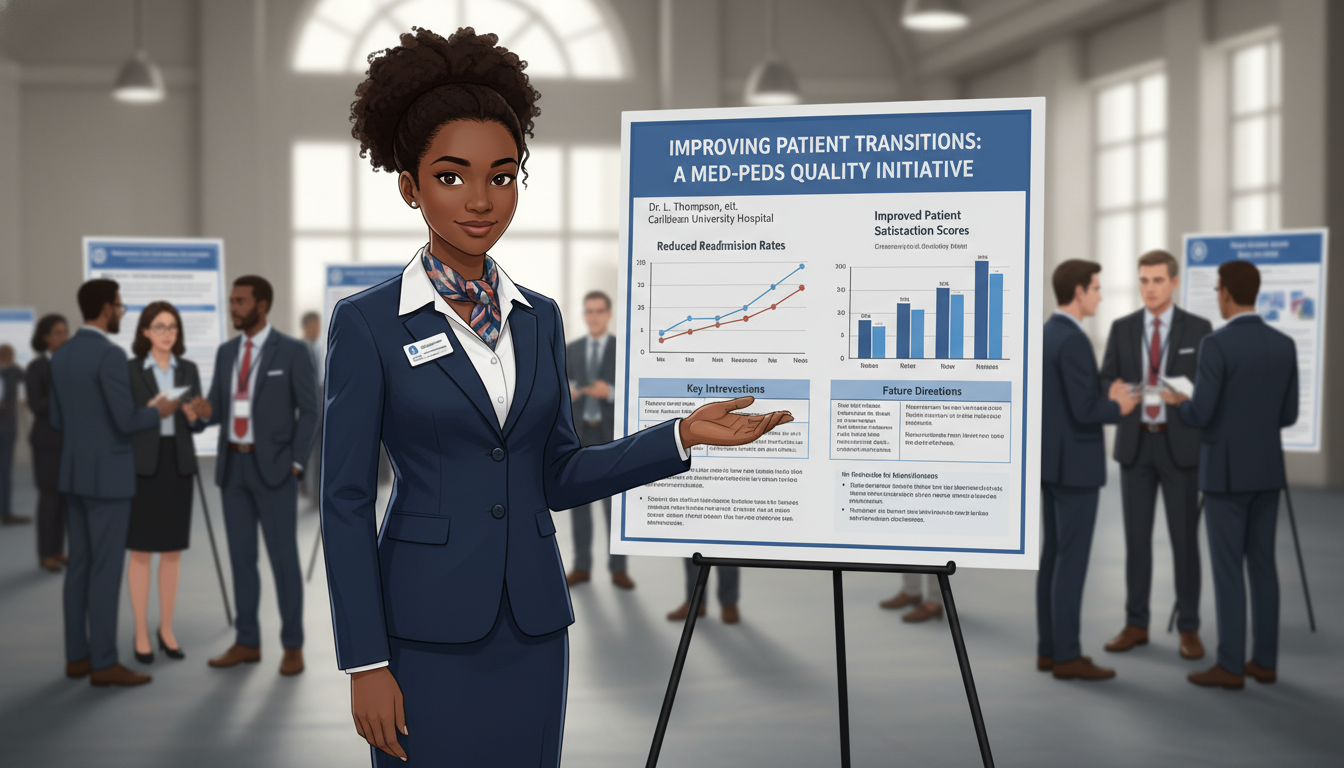
Getting Started: Building Your Research Foundation Early in Residency
Step 1: Clarify Your Goals
Before jumping into any project, define why you want to do research. Common goals for Caribbean IMGs in Med-Peds include:
- Strengthening competitiveness for fellowships (cardiology, pulmonology, endocrinology, infectious disease, adolescent medicine, Med-Peds hospitalist, etc.)
- Pursuing an academic career with teaching and scholarship
- Gaining skills in QI and health systems for leadership roles
- Building a niche in a specific population (e.g., congenital heart disease, sickle cell disease, autism across the lifespan)
Your goals will influence the types of projects, mentors, and timelines you pursue. For example:
- If you’re eyeing fellowship, prioritize projects that can realistically lead to presentations and publications before graduation.
- If you’re interested in an academic residency track, target longitudinal research projects and early involvement in existing studies.
Step 2: Take Inventory of Your Skills and Gaps
Caribbean medical school graduates often have diverse experiences—some have robust research exposure, while others have almost none. Honestly assess:
- Comfort with reading and critiquing literature
- Basic understanding of study design (cohort, case-control, RCT, QI frameworks)
- Familiarity with statistics and software (SPSS, R, Stata, Excel)
- Writing skills (abstracts, manuscripts, IRB submissions)
If you identify major gaps:
- Attend your institution’s resident research workshops or journal clubs
- Ask your program leadership about research boot camps or statistics sessions
- Use free online resources (Coursera/edX biostatistics, NIH clinical research modules, IHI Open School for QI)
You don’t need to master everything at once. Your first project can also be a learning laboratory.
Step 3: Identify the Right Mentors—In Two Departments
As a Med-Peds resident, you have an inherent advantage: access to both Internal Medicine and Pediatrics faculty. This can be particularly valuable for a Caribbean IMG trying to expand their network beyond the Caribbean medical school residency context.
Look for:
Faculty with an active research portfolio in areas overlapping Med-Peds:
- Transitions of care
- Chronic illnesses across the lifespan (e.g., cystic fibrosis, congenital heart disease, diabetes)
- Health disparities, global health, immigrant health
- Hospital medicine and readmissions
Med-Peds faculty (if present) who can help you navigate both departments and identify opportunities
Practical approaches to finding mentors:
- Review faculty profiles and publication lists on your hospital/university website
- Ask senior residents which attendings are known to work with residents on resident research projects
- Attend departmental grand rounds and introduce yourself to speakers
- Bring a concise “elevator pitch”: who you are (Caribbean IMG in Med-Peds), your interests (e.g., transitions of care), and your goals (e.g., present at a national conference by PGY-3)
Step 4: Start Small, Start Early
Beginning in intern year, you should:
- Join an ongoing project rather than trying to invent your own from scratch
- Volunteer to help with:
- Data collection or chart review
- Literature searches
- Drafting the background of a manuscript
- Ask your mentor: “What is the smallest unit of meaningful work I can own in this project?”
Realistically, your first project might be:
- A case report of an unusual Med-Peds presentation
- A QI project embedded in a clinic or inpatient workflow
- A small retrospective chart review using readily available data
Even a single poster presentation early in residency can:
- Build confidence
- Teach you the research process
- Add “US-based” or “Canadian-based” academic work to your CV, which can especially help if you feel your SGU residency match or equivalent pathway didn’t fully reflect your abilities.
Designing and Executing High-Impact Resident Research Projects
Choosing the Right Project for a Busy Med-Peds Resident
Given time constraints and call schedules, projects should be:
- Feasible: Can be completed within 1–2 years, not a decade-long cohort
- Mentored: Have a faculty sponsor actively engaged in the topic
- Aligned with your interests: To stay motivated through the inevitable obstacles
- Likely to produce something tangible: A poster, abstract, or manuscript
Examples tailored to Med-Peds residents:
Transitions of Care Research
- Question: What are the hospitalization and clinic follow-up patterns for adolescents with type 1 diabetes after they transition to adult care?
- Design: Retrospective chart review of patients aged 18–25
- Output: Abstract for a Med-Peds, AAP, or ACP conference
Chronic Disease Management Across Ages
- Question: Are there differences in blood pressure control between younger adults (18–39) and older adults (40+) in the same clinic?
- Design: Cross-sectional data analysis from EMR
- Output: QI-driven research with potential for protocol changes
Health Disparities and Caribbean/Immigrant Populations
- Question: Do patients from Caribbean or other immigrant backgrounds have different rates of follow-up or preventive care in Med-Peds clinics?
- Design: Retrospective study or mixed methods project (chart review + structured interviews)
- Output: Unique niche that highlights your background as a Caribbean IMG
Navigating the IRB and Ethics
Almost all research involving patients requires Institutional Review Board (IRB) review, but not all require full review:
- Full IRB review: Prospective trials, interventions, high-risk studies
- Expedited review: Minimal-risk chart reviews and surveys
- Exempt or QI: Some QI and educational projects, depending on local policy
Key steps:
- Ask your mentor whether the project will be classified as research, QI, or education scholarship.
- If IRB is required:
- Obtain access to your institution’s IRB portal
- Review prior approved protocols as templates
- Volunteer to draft portions of the IRB application to learn the process
- Complete any required institutional research ethics training (e.g., CITI Program).
Understanding the IRB process early in residency will serve you throughout your career, especially if you are drawn to an academic residency track or long-term scholarly work.
Data, Statistics, and Practical Execution
You don’t have to become a biostatistician, but you should:
- Understand basic statistical concepts:
- Descriptive statistics (means, medians, proportions)
- Common tests (t-test, chi-square, regression basics)
- Know when to seek help:
- Complex modeling
- Time-to-event analyses
- Adjusting for confounders
Many institutions provide:
- Consultation with biostatistics cores
- Templates for data collection and REDCap databases
- Resident research offices to help design feasible projects
Your role in execution:
- Develop and refine your research question using PICO or a similar framework
- Support data abstraction from charts (create a clear data dictionary)
- Maintain data security and patient confidentiality
- Contribute to data cleaning and basic interpretation
In Med-Peds, your clinical experiences will often inspire research questions. Keep a running list of clinical puzzles, patterns, and frustrations. Many high-yield Med-Peds studies are born from “Why do we do it this way?” moments while managing patients on the wards or in continuity clinic.

Balancing Clinical Duties, Research, and Life as a Caribbean IMG
Time Management Strategies That Actually Work
Balancing research during residency with call schedules, exams, and personal life is challenging for any resident, and perhaps more so for Caribbean IMGs who may feel additional pressure to “prove themselves.” Practical strategies:
- Block time protection:
- Use elective rotations or ambulatory blocks to concentrate on research work
- Negotiate specific half-days with your mentor (and program leadership) for research if your program allows
- Micro-sessions:
- 20–30 minute “micro-work” sessions on days off: revising abstracts, updating references, cleaning small chunks of data
- Defined weekly goals:
- Example: “By Sunday, I will finish the background section of my abstract and review 5 key articles.”
- Shared project management tools:
- Simple tools like Google Docs, Trello, or even email checklists can keep the team coordinated
Importantly, start preparing for major deadlines early:
- National conference abstract deadlines are often 6–9 months before the conference
- Manuscript writing always takes longer than expected
- Plan your heaviest project work during PGY-2 when clinical demands are often more predictable
Working Within the Realities of Being a Caribbean IMG
As a Caribbean IMG, you may:
- Feel less confident initiating research because of prior limited exposure
- Overestimate how “far behind” you are compared to US grads
- Juggle additional stressors (visa, relocation, financial constraints, family abroad)
Counter these with deliberate strategies:
Use your unique perspective:
- Your background can guide meaningful projects on immigrant health, global health, and health disparities.
- Your experiences navigating a Caribbean medical school residency route can inform education or wellness research for IMGs and residents.
Seek IMG-friendly mentors:
- Many faculty have successfully mentored SGU residency match candidates and other Caribbean graduates; they understand your path and potential.
- Don’t assume faculty will be less willing to work with you; they care about your enthusiasm and follow-through more than your medical school.
Prioritize mental health and sustainability:
- Overcommitting to multiple projects can backfire. Two well-executed projects are better than six half-finished ones.
- Be honest about your bandwidth and communicate clearly with mentors.
Turning Research into Career Capital: CV, Match, and Beyond
Research and the Medicine-Pediatrics Match (For Future Applicants)
If you’re still in medical school—especially at a Caribbean institution—and reading this to prepare for a future Medicine Pediatrics match, you should think about research in two phases:
Before Match (as a student):
- Any experience with data, case reports, or QI—even if not yet published—can strengthen your application.
- For Caribbean medical school residency pathways, US-based or Canadian-based research is especially valuable if you can secure it through electives, visiting rotations, or virtual collaborations.
During Residency:
- Build on your pre-residency work with more structured, mentored projects.
- Show progression from participant to co-author to potentially lead author.
Program directors for Med-Peds increasingly value residents who can interpret evidence and contribute to scholarship, especially if they’re pursuing an academic residency track.
Positioning Yourself for Fellowships and Academic Roles
Research during residency is one of the most powerful ways to:
- Demonstrate commitment to a subspecialty
- Build relationships with faculty who can write strong letters
- Show that you can follow a project from idea to dissemination
For Caribbean IMGs interested in competitive fellowships (e.g., cardiology, gastroenterology, critical care, endocrinology), your research output can help offset concerns about where you trained, whether that’s SGU or another Caribbean school.
Aim to graduate with:
- At least 1–2 national or regional conference presentations
- One or more publications (case reports, brief communications, original research, or QI reports)
- Clear, concise description of your scholarly role (not just “helped with research,” but “co-led data collection and co-authored manuscript”)
Include research prominently on your CV:
- Separate sections for:
- Peer-reviewed publications
- Abstracts and posters
- Oral presentations
- Resident research projects and QI initiatives
When interviewing for fellowship or academic hospitalist positions, be prepared to succinctly explain:
- Your research questions and why they matter
- What you specifically contributed
- How the experience will inform your future career in Med-Peds
Leveraging an Academic Residency Track (If Available)
Some Med-Peds programs offer an explicit academic residency track or research pathway. If available:
- Explore entry requirements early in PGY-1
- Consider whether you want protected research time (often in PGY-3 or PGY-4 for extended tracks)
- Use the structure to deepen your skills in:
- Study design and statistics
- Grant writing
- Academic teaching and curriculum development
For Caribbean IMGs, these tracks can provide both structure and credibility, signaling to future employers or fellowship directors that you’ve been intentionally trained as a clinician-scholar.
FAQs: Research During Residency for Caribbean IMGs in Med-Peds
1. I had almost no research in medical school. Is it too late to start during residency?
No. Many residents—IMGs and US grads alike—do their first meaningful research during residency. Start with manageable projects (case reports, QI, small chart reviews) and gradually take on more responsibility. Your willingness to learn and your reliability matter more than your starting skill level.
2. How many research projects should I aim for during my Med-Peds residency?
Quality matters more than quantity. A realistic goal for a busy Med-Peds resident is to meaningfully contribute to 2–3 solid projects, ideally yielding 1–2 posters and at least one publication. Overcommitting can lead to burnout and incomplete work; it’s better to be a key contributor on a few projects than a name on many that never get finished.
3. Do quality improvement (QI) projects “count” as research for fellowships and academic jobs?
Yes—if they are well-structured, use recognized QI methodologies (e.g., PDSA cycles), and lead to dissemination (posters, presentations, or publications). Fellowships value residents who can improve systems and patient outcomes. In many programs, QI is considered part of the required scholarly activity for residents.
4. I’m in a community-based Med-Peds program with limited infrastructure. How can I still build a research profile?
Focus on:
- QI and case-based projects that don’t require large infrastructures
- Collaborative projects with affiliated academic centers or virtual mentors
- Local or regional poster presentations
Use your unique Med-Peds position to identify cross-disciplinary questions. Even in smaller programs, motivated residents—especially those with the initiative often seen in Caribbean IMGs—can produce meaningful scholarship by being proactive, organized, and mentor-seeking.
By approaching research during residency strategically, Caribbean IMGs in Medicine-Pediatrics can transform residency from a purely clinical training period into a launchpad for a scholarly, impactful career. Whether your long-term goal is community practice with strong QI skills, a hospitalist role, or a full academic career, resident research projects can help you get there—and help your patients in the process.