
Why Research During Residency Matters for a DO Graduate in Pediatrics
For a DO graduate entering a pediatrics residency, research can feel like just “one more thing” competing with clinical duties, board prep, and life outside the hospital. Yet research during residency is one of the most reliable ways to:
- Open doors to competitive fellowships and academic positions
- Sharpen your clinical reasoning and evidence-based practice
- Build a professional niche in pediatrics (e.g., NICU, adolescent medicine, behavioral peds)
- Enhance your CV in ways that help overcome DO vs. MD bias in certain academic settings
If you are a DO graduate in a pediatrics residency—or preparing to start one—this guide will help you understand how to approach resident research projects strategically, even if you have minimal prior research experience.
We’ll cover how to get started, choose a realistic project, navigate the osteopathic residency match landscape and beyond, and leverage an academic residency track if you’re interested in an academic career.
Understanding the Role of Research in a Pediatrics Residency
DO Graduates and the Modern Pediatrics Training Landscape
The merger of AOA and ACGME accreditation systems has significantly changed the landscape for DO graduate residency options. While there are no longer “osteopathic-only” residencies in the same way as before, DO graduates may still encounter:
- Programs with strong osteopathic recognition or OMT integration
- Variable comfort among faculty with DO training pathways
- Different expectations for research exposure compared to MD-heavy programs
For a DO graduate in pediatrics, demonstrating success in meaningful research during residency can:
- Signal that you can perform at the same “academic productivity” level as any peer
- Help you stand out for fellowships (e.g., pediatric cardiology, critical care, heme/onc)
- Counteract any residual bias in highly competitive academic or subspecialty environments
Why Research Skills Matter in Pediatrics
Pediatrics is a highly evidence-driven specialty, with rapidly evolving guidelines around vaccination, developmental screening, neonatology, and chronic disease management. Research experience during residency builds:
- Critical appraisal skills – You’ll read literature more skeptically and apply evidence more accurately at the bedside.
- Quality improvement mindset – You’ll start seeing every patient-care problem as an opportunity for systematic improvement.
- Leadership and teamwork – Resident research projects often involve nurses, pharmacists, social workers, and other physicians.
- Communication skills – Presenting research at conferences or in publications builds your confidence and professional identity.
For DO graduates, there is an added benefit: research experience complements the osteopathic emphasis on holistic, patient-centered care. You can bring rigorous evidence to support integrative, whole-child approaches.
Getting Started: Finding Research Opportunities as a Pediatric Resident
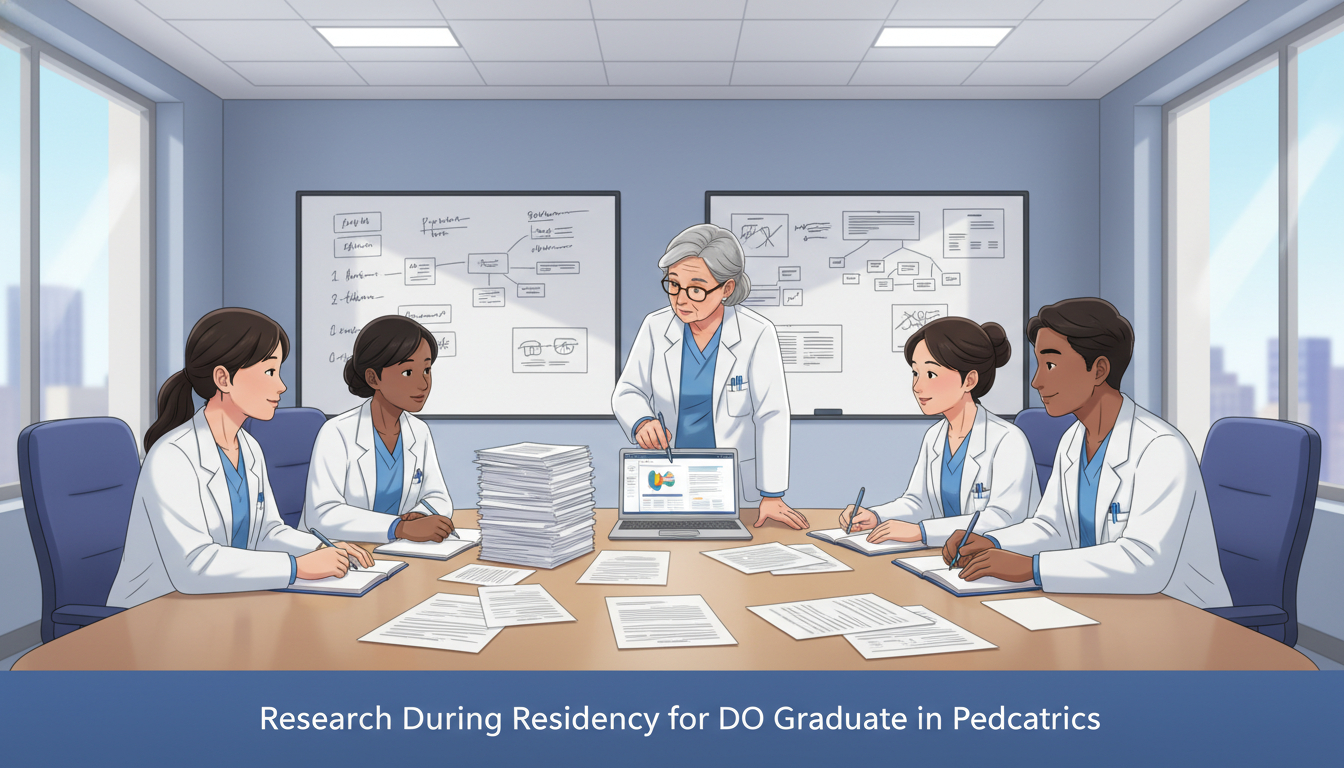
Assess Your Program’s Research Culture
Before committing to resident research projects, understand the environment you’re in. Ask:
- Is there a required scholarly activity for graduation (case report, QI project, poster)?
- Does the program have an academic residency track or research-focused pathway?
- Are there protected research blocks (e.g., 4–8 weeks of elective time)?
- Which faculty are actively publishing or consistently presenting at pediatric conferences?
Practical steps in your first 3–6 months:
- Review your program handbook for research or scholarly activity requirements.
- Attend resident research day (if available) to see what’s feasible.
- Ask senior residents: “Who are the most resident-friendly research mentors?”
- Identify subspecialties that interest you (NICU, general peds, hospitalist medicine, adolescent, behavior/development, etc.).
How to Find a Good Research Mentor
Your choice of mentor is more important than your choice of topic early on. A good mentor for a DO graduate in pediatrics:
- Has a track record of working with residents and getting them to submission/presentation
- Is supportive of DO trainees and understands your training background
- Has feasible, bite-sized projects you can realistically complete in residency
- Helps you navigate barriers like IRB, data access, or statistical analysis
Signs of a strong mentor:
- Clear expectations and regular check-ins
- Willingness to connect you with statisticians or co-mentors
- Involvement in multi-center or ongoing projects where you can “plug in”
Avoid depending solely on a highly productive but chronically busy PI who rarely meets with residents. Consistent mentorship is more valuable than a big-name publication that never materializes.
Types of Projects That Fit a Pediatric Resident’s Schedule
As a busy resident, particularly during your peds match journey and early postgraduate years, simplicity and feasibility are crucial. Consider:
Case Reports or Case Series
- Good for rare presentations, unusual complications, or novel treatments
- Often the easiest “first publication” for DO residents with limited experience
- Practical for inpatient or NICU settings where rare cases concentrate
Quality Improvement (QI) Projects
- Examples: Increasing vaccination rates, improving asthma action plan documentation, reducing unnecessary lab orders
- Align well with ACGME requirements and hospital goals
- Can often lead to posters, abstracts, and sometimes full manuscripts
Retrospective Chart Reviews
- Analyze existing EMR data to study prevalence, outcomes, or practice patterns
- Example: Evaluating readmission rates in bronchiolitis patients before and after a guideline change
- Requires IRB approval but can be done flexibly around your schedule
Educational Research
- Assessing the impact of a new resident or medical student curriculum (e.g., simulation in pediatric resuscitation)
- Attractive if you’re interested in clinician-educator roles
Multi-Center or Network Studies
- Large projects that often have specific “resident subprojects”
- Great exposure to collaborative academic pediatrics
- Can be time-intensive but high-yield if structured well
For a DO graduate new to research, starting with QI or a small retrospective study under strong mentorship is often ideal.
Designing a Feasible Research Plan During Residency
Step 1: Define a Focused, Answerable Question
Use frameworks like PICO (Population, Intervention, Comparison, Outcome) even for observational work.
Examples in pediatrics:
- “Among children admitted with asthma exacerbations (P), does standardized asthma education before discharge (I), compared with standard care (C), reduce 30-day readmission rates (O)?”
- “In infants admitted to the NICU (P), what is the association between early skin-to-skin contact (I) and length of stay (O)?”
For a busy pediatric resident, narrower is better. A sharply defined question:
- Keeps your dataset manageable
- Limits the number of variables you must collect
- Makes your IRB application simpler
Step 2: Clarify Your Scope and Timeline
Ask yourself:
- How many months can you realistically dedicate (e.g., 6–18 months)?
- How much protected time will you have, if any?
- Do you want at minimum a poster, or is your goal a manuscript?
Build a realistic timeline, for example:
- Months 1–2: Define question, find mentor, write IRB
- Months 3–5: IRB approval, data extraction
- Months 6–8: Data analysis, draft abstract
- Months 9–12: Present at local/regional meeting, begin manuscript
- Months 12–18: Revise and submit manuscript
This level of planning looks very impressive to fellowship directors and signals that you understand research project lifecycles.
Step 3: Navigate the IRB the Smart Way
Institutional Review Board processes can intimidate residents, especially DO graduates from schools that emphasized clinical exposure over heavy bench research. Strategies:
- Ask your mentor for a previous IRB submission to use as a template.
- Use institutional resources: many hospitals have research offices or IRB coordinators who will guide you.
- Start with minimal-risk projects (retrospective reviews, QI with de-identified data).
Whenever possible, attach yourself to a mentor’s existing protocol or an IRB amendment rather than starting from scratch.
Step 4: Collaborate With a Statistician Early
Even simple projects benefit from early statistical input. Typical questions to ask:
- Is my sample size meaningful?
- Are my outcomes clearly defined and measurable?
- Which basic tests (chi-square, t-test, regression) are appropriate?
You don’t need to become a statistician, but basic understanding of analytic methods strengthens your CV and interviews for academic residency track positions or fellowships.
Balancing Clinical Duties With Research Responsibilities
Use Your Schedule Strategically
As a pediatrics resident, your schedule will wax and wane in intensity. Plan your research workload accordingly:
- Heavy inpatient months (e.g., NICU, PICU, wards):
- Focus on small tasks—literature review, refining research questions, short data entry sessions.
- Outpatient or elective months:
- Dedicate larger blocks to data collection, analysis, and manuscript drafting.
Tip: Block research time on your calendar just like patient care responsibilities. Even 2–3 hours/week consistently can move a project forward.
Build Research Into Everyday Clinical Work
Leverage your daily patient care:
- Note unusual or instructive cases for possible case reports.
- Track patterns that might make for a QI project (e.g., frequent delays in pain medication for kids with fractures).
- Discuss with attendings: “Is anyone already studying this? Could this become a resident project?”
This approach keeps research clinically relevant and easier to justify when time is tight.
Collaborate With Co-Residents
Forming a small research team can:
- Distribute workload (e.g., one person manages IRB, another data collection, another writing).
- Keep you accountable through shared deadlines.
- Strengthen your sense of community, especially helpful for DO graduates who may be underrepresented in some programs.
Just be sure authorship roles are clarified upfront with your mentor to avoid conflicts later.
How Research Supports Your Career as a DO Pediatrician
Enhancing Your Competitiveness for Fellowships
For a DO graduate, research during residency can significantly strengthen your application for competitive pediatric fellowships (e.g., cardiology, heme/onc, critical care, GI, neonatology). Program directors look for:
- Evidence of longitudinal scholarly activity, not just last-minute projects
- Posters, presentations, or publications at national or regional pediatric conferences
- Strong letters of recommendation from research mentors emphasizing your initiative and reliability
You do not need dozens of publications. Even 1–3 solid projects with visible output (e.g., accepted abstracts, manuscripts under review) can be powerful, particularly in the context of strong clinical performance.
Overcoming DO Bias in Academic Settings
Although the gap is closing, DO graduates can still face subtle disadvantages in the osteopathic residency match and subsequent academic career paths, particularly in heavily research-focused institutions. Research productivity helps you:
- Demonstrate you can perform at the same academic level as MD peers
- Show comfort with evidence-based medicine and critical appraisal
- Signal you are prepared for an academic residency track or faculty position
In interviews, you can frame your DO background as a strength: emphasizing holistic care and systems-based thinking, while research shows you can pair that with rigorous scholarship.
Building a Professional Niche in Pediatrics
Research during residency helps you identify and cultivate your niche. For example:
- Interested in behavioral pediatrics? Study outcomes of ADHD screening tools in primary care clinics.
- Passionate about health equity? Investigate disparities in vaccination uptake by neighborhood or insurance status.
- Curious about hospitalist medicine? Evaluate interventions to reduce length of stay for common pediatric diagnoses.
These experiences:
- Influence your choice of fellowship or practice setting
- Build a coherent narrative for your CV and personal statements
- Help you become “the go-to person” for specific topics early in your career
Transitioning to an Academic Residency Track or Faculty Role
If your program has an academic residency track, participation often requires or at least strongly encourages research during residency. To position yourself:
- Seek early mentorship from the program’s research or academic track director.
- Present your long-term goal: e.g., “I want to be a clinician-educator with a focus on asthma QI,” or “I see myself as an academic neonatologist.”
- Use research to build a “mini-portfolio” before graduation: completed projects, teaching evaluations, and CME/education involvement.
After residency, your experience can facilitate:
- Chief residency positions
- Instructor or assistant professor roles
- Continuation of your research projects as an early-career faculty member
Practical Tips and Common Pitfalls for DO Pediatric Residents in Research
Practical Tips
Start small but start early
Even a simple case report or small QI project in PGY-1 or early PGY-2 can build momentum and confidence.Document everything
Keep a running list of:- Projects you worked on
- Your role (data collection, writing, analysis)
- Presentations, abstracts, and posters
This makes updating your CV and ERAS application much easier.
Learn basic research tools
- Reference managers: Zotero, Mendeley, EndNote
- Data tools: Excel, REDCap
- Literature search: PubMed filters, MeSH terms
Target pediatric-specific conferences
Aim for meetings like PAS (Pediatric Academic Societies), AAP section meetings, or subspecialty society conferences (e.g., pediatric hospital medicine). These environments are very DO-friendly and resident-focused.Ask explicitly about authorship
Early discussion with your mentor protects you and clarifies expectations:- Who is first author?
- Who is senior author?
- What contributions are needed for authorship?
Common Pitfalls to Avoid
Taking on too big a project
Multi-year, multi-center studies led by a new PGY-1 with no protected time are often not realistic. Subprojects or secondary analyses are often better.Lack of regular communication with your mentor
Long gaps between meetings lead to stalled projects. Aim for a brief update every 2–4 weeks.Ignoring deadlines for conferences
Abstract deadlines often occur 6–9 months before the conference. Ask your mentor early about target meetings and their deadlines.Underestimating the time for writing and revision
Data collection is only half the story. Writing, revising, and responding to feedback take substantial time—plan for that.
Frequently Asked Questions (FAQ)
1. Do I need research to match into a pediatrics residency as a DO graduate?
You can match into a general pediatrics residency without research, particularly in community-based programs. However, any research or scholarly activity can:
- Strengthen your ERAS application
- Help you stand out in the osteopathic residency match process
- Demonstrate commitment to pediatrics and evidence-based care
If you’re targeting highly academic programs or future competitive fellowships, research is strongly recommended, even if it’s limited (e.g., one or two projects).
2. I have almost no research background from medical school. Is it too late to get started during residency?
It is absolutely not too late. Many residents, including DO graduates, start with:
- A case report on an interesting patient
- A small QI initiative (e.g., improving vaccination documentation)
- Joining a senior resident’s existing project
Your residency mentors expect a learning curve. What matters is showing initiative and being reliable once you commit.
3. How many research projects should I aim for during my pediatrics residency?
Focus on quality and completion, not raw numbers. A realistic goal for many residents is:
- 1–2 completed projects with at least a poster or abstract presentation
- Ideally 1 manuscript submitted or in preparation by graduation
For those strongly interested in an academic residency track or fellowship, you might aim for a combination of:
- 1 QI project
- 1–2 clinical or educational projects
- 1–3 conference abstracts/posters
4. How can I talk about my research effectively in fellowship or job interviews?
Frame your research in a way that highlights:
- Your role (what you personally did)
- What you learned (skills, methods, content knowledge)
- Clinical relevance (how it changed or might change practice)
- Future directions (how you plan to build on it as a fellow or attending)
Example:
“During residency, I led a QI project to improve asthma action plan documentation on our general pediatrics service. I designed the intervention with my mentor, collected pre- and post-implementation data, and presented our results at a regional pediatric meeting. We saw a 30% improvement in documentation rates, which helped standardize discharge instructions. I’d like to continue this line of work in fellowship by examining readmission outcomes and expanding to other chronic conditions.”
Research during residency is not just about lines on a CV. For a DO graduate in pediatrics, it is a powerful way to integrate your osteopathic perspective with rigorous evidence, contribute to child health, and position yourself for a career that blends clinical excellence with scholarly impact. With realistic goals, the right mentor, and consistent modest effort, you can build a research portfolio that genuinely propels your future in pediatrics.