
Understanding the Role of Research in Otolaryngology Residency
For an MD graduate entering otolaryngology, research during residency is no longer optional “extra credit.” It’s increasingly embedded in how programs define a successful trainee, especially if you’re aiming for an academic residency track, a competitive fellowship, or a long-term career in academic medicine.
Otolaryngology is a rapidly evolving specialty: advanced endoscopic techniques, robotic surgery, cochlear implants, immunotherapy for head and neck cancer, and sophisticated airway and voice research are just a few examples of areas driven by strong clinical and translational research. For an MD graduate residency applicant or new resident, understanding how to strategically engage in resident research projects can directly influence:
- Your competitiveness for the otolaryngology match and later fellowships
- Your ability to critically appraise literature and practice evidence-based medicine
- Your professional network and long-term academic trajectory
This article will walk through how research fits into an ENT residency, what realistic expectations look like, how to select and complete projects, and how to balance research with busy clinical responsibilities.
Why Research Matters in an Otolaryngology (ENT) Residency
1. Strengthening Clinical Decision-Making
Research during residency isn’t just about lines on your CV. Actively participating in the research process forces you to:
- Formulate focused clinical questions (e.g., How does early vestibular rehab affect long-term outcomes in patients with vestibular migraine?)
- Understand study design strengths and weaknesses (retrospective vs. prospective, cohort vs. randomized trials)
- Interpret biostatistics and differentiate clinically meaningful vs. statistically significant findings
This directly improves your ability to practice evidence-based otolaryngology and counsel patients with clarity and confidence.
2. Positioning Yourself for the Otolaryngology Match and Beyond
Many MD graduate residency candidates in ENT increasingly arrive with prior research experience—often from allopathic medical school match–driven activities in medical school. Once in residency, research plays a continued and sometimes expanded role:
- Fellowships (e.g., head & neck oncology, otology/neurotology, rhinology, laryngology, pediatrics) often look for candidates with a track record of publications and presentations.
- Academic residency track positions and junior faculty jobs frequently favor candidates who understand how to generate questions, secure mentorship, and contribute to departmental scholarship.
- Even community-focused careers can be strengthened by quality improvement (QI), outcomes research, or practice-based research projects.
If you’re already thinking about an academic career, your residency years are the most concentrated, mentored time you will ever have to build a research identity.
3. Meeting Program and Accreditation Expectations
Most ACGME-accredited otolaryngology residencies now include:
- Protected time for resident research projects (often during PGY-2 or PGY-3)
- Requirements for at least one scholarly product: publication, abstract, poster, or oral presentation
- Journal clubs and evidence-based medicine curricula
Programs vary: some have a formal research track with additional protected time; others expect research largely on your own initiative. Understanding your program’s structure early is critical.

Types of Research Opportunities in ENT Residency
Research during an ENT residency is not one-size-fits-all. You can tailor your resident research projects to your interests, skills, and long-term goals.
1. Clinical Research
This is the most accessible type for most residents and often the best starting point.
Common topics include:
- Outcomes after endoscopic sinus surgery or septoplasty
- Voice and swallowing outcomes after laryngeal procedures
- Hearing outcomes after stapedectomy or cochlear implantation
- Quality-of-life measures in head and neck cancer survivors
- Airway outcomes in pediatric tracheostomy patients
Typical designs:
- Retrospective chart reviews
- Prospective cohort studies
- Case-control studies
- Cross-sectional survey-based studies
Clinical ENT research helps you appreciate patterns in your own patient population and may be more likely to generate publishable results within your residency timeframe.
2. Translational and Basic Science Research
If your interest leans toward discovery science:
- Investigating molecular pathways in head and neck squamous cell carcinoma
- Exploring hair cell regeneration in sensorineural hearing loss
- Studying inflammatory pathways in chronic rhinosinusitis
- Analyzing neural circuits involved in balance and vestibular function
These projects usually:
- Require coordination with basic science labs
- Take longer to yield results and publications
- Benefit from prior bench experience (but it’s not mandatory)
- Are often tied to an academic residency track with substantial research blocks
If you’re considering a long-term career as a surgeon-scientist, aligning with a strong translational or basic science mentor early is vital.
3. Quality Improvement (QI) and Health Services Research
Research during residency can also take form as:
- QI projects (e.g., reducing perioperative antibiotic overuse in tonsillectomy)
- Implementation science (e.g., introducing a same-day discharge protocol for thyroidectomy)
- Health services research (e.g., access disparities in cochlear implantation)
- Cost-effectiveness studies (e.g., imaging strategies in dizzy patients)
These projects can often be completed more quickly and may produce measurable changes in how your department cares for patients.
4. Educational Research
For residents with strong interest in academic teaching:
- Studying the impact of simulation-based training on temporal bone dissection skills
- Evaluating new curricula in flexible laryngoscopy for junior residents or medical students
- Assessing feedback tools in the OR and their effect on resident performance
Educational research is particularly relevant if you foresee a clinician-educator role after residency.
Getting Started: Choosing Mentors and Projects Strategically
As an MD graduate beginning an ENT residency, your early research decisions can set the tone for the next 5 years.
1. Clarify Your Goals Early
Ask yourself:
- Do I aspire to a heavily research-focused, academic residency track and career?
- Am I aiming for a competitive fellowship (e.g., otology/neurotology, head & neck oncology)?
- Or do I want a solid foundation in research during residency mainly to practice evidence-based medicine and contribute to quality improvement?
Your answers will shape the amount, type, and intensity of projects you pursue.
2. Identify the Right Mentors
Strong mentorship is the single biggest predictor of successful resident research projects.
Consider these mentor attributes:
- Accessible and responsive: Answers emails, available for regular check-ins
- Track record of productivity: Publications, grants, conference presentations
- Experience mentoring residents: Knows how to scope projects appropriately
- Alignment with your interests: HNS oncology, otology, rhinology, laryngology, pediatrics, facial plastics, etc.
- Clear expectations: Timelines, communication style, authorship criteria
Ask senior residents who the “go-to” research mentors are. Review faculty CVs or PubMed profiles to understand their work and whether they’re active in areas that excite you.
3. Select Projects You Can Actually Finish
In residency, feasibility is as important as ambition.
Key questions before you commit:
- What is the realistic timeline from start to completion? (Aim for 12–24 months.)
- How many institutional approvals are needed (IRB, departmental review, data use agreements)?
- Are the datasets or patient populations already available?
- How much time will data collection require day-to-day?
- What is my role relative to other residents or fellows?
A well-designed retrospective chart review with clear endpoints is often a better first project than an overly complex, under-resourced prospective trial that never finishes.
4. Start With a Narrow, Answerable Question
Examples of focused, resident-friendly ENT research questions:
- Among adults undergoing septoplasty, what factors predict persistent nasal obstruction at 6 months?
- In pediatric patients undergoing bilateral tympanostomy tube placement, does postoperative topical antibiotic use reduce otorrhea rates?
- Does adding standardized voice therapy after injection laryngoplasty improve long-term voice outcomes compared to injection alone?
A clearly framed question (PICO—Population, Intervention, Comparison, Outcome) will guide your methods, statistics, and interpretation.
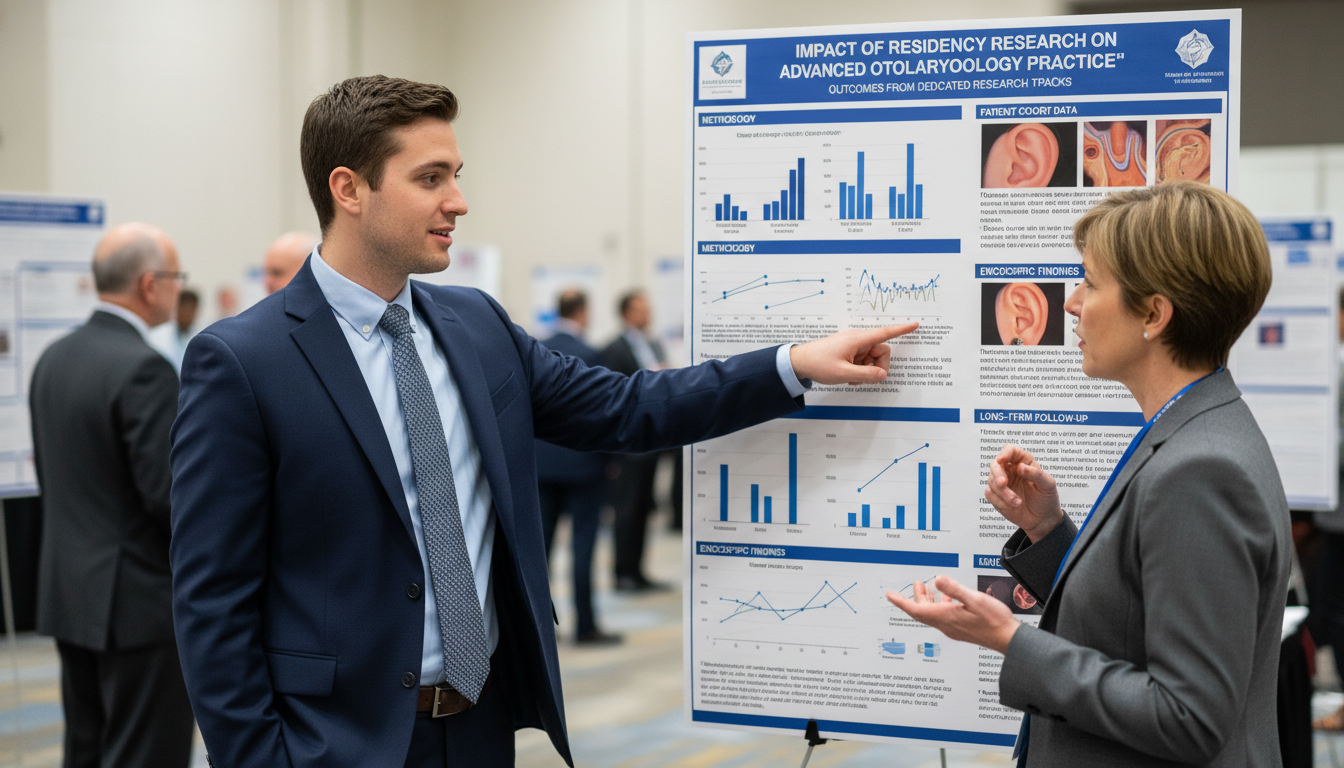
Executing Research During a Busy ENT Residency
Balancing research with intense clinical workloads is a central challenge for every MD graduate in residency.
1. Understand Your Program’s Research Infrastructure
Early in PGY-1 or PGY-2, find out:
- How much protected research time is built into the schedule (e.g., a 3–6 month research block, half-day per week, or periodic academic days).
- What support exists:
- Biostatistics or epidemiology core
- Research coordinators or data analysts
- IRB office assistance
- Medical librarians
- Whether the department has a formal research curriculum or structured mentorship program.
Align your project timelines with known research blocks to maximize productivity.
2. Navigating the IRB and Regulatory Steps
Most resident research projects, especially clinical and translational studies, require Institutional Review Board (IRB) approval.
To streamline this:
- Use previous successful IRB protocols as templates.
- Ask your mentor or senior resident for sample consent forms and data collection tools.
- Learn early about:
- Exempt vs. expedited vs. full-board review
- HIPAA considerations for patient data
- Requirements for storing and de-identifying information
Plan for an IRB turnaround time anywhere from 4–12 weeks (or longer) and build this into your project timeline.
3. Mastering Data Management and Basic Statistics
You don’t need to become a biostatistician, but you should understand:
- How to build a clean, well-structured dataset (e.g., in REDCap or Excel)
- Basic statistical concepts: p-values, confidence intervals, odds ratios, regression, survival analysis (when relevant)
- Which tests are appropriate for different data types (e.g., t-test, chi-square, logistic regression)
Practical tips:
- Meet with a statistician before you start collecting data to avoid flawed design.
- Create a data dictionary that defines each variable and coding scheme.
- Double-check data entry and run small pilot analyses early to identify problems.
4. Writing Abstracts, Manuscripts, and Presentations
As your resident research projects mature, dissemination is the next step.
Abstracts and Conferences
Plan to submit to:
- Major meetings: COSM (Combined Otolaryngology Spring Meetings), AAO-HNSF, specialty society meetings (AHNS, ALA, AOS, TRIO, etc.).
- Regional or institutional research days.
A strong abstract:
- Clearly states the background and objective
- Describes methods succinctly
- Presents key results with numbers, not vague statements
- Concludes with a direct, practice-relevant takeaway
Manuscripts
Manuscript writing during residency can feel daunting, but it’s manageable if you:
- Outline the paper early and write “as you go” (Methods and Results can be drafted while data collection is ongoing).
- Divide tasks with co-authors: literature review, figures, tables, discussion drafting.
- Use a reference manager (EndNote, Mendeley, Zotero) from the start.
Publishing in peer-reviewed journals (e.g., Otolaryngology–Head and Neck Surgery, Laryngoscope, Head & Neck, American Journal of Otolaryngology) helps solidify your academic presence.
5. Time Management Strategies That Actually Work
Some practical approaches for a busy MD graduate residency schedule:
- Block scheduling: Reserve fixed weekly time (e.g., Friday afternoons) as non-negotiable research time. Treat it like an OR day.
- Micro-tasks: Break large tasks into 20–30 minute actions (e.g., revise Introduction paragraphs, clean 50 data entries, run one statistical model).
- Use “found time”: Work on IRB revisions or manuscript edits during call downtimes or between cases when appropriate.
- Protect your bandwidth: Don’t take on more projects than you can realistically manage. It’s better to complete 2–3 strong, publishable projects than 8 half-finished ones.
Long-Term Payoff: Building an Academic Identity in ENT
Even if your immediate goal is simply to succeed in residency, research experiences can define your future in ways you might not anticipate as a new MD graduate.
1. Creating a Thematic Niche
Over time, aim to build a coherent narrative around your interests:
- Otology/neurotology: hearing outcomes, cochlear implants, skull base surgery
- Rhinology: chronic rhinosinusitis, endoscopic skull base outcomes, olfaction research
- Laryngology: voice outcomes, airway stenosis, swallowing disorders
- Head & neck oncology: functional outcomes, reconstruction, oncologic therapies
When your CV shows a cluster of projects, presentations, and publications in a related domain, you become recognizable to fellowship directors and academic departments as “the resident who does X.”
2. Networking Through Research
Research during residency naturally connects you with:
- Faculty in your department and beyond (e.g., radiology, oncology, audiology, speech-language pathology, biomedical engineering)
- National societies and subspecialty groups
- Potential future collaborators and mentors during conferences
These relationships can lead to:
- Letters of recommendation with detailed, credible commentary on your scholarly abilities
- Fellowship and job opportunities
- Invitations to collaborate on multi-center projects or guideline development
3. Transitioning From Resident to Junior Faculty
If an academic residency track is your goal, your resident research projects can help you:
- Prepare competitive fellowship applications
- Demonstrate potential for independent investigation (critical for K-award or other early-career funding later)
- Show evidence of productivity and follow-through, which departments value highly
Even if you pivot to a more clinically focused or community-based career, the skills you gained—data literacy, critical thinking, QI methodology—will still differentiate you as a thoughtful, evidence-driven physician.
Common Pitfalls and How to Avoid Them
1. Overcommitting to Too Many Projects
Enthusiasm early in residency often leads to saying “yes” to every opportunity. The result can be:
- Multiple half-complete data sets
- Missed deadlines
- Burnout and frustration
Strategy: Before committing, ask, “What specific role will I play, what is the timeline, and who is driving this project?” Prefer roles where you are first or second author and expectations are clear.
2. Poor Communication With Mentors
Projects often stall because expectations are not aligned.
Avoid this by:
- Agreeing on milestones (IRB submission, data completion, abstract submission, manuscript drafts) with dates attached.
- Scheduling recurring check-ins (even brief 15–20 minute meetings or emails).
- Being honest if clinical demands are delaying your progress and discussing adjustments proactively.
3. Neglecting Authorship and Ethics Early
Co-authorship rosters can become sensitive if not discussed up front.
Best practices:
- Clarify authorship expectations at the start: who is first author, who are co-authors, and what contributions are required.
- Follow ICMJE authorship criteria (substantial contributions to conception/design, data acquisition, analysis/interpretation; drafting/revising; final approval).
- Maintain strict data confidentiality and adhere to IRB-approved protocols.
4. Ignoring Your Own Well-Being
Research during residency is demanding. Combine that with clinical pressures, and the risk of burnout is real.
Support yourself by:
- Setting boundaries around your research time and personal time
- Using your program’s wellness resources
- Being selective with commitments and learning to say “no” when necessary
FAQs: Research During ENT Residency for MD Graduates
1. How important is research experience for the allopathic medical school match into ENT, and does it still matter once I’m already in residency?
For MD graduate residency applicants, research is increasingly important in the allopathic medical school match for otolaryngology due to the specialty’s competitiveness. Once you’re in residency, it continues to matter—but the emphasis shifts. Early research shows you can think critically and complete projects; residency research demonstrates your ability to generate your own questions, lead projects, and contribute scholarly work that often has direct clinical relevance. It’s particularly important if you’re considering a fellowship or academic residency track.
2. I don’t see myself in a purely academic career. Do I still need to do research during residency?
Yes, but your approach can be more targeted. Resident research projects focused on quality improvement, outcomes, or practice-based questions directly improve patient care and strengthen your skills in evidence-based medicine. Even if you plan a community-focused career, being able to interpret literature, evaluate new technologies, and lead QI initiatives is highly valued—and often expected—in modern practice.
3. When is the best time during residency to start research, and how many projects should I aim for?
Ideally, start identifying mentors and potential projects during PGY-1 or early PGY-2, even if your major data collection occurs later when you have more clinical context and possibly protected time. Regarding number, aim for depth over breadth: 2–4 well-conceived projects that progress from idea to presentation and publication across residency are usually more impactful than many unfinished efforts. If you’re on a dedicated academic residency track or strongly research-focused, you may naturally exceed this number with your mentor’s guidance.
4. How do I balance research with a very busy clinical schedule in ENT?
Balancing research during residency requires honest planning and boundaries. Use dedicated research blocks efficiently, schedule recurring “research appointments” with yourself, break tasks into small, manageable steps, and avoid overcommitting to too many projects. Communicate proactively with mentors about realistic timelines, and leverage institutional resources such as biostatisticians and research coordinators. Remember: consistent, modest weekly progress compounds far more than sporadic, intense bursts followed by long gaps.
By approaching research during residency strategically—choosing mentors well, selecting feasible projects, and aligning your work with your long-term interests—you can turn your ENT residency into a powerful launchpad for whatever path you choose, from high-volume clinical practice to a research-intensive academic career.