Understanding Research During a Transitional Year Residency as a Non-US Citizen IMG
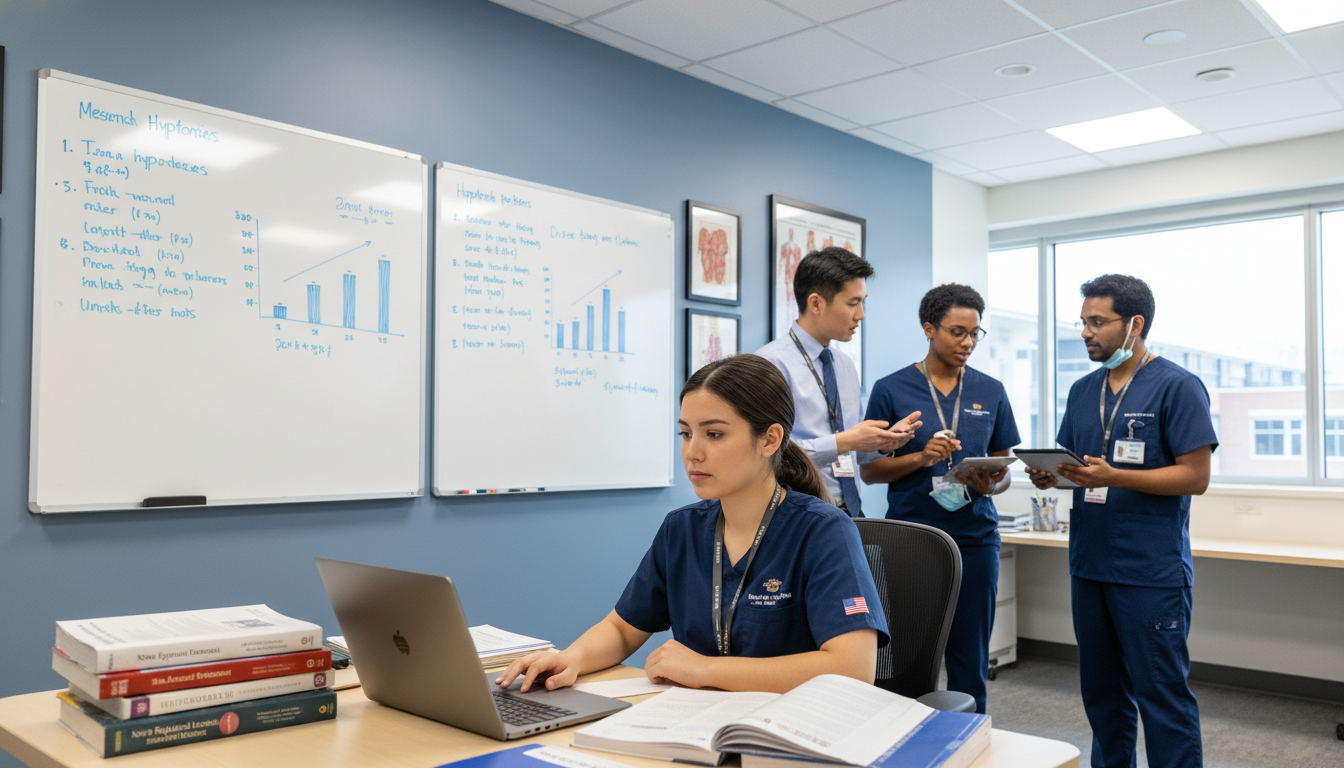
For a non-US citizen IMG in a transitional year residency, research is more than just a resume booster—it can be a strategic tool to strengthen your application for advanced residency, visa pathways, and long-term academic or clinical careers in the United States. A well-planned approach to research during residency can help you stand out in a highly competitive environment, especially when you are navigating the added complexity of immigration, credentialing, and unfamiliar systems.
This guide focuses on how a non-US citizen IMG or foreign national medical graduate in a transitional year residency (TY program) can design a realistic, impactful research strategy, even with busy clinical schedules and visa limitations.
1. Why Research Matters in a Transitional Year for Non-US Citizen IMGs
1.1 The Unique Role of the Transitional Year
A transitional year residency is typically one year of broad-based clinical training before entering advanced programs (e.g., radiology, anesthesiology, neurology, dermatology, PM&R). Compared with categorical programs, transitional year schedules can:
- Include more elective time and less continuity clinic
- Offer flexibility to explore subspecialties
- Provide opportunities to participate in resident research projects if you plan ahead
For a non-US citizen IMG, this year often serves three key purposes:
- Gain US clinical experience under supervision
- Build strong letters of recommendation (LORs) for advanced programs
- Demonstrate academic potential through research or scholarly work
If you plan to pursue an academic residency track, competitive subspecialty, or fellowship, a translational or clinical research portfolio can significantly improve your profile.
1.2 How Program Directors View Research for IMGs
Program directors in competitive specialties often view research as:
- Evidence of intellectual curiosity
- Ability to work systematically and persistently
- Comfort with medical literature and evidence-based practice
- Potential to contribute to the department’s academic output
For non-US citizen IMGs, research can also help address subconscious biases or uncertainty:
- Shows that you can adapt to US academic standards
- Demonstrates long-term commitment to the specialty
- Provides objective achievements (publications, abstracts, posters) that stand out beyond exam scores
1.3 Research and Long-Term Career Options
Strategic engagement in research during your TY program can open doors to:
- Advanced residency spots at academic centers
- Academic residency track positions with built-in research time
- Fellowships at institutions that value scholarly productivity
- Long-term careers combining clinical work, teaching, and research
Even if you eventually choose a community-based career, research experience develops skills in critical thinking, writing, and leadership that are valuable in any setting.
2. Types of Research You Can Do During a Transitional Year
Many non-US citizen IMGs assume that “real research” means long-term bench work or randomized trials, which are rarely feasible in a one-year program. In reality, shorter, focused resident research projects can be equally meaningful.
2.1 Clinical Research
Clinical research is often the most accessible during TY:
- Retrospective chart reviews (e.g., outcomes of patients with a specific condition in your hospital)
- Quality improvement (QI) projects with robust methodology
- Observational cohort studies using existing data
- Case–control or cross-sectional studies (if your institution supports them)
These are practical for a single year, especially if you join an existing project.
2.2 Quality Improvement and Patient Safety Projects
Most TY programs are required by ACGME to involve residents in quality or safety initiatives. If structured well, QI work can be publishable or at least presentable. Examples:
- Reducing unnecessary lab testing in internal medicine wards
- Improving documentation of home medications on admission
- Increasing vaccination rates in certain patient populations
By aligning your QI work with scholarly goals (e.g., pre/post analysis, data collection, formal write-up), you can convert it into a research abstract or publication.
2.3 Case Reports and Case Series
These are particularly useful for busy residents and for non-US citizen IMGs who must work within visa and time constraints:
- Single interesting cases with unique presentations, imaging, treatments, or complications
- Small case series of similar patients seen over time
While case reports are lower on the “evidence pyramid,” they still:
- Teach you scientific writing
- Help you understand the submission and peer-review process
- Provide a manageable path to your first publication
2.4 Educational and Curriculum Research
If you enjoy teaching or academic medicine:
- Evaluate the impact of a new teaching method or simulation scenario
- Assess resident understanding before and after a teaching intervention
- Develop and study a structured curriculum (e.g., EKG workshops, ultrasound teaching modules)
Education research is often feasible with small sample sizes and short timelines and is highly valued in academic residency track pathways.
2.5 Big-Data and Multi-Center Collaborations
Some institutions have access to:
- National registries
- Large EHR databases
- Multi-center research networks
As a non-US citizen IMG, you might not immediately get leadership roles on such projects, but you can:
- Contribute to data collection or chart review
- Assist with literature reviews and manuscript drafting
- Be co-author on larger collaborative papers
3. Practical Steps to Start Research in Your TY Program
3.1 Identify a Feasible Research Niche Early
Before or right at the start of your transitional year residency:
Clarify your long-term specialty goal
- Radiology, anesthesiology, neurology, derm, PM&R, etc.
- Your research should align with that field when possible.
Assess your time realistically
- How busy is your TY program?
- Are there elective months or “research-friendly” rotations?
Match your project to your capacity
- Case report or QI project if time is limited
- Retrospective or educational study if you have moderate time and access to mentorship
- Larger multi-center project only if you can commit consistently
3.2 Find a Research Mentor
Mentorship is critical, especially for a foreign national medical graduate who may not be fully familiar with US research norms.
Sources of mentors:
- Program Director (PD) and Associate Program Director (APD)
- Faculty who supervise your rotations and show academic interest
- Subspecialists in your target field (e.g., interventional radiologists, neuro-intensivists)
- Research directors or clinical scholars at the institution
How to approach a potential mentor:
- Email briefly: introduce yourself as a non-US citizen IMG in the TY program, your specialty interest, and prior research (if any)
- Be explicit about your limited one-year timeline
- Ask if they have ongoing resident research projects or small components you could join
- Offer concrete help: data collection, literature review, manuscript drafting, IRB application assistance
3.3 Understand Institutional Policies and IRB Requirements
Every hospital has its own rules:
- Institutional Review Board (IRB) approval for human subjects research
- Requirements for data security and patient confidentiality
- Policies on authorship and data access
As a non-US citizen IMG, pay attention to:
- Whether your visa status affects your ability to be paid for research or work outside clinical duties (e.g., moonlighting restrictions under J-1)
- Whether protected time is officially granted for research or only encouraged informally
Meet with a research coordinator or IRB office early if your project involves patient data.
3.4 Integrate Research into Your Weekly Schedule
To make research during residency sustainable:
- Block fixed time slots each week (e.g., 2 hours Sunday morning, 1 hour on a post-call afternoon)
- Use electives strategically—try to schedule a “research-heavy” elective month mid-year
- Batch tasks:
- One week for literature review and outlining
- Next weeks for data collection
- Later weeks for analysis and writing
Treat your research like a longitudinal clinic—recurrent, protected time rather than “whenever I have free time,” which rarely works.
3.5 Build a Small, Achievable Project Roadmap
A realistic pathway for a TY resident might be:
- Month 1–2: Identify mentor and choose 1–2 manageable projects
- Month 3: Submit IRB for a retrospective/QI study; begin gathering a case report
- Month 4–5: Start data collection; draft case report
- Month 6–7: Submit case report to a journal; perform initial data analysis
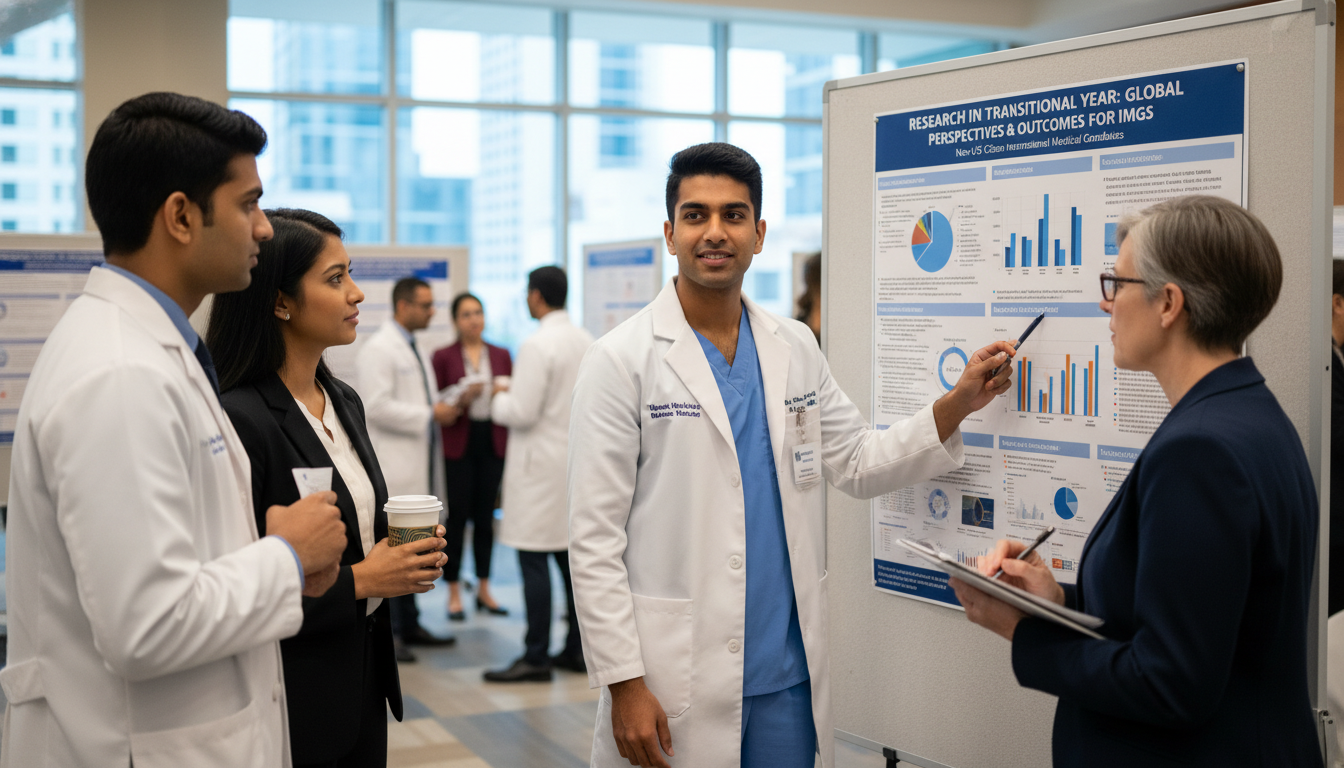
- Month 8–9: Draft abstract for a local/regional conference
- Month 10–11: Submit abstract and begin manuscript drafting
- Month 12: Present poster; finalize manuscript for submission
Even if one project does not lead to a publication during your TY, you will have abstracts, presentations, and contributions you can list on your CV.
4. Overcoming Common Challenges Specific to Non-US Citizen IMGs
4.1 Visa and Immigration Considerations
Your ability to participate in research may intersect with your visa status:
- J-1 visa: Usually allows clinical duties and research activities that are part of your approved training program; external paid research or moonlighting is more restricted
- H-1B visa: Slightly more flexible in some institutions, but still tied to employment terms
Key actions:
- Confirm with your GME office what is allowed under your specific visa
- Ensure all research activity is clearly part of your residency training
- Avoid informal, off-site, compensated research roles without official approval
4.2 Cultural and Communication Barriers
As a foreign national medical graduate, you may feel hesitant about:
- Speaking up at research meetings
- Asking for authorship clarification
- Negotiating your role on a project
To navigate this:
- Ask mentors early about expectations: “What would I need to do to qualify as a co-author?”
- Request written clarification if needed (email summaries)
- Practice presenting your work in short, clear English—this helps for conferences and interviews
4.3 Time Pressure and Burnout Risk
Transitional year residencies can still be demanding, and as a non-US citizen IMG you may also be:
- Studying for USMLE Step 3 or specialty boards
- Preparing applications for advanced positions
- Managing immigration and relocation issues
To balance these:
- Do not over-commit; 1–2 well-executed projects are better than 5 abandoned ones
- Choose research aligned with your specialty and career goals (so each hour serves multiple purposes—CV, learning, interview talking points)
- Collaborate with co-residents to share workload on data collection or QI initiatives
4.4 Access to Resources and Data
Some transitional year programs are at smaller hospitals with fewer research resources. In that setting:
- Focus on case reports, small QI projects, or educational research
- Seek collaboration with nearby academic centers or university-affiliated faculty
- Use national online research networks or specialty societies that offer mentorship or structured projects for residents
Even at smaller sites, it is often possible to complete at least a case report, QI project, or educational study.
5. Maximizing the Impact of Your Research for Future Applications

5.1 Building a Coherent Scholarly Narrative
Program directors like to see a clear story:
- Transitional year → research in an area related to your future specialty
- Consistent interest in a topic (e.g., perioperative complications, stroke imaging, chronic pain management)
- Progressive responsibility (e.g., from co-author on case report to first author on small study)
Examples of coherent narratives:
- TY resident aiming for radiology: case report on rare imaging finding + retrospective review of CT utilization patterns
- TY resident aiming for anesthesiology: QI project on perioperative pain control + abstract on postoperative nausea outcomes
5.2 Highlighting Research in Your CV and Personal Statement
On your ERAS or other applications for advanced positions:
- List resident research projects clearly with your role (first author, data collector, statistician, etc.)
- Include “submitted” or “in preparation” manuscripts transparently (do not exaggerate status)
- Emphasize presentations: posters, oral presentations, institutional research days, regional society meetings
In your personal statement:
- Briefly describe how research shaped your understanding of your chosen specialty
- Highlight any insight gained—e.g., health disparities, systems-based practice, patient safety
5.3 Preparing to Discuss Your Research at Interviews
Many IMGs underutilize research as an interview strength. Prepare to:
- Explain your project in 60–90 seconds using non-technical language
- Clarify your specific contributions (e.g., “I designed the data collection tool and performed initial analysis.”)
- Reflect on what you learned: about the disease, about the system, about working in teams
Interviewers may test whether your CV reflects genuine involvement; being able to talk confidently about your research reassures them.
5.4 Transitioning Research into an Academic Residency Track
If you are aiming for an academic residency track in your advanced specialty, use your transitional year as a springboard:
- Ask your mentor for letters emphasizing your research potential
- Mention in interviews that you are interested in structured research time during residency
- Identify programs that advertise “clinician-investigator” pathways, research tracks, or strong scholarly requirements
Having even one or two solid research experiences from your TY program makes you more competitive for these positions.
6. Practical Example Paths for Different Specialties
Below are example strategies tailored for a non-US citizen IMG in different advanced specialties, all starting from a transitional year residency.
6.1 Example: Future Radiology Resident
- Early in TY: connect with radiologists at your TY hospital
- Project 1: Case report of unusual CT or MRI finding
- Project 2: Retrospective study on the appropriateness of imaging orders for specific clinical indications
- Outcome: poster at a regional radiology meeting, abstract on ERAS, strong LOR from radiology mentor
6.2 Example: Future Anesthesiology Resident
- Early: connect with anesthesiology department or pain service
- Project 1: QI project on compliance with pre-op checklists
- Project 2: Retrospective review of postoperative pain scores with different analgesia protocols
- Outcome: quality award or local presentation, plus a draft manuscript submitted to a regional anesthesia or patient safety journal
6.3 Example: Future Neurology or PM&R Resident
- Early: connect with stroke unit, rehab unit, or neuro-ICU physicians
- Project 1: Case series of unusual stroke presentations in younger patients
- Project 2: Educational project on neuro exam teaching for interns or therapists
- Outcome: educational poster + case series submission, with framing around interest in neurorehabilitation or stroke care
FAQs: Research During Residency for Non-US Citizen IMGs in Transitional Year
1. Is it realistic to complete publishable research in a one-year transitional year residency?
Yes, but the scope must match your timeline. For a transitional year residency, the most realistic resident research projects are:
- Case reports or small case series
- Quality improvement projects with clear pre/post data
- Retrospective chart reviews with a focused question
Aim for at least one project that can lead to a poster or manuscript submission. Even if the paper is accepted after you finish the TY, it still adds value to your CV and career trajectory.
2. I am a non-US citizen IMG on a J-1 visa. Can I do research, and can I be paid for it?
You can almost always do research that is part of your residency training and takes place at your sponsoring institution, especially if it is unpaid or integrated into your schedule. Being paid specifically for extra research outside your official duties can be restricted under J-1 rules. Always:
- Confirm with your GME office and ECFMG (if J-1 sponsored)
- Ensure research activities are officially recognized as part of your training program
- Avoid off-the-books compensated roles in research without proper authorization
3. I have no prior research experience. Will this hurt my chances for an advanced residency position?
Lack of prior research does not disqualify you, but as a foreign national medical graduate, it is helpful to show some scholarly engagement during your transitional year. Start with scalable projects:
- Volunteer as a data collector or literature reviewer on an existing study
- Undertake a well-designed case report or QI project
- Seek mentorship from faculty experienced in guiding first-time researchers
Even modest achievements (a poster presentation, a co-authored paper) can signal potential and commitment.
4. How should I prioritize between research, exams (e.g., Step 3), and clinical performance?
As a non-US citizen IMG, you must balance all three:
- Clinical performance and professionalism are non-negotiable; poor evaluations or professionalism concerns can overshadow any research accomplishments.
- Step 3 or other required exams are essential for future visa and licensing pathways; schedule them strategically during lighter rotations.
- Research should be focused and realistic—one to two meaningful projects aligned with your specialty goals are ideal.
Plan your year with a calendar: mark exam dates, busy rotations, and potential research blocks. This structured approach helps ensure that each component supports, rather than competes with, your overall career trajectory.
By approaching research during residency strategically, especially within a transitional year residency, you can transform a single, intense year into a powerful academic foundation. For a non-US citizen IMG or foreign national medical graduate, this can be the difference between a generic application and a compelling, research-enhanced profile that stands out to competitive advanced and academic programs.