Understanding Research During Pediatrics Residency as a Non‑US Citizen IMG
For a non-US citizen IMG (international medical graduate), pediatrics residency in the United States is already a high-stakes journey. Adding research during residency on top of clinical duties can feel intimidating—but it is also one of the most powerful ways to distinguish yourself, open academic doors, and strengthen your long-term career prospects.
This article walks you step-by-step through what research can look like in pediatrics residency, how to get involved even with visa and time constraints, and how to leverage resident research projects to build a career in academic pediatrics.
We will focus especially on the realities and strategies specific to a foreign national medical graduate navigating the peds match, residency training, and beyond.
1. Why Research Matters for Non‑US Citizen IMGs in Pediatrics
1.1. Research as a Career Multiplier
For pediatric residents, research is no longer only for future physician‑scientists. It directly affects:
- Fellowship competitiveness (e.g., NICU, Pediatric Cardiology, Hem-Onc, Endocrinology)
- Academic job opportunities (assistant professor tracks)
- Leadership roles (program leadership, QI leadership, hospital committees)
- Visa and employment flexibility (more institutions willing to sponsor H‑1B or O‑1 for strong academic profiles)
For a non-US citizen IMG pediatric resident, research can:
- Demonstrate your ability to adapt to US academic culture
- Strengthen your CV compared to US grads who may already have home‑institution networks
- Create relationships with faculty who can advocate for visas and jobs
1.2. How Research Intersects with the Peds Match and Career Trajectory
By the time you match into a pediatrics residency, your prior research (if any) probably helped your application. But research during residency becomes even more critical if you:
- Want a competitive pediatric subspecialty fellowship
- Plan for an academic residency track or clinician‑educator role
- Hope to build a research-focused profile strong enough for awards, grants, and possibly an O‑1 visa down the line
Think of residency research as:
- Year 1–2: Build skills, relationships, and small outputs (posters, abstracts)
- Year 2–3: Complete projects, submit manuscripts, align with fellowship or career goals
Even if you are still early in residency, planning with this timeline in mind is very helpful.
2. Types of Research Opportunities in Pediatrics Residency
Not all research looks like pipettes and bench work. In pediatrics, you can be productive in multiple forms of scholarly activity, many of which are very feasible for a busy resident and a foreign national medical graduate balancing visa and personal demands.
2.1. Clinical Research
What it is: Studies that analyze patient data, outcomes, or interventions in real-world clinical settings.
Examples:
- Retrospective chart reviews (e.g., “Risk factors for readmission in pediatric asthma patients”)
- Prospective observational studies (e.g., “Growth outcomes in late preterm infants over 12 months”)
- Survey-based research (e.g., “Parental understanding of fever in toddlers”)
Why it’s great for residents:
- Uses existing hospital data
- Often easier to complete within residency timelines
- Relatively lower logistical barriers than basic science
2.2. Quality Improvement (QI) and Patient Safety Projects
QI is highly valued in pediatrics and often required for ABP (American Board of Pediatrics) certification and hospital accreditation.
Examples:
- Reducing unnecessary antibiotic use in bronchiolitis
- Improving vaccination rates at well-child visits
- Decreasing central line infections in the NICU
QI projects can become:
- Posters at local or national conferences
- Peer-reviewed publications
- Foundations for leadership roles in hospital quality programs
For a non-US citizen IMG, QI projects can be an efficient way to:
- Show system-level thinking
- Produce tangible outcomes (metrics improved)
- Build a track record of scholarly work even if your institution has limited traditional research infrastructure
2.3. Educational Research
Pediatrics is a teaching-heavy specialty. Many residents end up interested in clinician‑educator tracks.
Examples:
- Developing a simulation-based curriculum for pediatric emergencies
- Studying the impact of a new teaching tool on medical student exam performance
- Evaluating feedback systems for residents
These projects are ideal if you are drawn to teaching and academic residency tracks that emphasize education more than pure research funding.
2.4. Basic Science and Translational Research
Some pediatric residency programs are closely linked with strong research institutions and children’s hospitals. These offer:
- Laboratory-based projects (immunology, genetics, oncology, neonatology)
- Translational research bridging lab findings and clinical applications
Challenges for a resident—especially a foreign national medical graduate—include:
- Time-intensive experiments and long timelines
- Funding limitations and visa-related work restrictions
These projects suit residents aiming for physician‑scientist careers or MD/PhD-type roles, but they must be chosen carefully to ensure realistic completion.
2.5. Health Services Research and Public Health
These address care delivery, healthcare systems, and community factors:
Examples:
- Access to care for immigrant children
- Telemedicine use in rural pediatrics
- Social determinants of health and hospitalization rates
For non‑US citizen IMGs, this area can be especially meaningful, intersecting with:
- Global health
- Immigrant and refugee child health
- Health disparities
3. Getting Started: Practical Steps for Non‑US Citizen IMG Residents
3.1. Clarify Your Goals Early
At the beginning of PGY‑1 (or even before starting residency), ask yourself:
- Do I want a fellowship? If yes, which subspecialty?
- Am I aiming for an academic career (teaching, research leadership)?
- Do I need a strong portfolio for visa strategies (e.g., O‑1 later)?
- How much time and energy can I realistically commit?
This will shape how ambitious your projects should be and what kind of mentors you seek.
Example:
If you want Pediatric Hematology‑Oncology fellowship, prioritize:
- Oncology or Hem-Onc faculty mentors
- Projects involving leukemia outcomes, chemotherapy complications, or survivorship
3.2. Understand Your Program’s Research Structure
Every pediatrics residency program is different. Ask:
- Is there a required scholarly project?
- Is there a formal research curriculum (lectures, workshops on statistics, IRB, writing)?
- How many protected research weeks are available (if any)?
- Are there dedicated resident research projects funding or mini‑grants?
- Who is the Director of Resident Research or Scholarly Activity?
As a foreign national medical graduate, explicitly confirm:
- Whether your visa status limits certain kinds of paid research roles
- Any institutional policies on external work, moonlighting in research, or grant-funded positions
3.3. Finding the Right Mentor
Mentorship is critical, and the right person can compensate for your lack of local network.
Ideal mentor characteristics:
- Experience working with residents and IMGs
- Clear track record of publications and ongoing projects
- Reasonable expectations and good communication
- Aligns with your interest (e.g., NICU, GI, QI, global health)
How to find them:
- Review faculty profiles on your institution’s website
- Ask your program director, chief residents, or senior residents: “Who regularly mentors residents on research?”
- Attend departmental grand rounds and see who presents research
- Look at authors on published papers from your institution
Practical script (email):
Dear Dr. [Name],
I am a PGY‑1 pediatrics resident and a non‑US citizen IMG with a strong interest in [subspecialty/research type]. I read your work on [specific paper or project] and would like to explore potential opportunities to get involved.Could we schedule a brief meeting to discuss whether I might assist with any ongoing projects or plan a small, focused resident project under your mentorship?
Thank you for your time and consideration.
Sincerely,
[Your Name], MD
Pediatrics Resident, PGY‑1
3.4. Choosing Feasible Projects
A common mistake is taking on projects that are too large or complex for a 3-year residency, especially when you are new to the US system.
For your first major project, aim for:
- Clear, focused research question
- Realistic timeline (12–18 months)
- Data that already exists or is easy to collect
- A mentor with time and experience supervising residents
Good first-project examples:
- Retrospective chart review on admissions for status asthmaticus
- QI project to improve discharge instructions for bronchiolitis
- Survey of resident comfort in managing pediatric mental health issues
Avoid:
- Large multicenter trials (unless you join as a small sub-part)
- Projects entirely dependent on grant funding that is not secured
- Long, complex lab experiments without dedicated protected time
4. Time Management, Visas, and Institutional Realities
Balancing research, clinical duties, and personal life is challenging for all residents; as a non-US citizen IMG, you also juggle immigration issues and often limited local support systems.
4.1. Time Management Strategies for Busy Residents
- Start small and early: Even an hour a week in PGY‑1 to review literature or meet with a mentor pays off.
- Use elective or research rotations strategically: Plan them around critical project phases (data collection, analysis, manuscript writing).
- Create micro‑goals:
- Week 1–2: finalize research question
- Week 3–4: complete literature review
- Month 2: submit IRB application
- Batch tasks: Use post‑call afternoons or lighter rotations for reading and data entry.
- Leverage nights and weekends selectively: Protect your rest, but short focused blocks (2–3 hours) can be productive.
4.2. Visa Considerations for Research During Residency
Common visa types for non-US citizen IMG pediatric residents:
- J‑1 (most common via ECFMG)
- H‑1B (less common in pediatrics residency but exists at some programs)
Key points:
- J‑1: Typically tied to GME training; research that is part of your residency program activities is usually allowed, but outside employment or paid external research is restricted.
- H‑1B: Also employer-specific; you generally cannot work for another institution without proper authorization.
Practical implications:
- Focus on research within your own institution or collaborative projects where your role is defined as part of your residency.
- If someone offers you a paid research role or side project, confirm with:
- Your GME office
- Your program director
- Your international office / legal counsel
- If considering an academic residency track with extra research time funded by grants, clarify how it interacts with your visa and salary structure.
4.3. Institutional Support and Resources
Ask about:
- Biostatistics support: Many departments have biostatisticians who help with study design and analysis.
- Medical library and librarians: They can support literature reviews and systematic searches.
- Research seminars or workshops: IRB training, REDCap tutorials, basic statistics courses.
- Funding: Internal grants for resident research projects, support for conference travel.
As a foreign national medical graduate who may be less familiar with US funding systems, actively asking about these resources can save months of confusion.

5. Turning Resident Research into Presentations, Publications, and an Academic Track
Doing research is only part of the story; disseminating your work is what strengthens your CV and opens doors.
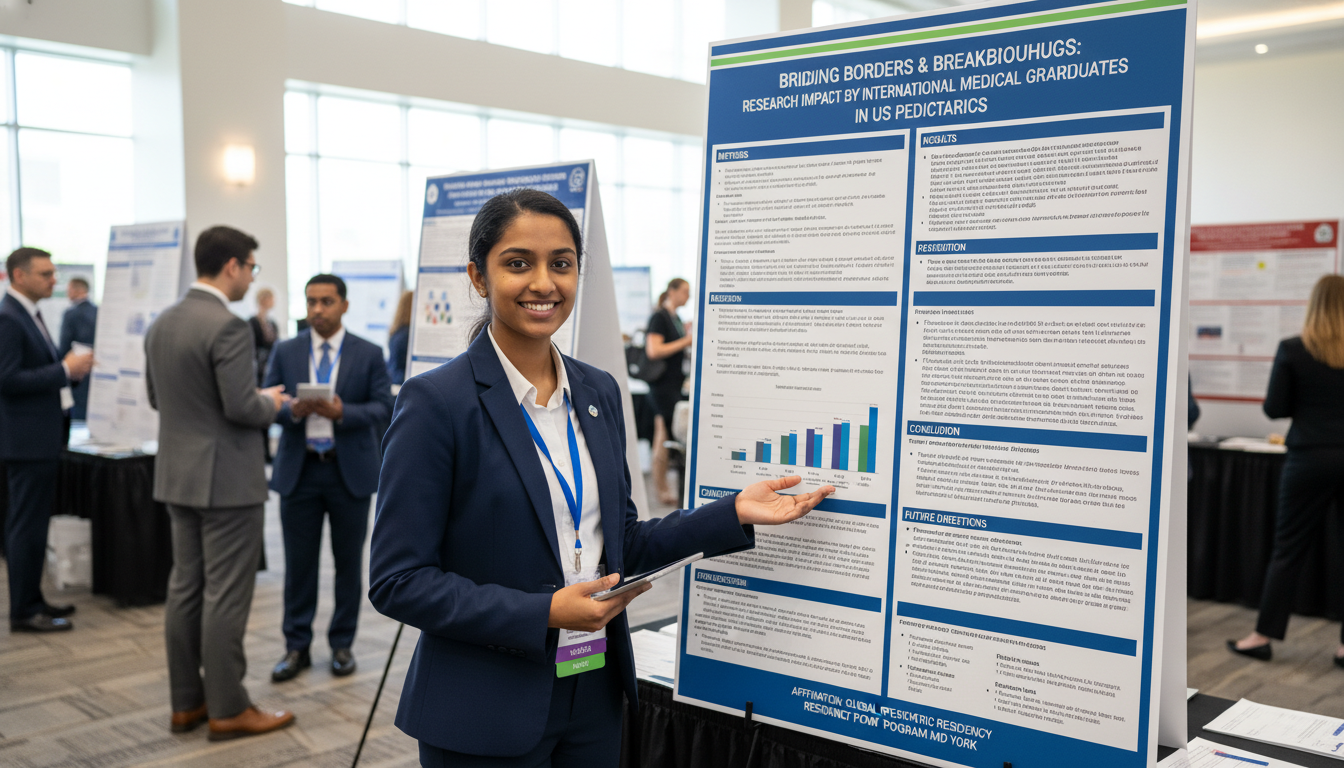
5.1. Presenting at Conferences
Target conference types:
- Local / Institutional research days: Often the most accessible first step.
- State/regional pediatrics societies
- National meetings: e.g., Pediatric Academic Societies (PAS), AAP National Conference, subspecialty meetings (e.g., ESPR, SPR, SPP, SHM for hospital medicine).
Typical timeline:
- Project design and IRB approval
- Data collection and preliminary analysis
- Abstract submission (often 4–9 months before the conference)
- Poster or oral presentation
Benefits for non-US citizen IMGs:
- Networking with future fellowship directors and collaborators
- Establishing visibility beyond your home institution
- Strengthening your peds match narrative if you are planning for fellowship or potentially a second residency or research fellowship
5.2. Writing and Publishing Manuscripts
Steps to publication:
- Choose the right journal: Match your project’s scope and impact level.
- Write the first draft: Focus on clarity; your mentor can refine style and structure.
- Revise based on feedback: From co-authors and possibly a statistician.
- Submit and respond to peer review: Address reviewers’ comments thoroughly.
Common article types for resident research:
- Original research (clinical, QI, educational)
- Case reports or case series
- Brief reports and research letters
As a foreign national medical graduate, you may feel less confident with English academic writing. Strategies:
- Use examples of well-written articles as templates.
- Ask co-residents or faculty to review for clarity and grammar.
- Make use of institutional writing centers or editors if available.
5.3. Building an Academic Residency Track Profile
Some pediatrics programs offer a formal academic residency track (sometimes called research track, clinician‑scientist track, or scholarly concentration). These often include:
- Extra protected research time
- Formal research mentorship and meetings
- Expectations for higher research output (papers, grants)
Even without a formal track, you can create your own academic identity by:
- Having at least one substantial resident research project
- Supplementing with smaller QI or educational projects
- Presenting locally and nationally
- Publishing at least one manuscript (ideally more if targeting research-heavy fellowships)
When applying to fellowships or academic jobs, highlight:
- Your evolution from novice researcher to leader of resident research projects
- The specific skills you developed (study design, statistics, manuscript writing)
- How your work benefited patient care or education in pediatrics
5.4. Using Research to Support Future Visa Options
While legal advice should always come from an immigration attorney, in broad terms:
- Strong research portfolios—especially with multiple peer-reviewed publications, national presentations, and impact on the field—can contribute to:
- O‑1 visa applications (extraordinary ability)
- EB‑1 or NIW (National Interest Waiver) pathways in the long term
- Documentation that helps:
- Publications and citation counts
- Awards, grants, and invited presentations
- Evidence of serving as a reviewer or committee member at conferences
For a non‑US citizen IMG in pediatrics, being intentional about documenting and archiving every scholarly achievement from residency onward is critical:
- Keep an updated CV
- Maintain a digital folder with PDFs of publications, acceptance emails, and conference programs listing your name
6. Example Pathways: How Different Residents Can Approach Research
To make this more concrete, consider three fictional non-US citizen IMG pediatric residents and how they navigate research:
6.1. Dr. A – Future Neonatologist on a J‑1 Visa
- Goal: NICU fellowship at a university program
- Strategy:
- PGY‑1: Joins an ongoing retrospective NICU project led by a senior fellow; learns data extraction and basic statistics.
- PGY‑2: Designs a QI project to decrease central line infection rates in the NICU; presents at PAS.
- PGY‑3: Co-authors a manuscript from the QI project and a secondary analysis focusing on late preterm infant outcomes.
- Outcome: Strong letters from NICU faculty citing her research productivity; matches into a competitive NICU fellowship.
6.2. Dr. B – Clinician‑Educator Track on an H‑1B Visa
- Goal: Hospitalist role with education focus
- Strategy:
- PGY‑1: Joins a group project building a simulation curriculum for pediatric emergencies.
- PGY‑2: Leads a study evaluating the curriculum’s impact on resident performance; organizes a local workshop.
- PGY‑3: Publishes in a medical education journal; presents a workshop at a national conference.
- Outcome: Hired as a pediatric hospitalist with protected teaching time; continues educational research as part of an academic residency track–style faculty role.
6.3. Dr. C – Global Child Health Researcher
- Goal: Work in global child health and academic pediatrics
- Strategy:
- PGY‑1–2: Collaborates with a mentor who has projects in East Africa on malnutrition and vaccine implementation.
- Uses remote data analysis and manuscript writing that fits within residency limitations.
- PGY‑3: Spends an elective block onsite abroad through an institutional partnership, completing field work.
- Outcome: Publishes multiple global health papers; later pursues a global health fellowship and eventually academic faculty role with international work.
FAQs: Research During Pediatrics Residency for Non‑US Citizen IMGs
1. Do I need research during residency if I am not sure about fellowship?
You do not need research to be a good general pediatrician, but completing at least one well-executed project is beneficial. It:
- Strengthens your CV in case you change your mind and apply for fellowship
- Teaches critical skills (critical appraisal, QI methodology, teamwork)
- Signals to employers that you engage in continuous improvement
If you truly dislike research, focus on a small, well-scoped QI or educational project to fulfill minimal requirements.
2. Is research possible at community-based programs with limited infrastructure?
Yes, but it requires more initiative. Strategies:
- Focus on QI projects and clinical audits that use readily available data
- Collaborate with academic centers via faculty who have dual appointments
- Use online tools (REDCap, virtual meetings) to participate in multicenter studies
- Present at regional conferences and institutional research days
Even a community-based program can support meaningful resident research projects with the right mentor and scope.
3. How many publications should I aim for during residency?
There is no fixed number. Quality and relevance matter more than raw quantity.
As a rough guide:
- For general pediatrics jobs: 0–2 solid scholarly products (e.g., posters, one manuscript) are sufficient.
- For most fellowships: 1–3 publications plus multiple posters/abstracts is typical.
- For research-intensive careers: Aim for multiple manuscripts and ongoing projects, possibly through an academic residency track or extended research training.
Remember: a single first-author paper closely aligned with your target subspecialty can be more valuable than several unrelated minor projects.
4. Will my non-US citizen status limit my research opportunities?
Institutional policies and visa restrictions may limit paid external work or certain grant-funded positions, but they rarely prevent you from doing research as part of your residency. The most common limitations are logistical (time, support, mentorship) rather than legal.
To navigate this:
- Clarify rules with GME and your international office.
- Concentrate research efforts within your home institution or collaborations that are clearly part of your training.
- Proactively seek mentors who are experienced with IMGs and understand how to structure projects that fit your situation.
Research during pediatrics residency can feel like a daunting extra load, especially for a non-US citizen IMG managing visas, cultural adaptation, and high clinical demands. But with deliberate planning, the right mentors, and realistic project selection, it becomes a powerful engine for your career—opening doors to fellowships, academic roles, and long-term stability in the United States.