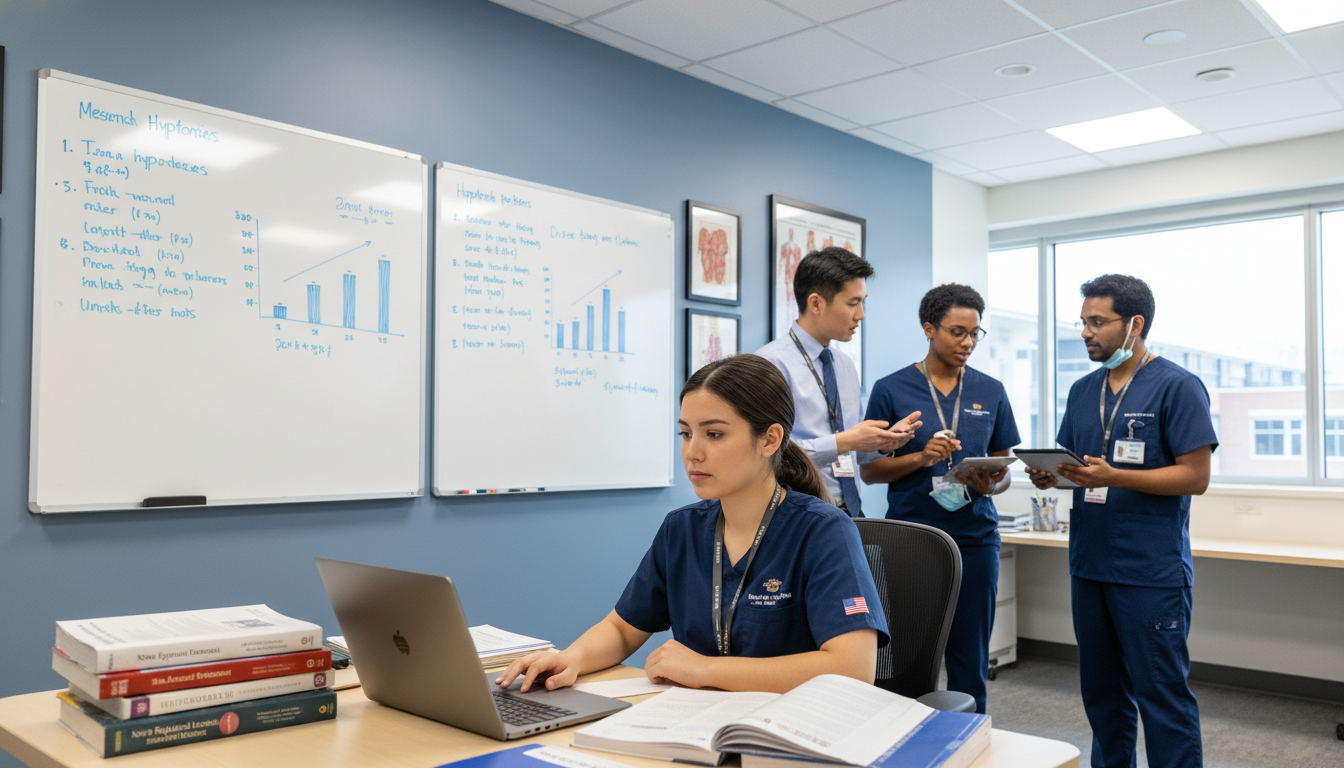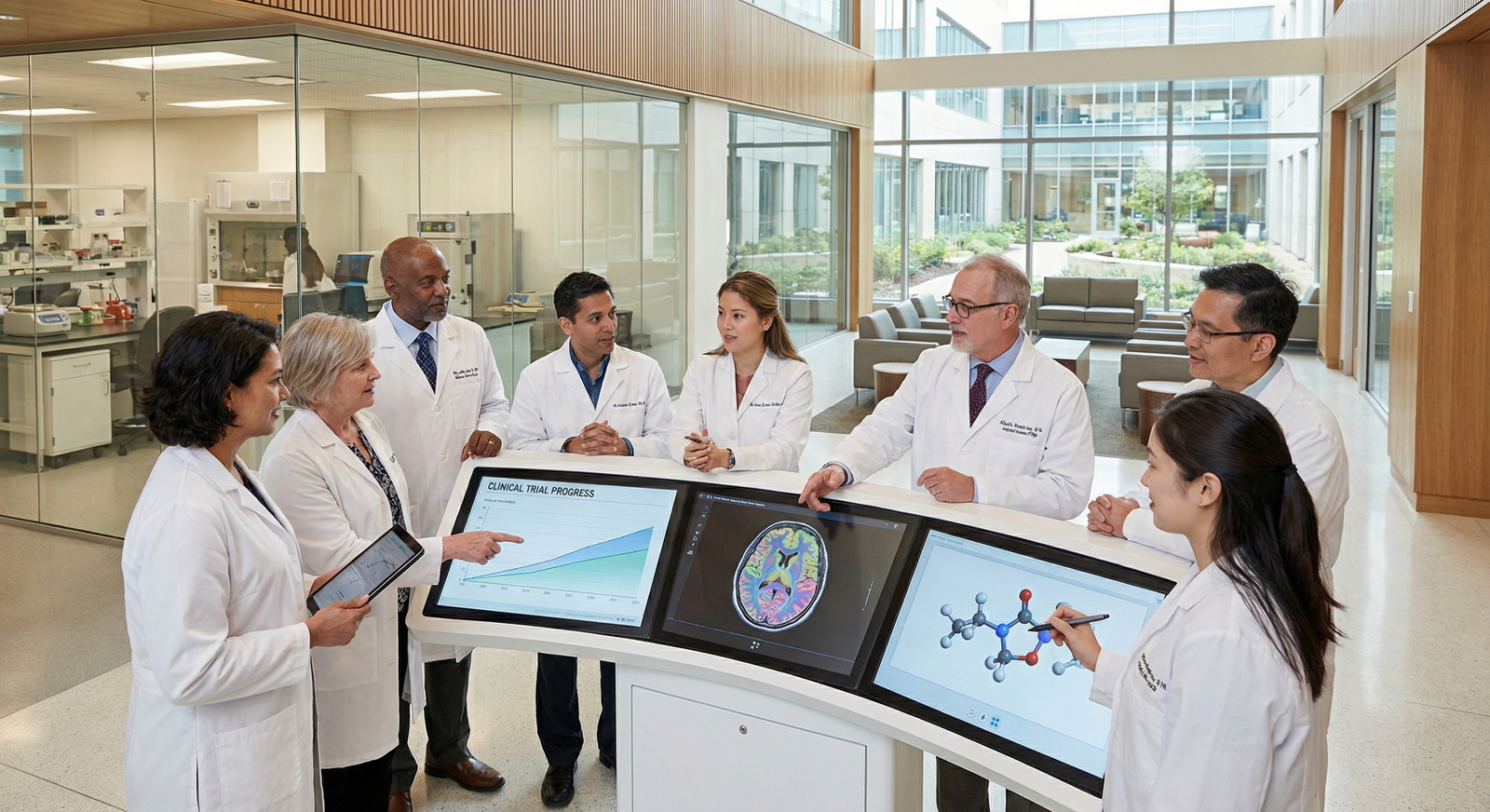
Why Research During Urology Residency Matters So Much for Non‑US Citizen IMGs
For a non-US citizen IMG in urology residency, research is more than a CV line—it is often your most powerful step toward long-term credibility, visa stability, and career advancement in the US.
Compared to US graduates, a non-US citizen IMG or foreign national medical graduate usually has:
- Less built‑in networking in US academic circles
- More visa constraints that affect job and fellowship options
- Extra scrutiny when competing for fellowships and academic positions
Strong resident research projects can help close those gaps by:
- Demonstrating academic potential beyond test scores
- Building relationships with faculty who can write powerful letters
- Increasing your competitiveness for subspecialty fellowships
- Opening doors to an academic residency track or future faculty roles
In urology specifically, research affects:
- Fellowship placement (oncology, endourology, female pelvic, pediatrics, reconstruction, etc.)
- Academic vs community practice options
- Your ability to pursue niche interests (e.g., AI in imaging, health services research, global urology)
If you are a non-US citizen IMG in urology residency—or planning to apply—treat research during residency as a core part of your training, not an optional extra.
Understanding the Research Landscape in Urology Residency

Common Types of Resident Research in Urology
Urology is highly research‑active, and you do not need a wet lab to be productive. Typical resident research projects include:
Clinical Outcomes Research
- Retrospective chart reviews (e.g., outcomes after robotic prostatectomy)
- Comparisons of surgical techniques (open vs laparoscopic vs robotic)
- Postoperative complications, readmission, or quality-of-life studies
Translational / Basic Science Research
- Bladder cancer biomarkers
- Prostate cancer genetics
- Tissue engineering (e.g., reconstruction, implants)
- Typically done in collaboration with PhD scientists
Health Services and Big-Data Research
- Using national databases (e.g., SEER, NSQIP, Premier)
- Cost-effectiveness analyses (e.g., stone disease management strategies)
- Access-to-care, disparities, and outcomes for underrepresented patients
Education and Simulation Research
- Surgical simulation and skills training studies
- Curriculum development for residents or medical students
- Assessment of technical and nontechnical competencies
Quality Improvement (QI) Projects
- Reducing catheter-associated infections
- Standardizing perioperative antibiotic use in urologic procedures
- Improving guideline adherence (e.g., PSA screening, hematuria workup)
- Many QI projects can become abstracts or manuscripts with proper design
As a non-US citizen IMG, clinical, health services, and QI projects are often the most accessible early on because they:
- Require less specialized lab infrastructure
- Can be done flexibly around clinical schedules
- Often have shorter timelines from design to publication
How Urology Programs Structure Resident Research
Different residency programs offer different levels of formal support:
Dedicated Research Blocks
- 3–12 months of protected time
- Often during PGY-3 or PGY-4 years
- Ideal for larger projects, databases, or lab work
Integrated Longitudinal Research
- Projects done in parallel with rotations
- Regular research meetings with mentors
- Suitable for clinical and QI projects
Formal Academic Residency Track
- Additional coursework (e.g., MPH, MS in Clinical Research)
- Extended training (e.g., 6–7 years total)
- Strong emphasis on grant writing and independent research skills
Before or early in your urology residency, learn:
- Does the program have required or optional research time?
- Are there expectations for number of abstracts or publications?
- Who runs the resident research program (director, coordinator, biostatistician)?
- Are there existing resident research projects you can join quickly?
The Added Layer for Non‑US Citizen IMGs
As a non-US citizen IMG or foreign national medical graduate, you also need to consider:
- Visa Status
- J‑1 and H‑1B can both be compatible with research, but funding mechanisms and job prospects differ.
- Some NIH and government grants are only open to US citizens and permanent residents.
- Funding Eligibility
- Institutional, philanthropic, or industry funds are often more flexible for international researchers.
- Long‑Term Plans
- If you are planning for an academic career in the US, you need a stronger early research trajectory than many peers.
The key is to design a research strategy that fits your visa timeline, residency demands, and long-term goals.
Getting Started: Building a Research Plan as a Non‑US Citizen IMG

Step 1: Define Your Long‑Term Career Goals Early
Your research strategy should align with where you want to be 5–10 years from now:
If you want an academic career in the US
- Aim for sustained productivity (multiple projects, first-author papers).
- Seek involvement in an academic residency track if available.
- Look for mentors nationally, not just at your home institution.
If you want a high‑volume surgical practice (US or abroad)
- Focus on surgical outcomes, surgical innovation, and QI research.
- Aim for presentations at major meetings to build your name.
If you plan to return to your home country
- Work on topics relevant both to US practice and global urology (e.g., global access to urologic cancer care, stone disease in low‑resource settings).
Clarifying this early helps you choose mentors, topics, and projects wisely.
Step 2: Map Out Your Timeline Across Residency
Use your PGY years strategically:
PGY-1 / Early PGY-2
- Learn how research is organized at your institution.
- Attend research meetings, grand rounds, and journal club.
- Join 1–2 ongoing resident research projects (even in “small” roles).
- Complete required research ethics / IRB training modules.
Late PGY-2 / PGY-3
- Take on a first-author project with realistic scope.
- Submit at least one abstract to a urology or surgical meeting.
- If you have a dedicated research block, front‑load IRB, data collection plans, and collaborator meetings.
PGY-4 / PGY-5 (Senior Years)
- Focus on converting abstracts into publications.
- Work on 1–2 higher‑impact or larger‑scale projects if feasible.
- Align projects with your fellowship interests (e.g., oncology, endourology).
- Use your growing portfolio to secure strong letters for fellowship or job applications.
Step 3: Identify the Right Mentors and Teams
For a non-US citizen IMG, mentorship is critical—both for academic growth and for visa‑sensitive career planning.
Look for mentors who:
- Are actively publishing in urology
- Have experience guiding residents in research during residency
- Have connections to national societies (AUA, SUO, etc.)
- Understand or are sympathetic to the challenges of an IMG / foreign national medical graduate
You may want two complementary mentors:
- Content Mentor – An expert in your clinical/research area of interest (e.g., uro‑oncology).
- Process Mentor – Someone good at study design, statistics, and navigating authorship and submissions.
Actionable steps:
- Email faculty with a short, focused message:
- 2–3 sentences on who you are and your visa/residency status
- 1–2 sentences about your interests
- Ask to discuss potential resident research projects for 15–20 minutes
- Show up with:
- A brief CV
- Any prior research experience
- Clear availability each week
Step 4: Choose Projects with High Feasibility and Impact
Aim for projects that are:
- Doable within 6–18 months
- Supported by accessible data (charts, registries, existing databases)
- Mentored by someone with a track record of completing studies
- Narrow enough for clear research questions, but broad enough to matter clinically
Examples:
- Evaluating outcomes of a specific robotic procedure at your institution
- Assessing adherence to guideline‑based hematuria evaluation
- Analyzing disparities in time to treatment for bladder cancer patients
For your first major project, avoid overly ambitious designs that rely heavily on external funding or long patient follow‑up periods.
Practical Strategies to Succeed in Resident Research Projects
Master the Basics: IRB, Data, and Statistics
You do not need to become a statistician, but you must be literate enough to design, understand, and critique studies.
Key skills to build:
IRB / Ethics
- Learn your institution’s IRB process.
- Identify whether your study is retrospective, prospective, QI, or exempt.
Data Management
- Use secure, HIPAA‑compliant tools (e.g., REDCap) for data collection.
- Design data dictionaries before extraction.
- Learn basic data cleaning principles (consistency checks, handling missing data).
Basic Statistical Concepts
- Continuous vs categorical variables
- Common tests (t‑test, chi‑square, logistic regression, survival analysis basics)
- Interpretation of p‑values and confidence intervals
Many institutions offer short courses or workshops in clinical research methods. As a non-US citizen IMG, taking advantage of these can offset any perceived disadvantage in your prior training.
Time Management: Balancing Operative Volume and Research
Urology is busy; time is your scarcest resource. To protect research time:
- Block 1–2 recurring hours each week on your calendar for research tasks.
- Break projects into small, concrete steps (e.g., “extract data for patient IDs 1–30”).
- Use low‑cognitive‑load time (e.g., post‑call afternoons) for simple tasks like formatting references.
- Communicate with co‑authors about realistic timelines, especially near exams or major rotations.
As a non-US citizen IMG, you may feel pressure to “prove yourself” clinically; do not sacrifice all research time. Long‑term, research productivity often matters as much as (or more than) an extra few cases on your log.
Writing Skills: From Abstract to Manuscript
Your research impact is only as strong as your ability to write and publish your findings.
Focus on:
High‑quality abstracts
- Clear objectives and hypotheses
- Concise methods and meaningful results
- Specific conclusions that align with the data
Efficient Manuscript Writing
- Start with an outline (IMRAD: Introduction, Methods, Results, and Discussion).
- Draft the Methods and Results early—they’re most straightforward.
- Use reference managers (EndNote, Zotero, Mendeley).
- Ask for feedback from mentors and peers, including grammar and flow.
Many non-US citizen IMGs worry about writing style or accent. Journals care about clarity and rigor, not native English fluency. Co-authors and editors can help polish language as long as the scientific content is strong.
Presenting Your Work: Meetings and Networking
Conferences are crucial, especially for a non-US citizen IMG seeking visibility in the US academic community.
Aim for:
Urology‑specific meetings
- American Urological Association (AUA) Annual Meeting
- Sectional AUA meetings
- Subspecialty conferences (SUO, Endourological Society, etc.)
Institutional and regional research days
- Lower travel costs, good practice for talks
- Opportunity to win resident research awards
When presenting:
- Practice your talk multiple times with mentors.
- Be ready to defend your methodology.
- Use presentations as networking tools—introduce yourself to program directors, fellowship leaders, and investigators in your area of interest.
These personal interactions often matter greatly when your name appears later on a fellowship or faculty application.
Leveraging Research for Visas, Fellowships, and Long‑Term Career Success
How Research Supports Visa‑Sensitive Career Paths
For a non-US citizen IMG, your research portfolio can directly affect:
Fellowship Placement
- Competitive urology fellowships (e.g., uro‑oncology, robotics) heavily weigh research.
- Demonstrated academic productivity signals that you can contribute to their program’s scholarly mission.
Academic Job Offers
- Institutions sponsoring H‑1B or O‑1 visas often want evidence that you bring “added value” beyond clinical care.
- Publications, leadership roles in research during residency, and grants can be used as supportive evidence for O‑1 (extraordinary ability) later in your career.
Future Green Card Applications
- For pathways like EB‑1 or NIW (National Interest Waiver), research productivity, citations, and national recognition are important components.
Keep copies and organized documentation of:
- Accepted abstracts, posters, podium presentations
- Published papers and your role (first, co‑first, corresponding author)
- Awards and recognitions
- Invited talks or panel participation
This will be invaluable years later when assembling visa or green card applications.
Using Research to Strengthen Fellowship and Job Applications
When applying for fellowships or jobs:
- Highlight depth, not just quantity: 2–3 strong, thematically connected projects often look better than 10 scattered abstracts.
- Emphasize your role: explain where you led design, analysis, or writing.
- Ask mentors to reference your research skills in letters: initiative, independence, reliability, and academic curiosity.
Consider targeting fellowships and institutions known for being supportive of:
- International graduates
- Research‑active trainees
- Visa sponsorship and long‑term academic career development
Pathway to an Academic Residency Track and Faculty Roles
If your program offers an academic residency track:
- Discuss it early—often during PGY-1 or PGY-2.
- Understand added requirements (extra projects, coursework, extended training).
- Ask whether the track helps with grant writing skills and protected research time as a junior faculty.
Post‑residency, your resident research projects can serve as the foundation for:
- Larger multi‑institutional trials
- R01 or foundation grant ideas (collaborating with senior investigators)
- Building a national reputation in a subspecialty niche
For a foreign national medical graduate, being productive and intentional during residency can compress the timeline to independent academic recognition.
Common Pitfalls for Non‑US Citizen IMGs—and How to Avoid Them
Waiting Too Long to Start
- Starting research only in senior years leaves little time to publish.
- Begin small projects in PGY‑1 or early PGY‑2, even if just as a collaborator.
Overcommitting to Too Many Projects
- Being listed as an author on numerous incomplete projects helps no one.
- Limit new commitments and prioritize finishing what you start.
Choosing Mentors Solely on Reputation, Not Fit
- A famous but overcommitted mentor may have limited time for you.
- You need mentors who respond, guide, and advocate for you.
Ignoring Authorship Expectations Early
- Clarify your role and authorship at project initiation.
- Misunderstandings can strain relationships and harm your reputation.
Neglecting Clinical Excellence
- Academic success does not compensate for poor clinical performance.
- Maintain strong evaluations and technical development; the best academic urologists are also solid clinicians.
FAQs: Research During Residency for Non‑US Citizen IMG in Urology
1. I matched urology as a non‑US citizen IMG with minimal prior research. Is it too late?
No. Residency is an excellent time to build your research record. Focus on:
- Joining ongoing clinical or QI projects in your first year
- Learning research basics (IRB, data handling, and statistics)
- Completing at least 1–2 first-author projects by graduation
Being consistent, reliable, and productive from now forward matters more than your starting point.
2. Can I do basic science or lab research on a J‑1 or H‑1B visa?
Yes, in most cases. Your ability to do lab research is typically determined more by:
- Institutional rules and funding sources
- Your schedule and research block availability
Some federal grants are restricted to US citizens or permanent residents, but many institutional, industry, and philanthropic sources are open to non‑US citizens. Work closely with mentors and your GME office to ensure compliance with your visa terms.
3. How many publications do I “need” as a urology resident?
There is no strict number. For a non-US citizen IMG aiming for an academic or subspecialty fellowship path, a reasonable target by graduation might be:
- 2–4 first‑ or co‑first‑author peer‑reviewed manuscripts
- Several additional co‑authored papers or abstracts
- Regular presentations at institutional or national meetings
Quality, relevance to your subspecialty interests, and your documented role in projects are more important than raw counts.
4. I struggle with academic English. Will this limit my research prospects?
It does not have to. Many highly productive researchers are non‑native English speakers. To adapt:
- Focus on getting the study design and analysis right first.
- Ask mentors or co-authors to help refine language.
- Use institutional writing centers or editing services if available.
- Read high‑quality urology journals regularly to absorb style and structure.
Journals and reviewers care most about scientific validity and clarity—both of which you can absolutely achieve with practice and support.
By approaching research during residency strategically—aligning projects with your goals, identifying supportive mentors, and using each project to build skills and visibility—you can transform your status as a non-US citizen IMG from a perceived barrier into a differentiated strength in the urology academic landscape.