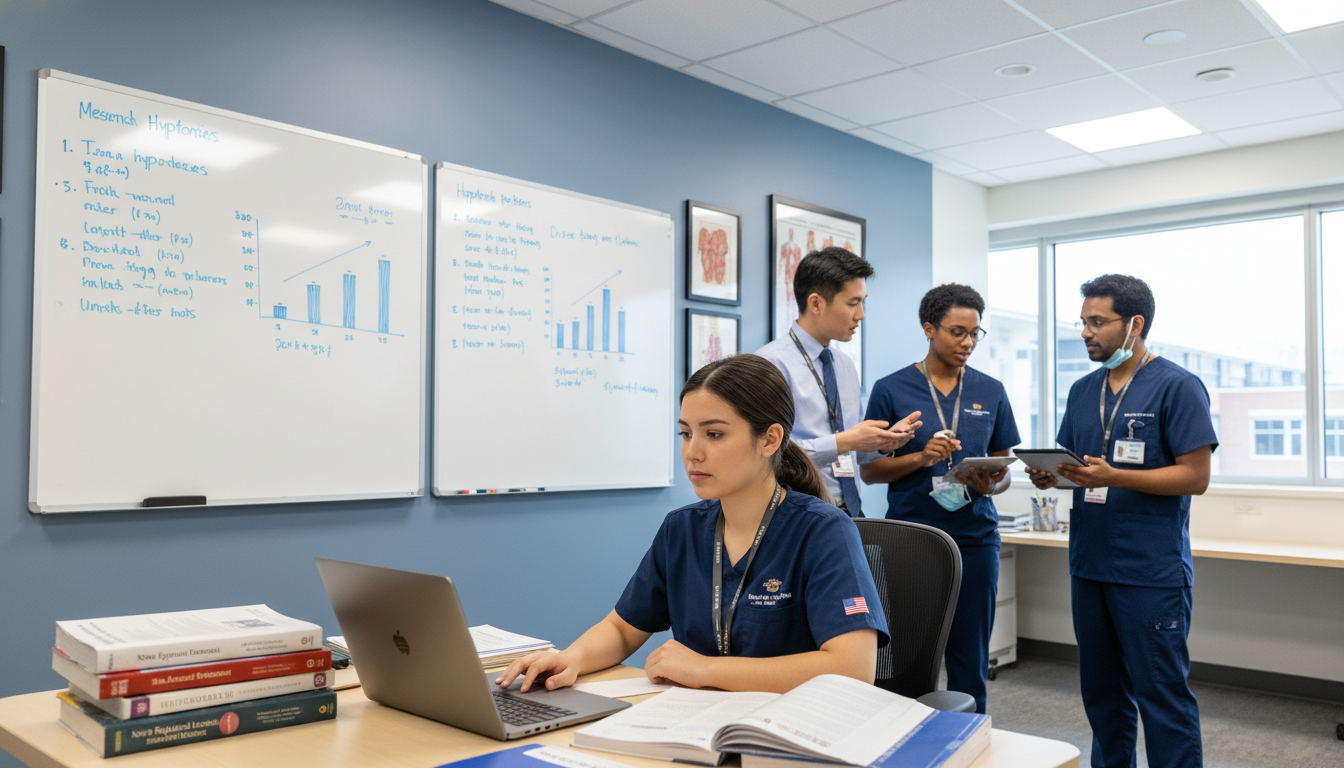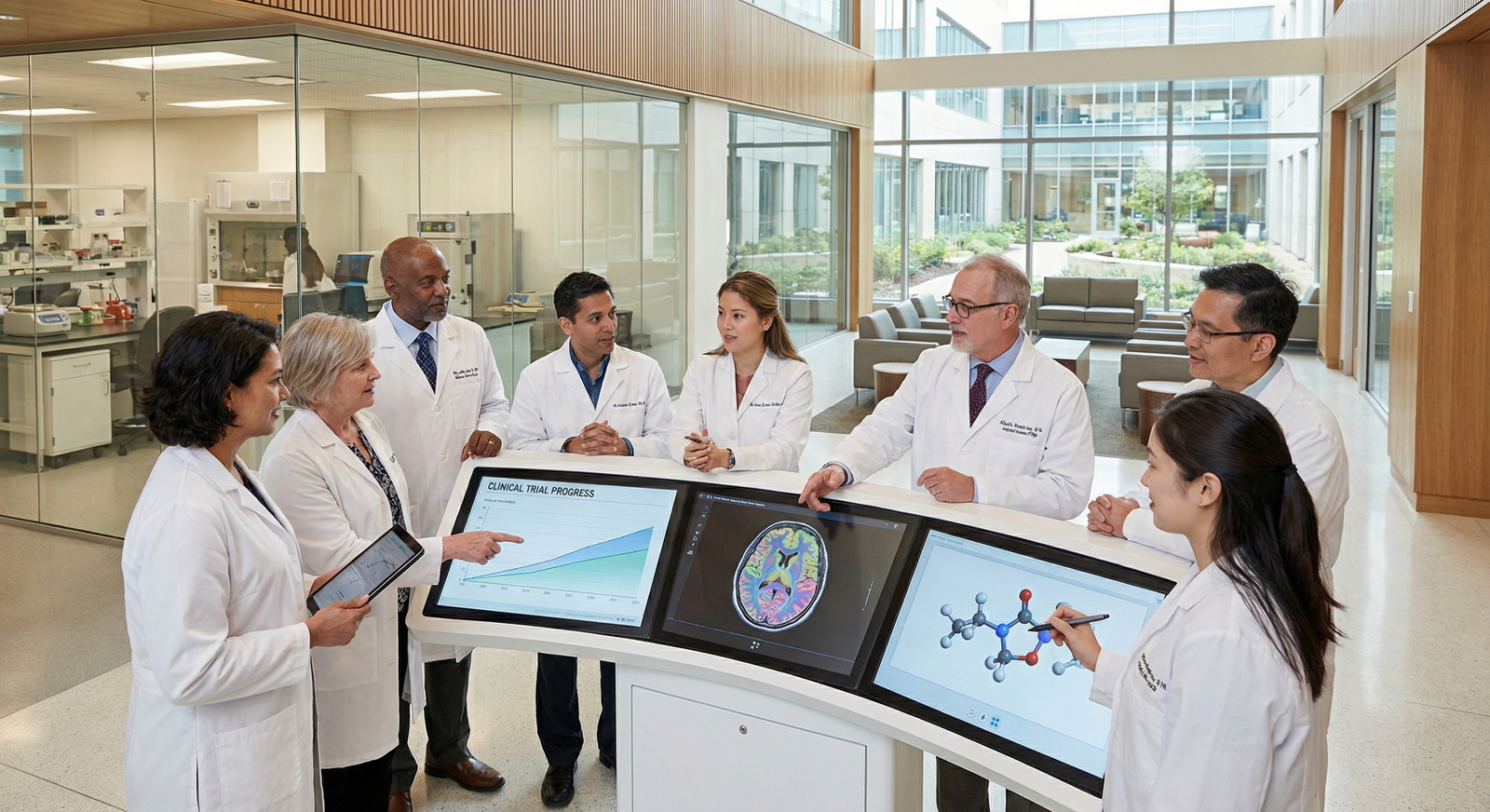
Entering emergency medicine (EM) as a US citizen IMG is an exciting step—and research during residency can significantly shape your career trajectory. Whether you’re aiming for an academic residency track, a future fellowship, or simply want to sharpen your clinical reasoning, understanding how to approach research as an EM resident is crucial.
This guide is written specifically for the US citizen IMG or American studying abroad who is planning to match—or has just matched—into an emergency medicine residency and wants to make the most of resident research opportunities.
Why Research During Residency Matters for US Citizen IMGs in EM
Research isn’t mandatory to have a successful career in emergency medicine—but it is increasingly valuable, especially for IMGs.
1. Strengthening Your Professional Identity
As a US citizen IMG in emergency medicine, you may still feel like you’re “catching up” compared with US MD/DO grads who trained domestically. Engaging in research during residency helps you:
- Demonstrate intellectual curiosity and initiative
- Show that you can contribute academically, not just clinically
- Build a professional identity beyond the “IMG” label
For program leadership and future employers, a resident who engages in research signals commitment to the specialty and potential as a future leader.
2. Enhancing Competitiveness for Fellowships and Academic Positions
If you’re considering:
- Ultrasound fellowship
- Critical care
- EMS
- Toxicology
- Pediatric EM
- Research or education fellowships
…then research during residency can be a differentiator. Many fellowships review:
- Number and quality of publications
- Conference presentations
- Participation in resident research projects
- Engagement with an academic residency track
For a US citizen IMG, these academic credentials can help offset perceptions related to training abroad and demonstrate that you can thrive in high-level academic environments.
3. Improving Your Clinical Practice
Emergency medicine research often focuses on:
- Diagnostic accuracy and decision tools
- ED operations and patient flow
- Resuscitation outcomes
- Ultrasound protocols
- Toxicology and procedures
Participating in research exposes you to the evidence underlying EM practice. This often translates into:
- Sharper clinical reasoning
- Better understanding of guidelines and controversies
- Comfort interpreting new studies and applying them to patient care
In other words, research during residency isn’t just about your CV—it can directly improve your bedside practice.
4. Building a Network Early
By working on research with faculty and co-residents, you’ll gain:
- Mentors who can write strong letters of recommendation
- Collaborators for future projects
- Connections at other institutions through multi-center studies or conference networking
For a US citizen IMG who may not have a strong built-in US medical school alumni network, this informal network is especially important.
Types of Research Opportunities in Emergency Medicine Residency
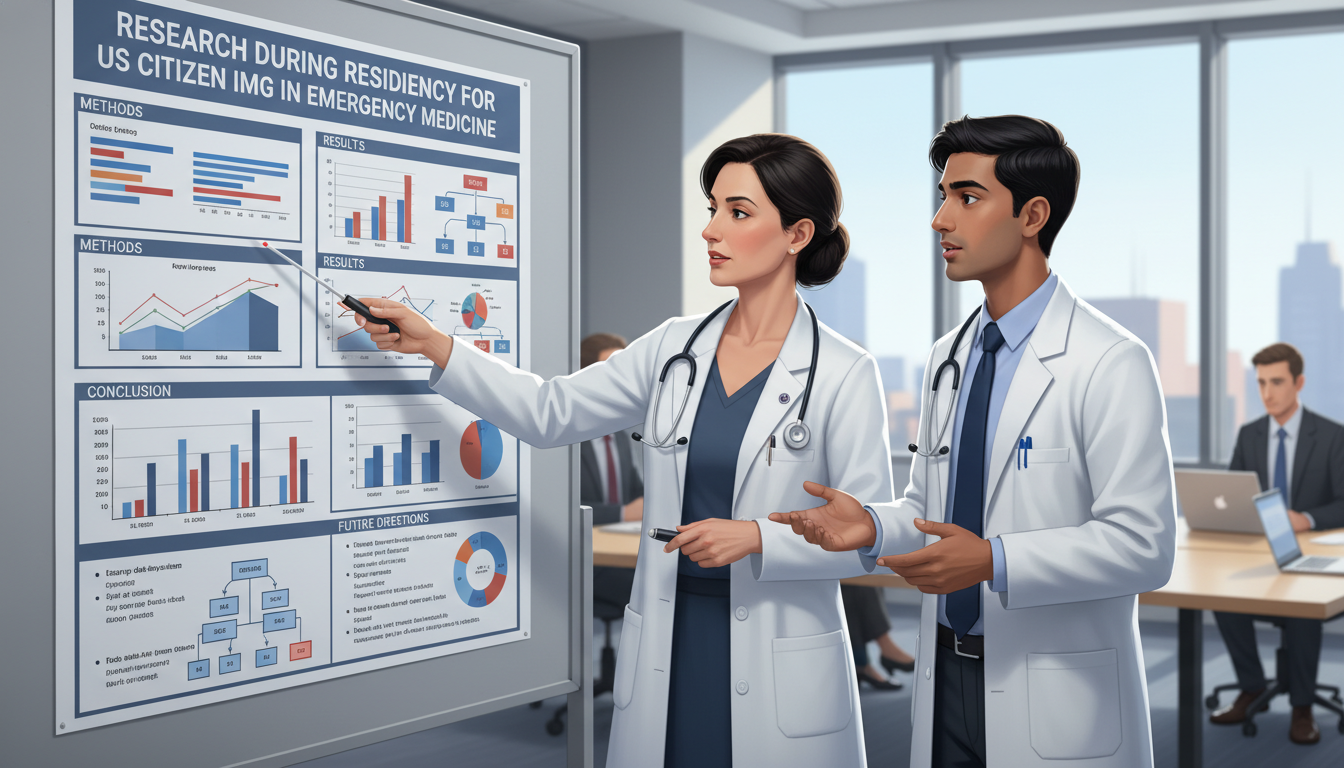
You don’t have to be a PhD-level researcher to contribute meaningfully. Emergency medicine offers a wide range of research pathways that can fit different interests and time constraints.
1. Clinical Research
Clinical research is the most common type encountered in EM residency.
Examples include:
- Retrospective chart reviews (e.g., outcomes of patients with mild TBI discharged from the ED)
- Prospective observational studies (e.g., assessing accuracy of a new risk stratification tool)
- Implementation studies (e.g., impact of a new sepsis protocol on door-to-antibiotic time)
For a busy emergency medicine resident, chart reviews and observational projects are often the most practical entry point—especially in PGY-1 and PGY-2 years.
Why it’s IMG-friendly:
These projects typically:
- Use existing patient data (fewer logistical barriers)
- Fit more flexibly around clinical schedules
- Allow you to develop skills in data collection and basic statistics
2. Quality Improvement (QI) and Patient Safety Projects
Many EM residencies require QI projects. These are excellent “research-adjacent” experiences that can be developed into publishable work.
Examples:
- Reducing left-without-being-seen (LWBS) rates
- Improving door-to-ECG time for chest pain patients
- Standardizing pain control for long-bone fractures
- Optimizing ED throughput or boarding times
While QI is not always traditional “research,” you can design QI projects with methodological rigor, collect data systematically, and submit them as abstracts or manuscripts.
3. Educational Research
If you’re interested in an academic residency track with a focus on teaching or medical education, educational research in EM is a natural fit.
Examples:
- Evaluating the effectiveness of a new simulation curriculum for airway management
- Studying how residents acquire point-of-care ultrasound skills over time
- Comparing different formats of didactic teaching (e.g., flipped classroom vs traditional lecture)
Educational research is ideal if:
- You like teaching and curriculum design
- Your program has a strong education-focused faculty group
- You see yourself as a future program director, clerkship director, or education fellow
4. Ultrasound, EMS, and Subspecialty Research
Emergency medicine spans many subspecialty areas; each often has vibrant research niches:
- Ultrasound: Image acquisition quality, diagnostic accuracy, educational interventions
- EMS: Prehospital stroke recognition, cardiac arrest bundles, overdose response strategies
- Toxicology: Poisoning patterns, antidote use, risk stratification tools
- Critical Care: ED-based sepsis resuscitation, ventilator management in the ED, shock resuscitation
If you already have a subspecialty interest, aligning your resident research projects with that interest can set you up for aligned fellowships and a coherent academic “story.”
5. Multi-center and National Collaboratives
Some academic EM departments participate in large research networks or registries. As a resident you might:
- Help enroll patients in multi-center trials
- Assist with data entry and quality checks
- Join sub-studies or secondary analyses
These experiences are particularly valuable because they expose you to high-level research structures and may lead to authorship on larger, more impactful papers.
Choosing the Right Research Environment: What to Look for in EM Programs
If you are still in the EM match process—or planning to apply soon as a US citizen IMG—choosing programs with the right research environment should be intentional.

1. Assessing a Program’s Research Culture
When evaluating emergency medicine residency programs, look for:
- Presence of an academic residency track or “scholarly track”
- Dedicated research director or research faculty
- Ongoing clinical trials or active projects listed on the department website
- Expectation of scholarly activity in the residency curriculum
During interviews (or virtual open houses), ask:
- “What proportion of residents participate in research?”
- “Are resident research projects commonly presented at national meetings?”
- “What kind of support is available for residents new to research?”
As a US citizen IMG, programs with structured support can help level the playing field if you had limited research exposure in medical school abroad.
2. Protected Time and Infrastructure
Key practical questions:
- Does the program offer protected research time (e.g., elective blocks, research rotations)?
- Is there IRB (Institutional Review Board) and data support accessible to residents?
- Are there research coordinators, statisticians, or data analysts available?
Even a small amount of structured time and support can significantly increase your chance of completing resident research projects.
3. Mentorship and Accessibility
You want a program where:
- Research-active faculty are approachable and enjoy working with residents
- There is a clear process for being matched with mentors
- Faculty understand that many residents—especially IMGs—may be new to formal research
Ask residents:
- “Did you feel supported doing research?”
- “Were you able to get a project from idea to completion within residency?”
- “How many of your co-residents presented at conferences or published?”
Learning about the lived experience of prior residents—particularly other IMGs or US citizen IMG graduates—can be revealing.
4. Fit for Your Career Goals
If you envision:
- A primarily community EM career with occasional teaching → a few well-chosen projects or QI initiatives may be enough.
- A career in academic EM or subspecialty fellowship → look for programs with a robust research infrastructure, strong mentorship, and opportunities to engage deeply in resident research projects.
You don’t need to commit to an academic career on day one, but picking a program that leaves that door open is especially wise for motivated US citizen IMGs.
How to Get Involved in Research Once You Start Residency
You don’t need a grand strategy on day one, but early, deliberate action helps you make the most of your time.
1. Start Early—Even Before PGY-1 Orientation if Possible
If you matched into EM and know you’re interested in research:
- Reach out via email to the program director or research director in the months before residency starts.
- Express that as a US citizen IMG and American studying abroad, you’re eager to develop research skills during residency.
- Ask if there are ongoing projects you might join, or if there are introductory reading materials or online courses (e.g., basic statistics, research methods) they recommend.
This early signal can help you get paired with a mentor sooner and allow you to “plug into” existing projects.
2. Find the Right Mentor
Look for mentors who:
- Have active projects in areas that genuinely interest you
- Have a track record of resident publications or successful resident projects
- Are responsive and approachable
Practical steps:
- Attend departmental research meetings or grand rounds early in PGY-1
- Ask co-residents which faculty are “resident-friendly” for research
- Request a brief meeting to discuss interests and possible roles
For IMGs, a mentor who understands your background—and believes in your potential—can be particularly impactful.
3. Start Small but Finish Something
A common trap: taking on an overly ambitious project that never reaches completion.
Instead, aim for:
- A manageable retrospective chart review with clear endpoints
- Helping with a manuscript revision, data collection, or abstract preparation for an ongoing project
- Co-authoring a case report or short communication early on
Finishing one project—no matter how small—is more valuable than starting five and finishing none.
4. Learn the Basics of Research Methods and Statistics
You don’t need to become a biostatistician, but basic literacy matters:
- Understand study designs: randomized trial, cohort, case-control, cross-sectional
- Recognize common biases and limitations in ED research
- Familiarize yourself with basic statistical concepts: p-values, confidence intervals, sensitivity/specificity
Resources:
- Online courses (Coursera, edX) in biostatistics or clinical research
- Your institution’s clinical and translational science center workshops
- Society resources (e.g., SAEM research resources, ACEP research webinars)
This knowledge makes you more effective in residents’ research projects and more confident discussing your work at conferences and interviews.
5. Aim for Concrete Deliverables: Abstracts, Posters, and Papers
Set clear goals with your mentor:
- Submit at least one abstract to a regional or national EM conference (SAEM, ACEP, AAEM)
- Present a poster or oral presentation by PGY-2 or early PGY-3
- Target at least one manuscript submission by graduation
These deliverables matter not just for your CV, but also for:
- Fellowship applications
- Academic job applications
- Promotion within your department if you stay on as faculty
Balancing Clinical Work, EM Match Planning (for Juniors), and Research
For some readers, you might still be in medical school abroad and planning your EM match as a US citizen IMG. Others may be early in residency trying to balance multiple competing demands.
1. If You’re Still in Medical School Abroad (Pre-Residency)
As an American studying abroad, you can start preparing for a research-focused residency experience by:
- Seeking out EM-related projects at your school or affiliated hospitals, even if not in the US
- Engaging in remote research with US-based mentors (some faculty are open to this)
- Completing online research methodology or statistics courses
On your ERAS application and in EM interviews, be ready to articulate:
- What you learned from your research experiences
- How you plan to build on them during residency
- Why resident research projects appeal to you in emergency medicine specifically
Programs are often impressed when a US citizen IMG arrives with a clear, realistic plan for growth.
2. Time Management During Residency
Typical challenges:
- Irregular shift work and circadian disruption
- Limited uninterrupted time for deep work
- Competing demands: board studying, procedures, wellness, family
Strategies:
- Block out regular, small chunks of time each week (e.g., 1–2 hours on post-nights or days off) for research tasks
- Use productivity tools (task lists, shared project management apps with your mentor)
- Break tasks into very small, concrete steps (e.g., “extract data for 10 patients” rather than “finish data collection”)
Discuss expectations explicitly with your mentor so they understand your schedule realities as an EM resident.
3. Avoiding Common Pitfalls
Pitfalls for US citizen IMGs in EM research:
- Overcommitting to multiple projects early on
- Being hesitant to ask questions due to imposter syndrome
- Not clarifying authorship expectations at the start
- Not tracking deadlines for conferences and journal submissions
Countermeasures:
- Limit yourself to one primary project and perhaps one smaller secondary project until you’ve proven you can complete them.
- Communicate early and often with mentors about progress and obstacles.
- Ask about authorship explicitly and professionally (e.g., “If I complete X, Y, and Z tasks, where would you see me in the author list?”).
Turning Resident Research Into a Long-Term Career Asset
Even if you ultimately choose a community EM career, you can leverage your research experiences far beyond residency.
1. For Fellowship Applications
Program directors and fellowship selection committees will look at:
- Abstracts and presentations (especially national meetings)
- Peer-reviewed publications
- Letters of recommendation commenting on your scholarly potential
As a US citizen IMG, having a clear record of completed research during residency helps demonstrate you can flourish in complex academic environments.
2. For Academic EM Positions
If you aim to join an academic department after residency:
- Highlight your resident research projects on your CV and in interviews
- Be ready to discuss your role: idea generation, data collection, analysis, writing
- Show how your research interests align with departmental priorities (e.g., ultrasound, education, ED operations, global EM)
An early track record makes it easier to negotiate for protected time or join an existing academic residency track as junior faculty.
3. For Community EM With Academic Touchpoints
Even in a mostly clinical setting, your research experience can:
- Support roles such as site PI for multi-center trials
- Help you lead QI initiatives within your ED
- Make you a more effective clinician-educator for APPs, rotators, and new hires
Your research background becomes part of your professional brand, reinforcing that you bring more than just clinical coverage.
4. Maintaining Productivity After Residency
If you want to remain research-active:
- Stay in touch with residency mentors and collaborators
- Continue working on projects initiated during residency (with appropriate agreements)
- Join professional societies’ research sections (e.g., SAEM, ACEP)
- Seek local collaborators in your new institution—hospitalists, intensivists, EMS services
Your resident research projects can be the foundation of an early-career scholarly niche.
FAQs: Research During Emergency Medicine Residency for US Citizen IMGs
1. Do I need research to match into emergency medicine as a US citizen IMG?
No, research is not strictly required to match EM, and many strong applicants match without extensive research. However:
- Having some EM-related research or scholarly activity can help your EM match application stand out as a US citizen IMG.
- Programs may view demonstrated scholarly curiosity positively, especially at academic centers or those with an academic residency track.
If you don’t have research before residency, you can still make a strong case by showing commitment through US clinical experience, strong SLOEs, and clear interest in EM.
2. How much research can I realistically do during a busy EM residency?
Most EM residents—IMGs and non-IMGs alike—complete 1–3 meaningful projects during residency. Realistic expectations:
- One primary project that leads to at least one abstract and potentially a publication
- One or two smaller contributions (e.g., case reports, co-authorship, QI initiatives)
The key is consistency and choosing manageable, well-scoped projects with supportive mentors.
3. I have little-to-no prior research experience from my international medical school. Will programs hold that against me?
Many programs recognize that opportunities vary widely between schools and countries. What matters more is:
- Your willingness to learn and engage during residency
- Clear communication that you are interested in developing research skills
- Evidence that you have taken initiative where possible (even small projects, self-study, or remote collaborations)
During interviews, frame your background honestly and focus on what you hope to achieve in resident research projects.
4. How do I decide between a community-focused EM residency and a research-heavy academic program as a US citizen IMG?
Consider:
- Your long-term goals: academic career or primarily clinical practice
- Your appetite for research during residency
- Program support and culture
If you’re unsure, leaning toward a program that offers at least moderate research infrastructure (even if not fully academic) preserves more future options—especially if you later decide to pursue a fellowship or academic residency track.
Research during residency is not just about publications; it’s about developing the mindset of a critical, reflective emergency physician. For the US citizen IMG in emergency medicine—often navigating additional challenges and transitions—resident research projects can be a powerful way to define your professional identity, open doors to advanced training, and ultimately improve the care you provide in the ED.