
Why Research During Residency Matters So Much for US Citizen IMGs in Cardiology
If you are a US citizen IMG dreaming of a cardiology fellowship, your residency years are the single most critical window to build a research portfolio. Whether you are an American studying abroad who trained in the Caribbean or another international school, your application will often be compared directly to US grads. Strong research during residency can narrow or even erase that gap.
For cardiology—one of the most competitive subspecialties—program directors consistently look for evidence that you can:
- Ask important clinical questions
- Work in teams and follow through
- Communicate your findings (posters, presentations, publications)
- Contribute to the academic mission of a program
This is true whether you’re aiming for an academic residency track, a community program with academic affiliations, or a highly research-focused tertiary-care center.
In this guide, you’ll learn:
- Why cardiology values research so highly
- How to find and join research as a resident, especially as a US citizen IMG
- Practical project types you can realistically complete
- Strategies to balance heavy clinical duties with research
- How to use your residency research to strengthen your cards fellowship match application
Throughout, the focus is specifically on your situation: a US citizen IMG building a pathway from internal medicine residency to a cardiology fellowship.
Understanding the Role of Research in the Cards Fellowship Match
Cardiology is an evidence-driven specialty. New therapies (SGLT2 inhibitors, GLP-1 agonists, novel anticoagulants, structural interventions) constantly change practice. Fellowship programs want trainees who can both interpret and generate that evidence.
How Programs Evaluate Research for Cardiology
Fellowship selection committees generally look at your research portfolio along five dimensions:
Quantity
- Not just “how many publications,” but how many meaningful activities: posters, abstracts, manuscripts, QI projects, database studies.
- A few well-executed projects outweigh a long list of superficial involvements.
Quality and Relevance
- Cardiology-focused research (arrhythmias, heart failure, ACS, imaging, structural heart, prevention) carries more weight.
- Peer-reviewed publications and national meeting presentations (AHA, ACC, HFSA) are especially impactful.
Role and Initiative
- First or second author roles show leadership and ownership.
- Participation in project design or data analysis is viewed more favorably than just “helped with data collection.”
Trajectory Over Time
- A clear, consistent pattern: e.g., starting small with case reports and growing into larger database or prospective projects.
- Fellowship programs like to see increasing responsibility across PGY-1 to PGY-3 years.
Fit With Career Goals
- If you’re interested in electrophysiology, having EP or arrhythmia-related projects is a plus.
- For interventional or imaging interests, aligned research signals clarity and motivation.
Why Research Matters Even More for US Citizen IMGs
As a US citizen IMG or American studying abroad, you often start with:
- Less name recognition for your medical school
- Potential biases or questions about the rigor of your training
- Fewer built-in academic pathways compared to many US MD programs
Strong resident research projects help you:
- Demonstrate that you can succeed in a US academic environment
- Show you can compete head-to-head with US grads on scholarly output
- Build relationships with mentors who can write powerful letters for your cards fellowship match application
In other words, research is not optional “extra credit.” For many US citizen IMGs targeting cardiology, it’s one of the primary levers you can control to change your trajectory.
Finding and Creating Research Opportunities as a Resident
Many IMGs worry: “My program doesn’t have a formal research infrastructure—am I doomed?” Definitely not. But you will need to be strategic and proactive.

Step 1: Map the Research Landscape at Your Institution
In your first few months of PGY-1:
Identify Cardiology Faculty Who Publish
- Look up your institution on PubMed or Google Scholar.
- Search for “cardiology [hospital name]” or specific faculty names.
- Note who publishes regularly and in what areas (heart failure, imaging, interventional, EP, prevention, outcomes).
Use Internal Resources
- Ask your chief residents which cardiology attendings are “resident-friendly” and active in research.
- Check if there’s a departmental research coordinator or biostatistics support.
- Learn which projects previous residents have joined; these often have “on-ramps” for newcomers.
Explore Beyond Your Immediate Hospital
- If your program is community-based, see if it’s affiliated with a larger academic center.
- Ask if residents can collaborate with faculty at the main campus or university partners.
- Look for multi-center registries or collaborative networks (e.g., quality collaboratives, regional STEMI systems).
Step 2: Introduce Yourself Strategically
Approach potential mentors with a focused and respectful plan:
- Timing: Email them after you’ve settled into residency (late PGY-1 or early PGY-2), or right after a cardiology rotation if you impressed them clinically.
- Content of Your Initial Email:
- Briefly introduce yourself as a US citizen IMG, your background, and interest in cardiology.
- Highlight any prior research experience (even if not cardiology).
- Express clear interest in contributing to ongoing projects.
- Attach or link your CV.
Example:
“I am a PGY-1 internal medicine resident, a US citizen IMG with a strong interest in cardiology and a long-term goal of pursuing a cardiology fellowship. During medical school, I helped with a retrospective chart review study on hypertension management. I’m eager to get involved in cardiology-related research here and would appreciate the opportunity to discuss whether I could assist with any ongoing projects or future ideas.”
Step 3: Start With Realistic Project Types
Especially with a heavy clinical schedule, it’s smart to begin with projects that are:
- Clearly defined
- Time-bounded
- Feasible within your PGY-1 to early PGY-2 commitments
Ideal starter projects include:
- Case reports or case series (e.g., rare cardiomyopathy, unusual STEMI presentations, device complications)
- Retrospective chart reviews using existing patients/registries
- Quality improvement (QI) projects in cardiology (e.g., improving door-to-balloon times, optimizing HF discharge education)
- Educational research (e.g., creating and evaluating a resident ECG curriculum)
You can scale up later into:
- Larger database or registry-based studies
- Prospective observational projects
- Multi-institutional collaborations
Step 4: Consider External or Remote Research Options
If your home program has limited cardiology research:
- Reach out to cardiology faculty at academic centers you rotated at as a student, especially if you were an American studying abroad who did US clinical rotations.
- Ask about remote collaboration: chart review, literature reviews, data cleaning, or manuscript writing.
- Join existing multi-center initiatives where residents from smaller programs contribute data.
This can be particularly powerful for US citizen IMGs, as it connects you to well-known academic cardiologists who can later serve as fellowship letter writers.
Types of Resident Research Projects That Make Sense for Cardiology
Not all projects are equal in terms of effort vs. payoff during residency. Below are realistic formats that fit within busy schedules and still impress in a cards fellowship match application.
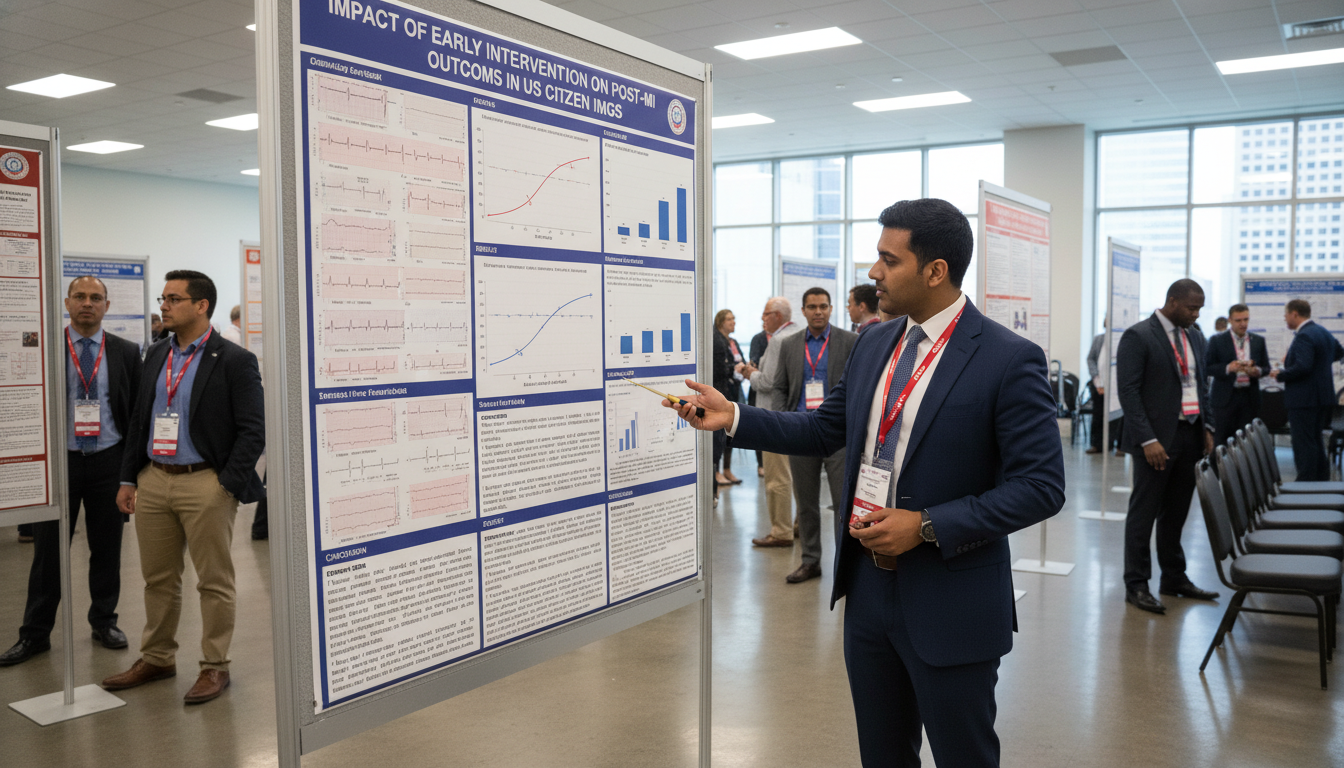
1. Case Reports and Case Series
Why they’re ideal early on:
- Fast to complete relative to larger studies
- Great for honing scientific writing skills
- High yield for conference abstracts and posters
Examples in cardiology:
- Takotsubo cardiomyopathy following unusual stressors
- Rare arrhythmias in young patients
- Uncommon complications of TAVR or PCI
- Unusual ECG findings in electrolyte disturbances
How to execute:
- Identify a striking or educational case during your rotation.
- Confirm novelty with a quick PubMed search.
- Ask your attending if they’re willing to be a co-author/mentor.
- Draft a structured report (introduction, case description, discussion, conclusion).
- Target a case report journal or submit as a poster to ACC/AHA.
While case reports carry limited weight alone, several of them—especially linked around a theme—demonstrate consistency and early initiative.
2. Retrospective Chart Reviews and Database Studies
These projects show greater methodological rigor and are particularly valued in cardiology.
Examples:
- Outcomes of HF patients admitted with concomitant AKI at your hospital
- Predictors of 30-day readmission after NSTEMI
- Adherence to guideline-directed medical therapy in reduced EF heart failure
- Anticoagulation strategies in AF patients with high fall risk
Key steps:
- Define a clear, focused research question.
- Get IRB approval (often through a mentor who knows the process).
- Use your hospital’s EMR and data warehouse, with IT/biostatistical support if available.
- Conduct basic data analysis (Chi-square, t-tests, logistic regression) with guidance.
For a US citizen IMG, being first author on one or two solid retrospective studies in cardiology can be a major strength in your fellowship application.
3. Quality Improvement (QI) Projects with Research Rigor
QI is a natural fit for resident schedules and can simultaneously count for program requirements and scholarly output.
Cardiology QI project ideas:
- Reducing door-to-balloon time delays for STEMI
- Improving adherence to DAPT (dual antiplatelet therapy) post-PCI
- Increasing use of SGLT2 inhibitors in eligible HF patients
- Standardizing discharge education for HF to reduce readmission
To convert QI work into stronger research:
- Use established QI frameworks (PDSA cycles, run charts, control charts).
- Collect pre- and post-intervention data systematically.
- Analyze and interpret results with statistical advice.
- Write it up as an abstract or manuscript for cardiology or hospital medicine conferences.
4. Educational and Curriculum-Based Research
If your passion leans toward medical education, you can blend this with cardiology content.
Examples:
- Designing and evaluating a curriculum for residents to interpret complex ECGs
- Creating an echo interpretation workshop for interns and measuring pre/post scores
- Studying the impact of simulation training for managing cardiogenic shock
Educational projects may be particularly appealing if you’re targeting a future academic residency track or teaching-oriented career.
5. Working Within an Academic Residency Track (If Available)
Some programs have a formal academic residency track or research track:
- Protected research time (e.g., 2–3 months per year)
- Assigned research mentors
- Monthly works-in-progress meetings
- Access to statisticians and methodologists
If your program offers this, it’s almost always worthwhile for a future cardiologist, especially as a US citizen IMG. The track signals to fellowship PDs that you’ve had structured scholarly training and used it productively.
If your program lacks a formal track, you can still:
- Informally structure your own “track” with recurring research blocks or elective time.
- Attend institutional research seminars or journal clubs.
- Seek out mentors who can teach you study design and analysis.
Balancing Clinical Demands With Research: A Practical Playbook
One of the biggest barriers to resident research projects is time. Long rotations, night float, and exam prep can easily overshadow scholarly work.
Here are practical strategies to make it sustainable.
Plan by PGY Year
PGY-1 (Foundation and Exposure)
Focus on:
- Learning the system and excelling clinically
- Identifying mentors and research interest areas
- Starting one small project (often a case report or QI project)
- Attending a few cardiology conferences or grand rounds when possible
PGY-2 (Production Phase)
This is often your key research year.
- Aim to launch at least one retrospective or QI-based project with strong methodology.
- Try to submit abstracts to regional or national conferences (ACC, AHA, local ACP).
- Build your skills in data analysis and manuscript writing.
- If interested in an academic residency track, solidify your involvement now.
PGY-3 (Consolidation and Fellowship Prep)
- Finalize and submit manuscripts from PGY-2 projects.
- Focus on presenting at conferences—these are highly visible to fellowship PDs.
- Align remaining projects with your specific cardiology interest (HF, EP, imaging, etc.).
- Make sure your mentors are prepared to comment on your research in letters of recommendation.
Build Weekly and Monthly Habits
- Set protected blocks: Even 2–4 hours per week on a consistent day can maintain momentum.
- Use lighter rotations: Clinic blocks, elective months, and ambulatory rotations are ideal for deep work.
- Batch tasks: Have “data-only” days, “analysis-only” days, and “writing-only” days to stay efficient.
- Use tools:
- Reference managers (Zotero, Mendeley)
- Project management apps (Trello, Notion) to track tasks
- Templates for abstracts, posters, and IRB protocols
Avoid Common Pitfalls
- Overcommitting early: It’s better to complete 1–2 projects than start 5 and finish none.
- Unclear authorship and expectations: Clarify your role with mentors at the beginning.
- Neglecting IRB and ethics: Always confirm whether your project needs IRB approval and follow institutional rules.
- Missing deadlines: Abstract deadlines for major cardiology meetings are often 6–9 months before the conference. Calendar them early.
Using Residency Research to Maximize Your Cardiology Fellowship Chances
You’re not doing research just to “check a box.” Every project should feed into a narrative that convinces a fellowship program:
“This candidate is a committed future cardiologist with a proven track record of scholarly productivity and the potential to contribute to our program’s academic mission.”
Crafting Your Research Narrative as a US Citizen IMG
As an IMG, your story matters. Use your research during residency to highlight:
- Resilience and initiative: You navigated medical training abroad, then built a research portfolio in the US on your own initiative.
- Progression: Show a clear timeline—earlier small projects leading to more sophisticated ones.
- Thematic focus: If possible, connect your work under a theme (e.g., heart failure outcomes, arrhythmias in special populations, cardiovascular risk in underserved groups).
How to Present Research on Your ERAS and in Interviews
On ERAS:
- List all abstracts, posters, and publications with full citations.
- Clearly indicate your authorship position and role.
- Don’t inflate contributions—programs value honesty.
In your personal statement:
- Mention one or two key projects, focusing on what you learned and how it shaped your interest in cardiology.
- Avoid listing everything; instead, build a coherent narrative.
In interviews:
- Be prepared to discuss methods, limitations, and implications of your projects.
- Be honest about your exact role—good interviewers can tell when details are vague.
- Show curiosity about how your research connects to ongoing work at the fellowship program.
Securing Strong Letters of Recommendation Based on Research
Aim for at least one letter from a cardiologist who knows you as both a clinician and researcher.
Choose mentors who can say:
- You worked reliably and met deadlines
- You understand basic study design and statistics
- You contributed intellectually, not just as a “data collector”
- You have clear potential to succeed in an academic cardiology environment
This is particularly essential for a US citizen IMG, as letters from respected academic cardiologists can substantially boost your credibility in the cards fellowship match.
FAQs: Research During Residency for US Citizen IMGs in Cardiology
1. How many publications do I need for a competitive cardiology fellowship?
There is no fixed number, but for a US citizen IMG, a strong target is:
- 1–2 first-author case reports or case series
- 1–2 first- or second-author retrospective or QI studies
- At least 1–2 national or major regional conference presentations
Quality and relevance to cardiology matter more than raw count. A single high-quality, cardiology-focused project with a national presentation and a pending or accepted manuscript can be as impactful as several smaller items.
2. Can I match cardiology without any research?
It’s possible, especially in less research-heavy programs, but substantially harder as a US citizen IMG. Research distinguishes you in a competitive pool. If your program truly has no cardiology research, aim for at least:
- A robust QI project with tangible outcomes
- One or two general internal medicine or hospital medicine studies with cardiovascular components
- Evidence of initiative (e.g., collaborating remotely with an external cardiology mentor)
3. What if I have no prior research experience before residency?
Many residents start with zero formal research background. Begin with:
- A case report or small QI project to learn the process and language
- Seeking out a mentor who is used to guiding beginners
- Attending institutional workshops on statistics, study design, and manuscript writing
Programs value growth. Showing that you developed research skills during residency is a strong positive signal.
4. Should I prioritize an academic residency track or a “strong clinical” program if I want cardiology?
If you’re a US citizen IMG aiming for cardiology, an academic residency track or a program with clear research infrastructure is generally advantageous. However:
- A clinically strong program with limited research can still be a launching pad if you actively seek external or remote projects.
- When ranking programs, ask specifically about resident research projects, cardiology mentorship, protected time, and past residents’ fellowship matches.
In the end, your initiative and how you use the opportunities available—whether in an academic track or not—will matter most.
By approaching your residency years with a clear strategy for research during residency, you can turn potential IMG disadvantages into strengths. Thoughtful, well-executed cardiology-focused projects will not only enhance your CV but also deepen your understanding of the field you hope to join—and move you one step closer to a successful cardiology fellowship match.