Understanding Research During Residency as a US Citizen IMG in Family Medicine
For many US citizen IMGs in family medicine, “research” can feel abstract, intimidating, or like something only academic powerhouses do. But research during residency is increasingly relevant for every family medicine resident—whether you ultimately want community practice, leadership, fellowship, or an academic career.
As an American studying abroad, you may have had limited access to structured research in medical school. The good news: residency is a fresh start. You can build a research portfolio, strengthen your CV, and open doors to leadership and advanced training—even if you’re starting from zero.
This article will walk you through:
- Why research matters in family medicine residency (even for community-focused careers)
- How US citizen IMGs can strategically leverage research opportunities
- The types of resident research projects that work well in FM
- Practical step-by-step strategies to get involved—without burning out
- How to use research to position yourself for fellowships, academic roles, and leadership
Why Research Matters in Family Medicine Residency for US Citizen IMGs
Research is not just for subspecialists or tertiary-care centers. In family medicine, research is tightly connected to what you do every day: patient care, systems-based practice, health equity, and quality improvement.
1. Strengthening Your Professional Identity as an IMG
As a US citizen IMG, you may sometimes feel you have more to prove—especially if you trained at a lesser-known international school. Research experience during residency can help:
- Demonstrate academic curiosity and initiative
- Show you can contribute beyond routine clinical care
- Differentiate you from peers when applying for chief resident roles, fellowships, or jobs
- Counterbalance any perceived disadvantages related to your medical school name or location
Program leadership and hiring committees see resident research output (posters, abstracts, manuscripts) as a signal that you’re engaged, disciplined, and capable of scholarly work.
2. Aligning with the Direction of Family Medicine
Family medicine is evolving quickly:
- Population health and value-based care
- Health equity and social determinants of health
- Telemedicine, digital health, and practice redesign
- Quality and safety metrics tied to reimbursement
Research—or more broadly, scholarly activity—is how the specialty tests new models of care, measures outcomes, and improves systems. Participating in these projects helps you:
- Understand metrics that drive clinic and hospital decisions
- Learn how to evaluate evidence and implement guidelines
- Become more effective at advocating for your patients and community
3. Supporting Future Goals: Fellowship, Academic Career, or Leadership
If you’re considering:
- Fellowships (sports medicine, geriatrics, palliative care, obstetrics, addiction medicine, hospice, academic medicine)
- An academic residency track or clinician-educator pathway
- A career in public health, quality improvement, or policy
Then research during residency is especially valuable. It can:
- Show fellowship directors that you can complete scholarly work
- Lead to letters from research mentors who know you well
- Make you more competitive for academic or leadership jobs
Even if you anticipate working in a busy community practice, research experience helps you become the colleague who can interpret new evidence, evaluate clinic data, and lead improvement efforts.
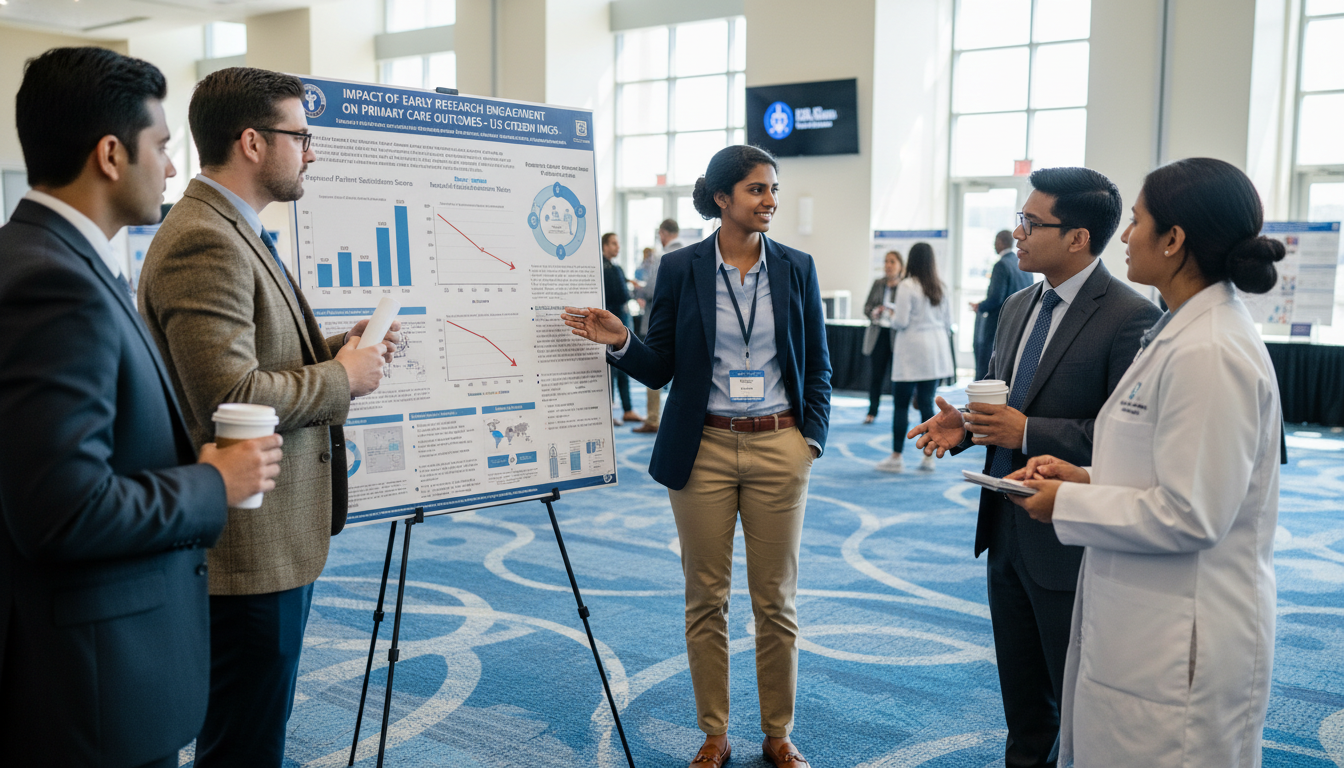
Types of Research and Scholarly Projects in Family Medicine Residency
“Research” in family medicine is broad. You do not need a bench lab or randomized trial to meaningfully contribute. Especially as a resident, the most realistic and high-yield projects fall into a few categories.
1. Quality Improvement (QI) and Patient Safety Projects
QI is often the most accessible entry point.
Examples:
- Reducing unnecessary antibiotic prescribing for upper respiratory infections
- Improving HbA1c control in patients with diabetes at your clinic
- Increasing colorectal cancer screening rates in an underserved population
- Streamlining follow-up after ED discharges to reduce readmissions
Why this is ideal for residents:
- Directly connected to your daily patient care
- Often required by ACGME and your residency program
- Easier to get IRB approval or use existing QI processes
- Can lead to posters, presentations, or even publications
As a US citizen IMG, QI can be your “gateway” into research: you learn basic methodology (PDSA cycles, process mapping, data collection) and begin to understand how to structure a project and present outcomes.
2. Clinical or Outcomes Research
These projects often use:
- Retrospective chart reviews (e.g., reviewing medical records over a defined period)
- Prospective observational data collection
- Registry or database analysis
Sample topics:
- Evaluating depression screening outcomes in your residency clinic
- Studying factors associated with poor blood pressure control in a specific population
- Assessing impact of a group visit model on diabetes or obesity outcomes
These typically require:
- A mentor with IRB experience
- A clear research question and protocol
- Commitment to data collection and analysis
For an American studying abroad who may have had limited statistics training, this is an excellent opportunity to build foundational skills in research design and data interpretation.
3. Educational Research and Curriculum Projects
If you like teaching or are considering an academic residency track, educational research is highly relevant.
Possible projects:
- Developing a curriculum on social determinants of health and measuring its impact
- Assessing residents’ comfort with LGBTQ+ health before and after a teaching intervention
- Evaluating the impact of a new simulation-based training on procedural skills
What you learn:
- Basic survey design and evaluation
- Pre/post assessment methods
- IRB considerations for educational studies
These projects can result in presentations at family medicine education conferences (e.g., STFM, AAFP National Conference).
4. Community and Public Health Research
Family medicine is deeply rooted in the community. Research may involve:
- Collaborating with local public health departments or community organizations
- Studying food insecurity, housing instability, or access to preventive services
- Evaluating community-based interventions (e.g., mobile clinics, school health programs)
This is particularly meaningful if you’re passionate about health equity or population health. As a US citizen IMG, you can integrate your personal experiences—often bridging cultures and systems—into projects that address care gaps in diverse populations.
5. Case Reports and Case Series
Case reports are an excellent starting point if you’re new to scholarly writing.
Examples:
- An unusual presentation of a common condition in primary care
- A rare disease first recognized in a family medicine clinic
- A significant medication side effect or diagnostic challenge
These are:
- Lower barrier to entry
- Good for learning the publication process
- Often co-authored with an attending
Publishing a case report shows initiative, attention to clinical detail, and willingness to follow through—key traits for more complex research later.
6. Narrative Reviews, Clinical Reviews, and Point-of-Care Tools
You can contribute to:
- Evidence-based review articles (e.g., “Hypertension management in older adults”)
- Guideline summaries or implementation tools
- Fast facts, pocket cards, or decision aids for your clinic
These projects sharpen your ability to critically appraise the literature and apply it to real patients.
How to Get Started with Resident Research Projects as a US Citizen IMG
If your medical school had limited research culture, it may be hard to know where to begin. Here’s a step-by-step strategy tailored to US citizen IMGs in family medicine.
Step 1: Clarify Your Goals
Ask yourself:
- Do I want research mainly to strengthen my CV and demonstrate scholarly activity?
- Am I considering a fellowship where research will be important?
- Am I drawn to teaching and possibly an academic residency track?
- Do I want to become a QI/leadership person in my future practice?
Your goals will shape:
- How ambitious your projects should be
- Whether you aim for publication or focus more on local impact
- The type of mentor you should seek
Step 2: Understand Your Program’s Research Culture
During interviews or early in intern year, gather information:
- Does the program have a research director or scholarly activity coordinator?
- Are there protected academic half-days or research blocks?
- Is there a track for residents interested in academic careers or research?
- What are recent resident abstracts, posters, or publications? (Ask to see examples.)
As a US citizen IMG, selecting or leveraging a program with even modest research support can make a big difference, especially if you didn’t get this foundation in medical school.
Step 3: Find a Mentor (or Two)
Good mentorship is more important than a brilliant idea.
Look for:
- Faculty who have presented or published in the last few years
- Attendings who attend academic conferences and are enthusiastic about teaching
- Someone whose interests overlap with yours (e.g., addiction, women’s health, geriatrics, health equity, medical education)
Practical tips:
- Email: “I’m interested in getting involved in resident research projects in family medicine, especially around [topic]. Could we meet briefly to discuss potential opportunities?”
- Come to the meeting with 1–2 broad ideas or areas of curiosity, but be open to their suggestions.
- Ask if there are ongoing projects that need a resident’s help (data collection, chart reviews, literature review, survey administration).
A good mentor will help you:
- Refine your question into something feasible for residency
- Navigate IRB approval and project logistics
- Stay on track and ultimately present or publish your work
Step 4: Start with a Feasible Project
Given competing clinical demands, especially in PGY-1 and PGY-2, choose something realistic:
- A case report plus a small QI project
- A focused chart review with a limited number of variables
- A single-site educational project with pre/post surveys
Examples feasible for a busy family medicine resident:
- QI: Implement a standardized depression screening tool and track screening rates over 6–12 months.
- Clinical: Retrospective chart review on rates of statin use in eligible diabetic patients in your clinic.
- Education: Introduce a brief teaching module on opioid prescribing and measure change in residents’ confidence scores.
Your first goal is not a high-impact journal; it is completion and learning the process.
Step 5: Learn Just Enough Methods and Stats—Strategically
As an American studying abroad, you may feel underprepared in biostatistics or research design. Don’t let that stop you. Use:
- Your institution’s library or online modules on basic research methods
- Free resources like the AAFP, STFM, or university webinars
- Short courses on QI, EBM, or research basics during residency
Focus on:
- Formulating a clear research question (PICO format can help)
- Understanding basic study designs (cross-sectional, cohort, case-control, RCT)
- Familiarity with descriptive statistics and simple tests (t-test, chi-square)
You don’t need to be a statistician; you do need to understand enough to discuss your project intelligently and interpret your results.
Step 6: Present Early and Often
Aim for:
- Local presentations: Residency academic days, hospital QI days
- Regional or national conferences: AAFP, NAPCRG, STFM, state academy meetings
Presentations:
- Are often easier to achieve than publications
- Count strongly as scholarly activity
- Help you practice describing your work succinctly and confidently
As a US citizen IMG, conference presentations also expand your professional network in US academic circles, which you may not have had access to during medical school abroad.
Step 7: Convert Finished Projects into Publications (When Possible)
With your mentor’s help:
- Target realistic journals (e.g., family medicine journals, QI-focused journals, education journals).
- Be open to writing brief reports or letters to the editor if the full article doesn’t work out.
- Accept that revisions and rejections are part of the process; they don’t diminish the value of the experience.
Even a handful of posters, one or two case reports, or a small QI paper can significantly enhance your scholarly profile by graduation.

Balancing Research During Residency Without Burning Out
Family medicine residency is demanding. You are learning broad clinical medicine, taking call, managing continuity clinic, and preparing for boards. It’s essential to approach research in a way that adds to, rather than undermines, your training.
Integrate Research with Your Clinical Work
Whenever possible, choose projects that:
- Use data from your own continuity clinic
- Target conditions or populations you care about and see frequently
- Align with existing QI or institutional priorities
This way, the time you spend on research reinforces your day-to-day practice.
Example:
If your clinic struggles with no-show rates among patients with chronic conditions, a QI project on appointment reminders or telehealth access improves your clinic and simultaneously becomes a scholarly product.
Use Structured Time Wisely
If your family medicine residency offers:
- Research or elective blocks
- Protected academic half-days
- A longitudinal scholarly activity curriculum
Plan in advance:
- Set specific goals for each week (“Complete IRB draft,” “Finish data collection on 50 charts,” “Write introduction and methods.”).
- Use a simple project management outline or Gantt chart (your mentor or a research coordinator can help).
As a US citizen IMG with potentially fewer local connections, being organized and proactive can help you stand out as reliable and capable.
Collaborate with Co-Residents
You don’t need to do everything alone.
- Join forces with co-residents who share interests.
- Divide tasks: literature review, data extraction, survey distribution, poster design.
- Rotate first-authorship roles across different projects.
Collaboration increases productivity and builds your academic network while lowering the individual time burden.
Set Boundaries and Priorities
You cannot—and should not—say yes to every opportunity.
- Prioritize 1–2 meaningful projects over many fragmented efforts.
- Discuss your limits with mentors honestly.
- Reassess annually: “What have I achieved? What is realistic for the coming year?”
Remember: your primary goal is to become a competent, compassionate family physician. Research should support, not replace, that mission.
Using Residency Research to Shape Your Future Career
Research during residency is not just about the CV line. It can actively shape your path after graduation.
For Residents Targeting Fellowships
If you’re thinking about sports medicine, geriatrics, academic medicine, addiction medicine, palliative care, or OB-focused fellowships:
- Choose topics that align with your planned fellowship (e.g., frailty assessment for geriatrics; chronic pain management for addiction medicine).
- Ask fellowship-trained faculty about unanswered questions or gaps in the literature.
- Present at specialty-specific conferences when possible.
Program directors will notice when your scholarly activity clearly supports your stated career direction.
For Residents Interested in an Academic Residency Track or Clinician-Educator Role
Research and scholarly output are particularly important if you envision:
- Teaching medical students and residents
- Leading curriculum development
- Taking on a faculty role soon after graduation
You may want to:
- Focus on education research and curriculum design
- Join your program’s academic or scholarly concentration track, if available
- Seek mentorship from faculty in education leadership roles
Your residency research can become the foundation for:
- Future educational grants
- Ongoing multi-year projects as junior faculty
- A portfolio for promotion and academic advancement
For Residents Planning Community or Private Practice
Even if you want a purely clinical family medicine job:
- Research experience makes you more appealing to practices or systems investing in quality and population health.
- You’ll be better equipped to lead practice-wide QI initiatives.
- You may become the “go-to” physician for interpreting new guidelines and practice data.
In an era of value-based care, experience with research during residency and QI methodologies is increasingly valuable—regardless of how “academic” your final job looks on paper.
FAQs: Research During Family Medicine Residency for US Citizen IMGs
1. I’m a US citizen IMG with almost no research from medical school. Is it too late to start in residency?
No. Family medicine residency is often where many physicians truly begin their research journey. Programs expect a wide range of prior experience, and being an IMG does not disqualify you. Start with achievable projects—QI, case reports, or small chart reviews—under good mentorship. Completion and consistency matter more than an impressive research history from day one.
2. Do I need research experience to match into a family medicine residency (FM match) as a US citizen IMG?
For the FM match, research is generally less critical than for highly competitive specialties. Strong US clinical experience, solid letters of recommendation, and a good fit with family medicine are usually more important. However, any research you’ve done (or can speak about thoughtfully) can help show maturity, curiosity, and dedication—especially if it connects to primary care, public health, or health equity.
3. How much research is “enough” during residency if I might want an academic career later?
There’s no fixed number, but a common pattern for residents heading into academic or fellowship paths is:
- 1–3 poster presentations (local, regional, or national)
- 1–2 publications (case reports, QI reports, or small studies)
- Clear involvement in at least one substantial project where you had ownership
Quality, continuity, and clear alignment with your interests are more important than raw quantity.
4. I’m worried about statistics and methods because my international school didn’t emphasize them. How can I bridge this gap?
Use residency as your training ground:
- Ask your mentor to walk you through study design decisions and basic stats for your project.
- Attend institutional workshops or online short courses in research methods and QI.
- Collaborate with a statistician through your hospital’s research office when available.
You don’t need to become an expert statistician; you need to understand the basics, ask good questions, and work effectively with methodologically skilled collaborators.
Research during residency is not about becoming a full-time scientist. For a US citizen IMG in family medicine, it’s about proving—to yourself and others—that you can ask meaningful questions, collect and interpret data, and use that knowledge to improve patient care and systems. With realistic goals, supportive mentorship, and strategically chosen projects, your time as a family medicine resident can launch a scholarly trajectory that enriches your entire career, whether in community practice, fellowship, or academic medicine.