Understanding Research During Pediatrics Residency as a US Citizen IMG
For a US citizen IMG (American studying abroad) entering pediatrics, “research during residency” can feel like a vague box you’re supposed to check—especially if your medical school abroad didn’t emphasize scholarly work. In US pediatrics programs, however, research is not just an optional extra; it is increasingly built into residency training and can shape your future career.
This article breaks down what research during residency actually looks like, how it works specifically in pediatrics, and how a US citizen IMG can leverage it for fellowship, academic careers, or simply becoming a stronger clinician.
You’ll learn:
- What “resident research” really means in pediatrics
- The differences between community vs academic residency tracks
- How to choose feasible resident research projects
- How to start with little to no prior research experience
- How to use research to stand out in the peds match and beyond
Why Research Matters in Pediatrics Residency for US Citizen IMGs
1. Aligning with Modern Pediatrics Training Expectations
Most pediatrics residency programs—community and university-based—now expect residents to participate in some form of scholarly activity. The ACGME (the US accreditation body for residencies) explicitly requires pediatric programs to provide opportunities for:
- Quality improvement (QI)
- Clinical or basic science research
- Educational or community health projects
For a US citizen IMG, showing you understand and value these expectations signals that you’re ready to integrate fully into US academic medicine culture.
2. Advantages for US Citizen IMGs Specifically
As a US citizen IMG (American studying abroad), you may feel you start with certain perceived disadvantages in the peds match:
- Fewer home institution connections in the US
- Sometimes fewer structured research opportunities during med school
- Less familiarity with US academic systems
Research during residency is one of the most powerful ways to:
- Build strong relationships with faculty who can advocate for you
- Demonstrate your academic potential regardless of where you went to med school
- Compete on equal footing (or better) for fellowships in neonatology, pediatric cardiology, pediatric critical care, heme/onc, and other subspecialties
3. How Programs View “Research During Residency”
Program directors in pediatrics typically view research in three main ways:
Required for graduation
- Many programs require at least one scholarly project by PGY-3.
- Often this is a QI project or a clinical research project with a poster or presentation.
Pathway to academic careers
- Some residents enter an academic residency track with structured time and mentorship to prepare for clinician–scientist or educator roles.
Signal of professionalism and curiosity
- Residents who complete meaningful research projects are often seen as organized, self-motivated, and able to manage complex tasks—traits that matter far beyond academia.
For US citizen IMGs, successfully navigating research during residency sends a powerful message: you can thrive in the US system and contribute at a high level.

Types of Research and Scholarly Activity in Pediatrics Residency
“Research” during residency is broader than just randomized controlled trials or bench science. Especially in pediatrics, your options span a wide range of project types, many of which are achievable even with a busy schedule and limited prior experience.
1. Quality Improvement (QI) Projects
Most common form of resident research in pediatrics. These projects aim to improve care processes and outcomes.
Examples:
- Increasing influenza vaccination rates in your continuity clinic
- Reducing unnecessary chest X-rays for bronchiolitis
- Improving asthma action plan documentation for hospitalized children
- Shortening time to antibiotic administration in febrile neonates
Why QI works well for residents:
- Directly connected to patient care
- Can be completed within 12–18 months
- Uses structured methods (PDSA cycles, run charts)
- Often built into program curricula
As a US citizen IMG, a strong QI project shows that you understand US quality and safety culture, which is highly valued.
2. Clinical Research
Clinical projects focus on real patients and outcomes, using chart reviews, databases, or prospective data collection.
Examples:
- Retrospective chart review of PICU admissions for status asthmaticus
- Comparing outcomes before and after a new sepsis protocol in pediatrics
- Studying factors associated with 30-day readmissions for children with chronic conditions
Pros:
- Highly relevant to patient care
- Often easier to publish than small QI projects if well-designed
- Builds skills in data analysis and critical thinking
Cons:
- Requires IRB approval and more planning
- May need statistical support
3. Educational Research and Curriculum Projects
Education-related projects are excellent for residents who enjoy teaching.
Examples:
- Designing and evaluating a resident curriculum for pediatric ECG interpretation
- Simulation-based training for pediatric resuscitation and studying its impact
- Creating a teaching module on adolescent mental health screening and measuring outcomes
These projects are a natural fit if you’re considering an academic residency track focused on medical education.
4. Community and Advocacy Projects
Pediatrics naturally intersects with public health, social determinants of health, and advocacy.
Examples:
- Community-based project improving vaccination awareness in immigrant populations
- Program to reduce food insecurity for families in your clinic
- Partnership with schools to address pediatric obesity or mental health
You can:
- Collect data before/after the intervention
- Present outcomes at local or national meetings (e.g., PAS, APA)
This path is especially meaningful if your background as an American studying abroad fuels an interest in health equity and culturally competent care.
5. Basic Science and Translational Research (Less Common but Possible)
More realistic in research-heavy academic centers.
Examples:
- Lab-based projects in immunology, genetics, or developmental biology
- Translational work linking lab findings to clinical pediatric outcomes
Consider these if:
- You have significant prior lab experience
- You are in (or planning to join) a research-intensive academic residency track
Choosing the Right Project and Mentor as a US Citizen IMG
The two most important decisions for research during residency:
- What project you pursue
- Who mentors you
1. How to Choose a Feasible Project
You will be busy. US pediatrics residency schedules are demanding, and as a US citizen IMG you may also be adjusting to a new healthcare system. Your project must be realistic.
Key criteria:
Scope:
Can it be completed within 12–24 months with limited protected time?- Good: Single-ward QI project, single-center chart review, modest educational study
- Risky: Multi-center projects, large prospective trials without strong infrastructure
Data access:
Is data easy to obtain from the EHR or existing registries? Are templates already used for documentation?IRB complexity:
QI projects sometimes qualify for expedited review or QI-only classification. Clinical research requires more extensive IRB review and planning.Statistical support:
Does your program have a biostatistician or research office? Can your mentor help with analysis or connect you with someone who can?
For first-time researchers, a QI or focused clinical project with a clear question is often the best starting point.
2. How to Find a Mentor in Your Program
As a US citizen IMG, mentorship is especially critical because you may lack pre-existing US academic contacts.
Practical steps:
Ask early (PGY-1):
During orientation or early rotations, ask your chief residents or program leadership:- “Which faculty frequently mentor resident research projects?”
- “Do we have a list of current or recent resident projects?”
Attend departmental conferences:
Grand rounds, journal clubs, and research conferences give you:- Names of active pediatric researchers
- A sense of who works in areas you care about (NICU, general peds, adolescent, etc.)
Leverage shared interests:
If you’re interested in neonatology, approach a neonatologist whose talk you enjoyed:- “I’m a first-year resident and a US citizen IMG very interested in neonatology and clinical research. Do you have any ongoing projects that might be suitable for a resident, or could you suggest someone I should talk to?”
Evaluate mentor fit, not just topic: A good mentor should:
- Have time for you (even 30–60 minutes per month)
- Be familiar with resident research timelines
- Help you navigate IRB, data access, and potential publication/presentation
- Be supportive of your background and goals
Red flags:
- No clear timeline or plan
- History of multiple unfinished resident projects
- Rarely responds to emails or meeting requests
3. Structuring the Research Relationship
Once you find a mentor:
Set expectations early:
- Target outputs: poster, abstract, manuscript, QI project summary
- Timeline: what should be done by the end of PGY-2 vs PGY-3
- Communication: how often you will meet and track progress
Clarify authorship:
- Discuss early: “If we complete this work, what might authorship look like?”
Typically, residents can be first authors on projects they lead.
- Discuss early: “If we complete this work, what might authorship look like?”
Ask for introductions:
- Your mentor can connect you with statisticians, research coordinators, lab staff, or other collaborators.
For a US citizen IMG, these connections significantly increase your integration into the department’s academic culture.
Practical Steps to Start and Complete a Resident Research Project
Step 1: Clarify Your Goals
Before choosing a project, understand what you want research during residency to do for you:
Strengthen fellowship applications?
Aim for projects with:- Clear abstract and manuscript potential
- Relevance to your desired subspecialty (e.g., NICU, PICU, cards, heme/onc)
Enhance your clinical practice and CV?
A solid QI project with visible clinical impact may be ideal.Prepare for an academic career?
Seek an academic residency track or physician-scientist pathway if your program has one.
Step 2: Narrow a Question That Fits Reality
Use a simple format:
Population – Intervention – Comparison – Outcome – Time frame (PICOT)
Example (QI in clinic):
- Population: Children with asthma in continuity clinic
- Intervention: Standardized asthma action plan template and provider education
- Comparison: Outcomes before vs after intervention
- Outcome: Percentage of patients with completed action plans, ED visits, oral steroid bursts
- Time frame: One year
Example (clinical research):
- Population: Children admitted with bronchiolitis
- Exposure: Use of bronchodilators vs no bronchodilators
- Outcome: Length of stay, need for oxygen, readmission
- Time frame: Past 3–5 years of data
Keep it tight. Narrow beats broad for resident projects.
Step 3: Get Early Input from Your Program
Talk to:
- Program director or associate program director for research
- Chief residents
- QI committee or hospital quality office
Ask:
- “Are there priority areas for QI or research in our department?”
- “Is there an existing database I can use instead of building one from scratch?”
- “Do you have templates for IRB applications or QI proposals?”
Many programs already have partially set-up projects that need a resident to move them forward.
Step 4: Navigate IRB and Institutional Requirements
Determine if it’s QI vs research:
Your hospital’s IRB can often tell you whether your project is:- Pure QI (may not require full IRB review)
- Human subjects research (requires IRB approval)
Complete required trainings:
- CITI training or similar human subjects protection course
- HIPAA and data privacy modules
Use examples:
- Ask peers or your mentor for a copy of a previously approved protocol.
As a US citizen IMG, this process will also teach you a lot about regulatory expectations in the US system—knowledge that will help long after residency.
Step 5: Manage Data and Time Efficiently
You will not have unlimited time.
Tips:
- Start small: Begin with a pilot sample or narrow timeframe.
- Schedule protected blocks: Use elective or research rotations intentionally for data collection and analysis.
- Use simple tools:
- REDCap, Excel, or institutional databases
- Basic descriptive statistics and simple comparisons (chi-square, t-tests) with help from statisticians
Plan to:
- Draft your abstract early (even in outline form)
- Update your mentor regularly on progress and roadblocks
Step 6: Disseminate Your Work
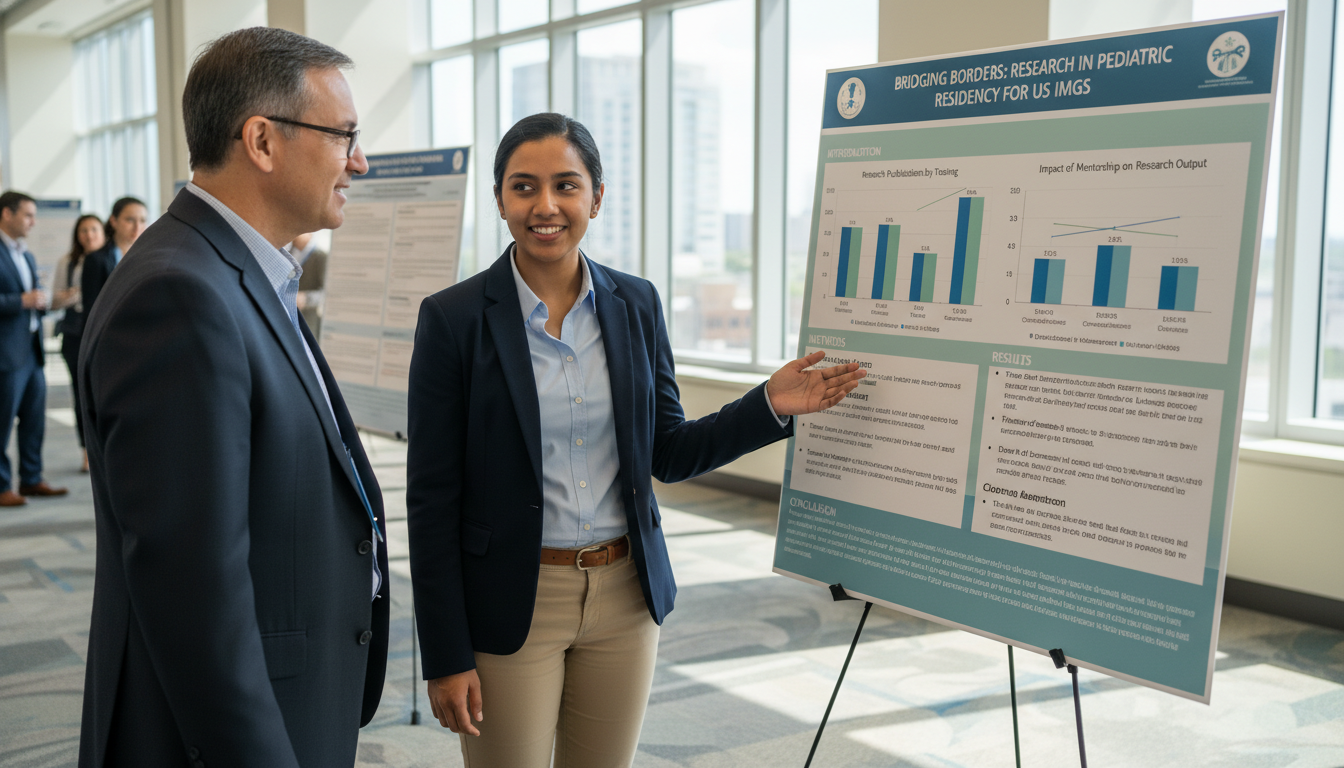
Aim for at least one form of dissemination:
Local presentations:
- Resident research day
- Departmental conferences
- Hospital QI/Patient Safety meetings
Regional/national meetings:
- PAS (Pediatric Academic Societies)
- AAP (American Academy of Pediatrics) Section meetings
- Specialty societies (e.g., SCCM Pediatric Section, ASPN, etc.)
Publications:
- Case reports (good for first-time publications)
- Short communications or brief reports for QI
- Full manuscripts for larger projects
On fellowship or job applications, you can list:
- Abstracts presented
- Posters or oral presentations
- Submitted or accepted manuscripts
For a US citizen IMG, these concrete outputs are often what differentiate you from peers with similar clinical training.
Using Research to Shape Your Pediatrics Career Path
1. Community vs Academic Residency Tracks
Not all peds programs have a formal academic residency track, but many have elements that function similarly.
Community-focused programs:
- Emphasis on clinical training and primary care
- Research more likely to be QI or community health projects
- Still possible to pursue research with university partners or hospital systems
- Great fit if your long-term goal is general pediatrics in the community, with some local QI or advocacy work
Academic programs/tracks:
- Stronger infrastructure for clinical or basic science research
- Protected research time, especially in PGY-2/3
- Access to statisticians, research coordinators, and grants
- Best suited if you’re interested in subspecialty fellowship or academic careers
As a US citizen IMG, you can match into either environment. Research during residency is feasible in both, but the scale and intensity may differ.
2. Research and the Peds Match (Looking Backward and Forward)
By the time you start residency, your peds match is behind you. But understanding how research fits into the match process helps you advise future students and plan future steps:
- For current med students (especially US citizen IMGs), even basic med school research or QI projects can strengthen your pediatrics residency application.
- For residents, ongoing research and scholarly work:
- Strengthens fellowship applications
- Can make you more competitive for chief resident positions
- Signals leadership potential and academic engagement
As you become a senior resident, you may help guide future US citizen IMGs and IMGs coming into your program—your research experience becomes part of that mentoring role.
3. Research Experience and Fellowship Applications
Residency research is nearly essential for competitive pediatric fellowships such as:
- Neonatology
- Pediatric cardiology
- Pediatric critical care
- Pediatric hematology/oncology
- Pediatric gastroenterology
- Pulmonology and others
Programs will look for:
- Demonstrated interest in the field (e.g., neonatology QI project if applying to NICU)
- Evidence of productivity (presentations, submissions, or publications)
- Strong letters from research mentors
As a US citizen IMG, fellowship programs may initially know less about your medical school but will fully understand:
- PAS poster presentations
- Peer-reviewed publications
- Major QI outcomes
These outputs legitimize your trajectory in a way that transcends your med school background.
4. Long-term: Building an Academic or Hybrid Career
With meaningful research during residency, you can:
- Apply for junior faculty positions at children’s hospitals
- Negotiate for protected research time in your first attending contract
- Pursue grants or further advanced degrees (MPH, MS in Clinical Research, etc.)
Many pediatricians ultimately choose hybrid roles:
- 60–80% clinical care
- 20–40% research, QI, or education
Your residency research is often the foundation for these later opportunities.
FAQs: Research During Pediatrics Residency for US Citizen IMGs
1. I’m a US citizen IMG with almost no prior research—can I still be successful?
Yes. Many residents (US-trained and IMGs) start residency with minimal research experience. What matters most is:
- Choosing a realistic, well-scoped project
- Finding a supportive mentor
- Showing consistent follow-through
If you build from scratch but complete one or two solid projects with a presentation or publication, you can absolutely be competitive for fellowships and academic roles.
2. How early in residency should I start working on a research project?
Ideally:
- PGY-1: Explore interests, attend research/QI meetings, identify potential mentors, and narrow your question.
- Late PGY-1 / early PGY-2: Formalize your project plan, submit IRB/QI proposal, start data collection or intervention.
- PGY-3: Focus on analysis, writing, and presenting your results.
Starting earlier gives you time to handle delays (IRB, data access, schedule conflicts).
3. Do I have to publish to benefit from research during residency?
Publication is ideal but not mandatory for benefit. You can still gain a lot from:
- Completed QI projects with measurable change
- Posters and presentations at local or regional meetings
- Strong mentor relationships and letters of recommendation
That said, if you’re aiming for competitive subspecialty fellowships, at least one peer-reviewed product (case report, brief report, or original paper) significantly strengthens your profile.
4. How can I balance research with clinical duties and board prep?
Strategies that work for many residents:
- Use research or elective blocks intentionally—protect that time as much as possible.
- Break the project into small, manageable steps (IRB, data collection, analysis, abstract, etc.).
- Schedule regular, brief check-ins with your mentor to stay accountable.
- Avoid overcommitting—one well-completed project is better than multiple unfinished ones.
- Integrate your research topic with your clinical learning (e.g., reading more deeply about your research area while studying for boards).
For a US citizen IMG adjusting to the US system, the key is realistic planning and consistent incremental progress rather than last-minute sprints.
By understanding the landscape of research during residency, choosing feasible resident research projects, and actively seeking an academic residency track or mentor where appropriate, you can turn research from an intimidating obligation into a powerful tool. As a US citizen IMG in pediatrics, this is one of the clearest ways to demonstrate your commitment, capability, and long-term value in the US healthcare system.