Why Research During Nuclear Medicine Residency Matters for an MD Graduate
For an MD graduate entering a nuclear medicine residency, research is no longer “extra credit”—it is increasingly part of the core identity of the specialty. Nuclear medicine is driven by innovation: new tracers, hybrid imaging technologies, theranostics, quantitative imaging, and AI-based analysis are all research-heavy domains that quickly translate to clinical care.
Engaging in resident research projects during training can:
- Strengthen your clinical reasoning and understanding of imaging biology
- Open doors to competitive fellowships and academic positions
- Position you for leadership roles in hospitals, industry, or regulatory agencies
- Improve your odds in an allopathic medical school match for advanced training and combined pathways (e.g., diagnostic radiology + nuclear medicine)
For an MD graduate residency path, especially in a field as technology- and data-intensive as nuclear medicine, research is a strategic investment—not just a CV filler.
Overview of Research Opportunities in Nuclear Medicine Residency
Nuclear medicine uniquely bridges radiology, oncology, cardiology, endocrinology, and molecular biology. As a resident, you can tap into diverse kinds of projects.
1. Clinical Imaging Research
These projects investigate how we use existing or new imaging techniques in patient care.
Common themes:
Optimization of protocols:
- Reducing radiation dose in PET/CT while maintaining diagnostic quality
- Streamlining SPECT protocols for cardiac perfusion
Comparative effectiveness:
- Comparing [^68Ga]-DOTATATE PET/CT with Octreoscan in neuroendocrine tumors
- Evaluating PSMA PET vs conventional imaging in prostate cancer staging
Diagnostic performance studies:
- Sensitivity/specificity of FDG PET for fever of unknown origin
- PET/CT vs MRI for detection of bone metastases
These projects are ideal entry points because they often rely on retrospective chart review of imaging studies already performed in your department.
2. Theranostics and Molecular Therapy Research
Theranostics is a growth engine for nuclear medicine. Residents often get involved in:
Outcomes research in radionuclide therapies:
- Lutetium-177 PSMA for metastatic prostate cancer
- Lutetium-177 DOTATATE for neuroendocrine tumors
- I-131 therapy for differentiated thyroid carcinoma
Toxicity and safety analyses:
- Renal dose constraints in peptide receptor radionuclide therapy (PRRT)
- Hematologic toxicity predictors after multiple therapy cycles
Dosimetry research:
- Patient-specific dosimetry protocols
- Correlating absorbed dose with clinical response
If you are considering an academic residency track, theranostics research is particularly high-yield for long-term career growth.
3. Quantitative Imaging, AI, and Image Analysis
Nuclear medicine is at the forefront of quantitative and AI-driven imaging. Projects may include:
Radiomics and machine learning:
- Using textural features on PET to predict tumor grade or response
- AI-based segmentation of lesions to reduce physician workload
Quantitative PET/SPECT:
- Standard uptake value (SUV) harmonization across scanners
- Reproducibility of quantitative measures in multi-center studies
Workflow and efficiency tools:
- AI triage of urgent scans
- Smart reporting templates based on structured data
These projects often require collaboration with physicists, engineers, or data scientists, which is valuable for building interdisciplinary research skills.
4. Translational and Basic Science Nuclear Medicine Projects
If you trained in an MD/PhD track or have strong bench science interest, you can leverage that in:
Tracer development:
- Testing novel PET tracers in animal models
- Biodistribution and pharmacokinetics analysis
Preclinical imaging:
- Small-animal PET/SPECT for oncology, neurology, or cardiology models
- Evaluating response to experimental drugs using molecular imaging biomarkers
Radiobiology and radionuclide therapy mechanisms:
- DNA damage pathways
- Tumor microenvironment changes after radionuclide treatment
These projects are often more time-intensive but are highly valued in academic residency tracks and for future R01-level research careers.
5. Educational and Quality Improvement (QI) Projects
Not all impactful research is lab-heavy. Many residents successfully publish:
Educational research:
- Novel curricula for teaching nuclear medicine to internal medicine residents
- Simulation-based learning for radioiodine therapy safety
Quality improvement projects:
- Reducing report turnaround time for urgent oncology PET scans
- Minimizing errors in radiopharmaceutical dosing or labeling
- Standardizing structured reporting templates
QI work can often be completed in shorter time frames and more easily dovetailed with clinical responsibilities.
Getting Started: Choosing the Right Research Path as a Nuclear Medicine Resident
Clarify Your Career Direction Early
Your research strategy should align with your long-term goals:
Academic nuclear medicine / academic radiology
- Prioritize original research, prospective studies, and multi-center projects
- Aim for first-author publications and national presentations
- Seek mentors with active grants and a track record of training residents
Hybrid clinical/imaging leadership (e.g., director of nuclear medicine, theranostics center lead)
- Focus on clinical outcomes, protocol optimization, and theranostics research
- Engage in QI and implementation-focused projects
- Build experience leading multidisciplinary initiatives
Industry, pharma, or radiopharmaceutical development
- Get involved in tracer development, dosimetry, or clinical trial design
- Gain experience with regulatory processes (INDs, FDA submissions)
- Network with industry partners during trials and conferences
Primarily clinical practice
- At least 1–2 solid projects demonstrate scholarly activity
- Focus on feasible retrospective or QI projects that result in a publication or poster
Even if you are undecided, exploring different resident research projects early in training will help you clarify your trajectory.
Find the Right Mentor and Research Environment
A strong mentor can be more important than the specific topic.
Look for:
Track record:
- Regular publications in nuclear medicine or radiology journals
- Participation in national or international imaging societies
- Experience guiding residents or fellows to successful projects
Availability and structure:
- Scheduled research meetings
- Clear expectations about timelines and roles
- Access to data, statisticians, and institutional infrastructure
Alignment with your interests:
- If you love oncology, choose a mentor active in oncologic PET or theranostics
- If you’re drawn to physics or AI, collaborate with medical physicists or data scientists
Ask senior residents in your MD graduate residency program who the most effective research mentors are. Their experience will help you avoid stalled or unsupported projects.
Select Projects That Match Your Training Timeline
Nuclear medicine residencies are relatively short (often 2–3 years, or part of an integrated diagnostic radiology + nuclear pathway). Choose projects with a realistic scope.
Typical project timelines:
Short-term (3–6 months)
- Case reports or small case series
- QI projects with simple metrics (e.g., report turnaround time)
- Educational innovations (development and pilot of a module)
Medium-term (6–18 months)
- Retrospective imaging outcome studies
- Dosimetry analyses from existing therapy patients
- Radiomics pilot projects
Long-term (18–36+ months)
- Prospective clinical trials
- Multi-center collaborations
- Basic/translational lab projects requiring experiments and animal approval
Your portfolio should include at least one medium-term project likely to yield a full manuscript by graduation.
Practical Steps: Designing and Executing Resident Research Projects
Step 1: Formulate a Focused Research Question
A good research question is:
- Specific (clearly defined population, imaging test, outcome)
- Feasible (doable with your department’s data and resources)
- Clinically meaningful (answers a question that matters to practice)
Examples:
“In patients with suspected recurrent differentiated thyroid carcinoma, does I-123 diagnostic whole-body scan combined with neck ultrasound improve detection of loco-regional recurrence compared with ultrasound alone?”
“Among patients with metastatic castrate-resistant prostate cancer treated with Lu-177 PSMA, what clinical or imaging factors predict hematologic toxicity?”
Use the PICO framework (Population, Intervention, Comparator, Outcome) to refine your question.
Step 2: Check Feasibility and Data Availability
Before you commit:
Estimate your sample size
- Ask: How many patients/year meet your criteria? Over how many years can you reasonably collect data?
- Determine whether your proposed effect size is likely detectable
Confirm data sources
- PACS (imaging data, reports)
- Electronic medical record (labs, clinical outcomes)
- Nuclear medicine information system (doses, radiopharmaceuticals)
Assess support
- Is a statistician available through your department or institution?
- Is there IT help for data extraction?
Step 3: Navigate Ethics and Institutional Review Board (IRB) Approval
Even retrospective chart reviews often require formal review or exemption.
Core steps:
- Write a concise protocol: background, objectives, methods, inclusion/exclusion criteria, data to be collected, and statistical plan.
- Complete required IRB training modules (e.g., CITI program).
- Submit the IRB application with mentor oversight.
- Address revision requests promptly.
This process teaches you essential aspects of research governance that will be valuable in academia or industry.
Step 4: Data Collection and Management
Good data handling is foundational.
- Create a data dictionary: define each variable, how it is measured, and allowed values.
- Use secure platforms (e.g., REDCap) if available.
- De-identify data according to IRB requirements.
- Keep a log of any data cleaning decisions (e.g., how you define “non-diagnostic scan”).
Example: For a project on FDG PET in lymphoma, variables might include:
- Demographics: age, sex
- Disease-specific: lymphoma subtype, stage, International Prognostic Index
- Imaging: baseline SUVmax, response classification (Deauville score)
- Outcomes: progression-free survival, overall survival, treatment regimen
Step 5: Statistical Analysis and Interpretation
Even if you’re not a statistician, you must understand the basics.
Common analyses in nuclear medicine:
- Descriptive statistics (means, medians, standard deviations, proportions)
- Comparisons of groups (t-test, chi-square, Mann-Whitney U)
- ROC curves to evaluate diagnostic performance
- Survival analysis (Kaplan-Meier, Cox regression) for outcome studies
Work closely with a statistician and document:
- Your primary endpoint
- Secondary endpoints
- How you will handle missing data
- Any planned subgroup analyses
Step 6: Writing and Disseminating Your Work
Aim for submission-quality manuscripts, not just internal presentations.
Typical structure:
- Abstract
- Introduction (problem statement, brief literature review, study goal)
- Methods (transparent and reproducible)
- Results (clear tables/figures, avoid over-interpretation)
- Discussion (interpretation, comparison with prior studies, limitations, implications)
- Conclusion (concise, clinically focused)
Where to submit:
- Specialty journals (e.g., Journal of Nuclear Medicine, Clinical Nuclear Medicine, European Journal of Nuclear Medicine and Molecular Imaging)
- Radiology/imaging journals
- Sub-specialty or organ-system journals depending on your topic
Also present at:
- SNMMI (Society of Nuclear Medicine and Molecular Imaging)
- RSNA (Radiological Society of North America)
- Regional and institutional research days
These conferences are powerful networking venues and boost your profile if you later pursue an academic residency track or fellowship.
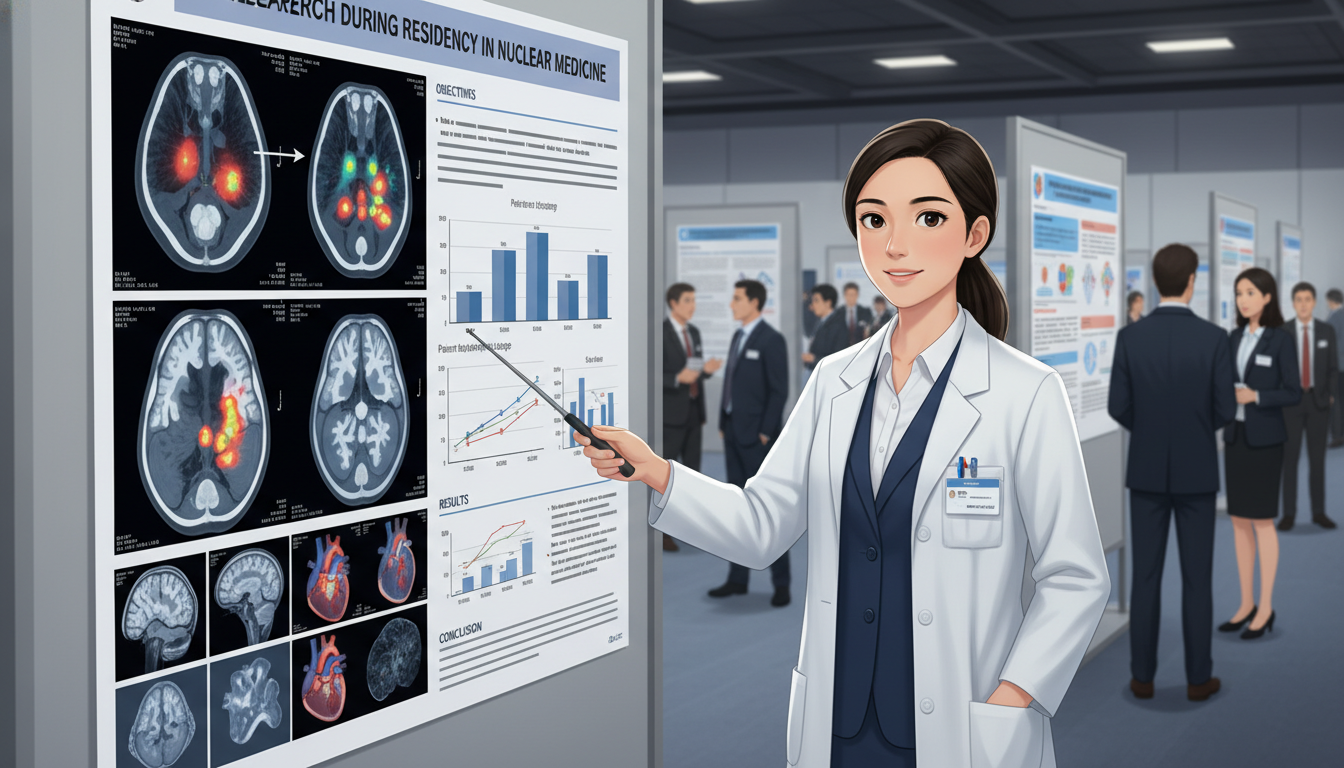
Balancing Clinical Training and Research During Residency
Time Management Strategies
Nuclear medicine residency is intense. To successfully integrate research during residency:
- Block off protected research time whenever possible (half-day or full-day per week)
- Use on-call downtime for: literature review, data cleaning, manuscript editing
- Set concrete, time-bound goals with your mentor (e.g., “complete data collection by month X”)
- Maintain a simple project management tracker (e.g., spreadsheet with tasks, deadlines)
Avoid spreading yourself too thin; 2–3 high-quality projects are more impactful than 8 unfinished ones.
Build a Small but Reliable Research Team
Instead of working entirely alone:
- Collaborate with:
- Co-residents (to share data collection and writing)
- Fellows (who can provide subspecialty insight)
- Physicists, statisticians, and IT staff
Clear role distribution:
- One person leads IRB and protocol
- Another focuses on data extraction and tables
- Another takes first pass on manuscript drafting
Define authorship expectations early to prevent conflict later.
Integrate Research With Your Learning Goals
When your research aligns with your clinical cases, both improve.
Examples:
- If you’re researching nuclear medicine residency applications of PSMA PET, pay special attention to all prostate cancer cases and therapy follow-ups.
- If you are involved in dosimetry research, volunteer for hands-on participation in dosimetry calculation for therapy patients.
- For AI projects, learn how the algorithms work by reviewing a few cases manually and comparing them to AI outputs.
This integration makes every clinical day an opportunity for hypothesis generation and data interpretation.
How Research Shapes Your Future Nuclear Medicine Career
Impact on Fellowship and Advanced Training Applications
If you plan to pursue additional training (e.g., diagnostic radiology, PET/MRI fellowship, or further subspecialization), a strong research record can:
- Distinguish you in a competitive allopathic medical school match for advanced programs
- Demonstrate sustained academic interest rather than last-minute CV padding
- Provide strong letters of recommendation from research mentors
Programs particularly value:
- First-author publications
- Presentations at national meetings
- Evidence of initiative (e.g., starting a multi-institutional collaboration)
Academic vs Non-Academic Career Pathways
If you envision an academic residency track or an academic attending role:
- Strive for a coherent research theme (e.g., theranostics, AI, neuroimaging) rather than completely unrelated scattered projects
- Seek opportunities to co-author reviews or textbook chapters
- Learn about grant mechanisms (e.g., NIH K awards, society grants)
For primarily clinical practice:
- A compact but credible portfolio (1–3 papers, 2–3 posters) still adds significant value
- Research experience makes you more effective at evaluating new technologies, guidelines, and therapeutic options in daily practice
Non-Traditional and Industry Careers
Research experience during nuclear medicine residency is also useful for:
- Pharmaceutical/radiopharmaceutical industry: trial design, biomarker validation, regulatory submissions
- Medical device and imaging companies: scanner optimization, software development, AI imaging tools
- Regulatory and governmental agencies: evaluation of new tracers, radiation safety policy, health technology assessment
Skills you develop through residency research—critical thinking, statistics, protocol design, data interpretation—translate well into these roles.
FAQs: Research During Nuclear Medicine Residency for MD Graduates
1. Do I need extensive research experience in medical school to succeed in nuclear medicine residency research?
No. Many MD graduates begin serious research for the first time during residency. What matters more is:
- Willingness to learn research methods
- Choosing good mentors and feasible projects
- Consistent effort over time
Your early projects might be simpler (retrospective reviews, QI) and can progress to more advanced work as you gain experience.
2. How many research projects or publications should I aim for during nuclear medicine residency?
There is no universal number, but a common benchmark for an MD graduate residency trainee aiming at an academic path is:
- 1–3 first-author publications
- Several conference presentations or posters
- Possibly 1 multi-center or prospective project in collaboration with senior faculty
If your goal is primarily clinical practice, 1 solid publication and a couple of posters still offer substantial benefit.
3. Can I realistically do research if my residency has limited formal protected time?
Yes, but you must be strategic:
- Choose smaller, more focused projects that match your bandwidth
- Collaborate with residents and fellows to share workload
- Use call downtime and lighter rotations for data analysis and writing
- Seek out mentors experienced in working with busy residents
Even in resource-limited settings, QI projects and retrospective chart reviews can be impactful and publishable.
4. How do I choose between clinical projects (e.g., PET outcomes) and more technical ones (e.g., AI, dosimetry)?
Base your decision on:
- Your personal interests (patients vs algorithms vs radiation physics)
- Available mentorship (who in your department can guide you effectively?)
- Long-term goals:
- Academic imaging scientist → AI/dosimetry/translational work
- Clinician-educator → clinical outcomes, QI, educational research
- Hybrid academic clinician → combination of clinical and quantitative imaging projects
You can start with a clinical project to build foundational skills and then add a more technical project if you identify strong collaborators.
Engaging in research during residency is one of the most powerful ways for an MD graduate in nuclear medicine to shape a fulfilling, future-proof career. Start early, choose your mentors wisely, and align your projects with both your interests and realistic timelines. Over the course of your training, your research will not only enhance your CV—it will deepen your understanding of nuclear medicine and expand the impact you can have on patient care and the field as a whole.