
Understanding Research During OB GYN Residency as a Non-US Citizen IMG
For a non-US citizen IMG (international medical graduate), research during OB GYN residency is more than a CV booster—it can determine your long‑term career trajectory in the United States. Whether you envision a future in academic medicine, subspecialty fellowship (MFM, REI, Gyn Onc, FPMRS), or leadership in global women’s health, strategically planned resident research projects are often essential.
At the same time, non-US citizen IMGs face unique challenges: visa constraints, unfamiliar research culture, variable mentorship, and sometimes fewer opportunities in community programs. This guide explains how to navigate those challenges, maximize your research potential, and align your work with a sustainable academic residency track in Obstetrics & Gynecology.
We’ll focus specifically on what a foreign national medical graduate needs to know to succeed in research during residency, from internship through graduation.
Why Research Matters for Non‑US Citizen IMGs in OB GYN
1. Differentiating Yourself in a Competitive Field
Obstetrics & Gynecology is increasingly competitive, especially for a non-US citizen IMG. Research makes you stand out in several ways:
Evidence of academic productivity
Publications, posters, and presentations show you can ask meaningful questions, analyze data, and communicate findings.Signal of long‑term commitment
Programs and future employers see research as a marker that you’re invested in advancing the field, not just “getting any job.”Foundation for subspecialty fellowship
Most fellowships in Maternal–Fetal Medicine, Gynecologic Oncology, Reproductive Endocrinology & Infertility, and Female Pelvic Medicine & Reconstructive Surgery heavily favor applicants with OB GYN–relevant research.
For a foreign national medical graduate, strong research may help offset perceived disadvantages such as lack of a US medical school pedigree or limited US clinical experience.
2. Enhancing Your Obstetrics Match Competitiveness (If You’re Still Applying)
If you haven’t matched into OB GYN yet and are planning a future application, research is valuable in two ways:
- Before residency (as a medical student or research fellow)
Demonstrates early interest and commitment to women’s health. - Signals readiness for an academic track
Programs with a strong research mission look for applicants already comfortable with basic research methods and scholarly work.
Even if your publications are not in OB GYN specifically, showing the ability to complete scholarly projects is helpful. However, whenever possible, anchor your work to women’s health, reproductive health, health disparities, or global health in obstetrics and gynecology.
3. Building a Long-Term Academic Residency Track
Many US OB GYN programs now define explicit research or academic residency track options. For a non-US citizen IMG, pursuing this pathway can:
- Provide protected research time
- Connect you with grant-funded mentors
- Support conference travel and presentations
- Position you for faculty roles or advanced fellowships
Research is not only about getting “points” for applications; it is about building a skill set that supports leadership in guideline development, quality improvement (QI), clinical trials, and policy in women’s health.
Types of Research Opportunities During OB GYN Residency
A realistic understanding of what research you can do while meeting clinical responsibilities is crucial. Below are the most common types of research available in OB GYN residency, with examples tailored to non-US citizen IMGs.
1. Clinical Research
Clinical research is the most accessible and common type of project during residency.
Examples of clinical OB GYN research projects:
Retrospective chart review
- Induction versus expectant management in late preterm preeclampsia
- Outcomes of trial of labor after cesarean (TOLAC) at your institution
- Postpartum hemorrhage management patterns and outcomes
Prospective observational studies
- Patient satisfaction with shared decision-making for mode of delivery
- Rates of postpartum depression screening and follow-up
Interventional pilot projects
- Implementation of a new labor progress protocol and its impact on cesarean rates
- Adoption of a standardized hemorrhage bundle and maternal outcomes
Retrospective chart reviews are often easiest to start as a resident: they rely on existing data and can be completed with modest protected time.
2. Quality Improvement (QI) and Patient Safety Projects
Many OB GYN programs require a QI project, which can double as a research opportunity if designed rigorously.
Examples:
- Reducing 3rd and 4th degree perineal laceration rates through provider education and protocol changes.
- Improving group B strep screening and treatment adherence on the L&D unit.
- Increasing contraception counseling documentation at postpartum visits.
QI projects can become publishable manuscripts or poster presentations if you:
- Use established QI methods (PDSA cycles, run charts, process maps).
- Collect pre- and post-intervention data.
- Clearly define outcome and process measures.
3. Basic Science and Translational Research
These projects are more time-consuming but can be highly impactful, particularly for residents targeting academic careers.
Common OB GYN basic science themes:
- Placental biology and preeclampsia mechanisms
- Ovarian cancer cell lines and targeted therapies
- Endometriosis pathophysiology and inflammation
- Reproductive endocrinology and fertility research
As a foreign national medical graduate, basic science opportunities depend on whether your residency program is affiliated with a research-intensive university and whether you can secure protected block time in a lab (e.g., 3–6 months during PGY3 or PGY4).
4. Educational Research
Educational research focuses on how we teach and train OB GYN residents and students.
Examples:
- Evaluating a simulation-based curriculum for shoulder dystocia management.
- Measuring improvements in residents’ laparoscopic skills after a boot camp.
- Assessing the impact of a new ultrasound training module.
For IMGs, this can be a great way to blend your own experiences in different education systems with scholarship in medical education.
5. Health Services and Health Disparities Research
Health services and disparities research is especially relevant if you are committed to global women’s health or working with underserved populations.
Sample topics:
- Differences in cesarean delivery rates by insurance status or ethnicity.
- Barriers to prenatal care for non-English-speaking patients.
- Access to postpartum contraception in low-resource settings or safety-net clinics.
As a non-US citizen IMG, your multinational perspective can be an asset when conceptualizing these projects, particularly if you can compare patterns between your home country and US healthcare systems.
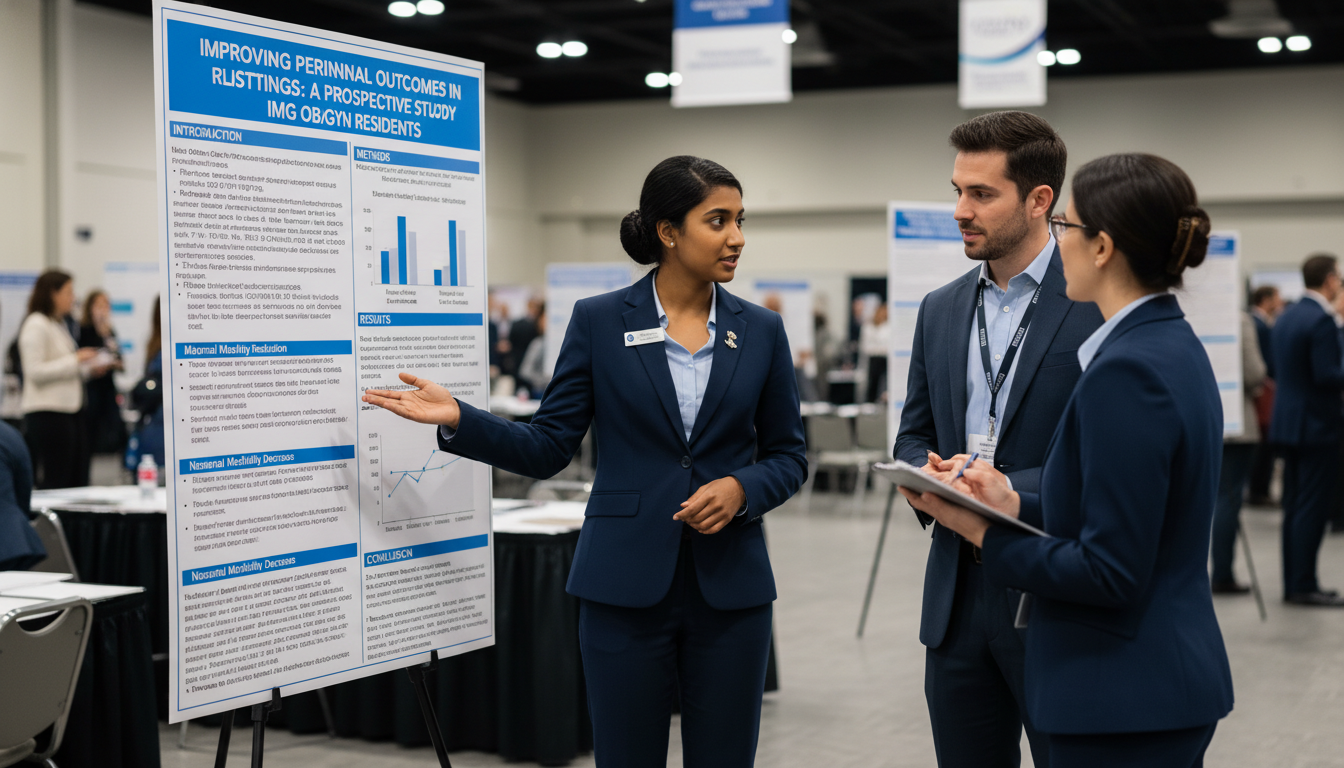
Navigating Visa and Institutional Barriers as a Foreign National Medical Graduate
Visa status matters for research—especially if you aim for grant funding, extended research blocks, or post-residency academic positions.
1. J-1 vs H-1B: Practical Implications for Research
J-1 Visa (ECFMG-sponsored)
- The most common visa for non-US citizen IMGs in residency.
- Generally allows residency training and usual research during residency.
- Limitations mainly appear when pursuing postdoctoral research or non-clinical research positions after residency, due to the 2-year home-country physical presence requirement (unless you obtain a waiver).
Impact on research during residency:
- You can participate fully in clinical and institutional research.
- You may apply for some internal institutional research grants.
- Federal grants (like NIH F32) are more limited for non-citizens, but you may be listed as co-investigator, research assistant, or collaborator.
H-1B Visa
- Less common for initial residency but seen more often for fellowships and attending positions.
- Can offer slightly more flexibility for longer-term research positions or faculty roles after training.
- For pure research-only roles, institutions sometimes prefer other visa categories (e.g., O-1 for extraordinary ability).
2. Key Questions to Ask Your Program About Research and Visa Issues
When interviewing or early in PGY1, ask:
- “Do residents have formal protected research time? How is it scheduled?”
- “Are there any visiting scholar or research fellow options for graduates on my visa type?”
- “Have previous non-US citizen IMG residents successfully published or presented research? What helped them succeed?”
- “Does your institution have an Office of Research or Clinical and Translational Science Institute (CTSI) that supports foreign national investigators?”
These questions help you gauge whether the environment will actively support your research ambitions.
3. Funding and Grant Eligibility
Many major US research grants require US citizenship or permanent residency. Still, you have options:
- Internal department grants (small pilot funds, resident research awards)
- Hospital foundation grants
- Professional society grants (e.g., ACOG section grants, SGO/SMFM small awards)
- Travel grants to present at conferences
Collaborating with a US citizen mentor as principal investigator (PI) while you act as a co-investigator or project leader can help bypass some eligibility limitations.
Step-by-Step Strategy to Build a Strong Research Portfolio During Residency
Step 1: Clarify Your Long-Term Goals Early
During your PGY1 year (or even before starting):
- Decide whether you are leaning toward:
- Academic career and faculty role
- Subspecialty fellowship (MFM, Gyn Onc, REI, FPMRS, Complex Family Planning)
- Clinically-focused general OB GYN, maybe with QI or leadership roles
Your research strategy should align with these goals. For example:
- Future MFM fellow: Focus on high-risk pregnancy, preterm birth, hypertension, diabetes in pregnancy, or perinatal epidemiology.
- Future Gyn Onc: Engage in oncologic outcomes, chemotherapy trials, surgical outcomes, or translational tumor biology.
- Future REI: Participate in projects on infertility, PCOS, IVF outcomes, or reproductive endocrinology.
Step 2: Identify the Right Mentor
Mentorship is the single most important factor in successful research during residency.
Qualities of a strong research mentor:
- Active in publishing within OB GYN or your subspecialty interest.
- Familiar with guiding residents and IMGs specifically.
- Responsive and consistent in feedback.
- Realistic about time constraints in residency.
Approach potential mentors:
- During rotations, ask attendings about their current projects.
- Attend department research meetings or grand rounds and note who presents frequently.
- Ask senior residents, especially other IMGs, which faculty are supportive of resident research projects.
When you meet, ask:
- “What current projects could a resident realistically lead or join?”
- “What timeline do you envision for manuscript submission?”
- “Have you worked with non-US citizen IMG residents before?”
Step 3: Start with One Achievable Project
For PGY1–PGY2, pick one main project that:
- Has clearly defined endpoints
- Fits into your available time and data access
- Has high likelihood of leading to at least a poster or abstract, and preferably a paper
A small retrospective clinical study or a well-designed QI project is often ideal. Once you’re comfortable, you can add more.
Pro tip for IMGs: Avoid overcommitting to 5–7 projects at once. Completing 1–3 strong projects is better than starting many and finishing none.
Step 4: Learn Essential Research Skills Efficiently
You do not need a PhD to do good research during residency, but you do need foundational skills:
- Study design basics: cohort, case-control, cross-sectional, RCTs
- Statistics: basic descriptive stats, logistic regression, p-values, confidence intervals
- Ethics & IRB process: consent, privacy, vulnerable populations in OB GYN
- Manuscript writing and abstract formatting
Resources for efficient learning:
- Free institutional workshops offered by your hospital or university.
- Online courses via Coursera/edX (biostatistics, epidemiology).
- ACOG and SMFM webinars on research and QI.
- Collaborating with biostatisticians through your department or CTSI.
Step 5: Understand the IRB and Data Access Process
Every resident research project involving patient data must go through the Institutional Review Board (IRB) or equivalent ethics committee.
Key steps:
- Develop a clear protocol: research question, hypothesis, methodology, inclusion/exclusion criteria, statistical plan.
- Prepare required documents: protocol, data collection instruments, consent forms (if needed), HIPAA forms.
- Submit with your mentor as PI: as a resident, you might be co-investigator.
- Respond to queries: IRB may request clarifications; address them promptly.
For a non-US citizen IMG unfamiliar with US regulations, pay special attention to:
- HIPAA rules around patient identifiers.
- Rules for vulnerable populations (pregnant individuals are often considered a vulnerable group).
- Data storage and de-identification requirements.
Step 6: Write, Present, and Publish
To transform your resident research projects into tangible academic outputs:
Aim for at least 1–2 abstracts/year
Submit to:- ACOG Annual Clinical & Scientific Meeting
- SMFM (for MFM-related work)
- SGO (for oncology topics)
- ASRM (for REI-focused projects)
- Local chapter meetings or institutional research days
Convert your best work into full manuscripts
Target journals that commonly publish resident or trainee-led OB GYN work. Your mentor can recommend suitable journals.Track your portfolio carefully
Maintain a spreadsheet or CV including:- Project title and role (e.g., first author, co-author).
- Conference abstracts and posters.
- Submitted, accepted, and published manuscripts.
This portfolio becomes essential when applying for fellowships, teaching positions, or future research grants.

Balancing Clinical Work and Research: Practical Tips for Non-US Citizen IMGs
The biggest challenge for any resident—including a non-US citizen IMG—is juggling heavy OB GYN clinical duties with research responsibilities.
1. Use Your Rotation Schedule Strategically
- Front-load idea generation and protocol development during less demanding rotations (e.g., gyne clinic, elective, night float with some downtime).
- Reserve more intense tasks like data collection and analysis for months when you have predictable off-duty time.
- Schedule manuscript writing during vacation or lighter rotations if possible.
2. Protect Your Time and Set Realistic Milestones
Work with your mentor to create a written timeline:
- Month 1–2: Finalize research question and literature review.
- Month 3–4: IRB submission and approval.
- Month 5–8: Data collection and preliminary analysis.
- Month 9–10: Abstract submission for a conference.
- Month 11–12: Manuscript drafting.
Use brief, regular check-ins:
- Short (15–20 min) meetings every 2–4 weeks can keep the project moving.
- Send an agenda or progress summary by email beforehand.
3. Leverage Teamwork
You don’t have to do everything alone:
- Partner with co-residents: one handles data abstraction; another focuses on analysis or writing.
- Involve medical students: they can help with chart review under your supervision—this also builds your teaching portfolio.
- Collaborate with biostatisticians: they can refine your study design and analysis, ensuring that the results are publishable.
4. Manage Cultural and Communication Challenges
Non-US citizen IMGs may feel hesitant to ask questions or to say “no” to excessive research tasks offered by faculty. Be proactive and assertive:
- Clarify expectations: “Given my clinical schedule, do you feel it is realistic to complete this project in one year?”
- Ask for explicit roles and timelines at project outset.
- Politely decline additional projects when you are at capacity: “I appreciate the opportunity, but I want to ensure I can fully complete my current project before starting another.”
5. Turn Everyday Clinical Work into Research Ideas
As you rotate through L&D, clinics, and GYN OR, constantly ask:
- “What pattern am I seeing repeatedly?”
- “Where are our outcomes not ideal?”
- “What process is inefficient or variable?”
Examples:
- High unplanned hysterectomy rates after cesarean for placenta accreta spectrum → retrospective outcomes study.
- Many postpartum patients missing 6-week follow-up → QI project on postpartum telehealth or early check-ins.
- Variation in prophylactic antibiotic use for gynecologic surgery → audit and protocol standardization.
These real-world observations often yield the most clinically relevant, publishable projects.
Frequently Asked Questions (FAQ)
1. I am a non-US citizen IMG with minimal prior research experience. Can I still do meaningful research during OB GYN residency?
Yes. Many residents start with little research background. Focus on:
- Finding a supportive mentor used to working with residents.
- Starting with a small, focused project (e.g., retrospective chart review or QI project).
- Using institutional resources such as research workshops, librarian support, and biostatistical consulting.
Over three to four years, you can still develop a strong record of resident research projects, especially if you convert them into abstracts and papers.
2. How many publications do I need if I want a subspecialty OB GYN fellowship?
There is no absolute number, but for competitive fellowships (MFM, Gyn Onc, REI), many successful applicants have:
- 1–3 first-author abstracts/posters, and
- At least 1–2 peer-reviewed publications (not necessarily all OB GYN, but ideally women’s health related).
Quality, relevance, and your role in the project matter more than the raw count. Being first author on a well-executed study often carries more weight than being one of many co-authors on a large project.
3. Does my visa status limit my ability to do research during residency?
For almost all clinical and institutional resident projects, your visa status (J-1 or H-1B) does not limit your participation. You may face restrictions only when:
- Applying for certain federal grants that require US citizenship or permanent residence.
- Seeking non-clinical, research-only positions after residency on a J-1 without a waiver.
During residency, you can still:
- Design and conduct projects.
- Present at national conferences.
- Publish in peer-reviewed journals.
- Apply for institutional or society-based small grants.
4. Should I prioritize research or clinical performance as a non-US citizen IMG?
You must never compromise your clinical performance for research. Residency programs and fellowship directors in OB GYN view:
- Strong clinical skills and professionalism as non-negotiable.
- Research and academic productivity as a powerful differentiator once clinical competence is assured.
Aim to:
- Meet or exceed expectations on clinical rotations.
- Use your non-clinical time efficiently for research.
- Communicate early with mentors about your schedule and workload to avoid burnout.
Research during residency offers non-US citizen IMGs in OB GYN a powerful route to leadership, fellowship, and long-term success in US academic medicine. By choosing the right projects, mentors, and strategies—and staying mindful of visa considerations—you can build a robust academic profile while excelling clinically and contributing meaningfully to women’s health.