Why Research During Residency Matters for Non‑US Citizen IMGs in Clinical Informatics
For a non-US citizen IMG interested in clinical informatics, research during residency is not optional—it is one of your most powerful tools to:
- Stand out in a competitive job and fellowship market
- Demonstrate you can thrive in a US academic environment
- Build a clear narrative from “foreign national medical graduate” to “future clinical informatics leader”
- Compensate for visa and eligibility constraints that sometimes limit traditional pathways
Clinical informatics is a data-driven specialty. Program directors and future mentors expect you to be comfortable with:
- Asking structured questions about care processes or digital tools
- Working with data (EHR data, quality metrics, workflow logs)
- Implementing and evaluating interventions (e.g., decision support tools, dashboards, mobile apps)
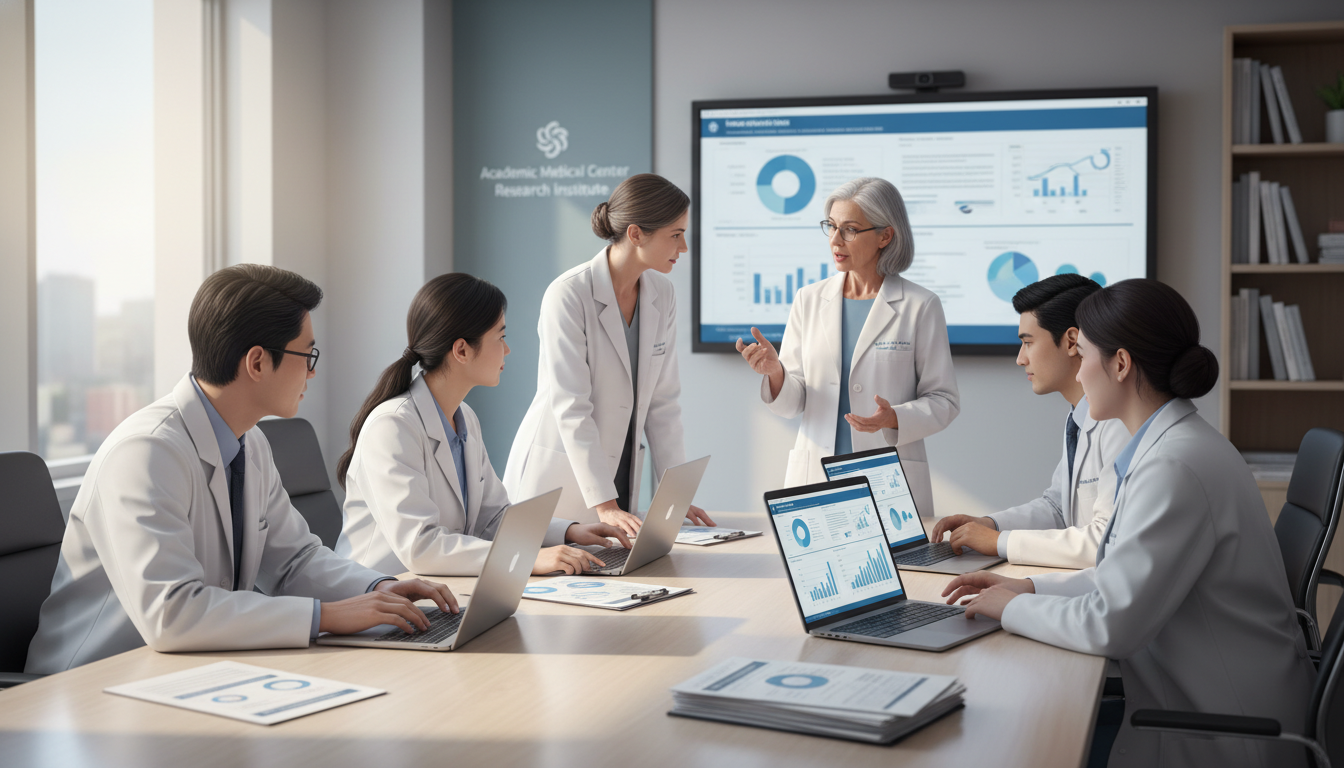
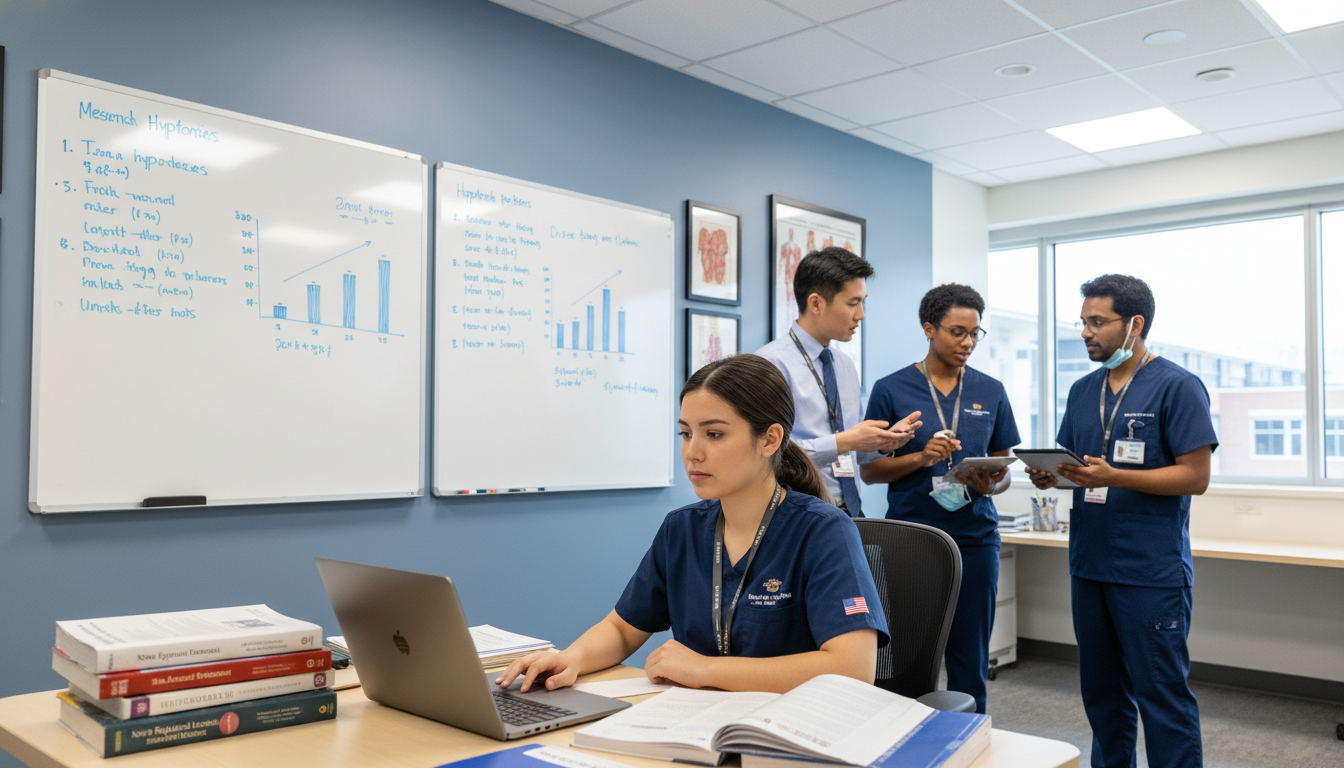
Research during residency—especially as part of an academic residency track—lets you practice these skills in a protected, supported environment. For a non-US citizen IMG, it can also help:
- Demonstrate your ability to work within US regulations (HIPAA, IRB processes)
- Build US-based letters of recommendation with concrete examples of your contributions
- Create a credible path to a clinical informatics fellowship or health IT training program
The rest of this article walks through how to plan, start, and leverage resident research projects specifically tailored to clinical informatics and the unique needs of non-US citizen IMGs.
Understanding the Landscape: Research, Residency, and Clinical Informatics
What “Research During Residency” Really Means
Research during residency can range from small quality improvement (QI) initiatives to complex data science projects. Most clinical informatics–oriented opportunities fall into one of four overlapping categories:
Quality Improvement / Patient Safety Projects
- Focus: Improving care processes (medication safety, test ordering, documentation quality).
- Methods: PDSA cycles, run charts, pre/post data comparison.
- Informatics angle: Using EHR tools, alerts, order sets, templates.
Health IT Implementation & Evaluation
- Focus: Rolling out or improving digital tools (CPOE, telemedicine modules, clinical decision support).
- Methods: Usability studies, workflow analysis, mixed-methods research.
- Informatics angle: Understanding how technology supports or harms workflows.
Data Analytics / Outcomes Research
- Focus: Leveraging EHR or registry data to answer clinical or operational questions.
- Methods: Retrospective cohort studies, predictive modeling, data visualization.
- Informatics angle: Data extraction, cleaning, and analysis; translating patterns into practice change.
Education and Human Factors
- Focus: Training clinicians to use IT tools, understanding how users interact with technology.
- Methods: Surveys, interviews, simulations, usability testing.
- Informatics angle: Interface design, cognitive load, decision support design principles.
As a resident, you might not become an expert in all of these, but one or two solid projects can signal to clinical informatics fellowship directors that you “speak the language” and can contribute from day one.
How Clinical Informatics Fellowships View Resident Research
Clinical informatics fellowship and health IT training program directors look for:
- Evidence of sustained interest in informatics
- Completion of at least one meaningful project where you saw a question from idea to analysis or implementation
- Basic comfort with data (e.g., spreadsheets, R, Python, SQL are a plus but not always mandatory)
- Ability to work in interdisciplinary teams (IT, nursing, administration, quality improvement)
- Understanding of real-world constraints (workflow, regulations, user acceptance)
For a non-US citizen IMG, these expectations are the same—but your research portfolio can also:
- Show that you can independently navigate the US research system
- Offset concerns about unfamiliarity with US healthcare workflows
- Provide concrete achievements that overcome biases based on school name or country of training
Unique Considerations for Non‑US Citizen IMGs
Visa Status and Institutional Restrictions
As a foreign national medical graduate, your visa type (J-1, H-1B, or others) can influence aspects of research during residency:
Funding eligibility:
- Some national grants (e.g., NIH F or T awards) may be limited to US citizens/permanent residents.
- Internal hospital or university funds are often more flexible and open to non-US citizen IMG applicants.
Employment and moonlighting:
- Some visa types restrict moonlighting or paid research work.
- Voluntary research and scholarly activity are usually fine—you’re doing it as part of residency training.
Travel for conferences:
- Ensure international travel doesn’t conflict with visa requirements (especially J-1 and re-entry issues).
- Plan ahead for visa renewal timelines if conferences are near those dates.
Action point: Early in PGY-1, meet with Graduate Medical Education (GME) and your program coordinator to clarify:
- Any limits on external funding
- Rules about research time counting as work vs. volunteer
- Requirements for travel approval and reimbursements
Building US-Based Research Credibility
Coming from outside the US, you may have excellent research from your home country, but clinical informatics fellowship selection committees often weigh US-based work more heavily because it:
- Uses US EHR systems, coding, and documentation standards
- Demonstrates familiarity with HIPAA and US regulatory frameworks
- Shows you can collaborate with US-based IT, QI, and administrative teams
Your goal in residency should be to:
- Anchor your prior work by connecting it to US-based projects (“In my home institution we did X; in my current project we adapted that to Y in the US system”).
- Secure at least two strong US-based research mentors who know your skills directly.
- Produce US-affiliated outputs: abstracts, posters, local presentations, and, ideally, peer-reviewed publications.
Overcoming Common Barriers as a Non-US Citizen IMG
Some typical challenges and ways to address them:
Feeling unsure about US research norms
- Solution: Attend your institution’s “research 101” or QI workshops, ask to shadow a senior resident’s project, review example IRB applications.
Limited initial network
- Solution: Introduce yourself early to:
- Program research director or vice chair for research
- Chief medical information officer (CMIO) or informatics lead
- Quality improvement office staff
- Express clear interest: “I am a non-US citizen IMG aiming for a clinical informatics fellowship. I’d like to get involved in resident research projects related to EHR, health IT, or data analytics.”
- Solution: Introduce yourself early to:
Lack of coding or analytics background
- Solution: Start with clinically grounded projects that use:
- Excel or basic statistical software
- Support from biostatistics or data teams
- Then gradually build skills in R, Python, or SQL through free online courses and small side analyses.
- Solution: Start with clinically grounded projects that use:
Finding and Designing the Right Research Project
Step 1: Map Your Environment
Before choosing a project, understand what’s possible at your residency program:
Systems and tools in use:
- Which EHR is used (Epic, Cerner, Meditech, etc.)?
- Is there a data warehouse or analytics team?
- Are there existing dashboards or reporting tools?
Active research areas:
- Are there ongoing informatics or QI initiatives (e.g., sepsis alerts, telehealth rollout, documentation redesign)?
- Which attendings or fellows are already doing clinical informatics or health IT training–related work?
Institutional priorities:
- Many hospitals have annual QI goals (readmissions, MIPS measures, patient portal sign-ups).
- Aligning your project with these priorities can unlock support, data access, and mentorship.
Practical tip: Spend one afternoon reviewing your hospital’s quality reports, institutional newsletters, and informatics committee summaries. Then schedule brief meetings with:
- The QI director
- Someone from the clinical informatics or IT team
- The residency research liaison
Ask them: “If a motivated resident wanted to help with informatics-related resident research projects, where would you start?”
Step 2: Choose a Clinical Informatics–Focused Question
Effective resident research projects share three qualities:
- Clinically relevant
- Feasible within 1–2 years
- Clearly connected to clinical informatics
Some practical examples:
EHR Alerts & Decision Support
- “Does a redesigned sepsis alert reduce alert fatigue while maintaining sensitivity?”
- “Can a more targeted medication interaction alert reduce override rates?”
Order Sets and Care Pathways
- “Does implementation of a standardized order set for heart failure discharge improve guideline-based therapy use?”
Patient Portal and Telehealth
- “What are the barriers for non-English speaking patients to using the patient portal?”
- “How did telehealth rollout affect visit no-show rates in our primary care clinic?”
Documentation & Workflow
- “Does use of a structured note template improve completion of discharge education elements?”
- “What is the effect of a scribe or AI-assisted documentation on clinic throughput?”
Step 3: Design a Feasible Study as a Resident
You don’t need to design a randomized trial. For a resident, strong options include:
Pre-post interventions:
- Measure a baseline (e.g., ordering pattern), introduce a change (new order set), then measure again.
Retrospective cohort studies using EHR data:
- Compare outcomes or processes before and after implementation of a tool, or between units using vs. not using a feature.
Mixed-methods studies:
- Combine surveys or interviews (qualitative) with usage data or clinical outcomes (quantitative).
Try to keep your first main project:
- Scope-limited (e.g., one unit, one clinic, one condition)
- Time-limited (e.g., data from 6–12 months)
- Dependent on existing data rather than requiring labor-intensive prospective data collection
Step 4: Build a Supportive Team
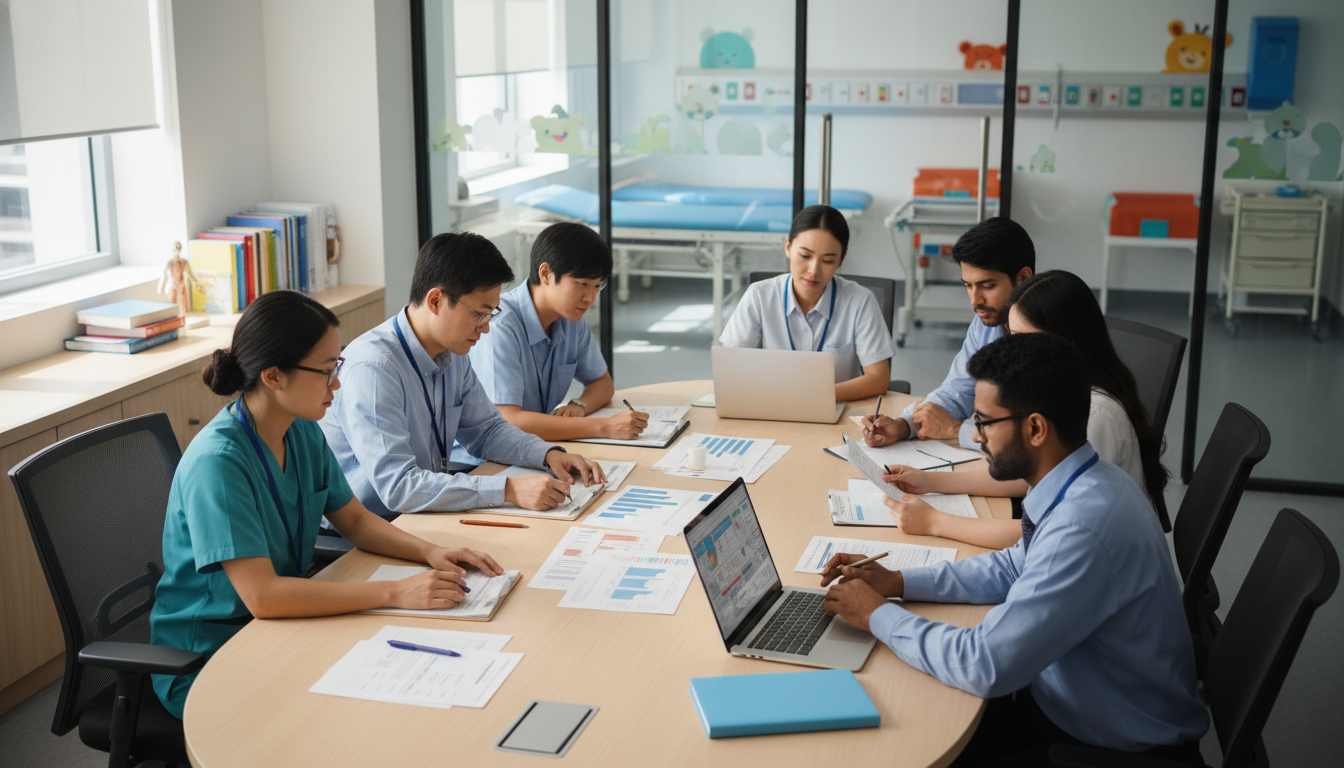
Strong teams for resident research projects in informatics usually include:
- Clinical mentor (attending in your specialty)
- Informatics mentor (CMIO, informatics fellow, or faculty with clinical informatics background)
- Data/analytics support person (data analyst, biostatistician, or research informatics staff)
- Quality improvement liaison (if your project intersects with hospital QI goals)
As a non-US citizen IMG, explicitly share your long-term goal:
“I am interested in a clinical informatics fellowship; I’d like this project to help me build both skills and a track record in this area.”
Mentors are more likely to invest when they see a clear trajectory.

Executing and Showcasing Resident Research Projects
Navigating IRB and Regulatory Issues
As a foreign national medical graduate, participating in IRB-regulated research is also a chance to show you understand US compliance expectations.
Key steps:
Determine if your project is QI or research
- Many informatics/QI projects qualify as QI and may have expedited review processes.
- Ask your mentor or institutional review board office early.
Complete required training
- Most institutions require CITI or similar human subjects research training.
- This is an important line on your CV, especially as a non-US citizen IMG.
Data governance
- Learn your hospital’s rules on:
- De-identification
- Data sharing and storage
- Use of personal devices and cloud tools
- Strict adherence strengthens trust in you as an IMG managing sensitive data.
- Learn your hospital’s rules on:
Practical Project Management During Residency
Balancing clinical duties and research is challenging. Practical strategies include:
Integrate research with rotations
- Choose projects connected to your continuity clinic or a specific ward you rotate on frequently.
- Use down time (between admissions, after rounds) for small analysis tasks instead of starting from scratch each time.
Use simple tracking tools
- Maintain a shared folder with:
- Protocol drafts
- Data dictionaries
- Analysis scripts or spreadsheets
- Presentation slides
- Track tasks in a simple spreadsheet or project management app (Trello, Notion, etc.).
- Maintain a shared folder with:
Set regular check-ins
- Weekly or biweekly brief meetings with your mentors keep momentum and identify roadblocks early.
Turning Work Into Scholarly Output
Research during residency only helps you long-term if it produces visible outputs. Aim for multiple layers of dissemination:
Local presentations
- Department grand rounds, morbidity and mortality conferences, QI days.
- These are relatively easy to obtain and good practice for larger stages.
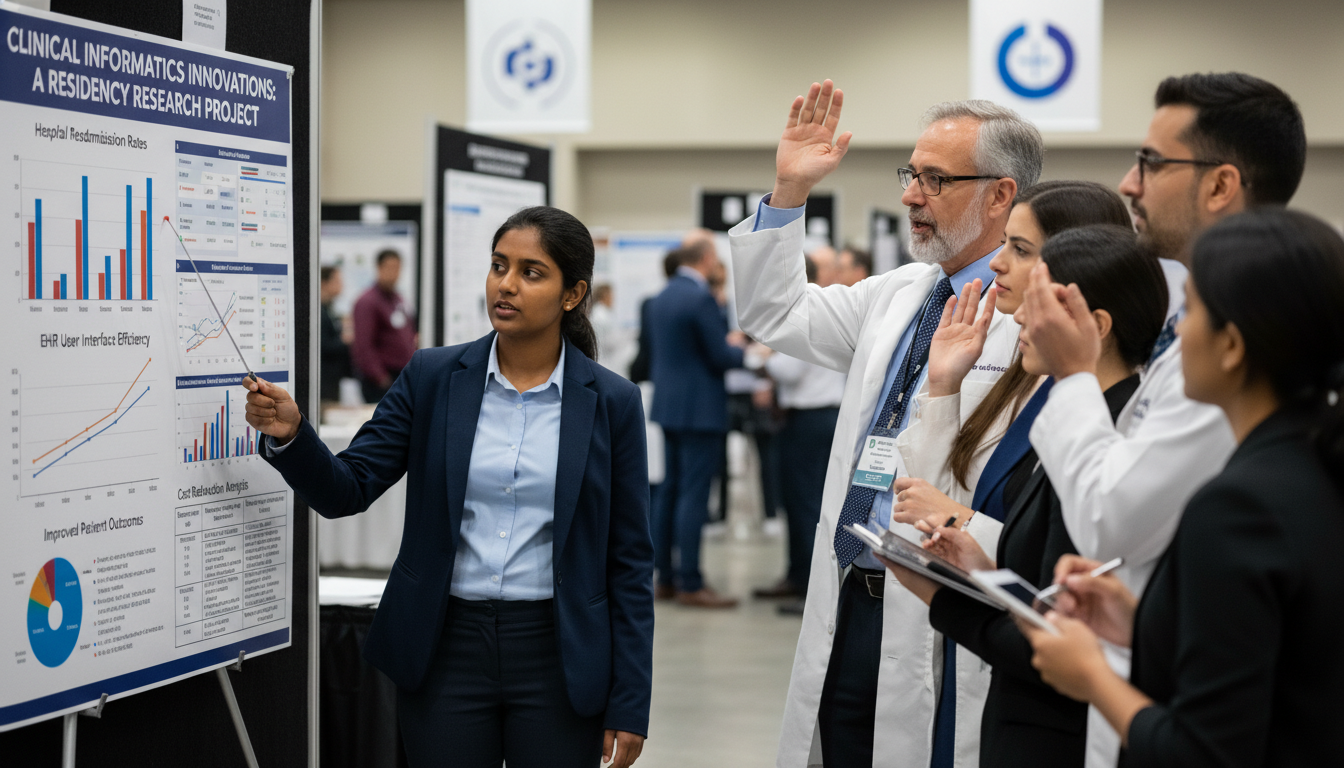
Posters at regional or national meetings
- Societies relevant to clinical informatics include:
- AMIA (American Medical Informatics Association)
- Specialty-specific informatics committees (e.g., HIMSS, SCCM informatics sections, internal medicine societies with IT/QI tracks)
- Plan timelines: abstract deadlines may be 6–9 months before conferences.
- Societies relevant to clinical informatics include:
Manuscripts
- Target journals that welcome:
- Brief reports or “innovations” pieces in informatics
- Quality improvement reports
- EHR implementation and evaluation case studies
- Target journals that welcome:
As a non-US citizen IMG, these outputs are critical: they provide objective evidence of your productivity and your ability to see projects through completion.
Aligning Research With an Academic Residency Track and Future Clinical Informatics Fellowship
Using an Academic Residency Track to Your Advantage
If your program has an academic residency track (research, clinician-educator, or QI track), joining it can provide:
- Protected research time
- Formal mentorship and coursework (e.g., research design, statistics)
- A structured environment and timeline
For a non-US citizen IMG, participating in an academic residency track:
- Signals commitment to academics despite visa or background differences
- Helps you build a cohesive story: “I came to the US, selected an academic track focused on informatics and QI, and produced X, Y, and Z outcomes.”
If your program doesn’t have a formal track, create an informal one for yourself by:
- Consolidating elective time into blocks you can dedicate to research
- Enrolling in institution-provided short courses on data analysis or implementation science
- Requesting a “scholarly concentration” with clear goals and deliverables
Positioning Your Research for Clinical Informatics Fellowship Applications
When you apply for a clinical informatics fellowship or similar health IT training programs, your applications should explicitly highlight:
Your main informatics research project(s)
- The problem you addressed
- The data/tools you used
- The outcomes or insights you produced
- Any resulting changes in practice or systems
Your role and leadership
- Were you the primary designer, data extractor, analyst, or presenter?
- Did you coordinate between IT, clinicians, and administrators?
Your skills portfolio
- Data skills: familiarity with databases, EHR structures, basic statistics
- Process skills: workflow mapping, user feedback gathering, pilot testing
- Professional skills: communication with non-clinical stakeholders, project management
In your personal statement, connect your journey as a foreign national medical graduate to your research:
“As a non-US citizen IMG, I have experienced diverse health systems. During residency, I leveraged this background to lead a project improving EHR-based sepsis alerts, integrating global perspectives on resource utilization with US standards of care.”
This framing turns what might be perceived as a disadvantage (being an IMG) into a unique strength supported by research achievements.
FAQs: Research During Residency for Non‑US Citizen IMGs in Clinical Informatics
1. I’m a non-US citizen IMG with no prior informatics research. Is it too late to start during residency?
No. Many successful clinical informatics fellows start with minimal prior research. The key is to:
- Start early in PGY-1 or PGY-2
- Choose one or two focused projects aligned with clinical informatics
- Seek mentors who can guide both the science and the practical aspects of EHR/data usage
- Produce at least a poster and ideally a publication by the end of residency
Your trajectory matters more than your starting point. Demonstrating rapid growth, initiative, and completion of a well-designed project carries significant weight.
2. How can I find mentors for clinical informatics research in a community-based or smaller program?
Even at smaller programs you can often:
- Identify the physician who works most closely with IT or EHR optimization (often an unofficial informatics lead)
- Ask your program leadership to connect you with the health system’s CMIO or informatics committee
- Seek external mentors:
- Through professional societies (AMIA, HIMSS physician groups)
- By contacting faculty at academic centers doing similar work and offering to collaborate on multi-site or remote projects
Combine local support (for data and IRB access) with external expertise (for project framing and publication strategy).
3. Do I need programming skills (R, Python, SQL) to be competitive for clinical informatics fellowship?
They are helpful but not mandatory. Strong clinical informatics fellows:
- Understand data structures, variables, and basic statistics
- Can collaborate effectively with data analysts and engineers
- Have at least some hands-on familiarity with data manipulation
During residency:
- Start with Excel or institution-provided tools (e.g., REDCap)
- Take beginner-friendly online courses in R or Python if time allows
- Try small personal projects: simple EHR exports, basic descriptive analyses
Your resident research projects can showcase your conceptual understanding even if you’re not yet an expert programmer.
4. How can research help overcome biases that non-US citizen IMGs sometimes face?
Research is concrete. It:
- Produces measurable outputs (abstracts, presentations, publications) tied to US institutions
- Demonstrates you can navigate US healthcare systems, regulations, and interdisciplinary teams
- Provides compelling stories for interviews (“In my project, I…”), anchored in data, outcomes, and real change
For a non-US citizen IMG, a strong portfolio of resident research projects in clinical informatics can:
- Shift attention from your school name or country of training to your proven contributions
- Position you as a candidate who brings both international perspective and US-based informatics experience
- Make you a more competitive applicant for clinical informatics fellowship, advanced health IT training, or academic roles after residency
By approaching research during residency thoughtfully—selecting feasible, informatics-focused projects; building mentorship and institutional support; and converting your work into visible scholarly output—you can transform your status as a non-US citizen IMG into an asset that enriches your clinical informatics career trajectory.