Why Research During Residency Matters for Caribbean IMGs
For a Caribbean IMG, residency is more than clinical training—it’s also your best opportunity to build a credible academic profile in the U.S. system. Whether you’re in internal medicine, pediatrics, family medicine, or another specialty, research during residency can:
- Strengthen your fellowship applications
- Improve your chances of securing academic positions
- Offset potential bias toward Caribbean medical school graduates
- Help you transition from “service resident” to “physician-scholar”
Residents from Caribbean schools like SGU, AUC, or Ross often enter residency feeling they need to “prove themselves” academically. A strong portfolio of resident research projects can do exactly that, especially at programs that value scholarship and offer an academic residency track.
You do not need to be at a top-tier academic center to do meaningful research. Community-based and hybrid programs can still offer excellent opportunities—if you are strategic, proactive, and realistic about scope and timelines.
This article lays out a detailed, step-by-step roadmap to help you:
- Find and choose feasible research opportunities
- Integrate research into a busy residency schedule
- Build a coherent academic “story” even if you start with zero experience
- Leverage your Caribbean medical school residency training (including things like the SGU residency match experience) to stand out as a researcher
Understanding the Research Landscape in Residency
Before you jump into a project, it’s crucial to understand the kinds of research that are realistic during residency and how they align with your goals as a Caribbean IMG.
Types of Research Residents Commonly Do
1. Case Reports and Case Series
- What they are: Descriptions of interesting or rare clinical cases.
- Why they’re ideal for residents:
- Shorter time frame
- Built directly from patient encounters
- Great starting point if you’re new to research
- Example: A PGY-1 internal medicine resident notices a rare infectious disease in a recently immigrated patient and writes it up with their attending for a journal that focuses on global or tropical medicine.
2. Quality Improvement (QI) Projects
- What they are: Projects aimed at improving clinical processes, safety, or patient outcomes (e.g., reducing readmissions, improving vaccination rates).
- Why they fit residency well:
- Often required by programs and align with ACGME competencies
- Frequently exempt from full IRB review or use simplified review
- Can lead to posters, presentations, and publications
- Example: A resident team works on improving diabetes control metrics in the resident clinic, then presents their results at a regional ACP meeting.
3. Retrospective Chart Reviews
- What they are: Analyzing existing patient data to study outcomes, characteristics, or patterns.
- Pros:
- No need to recruit new patients
- Can be done “after hours” with data access
- Cons:
- Needs IRB approval
- Data cleaning and analysis can be time-consuming
4. Prospective Clinical Research
- What it is: Enrolling patients into a study and collecting data going forward.
- Pros: Higher-quality evidence, can be very impressive
- Cons: More complex, often unrealistic to lead from scratch as a resident unless the project is already built and you join as a co-investigator or recruiter
5. Educational Research
- What it is: Studying the impact of new curricula, teaching strategies, or assessment methods.
- Especially relevant if: You’re considering an academic residency track or future roles in medical education.
How Research Fits into Different Types of Programs
Large Academic Centers
- Pros: Established research infrastructure, statisticians, mentors, formal academic tracks.
- Cons: Competition for high-profile projects; you may be one of many residents seeking the same mentors.
Community Programs with Academic Affiliations
- Pros: More personalized mentoring; fewer residents competing for each project.
- Cons: May have less infrastructure (e.g., no in-house statistician, fewer existing large projects).
Pure Community Programs
- Pros: You can carve out your own niche; attendings may be eager to collaborate.
- Cons: Often little formal support—success relies on your initiative.
As a Caribbean IMG, you may statistically be more likely to match into community or hybrid programs. That does not limit your research potential—but it changes the strategy. You’ll focus more on realistic, high-yield projects (case reports, QI, focused chart reviews) instead of aiming only for high-impact clinical trials.
Step-by-Step Strategy to Start Research During Residency
Step 1: Clarify Your Goals Early
Your research strategy should align with your long-term goals, particularly if you’re aiming for:
- Competitive fellowships (e.g., cardiology, GI, heme/onc)
- An academic residency track or academic hospitalist/clinician-educator role
- A research-heavy career (NIH-funded, major trials, etc.)
Ask yourself:
- Do I see myself primarily as a clinician, clinician-researcher, or clinician-educator?
- Which subspecialties or topics genuinely interest me (e.g., global health, health disparities, hospital medicine, critical care)?
- How much time can I realistically devote to research while meeting clinical expectations?
Your answers guide the types of resident research projects you pursue:
- Clinician with academic interest: 2–3 strong projects over residency (mix of QI, case reports, and maybe one retrospective study).
- Clinician-researcher: Multiple ongoing projects, clear theme (e.g., cardiovascular outcomes, infectious diseases, ICU metrics).
- Clinician-educator: Educational research, curriculum development, teaching-focused QI.
Step 2: Map the Research Environment in Your Program
Do this in the first 1–3 months of PGY-1.
A. Identify Key People
- Program Director (PD) and Associate PDs
- Research Director or Scholarly Activity Coordinator
- Chiefs (often know which attendings are research-active)
- Subspecialty faculty with publications (cardiology, GI, pulm/critical care, etc.)
B. Review Institutional Resources
- Does your hospital have:
- An IRB office or liaison
- Access to statistical support (biostatistics department, research core)
- A medical library and librarian
- Existing databases or registries (stroke registry, code blue logs, etc.)
C. Ask Specific, Not Generic, Questions
Instead of “Do you have research?” try:
- “Which residents in the last two years have published papers or presented at conferences?”
- “Are there ongoing projects that need help with data collection or chart review?”
- “Is there a formal academic residency track or protected research time?”
Your program may not have an official “academic residency track,” but many will allow informal customization—extra electives in research, QI, or subspecialty rotations—if you show serious interest and responsibility.
Step 3: Find Mentors Who Fit Your Needs
For a Caribbean IMG, mentorship can be the single biggest success factor.
Ideal research mentor qualities:
- Actually active in research (recent publications, ongoing projects)
- Experience working with residents or IMGs
- Reasonable expectations about your time constraints
- Clear communication and feedback style
How to approach potential mentors:
Send a concise, focused email:
- Briefly introduce yourself (PGY level, background as a Caribbean IMG)
- State your interests (e.g., hospital medicine, cardiology, health disparities)
- Mention any prior research experience (even small)
- Ask for a short meeting to discuss how you might contribute to existing work
Example:
“I’m a PGY-1 in Internal Medicine with a background from a Caribbean medical school and a strong interest in hospital medicine and quality improvement. I’m hoping to get involved in resident research projects and saw that you’ve published on sepsis outcomes. Would you have 15–20 minutes to discuss whether I could help with any ongoing projects or data collection?”
Approach 2–3 people; you don’t need to work with everyone. One or two solid mentors are often enough to create a productive research portfolio.
Step 4: Choose the Right Type and Scale of Project
As a PGY-1:
Focus on achievable, lower-complexity projects:
- 1–2 case reports or small case series
- Participation in a QI project (maybe on your continuity clinic or ward team)
- Assisting with data collection for a larger faculty project
As a PGY-2:
Scale up slightly:
- Lead a QI project with measurable outcomes
- Initiate or co-lead a retrospective chart review
- Submit abstracts to regional or national conferences
As a PGY-3:
Consolidate and showcase:
- Finish manuscripts and submit to journals
- Present posters or oral presentations
- Mentor juniors (PGY-1s and medical students)
The key for Caribbean medical school residency graduates is not the sheer number of projects but the combination of completion + visibility (abstracts, posters, publications).
Step 5: Integrate Research into a Busy Schedule
Time management is often the biggest challenge.
Practical strategies:
- Use lighter rotations strategically:
- Outpatient clinic months
- Electives
- Night float (if downtime allows)
- Block your time:
- 2–3 hours, 1–2 times per week for research-only work
- Protect these blocks as you would a clinic appointment
- Break tasks into micro-goals:
- Week 1: finalize research question and outline
- Week 2: draft IRB proposal
- Week 3–4: data collection
- Week 5: initial analysis with mentor
- Week 6–7: draft abstract
Consider setting recurring brief check-ins with your mentor to maintain momentum and accountability.

Designing and Executing High-Yield Resident Research Projects
Choosing a Good Research Question
A good resident project is:
- Feasible: Can be completed within 6–12 months part-time
- Relevant: Tied to patient care, QI, or education
- Supported: You have access to the data, mentorship, and IRB approval if needed
Use the “FINER” criteria:
- Feasible
- Interesting (to you and mentors)
- Novel (or adds something useful)
- Ethical
- Relevant
Example (QI Project):
- Question: “Does implementing a standardized discharge checklist reduce 30-day readmissions among heart failure patients on the internal medicine service?”
- Why it works:
- Data is accessible (hospital records)
- Clear outcome (readmission rate)
- Directly tied to patient care and ACGME expectations
Example (Retrospective Study):
- Question: “What are the outcomes of patients with sepsis who are admitted overnight to a community hospital ICU staffed by residents, compared to daytime admissions?”
- This could highlight your program’s performance and inform staffing or protocols.
Understanding IRB and Ethics as a Resident
Many Caribbean IMGs are unfamiliar with U.S. IRB processes. Some principles:
- Case reports often qualify as exempt from IRB or use simplified review (but always check your hospital’s policy).
- QI projects may be exempt if they are purely for internal process improvement, but if you plan to publish, many institutions still require at least a determination letter from the IRB.
- Retrospective and prospective studies almost always need IRB review.
Actions:
- Identify your institution’s IRB website or contact person.
- Ask your mentor for a recent IRB-approved protocol as a template.
- Complete any required human subjects training (CITI, etc.).
This process can take time; start early and be patient.
Data Management and Analysis
You don’t have to be a statistician, but you should understand the basics.
Tools you may use:
- Excel or Google Sheets (for simple data organization)
- SPSS, R, or Stata (often available through the institution)
- REDCap (secure data capture platform used by many hospitals)
If you lack statistical training:
- Ask if your institution has a biostatistician; many will consult with residents.
- Learn basic concepts: p-values, confidence intervals, descriptive statistics.
- Focus on realistic analyses (e.g., comparison of means, proportions, logistic regression with guidance).
Writing Abstracts, Posters, and Manuscripts
Abstracts:
- 250–300 words
- Standard sections: Background, Methods, Results, Conclusion
- Tailor to specific conferences (ACP, SGIM, CHEST, etc.)
Posters:
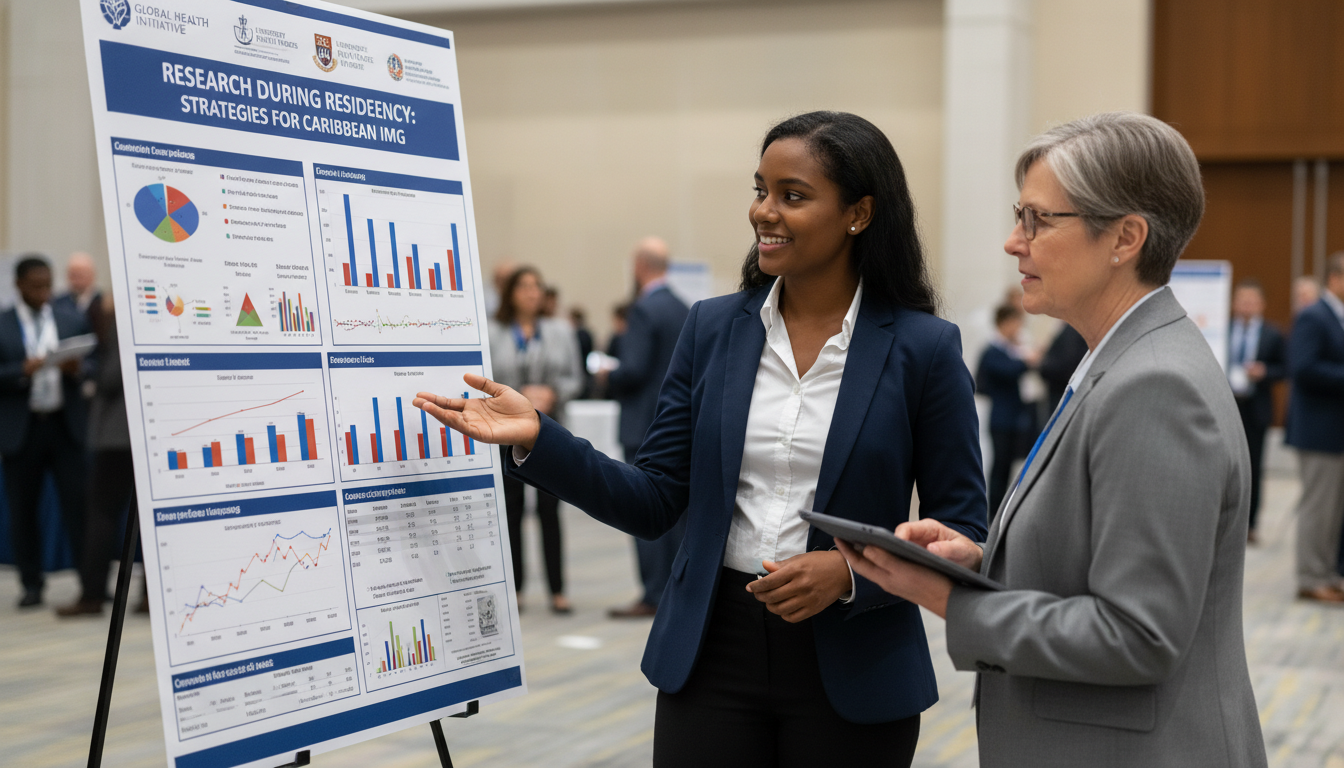
- Use clear headings and visuals (graphs, tables)
- Aim for 1–2 main messages, not overcrowded text
- Practice a 2-minute explanation for conferences
Manuscripts:
- Follow the target journal’s author guidelines strictly
- Ask your mentor for example papers in that journal
- You can start with a case report journal (e.g., Cureus, BMJ Case Reports, Journal of Medical Case Reports) to build experience
Building a Coherent Academic Narrative as a Caribbean IMG
Your long-term goal is to show that your research during residency is purposeful, not random. Programs and fellowship directors want to see a story.
Connecting Your Caribbean Background to Your Research
Your Caribbean medical school residency experience or SGU residency match story can become part of a powerful narrative:
- Interest in global health or health disparities → projects on care of immigrant populations, limited-resource settings, or access to care.
- Exposure to tropical or infectious diseases → case reports or series involving rare infections in the U.S. context.
- Understanding of different healthcare systems → QI or health services research focusing on system-level differences, readmissions, or transitions of care.
Example narrative for a fellowship personal statement:
“Having trained in the Caribbean, I gained early exposure to resource-limited care and diverse patient populations. During my U.S. residency, I built on this foundation through research focused on hospital-based quality improvement and outcomes in underserved populations, including a resident-led project to reduce readmissions in heart failure patients and a retrospective study of sepsis outcomes in a community ICU.”
Positioning Yourself for Academic Tracks and Fellowships
If your program has an official academic residency track, participation in research, teaching, and scholarly conferences is often required. If it doesn’t, you can still act as if you are on one:
- Seek out teaching roles (lectures to medical students, morning reports, case discussions).
- Present your research at institutional grand rounds or departmental meetings.
- Aim for continuity of topic (e.g., several projects in cardiology, critical care, or hospital medicine).
Fellowship and academic hiring committees look at:
- Number and quality of publications/abstracts
- Role in projects (first author vs. middle author)
- Thematic consistency (does your work reflect your claimed interests?)
- Letters of recommendation from research mentors
For Caribbean IMGs, this can help overcome concerns about where you went to medical school and redirect attention to your demonstrated productivity and intellectual curiosity.
Common Pitfalls and How to Avoid Them
Overcommitting to Too Many Projects
It’s tempting to say “yes” to everything, especially when you feel you must “catch up” as a Caribbean IMG. This often leads to:
- Burnout
- Unfinished projects
- Damaged reputation (mentors see you as unreliable)
Solution:
- Prioritize 1–2 primary projects at a time.
- Only accept additional roles if your main work is on track.
- Be honest with mentors about your schedule.
Poor Communication with Mentors
Silence can kill a project. Avoid:
- Going months without updates
- Missing deadlines without explanation
- Disappearing after initial enthusiasm
Solution:
- Set expectations early (check-ins every 2–4 weeks).
- Send brief progress emails, even if small (“This week I extracted data for 12 patients; next week I’ll finish data entry.”).
- Ask for help early if you’re stuck.
Underestimating the Time from Project to Publication
Even a simple project can take:
- 1–3 months: IRB approval and planning
- 2–4 months: Data collection
- 1–2 months: Analysis and writing
- 3–12 months: Journal review and revisions
Takeaway: Start early, ideally by mid-PGY-1, if you want publications on your CV by fellowship application time (usually early PGY-3).
Ignoring Non-Traditional Scholarly Work
Not everything must be a PubMed-indexed paper. For a resident, these also count:
- Oral presentations or posters at local, regional, or national meetings
- Curriculum development with evaluation data (educational research)
- Contributions to clinical guidelines or protocols within your institution
Include these under “Scholarly Activity” on your CV.
FAQs: Research During Residency for Caribbean IMGs
1. I matched into a small community program with minimal research. Is it still realistic to do research during residency?
Yes. Focus on case reports, QI projects, and modest retrospective reviews that use existing data. Identify even one research-inclined attending and build from there. Many community programs produce residents who successfully publish and match into competitive fellowships by being strategic and persistent.
2. I had little or no research in medical school. Will that hurt my chances for fellowship even if I start now?
Fellowship committees care most about recent and relevant work. If you start early in residency, complete a few solid resident research projects, and present or publish them, you can absolutely be competitive—even coming from a Caribbean medical school. Your trajectory (upward curve) matters more than what you lacked as a student.
3. How many publications do I “need” for a strong fellowship application?
There is no fixed number. As a general guideline for many internal medicine subspecialties, 2–4 meaningful scholarly activities (e.g., posters, oral presentations, or papers, ideally with you as first author on at least one) can significantly strengthen your profile. The quality, relevance, and your role in the work matter more than raw numbers.
4. I’m worried research will interfere with my clinical performance. How do I balance both?
Clinical performance always comes first; poor evaluations or exam scores will outweigh any research. Balance by:
- Choosing feasible projects that match your rotation schedule
- Using elective or outpatient blocks for focused research time
- Setting clear limits (e.g., not taking on new projects during ICU months)
Residents who succeed typically plan their year, align projects with lighter months, and communicate proactively with mentors about timing.
Research during residency is not just “extra credit” for Caribbean IMGs—it’s a powerful way to shape your identity in U.S. medicine, demonstrate academic potential, and open doors to fellowships and academic careers. With intentional planning, the right mentors, and realistic project choices, you can build a strong scholarly foundation that complements your Caribbean medical school residency training and helps you stand out in a competitive landscape.