
Why Research During ENT Residency Matters for DO Graduates
For a DO graduate entering otolaryngology (ENT) residency, research is no longer just “nice to have.” It directly influences:
- Fellowship competitiveness (neurotology, facial plastics, rhinology, head & neck oncology, pediatrics, etc.)
- Academic career opportunities and access to an academic residency track
- Leadership roles in departments and professional societies
- Your ability to critically evaluate the literature and practice evidence-based medicine
Historically, DO graduates sometimes had to work harder to demonstrate academic productivity compared with MD peers, especially in competitive fields like ENT. The osteopathic residency match has now merged into a single NRMP match, but program directors still look closely at resident research projects, publications, and scholarly engagement.
The good news: ENT is a specialty filled with clinical questions, novel technology, and surgical innovation—a perfect environment for impactful research during residency, regardless of whether your medical degree is DO or MD.
This article will walk you through:
- How research fits into an ENT residency (and how it affects your career)
- Types of research that are realistic and high-yield during training
- Step-by-step strategies to start and successfully complete projects
- How to position yourself for an academic residency track or fellowship
- Practical tips specific to DO graduates navigating the otolaryngology match and beyond
How Research Fits Into an Otolaryngology Residency
Research in an ENT residency has to coexist with a demanding schedule: clinic, OR, call, conferences, and studying for boards. To use your time wisely, it helps to understand:
- What programs expect
- When research tends to happen
- How research is evaluated later (fellowships, jobs)
Typical Research Expectations in ENT Programs
While every program differs, most otolaryngology residencies have at least some structured requirement for scholarship. Common models include:
- Minimum requirement:
- 1–2 completed projects by graduation
- 1 presentation at a regional or national meeting
- 1 manuscript submitted or accepted
- Dedicated research rotation or block:
- 1–6 months (often PGY-3 or PGY-4)
- Protected time to design, execute, and write up a project
- Longitudinal scholarly requirement:
- Quality improvement (QI) project with iterative data collection
- Ongoing participation in attending-led research teams
As a DO graduate in ENT, you should aim to exceed the minimum. Competitive subspecialty fellowships and academic positions often expect several of the following by the end of residency:
- 3–10+ publications (original articles, case reports, reviews)
- Multiple conference presentations (poster and podium)
- At least one project where you played a major role in conception/analysis
When During Residency to Focus on Research
Think about research as a longitudinal thread, not a one-time event.
PGY-1 (Intern Year)
- Focus: learning the system, basic clinical skills, early exposure
- Research actions:
- Identify ENT faculty doing research
- Join an existing project as a collaborator
- Complete any IRB training and research compliance modules
- Start small: case reports, literature reviews, database queries
PGY-2–3 (Junior/Senior Resident)
- Focus: major growth in surgical skills + ramping up scholarship
- Research actions:
- Take on 1–2 main resident research projects
- Collect data systematically; aim for abstracts at national meetings
- Learn basic statistics and work closely with biostatistics support
PGY-4–5 (Senior/Chief Resident)
- Focus: leadership, consolidation, and output
- Research actions:
- Finish data collection, finalize analyses
- Write and submit manuscripts
- Use research portfolio to strengthen fellowship or job applications
Planning early lets you avoid the common scenario: a panicked PGY-4 trying to patch together “something” to meet graduation requirements.
Types of High-Yield Research ENT Residents Can Do
You don’t need a PhD or a wet lab to produce meaningful research during residency. For a DO graduate in otolaryngology, the most realistic and impactful approaches typically fall into several categories.

1. Clinical Retrospective Studies
What it is:
Using existing patient data (charts, imaging, operative notes, registries) to answer clinical questions.
Why it’s great for residents:
- Feasible without large funding
- Does not require bench lab space
- Can be done in parallel with your clinical work
- Often publishable in reputable ENT journals
Examples in ENT:
- Outcomes of endoscopic sinus surgery in chronic rhinosinusitis with nasal polyps vs without polyps
- Predictors of postoperative hemorrhage after tonsillectomy in pediatric patients
- Time to diagnosis and staging patterns for HPV-positive vs HPV-negative oropharyngeal cancers
- Impact of preoperative vestibular testing on outcomes of stapedectomy
Actionable steps:
- Identify a clinical pattern you notice in clinic/OR:
- “We seem to have an unusual number of young oral cavity cancer patients lately.”
- Discuss it with a research-oriented attending:
- “Has this been studied? Can we look at our institution’s data?”
- Outlining:
- Define inclusion/exclusion criteria
- Determine the key outcome(s)
- Develop a data collection sheet
- Submit an IRB proposal (retrospective chart review often qualifies for expedited review).
2. Prospective Clinical Studies
What it is:
Designing a study in advance, enrolling patients going forward, and collecting standardized data.
Why it’s valuable:
- Stronger methodology and less bias than retrospective studies
- Highly valued by academic committees and journals
Examples:
- Prospective assessment of patient-reported outcomes after septoplasty with vs without turbinate reduction
- Prospective registry of pediatric airway anomalies and surgical outcomes
- Comparing two postoperative pain management regimens after tonsillectomy or thyroidectomy
Considerations for residents:
- Requires careful planning and realistic timelines
- Important to start early (PGY-1/2) if you want to see it through and publish before graduation
- Partner with faculty who have a track record of managing prospective trials
3. Case Reports and Case Series
What it is:
Detailed reporting of unusual, rare, or instructive clinical cases.
Why it’s particularly good for early DO graduates in ENT:
- Excellent entry point if you have little prior research experience
- Helps you learn the structure of a scientific paper
- Can be completed within months, not years
Examples:
- Rare parapharyngeal space mass presenting with atypical symptoms
- Unusual complication of cochlear implant surgery and its management
- Novel endoscopic approach for a challenging skull base lesion
Best practices:
- Only write up cases that are truly novel, rare, or have a strong educational angle.
- Perform a thorough literature review to confirm novelty.
- Target journals that regularly publish case reports in otolaryngology.
4. Quality Improvement (QI) and Patient Safety Projects
QI may not always lead directly to publication, but it’s increasingly valued in:
- Residency evaluations
- Accreditation (ACGME)
- Hospital leadership roles
ENT-focused QI examples:
- Reducing unplanned readmission after thyroidectomy through standardized discharge education
- Improving perioperative antibiotic compliance in clean-contaminated head & neck surgery
- Standardizing tracheostomy care pathways to decrease tube-related complications
QI projects can turn into publishable research if:
- You use a systematic framework (e.g., PDSA cycles)
- You collect and analyze data rigorously
- You report your methods and outcomes clearly
5. Basic Science and Translational Research
Some ENT departments have robust labs in:
- Head & neck oncology (tumor biology, immunology, molecular markers)
- Otology/neurotology (hair cell regeneration, cochlear physiology)
- Rhinology (mucosal immunology, microbiome research)
Considerations for DO graduates:
- Basic science can be high-impact but also time- and resource-intensive
- Best suited for residents with:
- Prior lab experience
- Dedicated research years or blocks
- Strong mentorship and institutional support
- If you’re considering a highly academic career or an NIH-funded path, basic/translational work can be very helpful.
6. Educational and Outcomes Research
As residency education evolves, there is growing interest in:
- Surgical simulation in ENT
- Competency-based assessment tools
- Novel curricula (e.g., vestibular training, facial trauma bootcamps)
Project ideas:
- Evaluating a new endoscopic sinus surgery simulation curriculum and its impact on OR performance
- Developing and validating an assessment tool for flexible laryngoscopy skills
- Studying the effect of structured feedback on resident performance in the temporal bone lab
This type of research can be especially relevant if you’re interested in an academic residency track and medical education leadership.
Step-by-Step Strategy to Succeed in Resident Research (As a DO Graduate)
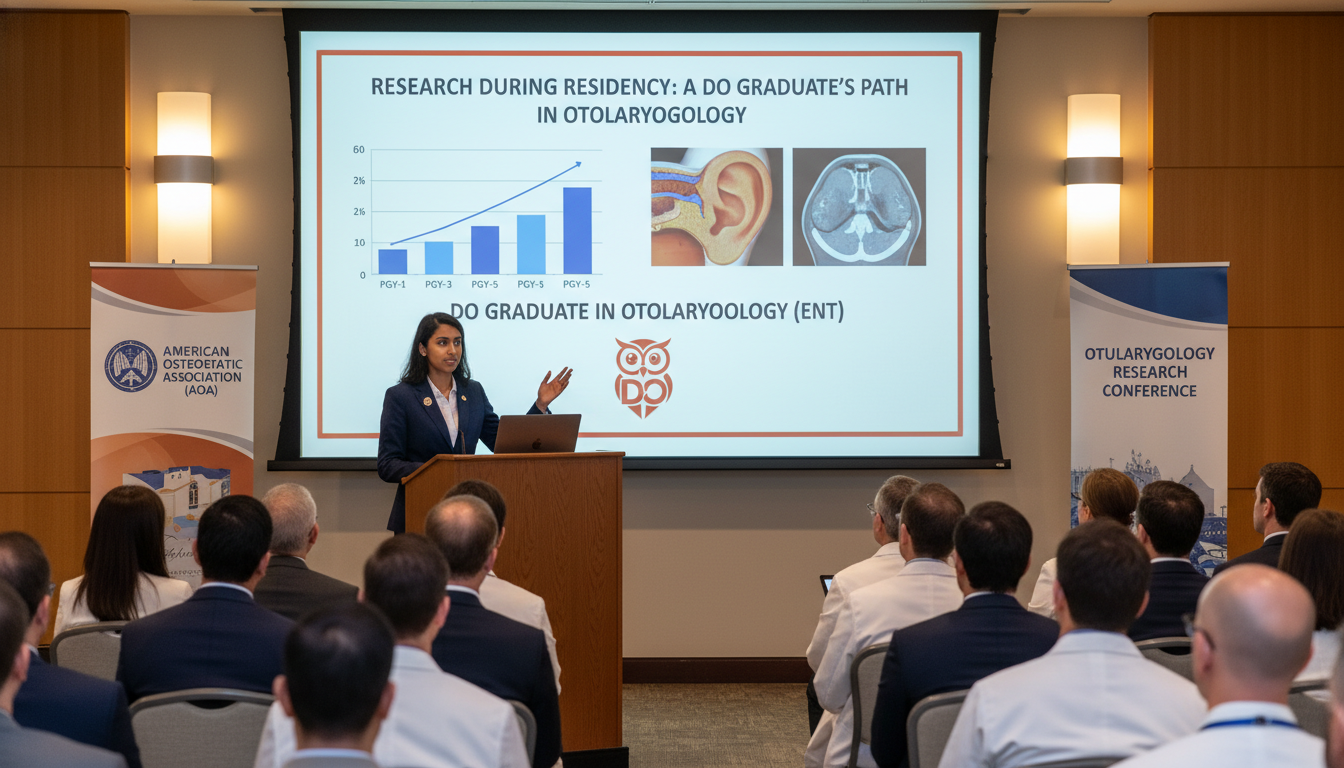
1. Build Your Research Mentorship Team Early
Research success in residency is rarely a solo effort. You benefit enormously from a supportive mentorship network:
Primary research mentor (ENT faculty)
- Guides overall strategy, helps refine questions
- Offers access to patient populations and existing datasets
- Co-authors on papers and presentations
Secondary mentors
- Biostatistician: helps with study design, power calculations, analysis
- Methodology/education expert: for QI or education projects
- Senior residents or fellows: practically invaluable for “how do I actually do this here?”
How to find them:
- Review your department’s faculty profiles and PubMed output.
- Attend departmental research meetings and ask which faculty are open to working with residents.
- Politely email:
- 2–3 sentence intro (DO resident, research interests)
- A concise ask: “I’d love to discuss getting involved in ongoing projects in rhinology/head & neck/etc.”
2. Choose Projects Strategically
Your time is limited. Prioritize projects that are:
- Feasible:
- Doable with your schedule, data access, and skills
- Mentor-supported:
- Active mentor engagement and realistic plan to publish
- Aligned with your goals:
- If you want neurotology, pick at least one project in otology
- If you want an academic residency track or future faculty role, include at least one prospective or more methodologically rigorous project
Consider a portfolio approach:
- 1–2 “big” projects (e.g., major retrospective or prospective study)
- 2–4 “small” projects (case reports, brief clinical notes, QI reports, reviews)
- 1 education or QI project if you enjoy teaching and systems improvement
3. Learn the Basics of Methods and Statistics
You are not expected to be a full biostatistician, but you should:
- Understand common study designs (cohort, case-control, randomized trial, cross-sectional)
- Know basic statistical concepts:
- p-values, confidence intervals
- t-tests, chi-square tests
- Regression basics
- Be able to interpret and critically appraise ENT papers
Practical actions:
- Complete your institution’s required research/IRB modules carefully.
- Use short online resources (e.g., free biostatistics primers geared to clinicians).
- Ask your biostatistician to explain the rationale behind analyses during project meetings.
4. Master the IRB and Regulatory Process
For a DO graduate who may have had variable prior exposure to research infrastructure, getting comfortable with IRB processes is crucial:
- Complete all required institutional training (e.g., CITI).
- Learn:
- How to write a concise, clear IRB application
- The difference between exempt, expedited, and full-board reviews
- How to handle HIPAA and data security requirements
- Save templates from successful IRB applications (e.g., language about minimal risk, data de-identification).
Being “the resident who knows how to get IRB approval efficiently” can make you an invaluable collaborator.
5. Develop a Realistic Timeline and Workflow
Balance is everything. A sample annual research plan could look like:
Quarter 1
- Finalize study idea
- Draft IRB proposal
- Build data collection forms
Quarter 2–3
- Data collection and preliminary analysis
- Submit abstract to at least one conference
Quarter 4
- Final analysis with statistician
- Draft and submit manuscript
Use simple tools:
- Project management apps (Trello, Notion) or even a spreadsheet
- Shared cloud folders for data (de-identified), figures, and drafts
- Standing monthly meeting with your mentor(s)
6. Write and Present Effectively
Writing and presenting your work is as important as doing it.
Manuscript writing tips:
- Start with Methods and Results while details are fresh.
- Use the journal’s required structure and reference style from the start.
- Ask seniors for sample successful manuscripts from your department.
- Be prepared for multiple rounds of revision—it’s normal.
Presentations and abstracts:
- Target both ENT-specific meetings (e.g., AAO-HNSF, subspecialty societies) and broader meetings if suitable.
- Practice your elevator pitch:
- “In one or two sentences, what is your study, why does it matter, and what did you find?”
- Use talks and posters as networking opportunities, especially if you’re interested in a particular fellowship.
Using Resident Research to Shape Your Career Path
Research is not only about publications; it can shape the direction and opportunities of your ENT career.
Strengthening Your Otolaryngology Match Credentials (and Beyond) as a DO Graduate
If you’re an incoming or early resident who matched as a DO graduate, you likely already recognize how competitive the otolaryngology match is. Research provides:
- Objective evidence of academic capability to counter any perceived bias
- A narrative: “I’m passionate about X area, as shown by these projects”
- Early connections to potential letter writers and fellowship mentors
Even after the osteopathic residency match merged with the allopathic match, PDs still:
- Look at publication lists and presentations during rank discussions
- Compare research output among applicants to advanced positions and fellowships
Positioning for an Academic Residency Track or Academic Career
Many ENT departments offer some form of academic track for residents or junior faculty. Features may include:
- Additional protected time for research
- Advanced degrees (MPH, MS in Clinical Research, or Education)
- Formal mentorship committees
- Expectations for ongoing grant applications and publications
To be a strong candidate for such paths:
- Demonstrate sustained engagement with research during residency (not just one project).
- Show progression: from case reports to more sophisticated study designs.
- Express clear academic interests in your personal statements and interviews.
- Get letters from research mentors that highlight:
- Your initiative and ownership of projects
- Your ability to work through challenges
- Your potential as a future academic otolaryngologist
Preparing for Competitive Fellowships
Subspecialty fellowships in ENT often strongly value:
- Subspecialty-relevant research (e.g., rhinology, otology, laryngology, pediatrics, facial plastics, head & neck)
- Presentations at subspecialty meetings
- Clear evidence that you understand and contribute to the field’s evolving literature
Example:
A DO resident aiming for a neurotology fellowship might:
- Join a project examining outcomes of revision stapedectomy
- Write a case report on a rare vestibular schwannoma presentation
- Participate in a multi-institutional database project on cochlear implant performance in complex anatomies
By the time fellowship applications go out (often PGY-4), the resident’s CV clearly reflects an otology/neurotology research focus.
Practical Tips and Common Pitfalls for DO Graduates in ENT
Leverage Your Osteopathic Training
Being a DO graduate can be an advantage in certain research areas:
- Holistic and functional outcomes:
- Patient-reported outcomes in sinonasal disease or voice disorders
- Quality of life after head & neck cancer treatment
- Musculoskeletal/OMT-related perspectives:
- ENT-related issues in patients with cervical spine pathology
- Balance, posture, vestibular symptoms
You can highlight your osteopathic background when designing projects that emphasize function, quality of life, and whole-patient care.
Avoid Spreading Yourself Too Thin
Common mistake: saying “yes” to every project and ending up with many incomplete efforts.
To avoid this:
- Limit the number of major projects running simultaneously (1–2 is often ideal).
- Regularly review your commitments with a mentor.
- Be transparent if your bandwidth changes due to rotations or call.
Protect Research Time—Even on Busy Rotations
You will rarely get “perfect” free chunks of time. Instead:
- Schedule 30–60 minute blocks weekly for research tasks (reading, data entry, drafting).
- Use downtime between cases or in clinic (when appropriate) for focused micro-tasks.
- Batch tasks: spend a dedicated session just organizing data, another just editing figures, etc.
Document Everything
Keep meticulous records:
- Data dictionaries and variable definitions
- IRB numbers, approvals, and expiration dates
- Authorship agreements and contribution notes
- Versions of manuscripts and dates of submission/revision
This protects you and makes it easier to resume projects after busy rotations.
FAQs: Research During Otolaryngology Residency for DO Graduates
1. I’m a DO graduate with minimal research experience. Can I still be successful in ENT research?
Yes. Many residents start residency with limited research background. Focus early on:
- Finding a supportive mentor in your department
- Starting with manageable projects (case reports, retrospective reviews)
- Learning the basics of study design and statistics
Consistency and follow-through matter more than having done research in medical school.
2. Do I need basic science research to pursue an academic career in otolaryngology?
Not necessarily. Many successful academic otolaryngologists build their careers on:
- Clinical research
- Outcomes research
- Educational scholarship
- Quality improvement and implementation science
Basic science is valuable but not mandatory. Choose what aligns with your skills, interests, and institutional resources.
3. How many publications should I aim for by the end of residency?
There is no strict number, but for residents interested in academic careers or competitive fellowships, a reasonable target might be:
- 3–5+ peer-reviewed publications
- Several abstracts or presentations at regional and national meetings
Quality and relevance to your chosen subspecialty matter more than sheer quantity.
4. How can I stand out as a DO graduate when applying for fellowships or academic jobs?
You can stand out by:
- Demonstrating a coherent research narrative (projects clustered around a theme or subspecialty)
- Showing progressive responsibility in projects (from contributor to first author or project lead)
- Highlighting strengths from your osteopathic background (focus on function, quality of life, and holistic care)
- Obtaining detailed recommendation letters from mentors who can vouch for your scholarly potential
Research during residency is a powerful tool for shaping your career as a DO graduate in otolaryngology. With strategic project choices, strong mentorship, and disciplined follow-through, you can build a research portfolio that opens doors—whether your goal is a highly academic residency track, a competitive fellowship, or a clinically focused career grounded in evidence-based ENT practice.