Why Research Matters During Vascular Surgery Residency for DO Graduates
For a DO graduate entering vascular surgery, research during residency is no longer “optional enrichment”—it is a core component of modern surgical training. Whether your goal is an academic career, a high-volume private practice, or an integrated vascular program leadership role, research experience will influence your opportunities, your credibility, and your clinical decision-making.
As a DO graduate, you may be particularly motivated to demonstrate scholarly productivity and academic rigor, especially if you trained in a program or environment where osteopathic residency match stigma once existed. Strategic, well-planned research during residency can help you:
- Build a competitive academic portfolio
- Develop critical appraisal and lifelong learning skills
- Differentiate yourself within vascular surgery residency and beyond
- Position yourself for fellowships, advanced degrees, or an academic residency track
This article walks through a practical roadmap for DO graduates in vascular surgery residency who want to make research a meaningful, career-shaping part of their training.
Understanding the Research Landscape in Vascular Surgery
Vascular surgery is inherently data-driven. Decisions about open vs. endovascular repair, antithrombotic strategies, limb salvage vs. amputation, and surveillance protocols are guided by evolving evidence. That means there is a constant need for high-quality research—and plenty of ways for residents to contribute.
Common Types of Research in Vascular Surgery
You do not need a PhD in biostatistics to be productive. Most resident research projects fall into several accessible categories:
Retrospective chart reviews
- Using existing patient data from your institution to answer specific questions
- Examples:
- Outcomes of DOAC vs. warfarin in patients with lower extremity bypass
- Predictors of readmission after carotid endarterectomy
- Advantages:
- Feasible within residency time constraints
- Data often already available in electronic health records
Prospective observational studies
- Enrolling patients going forward and tracking outcomes, symptoms, or imaging parameters
- Examples:
- Quality-of-life outcomes after endovascular vs. open AAA repair
- Wound healing trajectories in critical limb-threatening ischemia (CLTI) patients
- Advantages:
- Higher-quality data with standardized collection
- Can lead to strong abstracts and publications if well designed
Clinical trials (sub-studies or collaborative roles)
- Many academic vascular programs participate in industry- or investigator-initiated trials
- Residents may:
- Help with patient recruitment
- Perform protocol-driven assessments
- Analyze specific subgroups or secondary outcomes
Quality improvement (QI) and implementation science
- Often more feasible than full-scale clinical trials
- Examples:
- Reducing contrast-induced nephropathy in peripheral interventions
- Improving door-to-balloon times for acute limb ischemia
- These can turn into abstracts, posters, or even peer-reviewed manuscripts.
Basic and translational research
- Less common for busy surgical residents but very powerful if available
- May involve:
- Animal models of atherosclerosis or aneurysm formation
- Vascular tissue engineering or graft development
- Lab-based biomarkers of limb ischemia or graft failure
Educational and outcomes research
- Particularly relevant to those interested in teaching or an academic residency track
- Examples:
- Simulation-based training for endovascular skills in residents
- OSCE-style assessment of vascular physical examination skills
How DO Graduates Fit Into the Research Ecosystem
As a DO graduate, you might come from a medical school with variable research infrastructure compared to some large allopathic centers. That does not limit your potential:
- You may bring unique training in holistic care, OMM history, and functional outcomes, which can shape interesting patient-centered research questions.
- You can leverage your experiences from the osteopathic residency match and osteopathic clinical rotations to explore topics like access to care, rural vascular surgery, and health disparities.
- Many program directors recognize that DO graduates often need to “work harder to be seen”—your research productivity can be powerful proof of your academic capabilities.

Getting Started: Building a Research Plan Early in Residency
To integrate research during residency without burning out, you need a deliberate strategy, not opportunistic chaos. Think of it as building a mini “academic roadmap” from PGY-1 onward.
Step 1: Clarify Your Goals
Ask yourself:
- Do I want an academic career with a focus on grants, publications, and teaching?
- Do I want a clinically heavy career but still be a respected contributor to guidelines and trials?
- Am I aiming for leadership roles in an integrated vascular program or major vascular center?
Your answers shape:
- How many projects to pursue
- Whether to prioritize longer, high-impact studies or multiple smaller projects
- Whether to seek extra training (e.g., master’s in clinical research, MPH)
Step 2: Identify Mentors and Research Groups
Strong mentorship is the single most important factor in successful resident research.
Actionable steps:
- In the first 3–6 months of PGY-1 or PGY-2, ask your program director or senior residents:
- “Which faculty are most active in vascular research?”
- “Who has a track record of publishing with residents?”
- Review faculty profiles, PubMed, and institutional websites to find:
- Who leads clinical trials?
- Who publishes frequently in vascular journals (e.g., JVS, Annals of Vascular Surgery)?
- Meet with 2–3 potential mentors and come prepared:
- Have a brief CV ready (even if modest)
- Outline your interest in vascular research and your long-term goals
- Ask how residents typically get involved
Mentors don’t have to be vascular surgeons exclusively. Cardiologists, interventional radiologists, intensivists, nephrologists, and outcomes researchers often collaborate on vascular issues. That said, at least one vascular faculty mentor is very valuable for your specialty trajectory.
Step 3: Start Small but Strategic
During your first 1–2 years, prioritize projects that are:
- Feasible: Retrospective chart reviews, case series, or secondary analyses of existing datasets
- Time-bound: Projects that can realistically be completed in 6–12 months
- Mentor-supported: Your mentor already has IRB approval or data infrastructure in place
Examples for a new DO graduate in vascular surgery:
- A retrospective study on limb salvage rates before and after a new CLTI protocol
- A review of outcomes in DO vs. MD graduates within your program’s vascular surgery cohort (if available)
- A descriptive study of access to vascular surgery services in osteopathic teaching hospitals
Step 4: Align with the Program’s Culture and Requirements
Many vascular surgery residencies, including integrated vascular programs and independent fellowships, have:
- Formal research requirements (e.g., one completed project per year, or at least one publication)
- Dedicated research rotations (4–12 weeks)
- Expectations for national presentations at SVS, VESS, or other societies
Clarify:
- What your program explicitly requires
- How other residents have successfully met or exceeded those expectations
- Opportunities for an academic residency track, if your institution offers a structured path with additional protected research time
Designing and Executing Resident Research Projects Effectively
Once you commit to a project, execution quality matters more than simply “being on a paper.” A meaningful resident research project teaches you methodology, teamwork, and academic writing.
Selecting the Right Project
A good resident research project for a busy vascular surgery trainee should be:
Clinically relevant
- Does the question address a common or controversial clinical decision point?
- Will the results matter to practicing vascular surgeons?
Methodologically doable
- Can you clearly define inclusion/exclusion criteria?
- Is data accessible in your EHR or existing database?
Time-appropriate
- Does the timeline fit within your rotation schedule and research time?
- Can you reasonably present something at a conference within 1–2 years?
Mentor-supported
- Is your mentor responsive, with a track record of getting projects across the finish line?
Example: A Feasible PGY-2 Project
Topic: Predictors of unplanned 30-day readmission after elective lower extremity bypass surgery.
- Design: Single-center retrospective cohort study
- Data source: EHR data over the past 5–7 years
- Variables: Demographics, comorbidities, procedural details, discharge disposition, medication regimen
- Outcome: 30-day unplanned readmission (yes/no)
- Feasibility:
- Straightforward inclusion/exclusion
- Easily IRB-approvable
- Supports logistic regression analysis
- Academic potential:
- Abstract at SVS
- Manuscript in a vascular or quality-improvement journal
- Foundation for a QI project to reduce readmissions
Navigating IRB and Regulatory Steps
Even for simple projects, you must respect ethical and regulatory requirements.
Key points:
Determine if your project is research vs. QI.
- Research typically requires formal IRB review.
- Some QI projects may qualify for expedited review or exemption, but that is an IRB decision—not yours.
Attend institutional training.
- Many hospitals require CITI training or equivalent for human subjects research.
- Completing this early in residency will make you “ready to go” when projects arise.
Ask your mentor to share example IRB submissions.
- Learn how they frame hypotheses, methods, and data protection strategies.
Data Management and Basic Statistics
You don’t need to be a statistician, but you should:
Learn basic software tools:
- Excel, REDCap, or institutional databases for data capture
- Basic analysis with software like SPSS, Stata, R, or SAS (often with biostatistician support)
Understand key concepts:
- Continuous vs. categorical variables
- Univariate vs. multivariable analysis
- Common tests (t-test, chi-square, logistic regression, Cox models)
Most academic centers have a biostatistics core. As a DO graduate, use these resources confidently—your MD peers rely on them too. Early involvement of a statistician improves your study design and prevents data pitfalls.
Writing and Presenting Your Work
Abstracts and conferences
- Target vascular-specific meetings:
- Society for Vascular Surgery (SVS)
- Vascular and Endovascular Surgery Society (VESS)
- Regional vascular societies
- Also consider general surgery or osteopathic venues that highlight DO graduate residency and osteopathic perspectives.
- Target vascular-specific meetings:
Manuscripts
- Start with a clear structure: Introduction, Methods, Results, Discussion, Conclusion.
- Use mentor manuscripts as style templates.
- Aim for journals such as:
- Journal of Vascular Surgery
- Annals of Vascular Surgery
- Vascular and Endovascular Surgery
- Journal of Endovascular Therapy
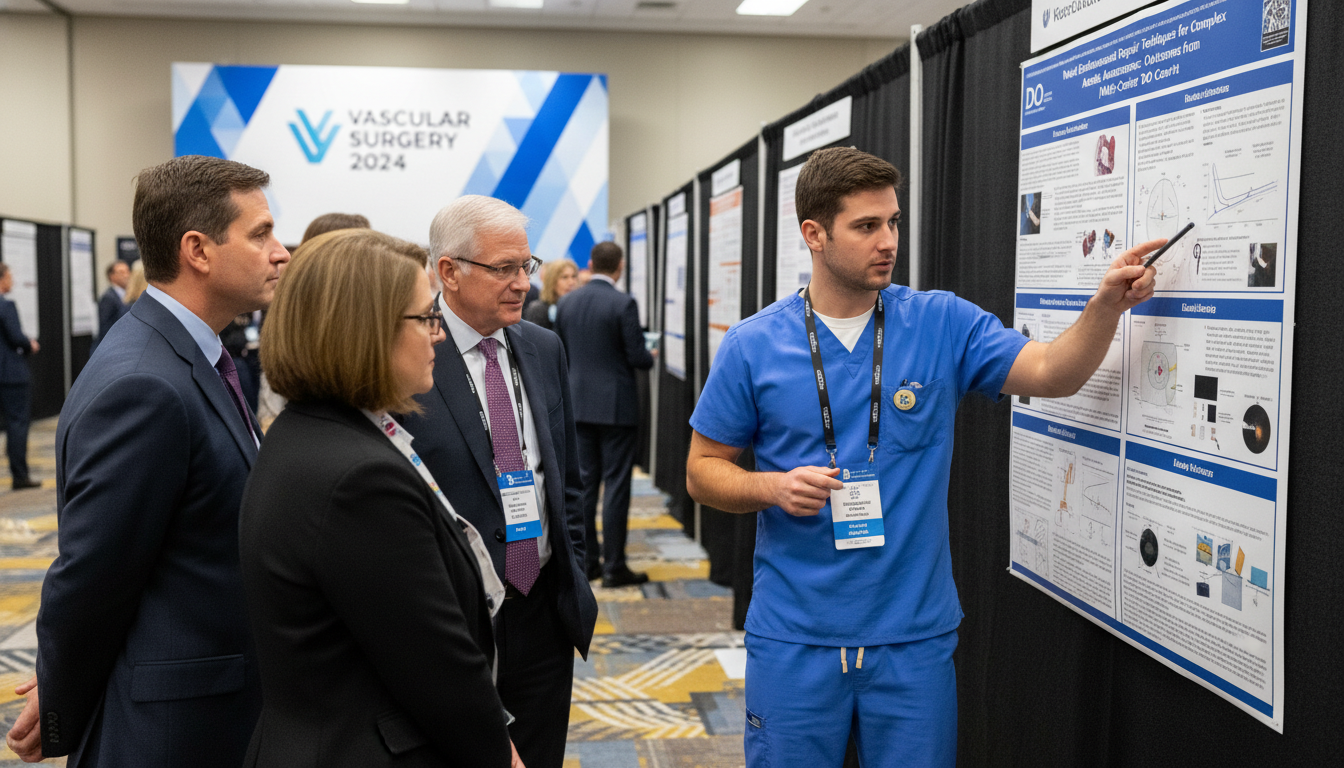
Oral and poster presentations
- Practice concise 8–10 minute talks.
- Highlight clinical relevance: “This changes how we manage X in our vascular practice.”
- As a DO graduate, this is also your chance to expand your professional network and show your academic capabilities.
Balancing Clinical Demands with Research During Residency
Vascular surgery residency is demanding—call schedules, emergencies, complex cases, and long OR days are the norm. Research has to coexist with all of that.
Time Management Strategies That Work
Block scheduling
- Dedicate specific weekly “micro-blocks” for research:
- Example:
- Tuesday 6–7 am: data analysis
- Thursday 8–9 pm: manuscript writing
- Example:
- Treat these blocks like protected appointments with yourself.
- Dedicate specific weekly “micro-blocks” for research:
Maximize low-intensity time
- On-call weekends or nights may include down-time. If safe and allowed, use these periods for:
- Literature searches
- Manuscript editing
- Abstract revision
- On-call weekends or nights may include down-time. If safe and allowed, use these periods for:
Use research rotations wisely
- Many integrated vascular programs offer 1–3 months of research time.
- Don’t start new projects during that rotation; execute and finish ongoing ones.
- Set clear goals before the block:
- Submit an abstract
- Submit one manuscript
- Complete data collection for one study
Collaborative division of labor
- Within your residency cohort, divide tasks:
- One resident leads data collection
- Another focuses on statistical analysis
- Another on drafting figures and tables
- Rotate first-author roles fairly and transparently.
- Within your residency cohort, divide tasks:
Avoiding Burnout and Scope Creep
Residents often overcommit, especially those trying to “prove themselves” as DO graduates in competitive specialties.
Protect yourself by:
Limiting yourself to 1–2 active major projects at a time.
Politely declining new invitations if existing responsibilities are at risk:
- “I’m honored you thought of me; I’m currently at capacity with two ongoing projects, but I’d be very interested in future collaborations once these are submitted.”
Being honest with mentors about your bandwidth and call schedule.
Recognizing that quality and completion outweigh the total number of half-finished projects.
Strategic Long-Term Benefits: How Resident Research Shapes Your Career
Research during residency does more than fill your CV. It can redefine your career trajectory as a vascular surgeon.
Enhancing Your Fellowship and Job Prospects
Even though you are already in a vascular surgery residency, your research record continues to matter:
For DO graduates in integrated vascular programs:
- Productivity can position you for chief resident roles, national committee service, or prestigious fellowships in advanced endovascular techniques, complex aortic surgery, or academic leadership programs.
For graduates from independent vascular surgery fellowships:
- A strong research record helps secure academic appointments and hospital leadership positions.
Search committees and department chairs often look for:
- Consistent scholarly output (not just a single isolated project)
- Evidence you can take a project from idea → IRB → data → presentation → publication
- Letters from mentors describing your independence, curiosity, and reliability
Pathways to an Academic Residency Track or Academic Career
If your institution offers an academic residency track, research productivity is often a key eligibility factor. This may include:
- Additional protected research time
- Formal courses in study design, statistics, or clinical epidemiology
- Opportunities to co-author grants or lead multi-center trials
Long-term, your resident research can evolve into:
- A focused academic niche (e.g., CLTI, carotid disease, complex aortic pathology, health disparities in vascular care)
- A pathway to a master’s degree (MPH, MS in Clinical Research)
- Leadership roles in guideline committees and vascular societies
Contribution to the Field and Patient Care
Research during residency teaches you to:
- Critically appraise new devices and interventions rather than accepting marketing claims
- Recognize biases and limitations in vascular trials
- Implement evidence-based changes in your own practice
As a DO graduate, you may be particularly attuned to functional outcomes, quality of life, and holistic care. Bringing that perspective into vascular surgery research enriches the entire field, especially in areas like:
- Limb salvage and rehabilitation after revascularization
- Patient-reported outcomes in chronic limb-threatening ischemia
- Longitudinal care for patients with peripheral arterial disease in community and rural settings
Frequently Asked Questions (FAQ)
1. I’m a DO graduate in a busy vascular surgery residency. Is it realistic to do meaningful research?
Yes. Many DO graduates complete impactful research during residency by:
- Starting with focused, feasible projects (e.g., retrospective chart reviews, QI)
- Working closely with productive mentors
- Using scheduled time blocks and research rotations efficiently
The goal is not volume alone, but completion of well-designed projects that reach presentation or publication.
2. How many publications should I aim for by the end of vascular surgery residency?
There is no universal number, but for DO graduates interested in academic careers or leadership roles in an integrated vascular program, a reasonable target might be:
- 2–4 first- or co-first-author publications
- Additional middle-author contributions from collaborative projects
- Several regional or national presentations
Quality, relevance, and your role in each project matter more than the raw count.
3. Do I need basic science research to be competitive for an academic vascular position?
Not necessarily. Many successful academic vascular surgeons focus on clinical research, health services research, or implementation science rather than bench work. Basic science or translational research is valuable if it matches your interests and you have access to strong lab mentorship, but it is not mandatory for every academic pathway.
4. How can I highlight my research as a DO graduate when applying for jobs or faculty positions?
Emphasize:
- Your ability to initiate and complete resident research projects
- Presentations at recognized vascular meetings (SVS, VESS)
- Any projects that changed practice at your institution (QI initiatives, protocol changes)
- Mentors’ support letters that underscore your independence and leadership
You can also frame your background as a DO graduate as a strength—bringing a holistic, outcomes-focused lens to vascular surgery and contributing to a diverse, inclusive academic environment.
By approaching research during residency with intention, structure, and strong mentorship, DO graduates in vascular surgery can build not only a robust academic portfolio, but also a deeper, more evidence-based approach to patient care that will set them apart for the rest of their careers.