Understanding the Role of Research During Vascular Surgery Residency
For a non-US citizen IMG (international medical graduate), research during residency is more than an academic checkbox—it is often the key to standing out, building credibility, and opening doors in a highly competitive field like vascular surgery. Whether you are in an integrated vascular program or a traditional general surgery track leading to vascular fellowship, research activity can significantly influence your training quality, future job prospects, and your ability to remain in the United States on a stable visa pathway.
In vascular surgery, research is tightly linked to innovation: endovascular devices, complex aortic repairs, limb salvage strategies, health services research in peripheral arterial disease, and outcomes research for carotid and mesenteric disease. Academic programs expect residents to understand not only how to perform procedures, but also how to critically evaluate literature, design studies, and contribute to scientific progress.
This article focuses on how a foreign national medical graduate can strategically use research during residency to:
- Strengthen competitiveness within an integrated vascular program
- Build a strong academic profile despite visa and status challenges
- Turn resident research projects into long-term academic career capital
- Prepare for an academic residency track or fellowship in vascular surgery
Why Research Matters So Much for Non-US Citizen IMGs in Vascular Surgery
For a non-US citizen IMG in vascular surgery, research is not optional; it functions as a multiplier of your overall profile.
1. Leveling the Playing Field
Program directors may be less familiar with your medical school, grading standards, or clinical experiences. Peer-reviewed publications, abstracts, and presentations are objective, comparable markers that help them gauge your performance.
Research can:
- Compensate to some extent for lack of US clinical experience before residency
- Help offset lower standardized test scores if they are not ideal
- Demonstrate your ability to work in a US academic environment
A solid research record says: “I understand the US academic system, I can publish in English-language journals, and I can work productively with faculty.”
2. Differentiating Yourself in Vascular Surgery
Vascular surgery is relatively small but research-intensive. Many faculty are PIs on device trials, registries, and outcomes studies. Residents who contribute meaningfully to this work become known as “go-to” people for data, analysis, and writing.
This can lead to:
- Strong letters of recommendation emphasizing your research potential
- Invitations to present at national meetings (SVS, VESS, AVF, ACS)
- Early involvement in device trials or quality improvement initiatives
- Networking with leaders at other institutions who see your name on abstracts
For a foreign national medical graduate, those relationships are often crucial later when you apply for fellowships, academic positions, or even future visa sponsorship.
3. Supporting a Long-Term Academic Career
If you envision an academic residency track or an eventual role as a vascular surgery faculty member, research during residency is your foundation:
- Shows commitment to scholarly work
- Demonstrates capacity to complete projects despite heavy clinical loads
- Positions you to apply for research fellowships, T32 grants, or NIH-funded training in the future
Residency is where you prove you can balance OR, patient care, and scholarship—the same triad you will face as academic faculty.
Types of Research Opportunities in Vascular Surgery Residency
Research during residency is not limited to basic science or randomized trials. As a non-US citizen IMG, you should understand the spectrum of options and select projects that are feasible and meaningful.
1. Clinical Outcomes and Database Research
This is the most common and accessible form of research for vascular surgery residents.
Examples:
- Retrospective chart review of limb salvage outcomes after below-knee interventions
- Analysis of carotid stenosis management trends using institutional databases
- Use of national registries such as VQI (Vascular Quality Initiative) or NSQIP
Advantages for non-US citizen IMG residents:
- Often does not require complex lab infrastructure
- Faster timelines for IRB approval and data collection
- Easier to work into your schedule, especially in integrated vascular programs
- High relevance to clinical practice and patient outcomes
You can start by:
- Asking your vascular surgery faculty which ongoing databases or registries they maintain
- Volunteering to clean data or help with follow-up for existing studies
- Identifying simple, focused questions that can be answered with available data
2. Quality Improvement (QI) and Implementation Science
QI projects are particularly valuable if your program does not have strong basic science infrastructure.
Typical vascular QI examples:
- Reducing contrast-induced nephropathy in patients undergoing EVAR
- Increasing adherence to best-practice guidelines for anticoagulation after bypass
- Standardizing pre-op risk assessment to decrease 30-day readmissions
QI projects can result in:
- Institutional presentations or posters
- Abstracts at regional or national meetings
- Peer-reviewed QI-focused manuscripts
These projects show practical impact on patient care and are attractive to program leadership.
3. Basic Science and Translational Research
Some integrated vascular programs are attached to robust basic science labs focusing on:
- Vascular biology (e.g., endothelial dysfunction, aneurysm pathogenesis)
- Device testing, 3D-printed vascular models, or flow dynamics
- Biomarkers for peripheral arterial disease or graft failure
Pros:
- Strong academic credibility and potential for high-impact journals
- Opportunity to learn lab techniques and mechanisms behind disease
Challenges for non-US citizen IMGs:
- May require visa considerations (e.g., funding sources, employment status if in a dedicated research year)
- Longer timeline to publication
- May require protected 1–2-year research blocks
If you’re interested in an academic residency track, a dedicated basic science or translational research year can be powerful—but must be planned early with explicit visa and funding discussions.
4. Educational and Curriculum Research
Vascular surgery also offers opportunities in surgical education research:
- Evaluating simulation training for endovascular skills
- Studying competency-based milestone assessments in integrated vascular programs
- Designing and assessing bootcamps for junior residents
These projects are often more feasible for residents who enjoy teaching and may not require complex IRB processes.
5. Case Reports and Case Series
While case reports rank lower in academic hierarchy, they are very useful early in training—especially for a non-US citizen IMG trying to build a track record.
Examples:
- Unusual presentation of visceral artery aneurysm
- Complex redo bypass with hybrid open-endovascular approach
- Novel use of a device in a challenging anatomy
Benefits:
- Shorter timeline
- Good introduction to the process of writing, submission, and peer review
- Opportunities to present posters or brief oral presentations at meetings
Aim to use case reports as your “on-ramp” to more substantial resident research projects.

Strategically Navigating Research as a Non-US Citizen IMG
1. Understanding Visa and Funding Constraints
Your visa status (J-1 vs H-1B vs other) can affect research opportunities, especially for “off-cycle” research years.
Important considerations:
J-1 Visa:
- Typically tied to clinical training; dedicated non-clinical research years may require specific arrangements.
- Some institutions are more experienced than others in managing J-1 research years.
- Funding must often come via GME or institutional sources rather than “off-payroll” grants.
H-1B Visa:
- Employer-sponsored; any change in job role (e.g., stepping out of clinical duties for full-time research) may require amendments.
- Universities with strong research infrastructure are more flexible, but details matter.
Actionable advice:
- Before committing to a research year or large research commitment, ask your program director and institutional GME office:
- “Are there any visa limitations on participating in a full-time research year?”
- “Can I remain on my current visa category while undertaking 80–100% research?”
- “How have prior non-US citizen IMGs in our program navigated research years?”
Proactive, informed communication is critical.
2. Choosing the Right Mentors and Projects
For a foreign national medical graduate, mentorship can determine whether your resident research projects actually get completed and published.
Look for:
- Faculty who have a track record of publishing with residents
- Clear expectations about timeline, authorship, and your role
- Access to data, IRB approvals, or ongoing registries
- Willingness to write letters highlighting your independence and productivity
Questions to ask potential mentors:
- “How many resident-authored papers have you published in the last 3–5 years?”
- “Do your resident projects usually result in abstracts or manuscripts by the end of a year?”
- “What roles would you expect me to take in this project—data collection, analysis, writing, presenting?”
Selecting 2–3 strong mentors is usually more efficient than superficially attaching yourself to many projects.
3. Balancing Clinical Demands and Research
In an integrated vascular program, clinical demands are high and early. Time management is paramount.
Strategies:
- Block scheduling: Reserve regular small research blocks (e.g., 2 hours on post-call days or early mornings once a week).
- Micro-goals: Break large tasks into 30–60 minute steps (e.g., “write methods section,” “revise introduction”).
- Shared tools: Use shared drives (e.g., Box, Google Drive, REDCap) and reference managers (e.g., Zotero, EndNote) to work asynchronously with co-authors.
- Weekend “sprints”: Dedicate specific half-days on weekends for uninterrupted writing or data analysis.
Make your schedule transparent to your mentor: “My best research hours are post-call afternoons and Sunday mornings. Can we plan around that?”
4. Building a Coherent Academic Narrative
Instead of random, unconnected projects, aim to develop a recognizable theme over several years. This helps for future academic residency track applications or faculty positions.
Examples of coherent themes:
- Limb salvage and critical limb-threatening ischemia outcomes
- Aortic pathology (thoracoabdominal aneurysms, dissections, EVAR durability)
- Health disparities and access to vascular care in underserved populations
- Simulation and education in endovascular training
When your CV shows multiple related projects, reviewers see you as an emerging expert in that area.
Making the Most of Resident Research Projects: From Idea to Publication
1. Start With a Clear, Feasible Question
Vague idea: “I want to study EVAR outcomes.”
Refined question: “Among patients undergoing infrarenal EVAR at our institution between 2015–2023, what factors are associated with reintervention within 2 years?”
Check feasibility:
- Do you have access to the necessary data?
- Is the sample size adequate?
- Has IRB been obtained, or is your mentor willing to help submit it?
As a non-US citizen IMG, don’t hesitate to ask for concrete feasibility checks—this reduces the risk of stalled projects.
2. Learn Basic Research Skills Early
You do not need to become a biostatistician, but you should learn:
- How to design a retrospective cohort or case-control study
- Basic concepts: bias, confounding, p-values, confidence intervals, hazard ratios
- How to use at least one analysis tool (e.g., SPSS, Stata, R, or basic regression in statistical software)
Resources:
- Institution’s biostatistics core or workshops
- Online courses (Coursera, edX) on clinical research methods
- SVS and ACS research webinars or sessions at national conferences
These skills make you more independent and valuable as a collaborator.
3. Write Early, Write Often
Don’t wait until all data are perfect to start writing. Begin with:
- A preliminary abstract draft: background, objective, methods, sample size so far
- Skeleton manuscript: introduction outline, figure ideas, table shells
Advantages:
- Clarifies your thinking about the question and endpoints
- Makes it easier to refine analysis later
- Speeds up submission when the dataset is final
Mentors are more likely to stay engaged when you send them written draft sections they can react to.
4. Aim for Presentations First, Then Manuscripts
For vascular surgery, an ideal progression:
- Internal department or hospital research day presentation
- Regional or national meeting abstract (e.g., SVS, VESS, regional vascular societies)
- Full manuscript submission to a vascular or surgery journal
As a foreign national medical graduate, conference presentations are particularly valuable because:
- You can network with leaders in vascular surgery who may later support your academic career
- You gain visibility beyond your institution
- Meeting participation strengthens your academic narrative on your CV
Plan ahead for travel funding and any visa documentation required for conference attendance.
5. Track and Curate Your Academic Portfolio
Maintain:
- A spreadsheet or document listing all projects, roles, dates, and statuses (idea, data complete, abstract submitted, under review, published).
- A folder structure with data files, analysis code (if applicable), drafts, and final versions.
- A running CV updated with each abstract, poster, talk, and publication.
This organization is critical when you later prepare fellowship or job applications and need precise details.
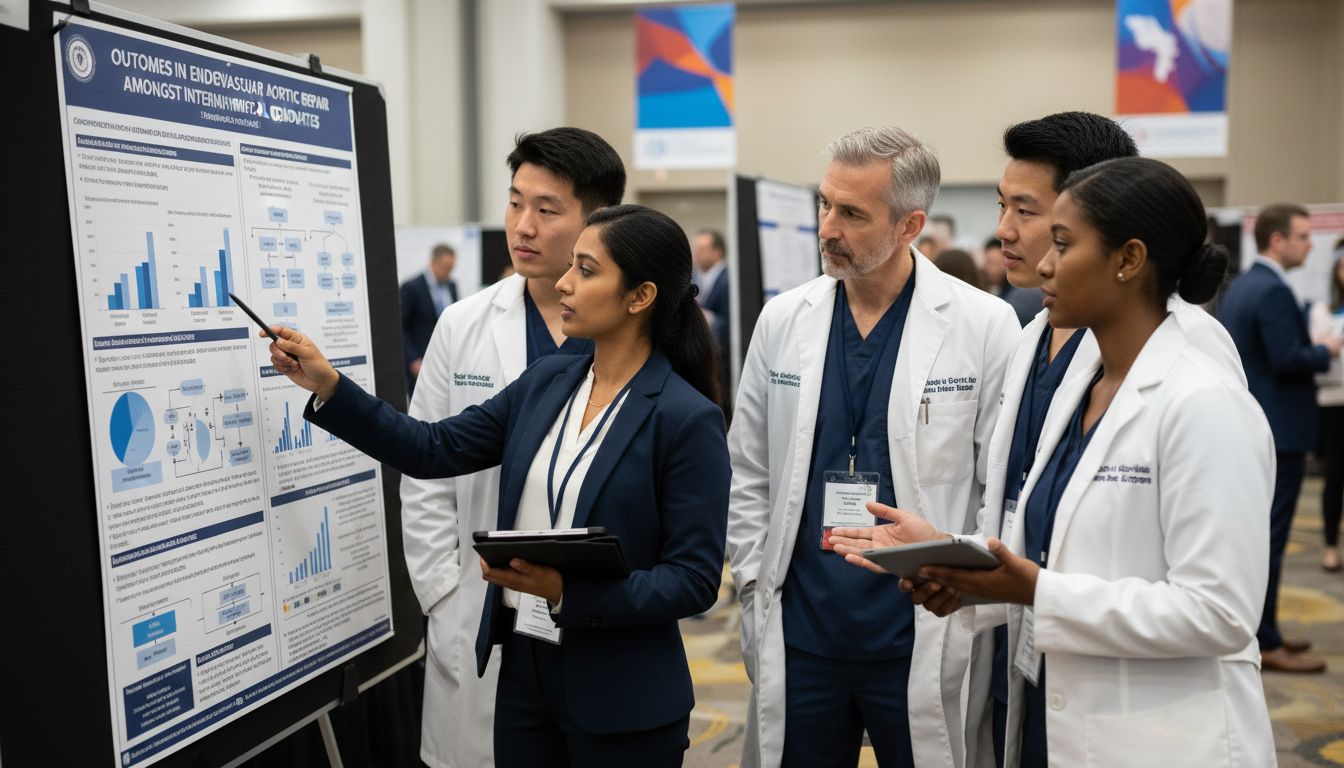
Positioning Yourself for an Academic Track and Future Opportunities
1. Signaling Interest in an Academic Residency Track
Even if your program does not have a formal “academic track,” you can behave like an academic-track resident:
- Consistently participate in resident research projects
- Volunteer for departmental quality committees or morbidity & mortality analysis
- Help junior residents or medical students with their projects
- Show up at journal clubs well-prepared and ready to discuss methodology
Tell your program director and mentors directly:
“I am a non-US citizen IMG, but I am very interested in an academic vascular surgery career. What would you recommend I focus on over the next 2–3 years to become competitive for an academic position?”
2. Leveraging Research for Fellowships and Jobs
When applying to vascular fellowships (if you take the general surgery → vascular route) or academic jobs:
Your research portfolio should demonstrate:
- A clear thematic focus (or two)
- Productivity: number of abstracts, presentations, first- or second-author papers
- Evidence of independence: projects where you conceived the question or took major leadership role
- Strong letters from mentors attesting to your academic potential
For a non-US citizen IMG, these letters and your track record often weigh heavily in decisions about offering H-1B sponsorship or long-term positions.
3. Using Research to Support Future Visa Options
While immigration specifics require legal counsel, your academic work may help with:
- Demonstrating “extraordinary ability” later if pursuing O-1 visas
- Supporting evidence for academic appointments that sponsor employment-based green cards
- Showing national or international recognition for your contributions
High-impact publications, national presentations, awards, and visible leadership roles in societies (e.g., SVS committees) all strengthen your long-term profile.
Common Pitfalls and How to Avoid Them
1. Overcommitting to Too Many Projects
Trap: Saying yes to every project, leading to multiple unfinished manuscripts.
Solution:
- Limit yourself to a small number of active, high-yield projects (e.g., 2–3 major ones, plus occasional smaller contributions).
- Ask at the start: “What is the timeline for this project, and what are the realistic publication goals?”
2. Unclear Authorship Expectations
Authorship conflicts are painful and can be especially difficult for non-US citizen IMGs who may feel less empowered to speak up.
Preventive strategies:
- Clarify at the beginning: “If I collect data and write the first draft, would I be first author?”
- Document the agreement in an email.
- Keep your mentor updated with progress to reinforce your central role.
3. Neglecting Clinical Performance
Exceptional research cannot fully compensate for poor clinical performance. Program directors and vascular faculty must trust you in the OR and on call.
Balance:
- Prioritize safe, reliable patient care.
- Complete documentation and clinical tasks before diving into research each day.
- If your clinical performance slips, discuss with your mentor how to temporarily scale back research load.
4. Waiting Too Late in Residency to Start
If you wait until PGY-4 or PGY-5 to start, you limit what can mature into publications before graduation.
Ideal timeline:
- Early PGY-1 or PGY-2 (or early in the integrated vascular program): join one small project and one larger long-term project.
- Mid-residency: develop your own first- or second-author clinical outcomes paper.
- Late residency: refine your portfolio, complete manuscripts, and present at major conferences.
Frequently Asked Questions (FAQ)
1. As a non-US citizen IMG in a vascular surgery residency, is a dedicated research year necessary to be competitive for an academic career?
Not always. A research year can be valuable, especially at institutions with strong vascular labs or outcomes groups, but it is not mandatory. Many residents build excellent academic profiles through ongoing research integrated into their clinical years. More important than a research year is sustained productivity: multiple completed projects, consistent presentations, and peer-reviewed publications. Before committing to a year off, confirm that visa logistics and funding are secure and that you will have high-quality mentorship and clear project plans.
2. How many publications should I aim for during residency to be competitive for an academic vascular position?
There is no strict number, but a strong academic applicant often has:
- Several abstracts presented at regional or national meetings
- Around 3–8 peer-reviewed publications, with at least some as first or second author
- A clear thematic area of focus (e.g., limb salvage outcomes, aortic disease, or health disparities)
Quality and coherence matter more than raw quantity. A smaller number of well-executed, impactful projects outweighs many minor, loosely related contributions.
3. I’m on a J-1 visa. Can I still participate in research and present at conferences?
Yes. Most J-1 residents routinely participate in research, present at conferences, and publish. The main complexities arise when considering full-time, off-cycle research years or roles that change your primary activity from clinical to non-clinical. For standard resident research projects and conference presentations, there are generally no major visa obstacles. Always check with your GME office and institutional immigration services if you plan extended out-of-residency research time or external research appointments.
4. My program has limited research infrastructure. How can I still build a strong research profile?
Even in resource-limited settings, you can:
- Focus on retrospective chart reviews, QI projects, and case series that use existing data.
- Collaborate with other departments (radiology, cardiology, anesthesia) on shared vascular topics.
- Seek external mentors through national societies (SVS, ACS) or multi-center collaboratives.
- Use online resources to learn basic statistics and research methods.
If your local environment is very limited, consider visiting rotations or short-term research collaborations at more research-intensive centers, with explicit support from your program director.
By approaching research during residency with strategic focus, strong mentorship, and awareness of your unique position as a non-US citizen IMG, you can transform resident research projects into a powerful platform for a long-term, fulfilling academic career in vascular surgery.