Why Research During Residency Matters So Much for Non‑US Citizen IMGs in Heme-Onc
For a non-US citizen IMG aiming for a hematology-oncology fellowship, research during residency is not optional—it is strategic currency.
Hematology-oncology is one of the most competitive internal medicine subspecialties. Program directors value not only strong clinical performance but also clear evidence that you can think like a scientist, handle data, and contribute to the academic mission of their program. For a foreign national medical graduate, rigorous research during residency helps:
- Offset disadvantages such as visa needs and lack of US medical school pedigree
- Demonstrate commitment to an academic career and specialization in heme-onc
- Build relationships with faculty who can strongly support your oncology fellowship match
- Create tangible output—abstracts, posters, publications, QI projects—that make your CV stand out
Research is also one of the few areas where you can clearly differentiate yourself from hundreds of other well-qualified applicants. Thoughtfully planned resident research projects can transform your trajectory from “solid resident” to “future academic heme-onc leader.”
This article walks you step-by-step through how to plan, find, execute, and leverage research during residency as a non-US citizen IMG targeting hematology-oncology.
Understanding the Research Landscape in Hematology-Oncology
Types of Research You’re Likely to Encounter
As a resident, you won’t usually start by curing leukemia in the lab. Instead, you’ll mostly participate in practical, feasible projects:
Clinical research
- Retrospective chart reviews (e.g., outcomes of patients with DVT on different anticoagulation regimens)
- Prospective observational studies (e.g., adherence to oral chemotherapy in an outpatient population)
- Clinical trials (usually as a sub-investigator, helping with data collection, consent, or follow-up)
Outcomes and health services research
- Hospital readmission patterns for neutropenic fever
- Time-to-treatment metrics for new leukemia diagnoses
- Disparities in access to stem cell transplant among different demographic groups
Quality improvement (QI) projects
- Standardizing transfusion thresholds
- Reducing delays in chemo administration
- Improving VTE prophylaxis in admitted oncology patients
Translational / basic science research (less common for busy residents, but powerful)
- Molecular pathways in lymphoma or myeloma
- Tumor microenvironment studies
- Lab-based projects using cell lines or animal models
All of these can strengthen your profile for a heme onc fellowship, especially when you stay consistent, focus on hematology-oncology themes, and translate projects into posters and publications.
Why Research Is Especially Critical for Non‑US Citizen IMGs
Program directors are often transparent: visa issues and unfamiliar schools create risk. Robust research productivity helps mitigate that risk by:
- Showing academic potential beyond the name of your medical school
- Providing US-based mentors who can vouch for you in letters
- Demonstrating persistence and adaptability in a highly competitive environment
- Signaling that you’re a good fit for an academic residency track, which is often the best path to a strong heme onc fellowship match
If your residency doesn’t have a formal academic residency track, you can create your own “academic identity” via consistent projects, scholarly presentations, and collaboration with heme-onc faculty.

Setting Up for Success: Before and Early in Residency
Step 1: Clarify Your Long-Term Heme-Onc Career Vision
Before jumping into projects, spend a bit of time clarifying where you want to go:
Ask yourself:
- Do I see myself in academic hematology-oncology (university center, research, teaching)?
- Am I more drawn to clinical trials, health disparities, thrombosis/benign heme, or malignant heme/solid tumors?
- Do I want a bench or translational angle in my heme onc fellowship and career?
You don’t need complete clarity, but broad direction helps you choose more coherent resident research projects, showing a narrative of focused interest rather than random activities.
Step 2: Do Reconnaissance on Your Institution’s Research Environment
As soon as you match:
Study your program’s research structure
- Does it have a designated research director or “scholarly activity” coordinator?
- Are there protected research blocks (e.g., 1–3 months in PGY-2/PGY-3)?
- Are there required resident research projects or QI curricula?
Review faculty profiles
- Go to the institution’s heme-onc division webpage
- Identify faculty with interests aligning to yours (e.g., myeloma, lymphoma, leukemia, thrombosis, survivorship, palliative oncology)
- Note their recent papers (PubMed), ongoing trials (ClinicalTrials.gov), and whether they often include residents
Identify supportive structures
- Biostatistics support for resident projects
- IRB office with guidance for first-time investigators
- Internal funding (small grants, poster awards, travel support)
This early reconnaissance lets you target the right mentors and set realistic goals.
Step 3: Leverage Your IMG Background as a Strength
As a non-US citizen IMG and foreign national medical graduate, you bring a valuable perspective:
- Understanding of global oncology and resource-limited settings
- Potential for comparative studies (e.g., treatment outcomes or guideline adherence in your home country vs. US)
- Language skills for engaging diverse patient populations
Examples of uniquely positioned projects:
- Patterns of late-stage presentation in specific ethnic communities
- Barriers to clinical trial enrollment among immigrants with cancer
- Outcomes of hematologic malignancies in low-resource settings (via collaborations with your home institution)
Naming this perspective as a research interest area during residency can differentiate your academic path.
Finding Mentors, Projects, and an Academic “Home”
Identifying Strong Research Mentors in Heme-Onc
Your mentor is almost more important than the project itself. Look for:
- A track record of resident/fellow publications (check PubMed affiliations and authorship lists)
- Active involvement in clinical trials or funded studies
- A reputation for being approachable and responsive
- Prior experience working with IMGs or foreign national medical graduates
Aim to build a “mentorship team”:
- A primary heme-onc mentor (e.g., lymphoma, leukemia, benign heme)
- A secondary mentor in methodology (biostatistics, outcomes research, QI)
- Possibly a senior fellow as near-peer mentor for day-to-day troubleshooting
How to Approach Potential Mentors (Even as a Busy Intern)
Email strategy:
- Keep it short and specific.
- Show you have done your homework.
- Offer concrete, limited time commitment at first.
Sample structure:
- Brief intro: name, PGY level, non-US citizen IMG, visa type
- State your goal: planning for a heme onc fellowship match with a focus on research
- Mention specific paper or project of theirs that interests you
- Ask:
- if they have ongoing projects needing help, OR
- if you can meet for 15–20 minutes to discuss potential resident research projects
The mention that you are a foreign national medical graduate can help frame your motivation and urgency without apologizing for your status.
Choosing the Right Project Type for Each Stage of Residency
PGY-1: Low-complexity, high-yield projects
- Case reports and case series (especially rare hematologic disorders or interesting oncology complications)
- Simple retrospective chart reviews using existing databases
- QI projects targeting inpatient oncology wards or hematology consult services
PGY-2: Intermediate projects with publication potential
- Larger retrospective studies with multivariate analysis (with statistician help)
- Participation in multicenter registries or outcomes studies
- Co-authoring review articles or book chapters with your mentor
PGY-3: More ambitious or culminating projects
- Leading your own IRB-approved study
- First-author manuscript submissions to peer-reviewed journals
- Grant applications (small institutional grants, foundations)
- Projects that bridge into what you want to continue in heme onc fellowship
The key is continuity: ideally, your PGY-1 project flows into deeper work, culminating in a coherent story for your fellowship applications.
Executing Strong Resident Research Projects in Heme-Onc
Balancing Clinical Demands and Research Time
Your biggest challenge: time.
Strategies to make it work:
Micro-scheduling
- 30–45 minute research blocks pre- or post-shift
- One protected half-day each week on elective or ambulatory rotations
- Early-morning or weekend sessions dedicated to writing
Protect research time like a clinical duty
- Put research blocks on your calendar
- Let co-residents and your mentor know when you’re “research unavailable,” within reason
Choose projects that respect your bandwidth
- Simple datasets, focused questions, and clear timelines
- Avoid huge, unstructured projects without solid support
Building Skills: Statistics, Study Design, and Writing
You don’t need a PhD, but you do need literacy in:
Basic study design
- Retrospective vs. prospective
- Cohort, case-control, randomized trial structures
- Confounders, biases, and how to discuss limitations
Foundational biostatistics
- Descriptive stats, t-tests, chi-square, basic regression
- Interpretation of hazard ratios and confidence intervals (especially key in heme onc literature)
Medical writing
- Clear, concise abstracts
- Structured manuscripts (IMRAD: Introduction, Methods, Results, And Discussion)
- Responding to reviewer comments professionally
Practical steps:
- Take advantage of any resident research workshop or online statistics course offered by your institution.
- Use free resources (e.g., Coursera basic stats courses, guidelines from major journals, CONSORT/STROBE checklists).
- Read high-quality hematology-oncology articles (e.g., in Blood, JCO, Lancet Haematology) and actively dissect how they’re structured.
Practical Example: A Feasible PGY-1–to–PGY-3 Project Path
PGY-1:
- On your hematology consult rotation, you notice high variation in platelet transfusion thresholds for stable thrombocytopenic patients.
- You and your mentor start a QI project:
- Audit current practice
- Compare to guidelines
- Develop a simple order-set recommendation
Output: Poster at local research day, abstract at a regional conference.
PGY-2:
- You expand this into a retrospective outcomes study:
- Extract data for 3–5 years
- Evaluate bleeding outcomes, transfusion reactions, and cost implications
- Work with a biostatistician to do analyses
Output: Abstract submission to ASH (American Society of Hematology), manuscript draft.
PGY-3:
- You refine and submit the manuscript to a peer-reviewed journal.
- You write a narrative review on transfusion practices in hematologic malignancies, co-authored with your mentor.
Output: At least one accepted publication, which you prominently feature in your heme onc fellowship ERAS application.
This kind of story shows longitudinal interest, leadership in resident research projects, and the potential for academic hematology-oncology work.
Harnessing Institutional and External Opportunities
Resident research tracks / academic residency track:
If available, enroll early. These tracks often provide structured mentorship, protected time, and guaranteed projects. As a non-US citizen IMG, a visible academic residency track further signals your seriousness about an academic heme onc path.Dedicated oncology research months:
Use these to intensively push a project past major milestones (data analysis, first draft, revisions).Conferences:
Focus on:- ASH
- ASCO (American Society of Clinical Oncology)
- Local/regional chapters (e.g., state hematology/oncology societies)
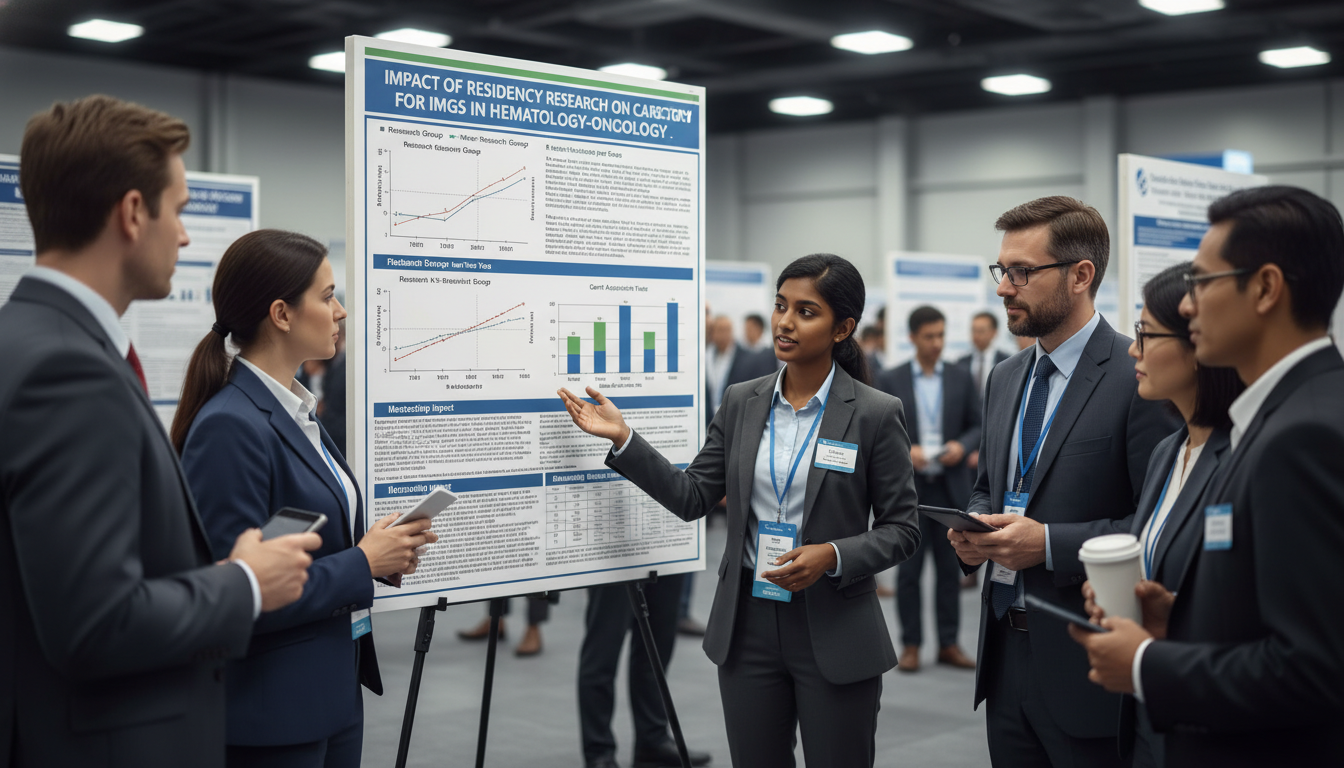
Abstracts accepted at major meetings carry significant weight in your oncology fellowship match file.
Leveraging Research for a Strong Heme Onc Fellowship Match as a Non-US Citizen IMG
Building a Convincing Scholarly Profile
By the end of residency, aim for:
- 3–6 abstracts/posters (regional or national meetings, including at least 1 major heme-onc meeting if possible)
- 1–3 peer-reviewed publications (case reports, original research, or reviews)
- A clearly articulated research interest (e.g., thrombosis in cancer, acute leukemia outcomes, lymphoma in underrepresented groups, survivorship in young adults with cancer)
What matters is not just numbers but coherence—a set of projects that makes sense together and points toward your future niche.
Highlighting Your Work in ERAS and Interviews
On your heme onc fellowship applications:
- Use the “Experiences” and “Publications” sections to underscore:
- Your role (first author, data collection, analysis, writing)
- The hematology-oncology relevance of the project
- Any awards or travel grants you received
During interviews, be ready to discuss:
- How you generated the research question
- Challenges you faced as a foreign national medical graduate (e.g., navigating IRB, learning new documentation systems) and how you overcame them
- How your projects prepared you for an academic heme onc career
Practice concise 1–2 minute narratives for each major project.
Turning Mentors into Advocates
Strong letters of recommendation often decide borderline cases in the oncology fellowship match, particularly for a non-US citizen IMG needing visa sponsorship.
To maximize letter strength:
- Provide your mentor with your updated CV and personal statement.
- Remind them of your key contributions: leadership roles, initiative, critical thinking, reliability.
- Where appropriate, gently highlight that some programs may be cautious about sponsoring visas, and a strong, specific letter can make a major difference.
A letter that states, “This resident is in the top 5% of all trainees I have worked with in my career and is already functioning at the level of our fellows,” is enormously powerful.
Thinking Ahead: Bridging to Future Heme-Onc Research
Finally, use your residency research to “pre-launch” your fellowship trajectory:
- If possible, align your projects with ongoing lines of work at fellowship programs that commonly sponsor visas.
- Mention in your personal statement how you plan to continue or expand specific areas of research in fellowship.
- If you’re applying to programs where your mentor has collaborators, ask if they can informally introduce you to potential future research supervisors.
This shows foresight, commitment, and a well-thought-out plan for an academic hematology-oncology career.
Frequently Asked Questions (FAQ)
1. I’m a PGY-1 non‑US citizen IMG with no prior research. Is it too late for heme-onc?
No. While prior research is helpful, many residents begin during PGY-1. Focus on:
- Quickly identifying a heme-onc mentor
- Starting with feasible projects (case reports, small retrospective studies, QI)
- Building momentum so that by the end of PGY-2 you have at least some tangible output
For a foreign national medical graduate, the urgency is real, but there is still time if you’re proactive and consistent.
2. My program has limited heme-onc research. What can I do?
Options include:
- Targeting quality improvement or outcomes projects on your oncology inpatient service
- Collaborating with nearby academic centers if geographically feasible
- Asking faculty if you can help with manuscript writing or literature reviews remotely
- Exploring multi-institutional virtual collaborations, which increased significantly post-pandemic
You may not have a massive research infrastructure, but even smaller, well-completed resident research projects can demonstrate initiative and academic promise.
3. How many publications do I need for a competitive oncology fellowship match as a non-US citizen IMG?
There is no strict number. Many successful non-US citizen IMGs match with:
- Around 1–3 peer-reviewed publications (including case reports or reviews)
- Several abstracts/posters at reputable meetings
Quality, relevance to hematology-oncology, and your level of contribution matter more than raw count. A single strong first-author paper with a clear heme-onc focus can weigh more than multiple minor co-authorships.
4. Will my visa status limit my ability to do research or get funding?
Your visa may affect:
- Some federal grants (e.g., NIH training grants often require certain citizenship statuses)
- Long-term funding opportunities in early faculty years
However, as a resident:
- Most resident research projects (QI, retrospective studies, institutional databases) are not restricted by visa status.
- Many institutional pilot grants and travel awards are open to non-US citizens.
Clarify your status with your GME office and your mentor, but in most cases, your visa should not prevent you from doing impactful research during residency.
By approaching research during residency as an intentional, structured, and strategic endeavor, you can convert your position as a non-US citizen IMG into a differentiated strength. With thoughtful mentorship, feasible yet meaningful projects, and clear alignment to hematology-oncology, you significantly increase your chances of a successful, academically oriented heme onc fellowship match and a rewarding career in this specialty.