Why Research During Residency Matters So Much for US Citizen IMGs
For a US citizen IMG, residency is not just about clinical training; it’s also your prime opportunity to prove your academic value in the US system. Research during residency is one of the most powerful ways to:
- Stand out for fellowships and competitive subspecialties
- Transition to an academic residency track
- Build a CV that competes with US MD/DO graduates
- Repair or strengthen a nontraditional or IMG profile
- Create mentorship networks and long-term career opportunities
As a US citizen IMG (often an American studying abroad), you may feel a step behind classmates who trained in the US. Research can be your “force multiplier”—turning a good application into a standout one, and a decent residency experience into a launchpad for academic medicine or leadership.
This article breaks down, in practical terms, how to strategize and execute research during residency: what to prioritize, how to find projects, how to manage time on busy rotations, and how to position yourself for academic and fellowship success.
Understanding the Landscape: Research Expectations in US Residency
Research expectations vary widely depending on:
- Specialty (e.g., internal medicine vs family medicine vs surgery)
- Program type (community vs university-affiliated vs academic)
- Future goals (community practice vs subspecialty vs academic career)
Where Research Matters Most
For a US citizen IMG, research is especially valuable if you are aiming for:
- Highly competitive fellowships: cardiology, GI, heme/onc, critical care, radiology subspecialties, dermatology, etc.
- Academic residency track positions: chief resident, clinician-educator roles, junior faculty positions
- Transitioning into a different specialty or subspecialty after initial residency
- Visa-free leverage: even though you’re a US citizen IMG and don’t need sponsorship, you’re still compared to US grads—research helps narrow that perceived gap.
Programs often look for:
- First- or co-author publications in peer-reviewed journals
- Abstracts and posters presented at regional/national conferences
- Quality improvement (QI) projects with measurable impact
- Resident research projects that align with departmental priorities
You don’t need an MD/PhD–level portfolio, but you do need evidence that:
- You can ask meaningful questions.
- You can follow a project through to completion.
- You understand basic research methods and critical appraisal.
Step 1: Clarify Your Goals and Choose the Right Research Focus
Before jumping into any project, define what research needs to do for you as a US citizen IMG.
Clarify Your Long-Term Direction
Ask yourself:
Do I want an academic or community career?
- If academic: prioritize projects that lead to publications and conference presentations, and aim to connect with faculty on an academic residency track.
- If community: focus more on QI, patient safety, and practical system-improvement projects.
Am I aiming for a competitive fellowship?
If yes, you’ll want:- Multiple projects in your intended subspecialty
- At least one or two peer-reviewed publications
- Ideally, presentations at national meetings in that field
Do I want to work in the US long-term after residency?
As a US citizen IMG, you’re not limited by visas, but you still face perception hurdles. A strong research profile signals:- Commitment to US medicine
- Familiarity with US academic standards
- Ability to work in interdisciplinary teams
Align Topics with Your Specialty and Identity
As an American studying abroad, you can use your background as a strength:
- Consider projects focused on:
- Health disparities or access-to-care issues relevant to immigrants or international populations
- Comparative care models (e.g., comparing practice patterns between US and your medical school country)
- IMG performance, training, and integration in the US system
For core specialty topics, consider:
Internal Medicine:
- Outcomes in heart failure, COPD, diabetes management
- Readmission reduction projects
- Antimicrobial stewardship
Family Medicine:
- Chronic disease management in underserved populations
- Preventive care interventions
- Behavioral health integration
Surgery:
- Postoperative complications and risk stratification
- Enhanced recovery after surgery (ERAS) bundle adherence
- Surgical QI and checklist implementation
Psychiatry:
- Telepsychiatry outcomes
- Substance use interventions
- Cultural factors in diagnosis and treatment adherence
Choosing a focus that matches your desired fellowship or academic track helps you tell a consistent story in your CV, personal statements, and interviews.

Step 2: Finding and Securing Research Opportunities as a Resident
One of the biggest challenges for US citizen IMGs is not willingness, but access. You may not have a home US medical school network to plug into automatically. Here’s how to systematically find research during residency.
1. Map the Research Ecosystem at Your Program
Start by identifying:
- Program Research Director or Vice Chair for Research
- Residency Program Director (PD) and Associate PDs with academic titles
- Faculty with an academic residency track or protected research time
- Fellows in your department (they are often actively publishing)
Practical steps:
- Ask for a list of ongoing resident research projects at orientation or early in PGY-1.
- Review faculty profiles on:
- Department website
- PubMed (search by institution)
- ResearchGate or Google Scholar profiles
Track:
- Who is publishing in your areas of interest
- Who has a history of mentoring residents
- Who is presenting at conferences
2. Use a “Three-Tier” Strategy to Join Projects
As a new resident, you should build a portfolio across three tiers:
Tier 1: Quick-win, low-complexity projects (3–6 months)
- Case reports or case series
- Chart reviews with limited scope
- Conference posters based on existing data
Goal: build confidence, get early CV entries.
Tier 2: Moderate projects with publication potential (6–12 months)
- Retrospective cohort studies
- More robust QI initiatives
- Survey-based research
Goal: aim for peer-reviewed manuscripts.
Tier 3: Long-term or high-impact projects (12–24+ months)
- Prospective studies
- Multi-center collaborations
- Major QI interventions with institutional backing
Goal: cornerstone publications that anchor your academic story.
3. How to Approach Faculty Effectively (Especially as an IMG)
Approach matters. Faculty are more receptive if you:
Come prepared with:
- A brief introduction (US citizen IMG, where you trained, your goals)
- A clear interest area (e.g., “I’m very interested in nephrology and outcomes research”)
- Specific ways you can help: data collection, chart review, literature review, manuscript edits
Example email:
Subject: Intern interested in contributing to research in [subspecialty]
Dear Dr. [Name],
My name is [X]. I’m a PGY-1 in [Program] and a US citizen IMG who completed medical school at [School, Country]. I’m interested in [subspecialty] and in developing my skills in clinical research during residency, with a long-term goal of pursuing an academic residency track and fellowship in [field].
I reviewed your recent publications on [topic] and would be very grateful for the opportunity to assist with ongoing or upcoming projects (data collection, chart review, literature review, or manuscript preparation). I’m committed, reliable, and able to dedicate [X] hours per week, even on busy rotations.
If you’re open to it, I’d appreciate a brief meeting to discuss how I might get involved.
Best regards,
[Name], PGY-1 [Program]
As an American studying abroad, be honest about your background but emphasize strengths:
- Prior research experience (if any)
- Comfort with statistics or writing
- Work ethic and reliability
4. Don’t Ignore Non-Traditional Mentors
Beyond attendings, consider:
- Senior residents or chief residents with publications
- Fellows in your target subspecialty
- Hospital QI department staff
- Clinical pharmacists, data analysts, or epidemiologists
These collaborators often have projects in motion and may welcome a motivated resident.
Step 3: Balancing Research with Clinical Duties (Without Burning Out)
The major bottleneck for resident research projects is time, not talent. As a US citizen IMG, you may feel extra pressure to prove yourself clinically and academically. That makes time management even more critical.
Understand Your Rotation Calendar Strategically
Plan your research around:
Heavy rotations (e.g., ICU, wards, night float):
- Maintain only low-intensity tasks (e.g., reading articles, small edits).
- Avoid starting new projects.
Lighter rotations (e.g., electives, outpatient, research blocks):
- Schedule meetings with mentors.
- Push major writing, data analysis, IRB submissions.
- Set concrete milestones (e.g., “finish first draft of introduction by end of month”).
If your program offers a research elective or protected scholarly time, aim to:
- Have a project already defined before that block starts.
- Use that time to execute—not to brainstorm from scratch.
Build a Weekly Research Routine
Even on busy weeks, aim for consistent micro-progress:
Set a minimum research commitment: e.g.,
- 3–5 hours per week, broken into 30–60-minute sessions
- One “research half-day” during a lighter weekend if workload allows
Create a simple structure:
- Monday/Tuesday: quick tasks (emails, edits)
- Midweek: data entry or simple analyses
- Weekend: reading, drafting sections of a manuscript
Use tools:
- Task management apps (e.g., Todoist, Notion, Trello)
- Reference managers (e.g., Zotero, Mendeley, EndNote)
- Cloud storage (Google Drive, OneDrive) for shared documents
Set Clear Boundaries and Expectations
With mentors:
- Be honest about your schedule and workload.
- Agree on realistic deadlines.
- Ask for prioritized tasks (“What is the most important thing I can do this week?”).
With yourself:
- Don’t over-commit to 5–6 projects at once.
- Aim for 2–3 active projects at different stages:
- One data collection
- One writing
- One abstract/manuscript revision
Avoid the common IMG trap of saying “yes” to everything and finishing nothing.
Step 4: Turning Resident Research Projects into Tangible Academic Output
Your goal is not just to “do research” but to produce visible, citable work. This is what will influence future fellowship and job applications.
Focus on Projects That Can Actually Finish
Ideal resident research projects during residency share these features:
- Feasible sample size (data you can access within your institution)
- Clear, focused research question
- Simple, appropriate statistical methods
- Reasonable IRB and data requirements
Examples:
- Retrospective review of 12–24 months of data on a common condition
- QI project with pre- and post-intervention outcome measures
- Survey study with well-defined target population (e.g., residents, patients with X condition)
Avoid overly ambitious designs that require multi-year follow-up or multi-center coordination, unless you’re part of an established team that already has infrastructure.
Understand the Basic Pathway: From Idea to Publication
Typical stages:
Conceptualization
- Identify the problem or question.
- Review background literature.
Study design & IRB
- Define hypothesis, outcomes, inclusion/exclusion criteria.
- Write protocol and submit to IRB.
Data collection
- Extract data from EMR.
- Ensure data cleaning and standardization.
Analysis
- Work with a biostatistician if possible.
- Start with simple statistics (descriptives, simple regressions).
Manuscript preparation
- Draft sections in parallel: Introduction, Methods, Results, Discussion.
Submission and revision
- Target appropriate journal.
- Respond to reviewer comments constructively.
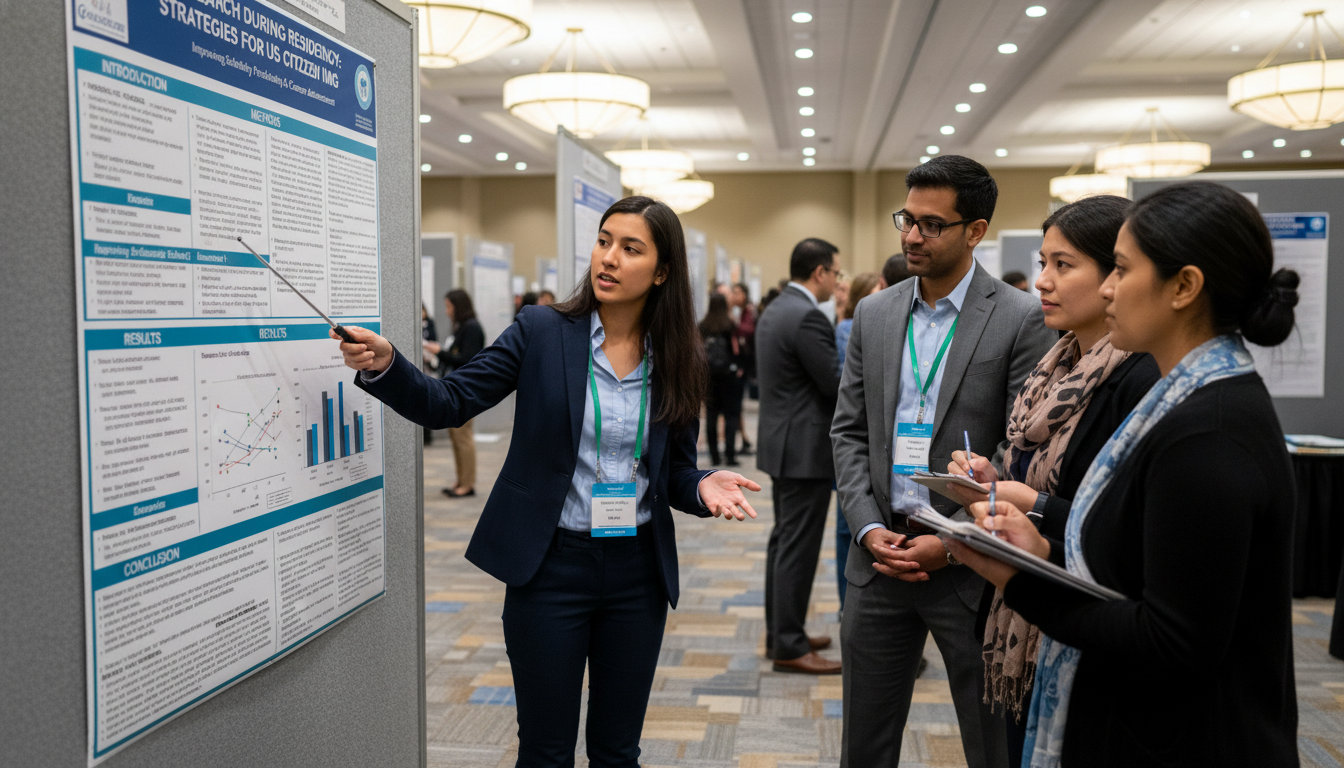
Make Conferences Work for You
As a US citizen IMG, conference presentations offer added benefits:
- Show that you are actively engaged in US academic circles.
- Provide networking with fellowship directors and faculty at academic institutions.
- Allow you to “tell your story” face to face, reducing the “IMG unknown” factor.
Action steps:
- Know the major conferences in your specialty (e.g., ACP, AHA, ATS, ASCO, APA).
- Track abstract deadlines 6–12 months ahead.
- Prepare “conference-ready” figures and concise abstracts early.
Ask your program about:
- Funding for conference travel (many programs support at least 1–2 resident trips per year).
- Opportunities to practice poster or oral presentations locally before the national meeting.
Step 5: Leveraging Research for Academic Tracks, Fellowships, and Beyond
Your research during residency is most powerful when it is clearly linked to your next career step.
Building an Academic Residency Track Narrative
If you’re interested in an academic residency track or clinician-educator role:
Emphasize:
- Longitudinal involvement in a topic (e.g., hospital medicine, health disparities, curriculum innovation)
- Teaching-related scholarship (e.g., resident-led curricula, educational QI projects)
- Collaborations with faculty who are already on academic tracks
Seek:
- Opportunities to mentor junior residents or medical students in projects
- Roles in journal clubs, research committees, or QI councils
Targeting Fellowship Programs as a US Citizen IMG
Fellowship selection committees often review:
- Number and quality of publications
- Whether projects align with the fellowship’s scope
- Your role (first author vs middle author)
- Conference presentations in the target field
To stand out as a US citizen IMG:
Aim for at least:
- 2–4 total publications or in-press manuscripts (depending on field competitiveness)
- 1–2 first- or second-author papers in your intended subspecialty
- Several abstracts/posters at relevant national meetings
Use your personal statement and interviews to:
- Connect your IMG journey with your research interests (e.g., global perspectives, unique patient populations).
- Highlight persistence, adaptability, and the ability to build research from scratch in a new system.
Keep a Meticulous Academic Portfolio
Maintain a live document (or spreadsheet) with:
- Project titles, roles, and status (idea/data/analysis/submitted/published)
- Full citations (once published)
- Conference presentations (poster vs oral, meeting name, date, location)
- Awards or research-related honors
This will save time for:
- Updating ERAS / fellowship applications
- Crafting CVs for academic positions
- Answering “Tell me about your research” in interviews with specific, confident detail
Common Pitfalls for US Citizen IMGs—and How to Avoid Them
Overcommitting early PGY-1
- Solution: Start with 1–2 focused projects and scale as you learn your bandwidth.
Choosing projects without clear mentorship
- Solution: Ensure every project has an engaged, reachable mentor with a publication track record.
Not understanding authorship expectations
- Solution: Clarify authorship and roles at the outset; document contributions.
Doing great work that never leaves the hospital server
- Solution: From day one, ask: “What is the publication or presentation pathway for this project?”
Letting IMG insecurity prevent you from asking for opportunities
- Solution: Remember: your US citizenship removes visa barriers; your IMG status can be an asset if you frame it as diverse training and perspective. Faculty care about reliability and output, not just your diploma’s location.
FAQs: Research During Residency for US Citizen IMGs
1. I’m a US citizen IMG with no prior research experience. Is it too late to start during residency?
No. Residency is an excellent time to start, even from zero. Begin with:
- Case reports and case series
- Small retrospective projects
- QI initiatives with clear, measurable outcomes
Ask senior residents or fellows if you can join their resident research projects to learn the process. With consistent effort, you can still build a meaningful research portfolio over 3 years.
2. Do I need publications before residency to get onto an academic residency track?
Prior publications help, but they’re not mandatory—especially for US citizen IMGs who may have had limited access abroad. Programs care more about:
- Your demonstrated interest and potential
- The trajectory you show during residency
Once in residency, focus on building 2–4 solid projects and seek mentors already on an academic residency track. Where you finish matters more than where you start.
3. How many publications do I need to match into a competitive fellowship as a US citizen IMG?
There is no fixed number, but as a rough guide for highly competitive fields:
- Aim for:
- 2–4 peer-reviewed publications (at least 1–2 in the target subspecialty)
- Several abstracts or posters at national meetings
Quality and relevance matter more than raw count. Being first or second author on a well-executed, specialty-relevant paper can weigh more than multiple minor middle-author credits.
4. My program is community-based with limited research infrastructure. What can I realistically do?
You still have viable options:
- Focus on QI projects (e.g., reducing readmissions, improving guideline adherence).
- Collaborate with:
- University-affiliated faculty
- Regional academic centers
- Multicenter registries or consortia
- Use remote opportunities:
- Online biostatistical support
- Virtual project meetings with external mentors
As a US citizen IMG, you can use research to bridge from a community-based residency to an academic fellowship, but you must be proactive in seeking collaborations and turning local efforts into presentations and publications.
Research during residency is not just an “extra”; for many US citizen IMGs, it is a core strategy to level the field, open academic doors, and shape a long-term career. Approach it deliberately—with clear goals, the right mentors, a realistic plan, and consistent follow-through—and it can become one of the most transformative parts of your training.