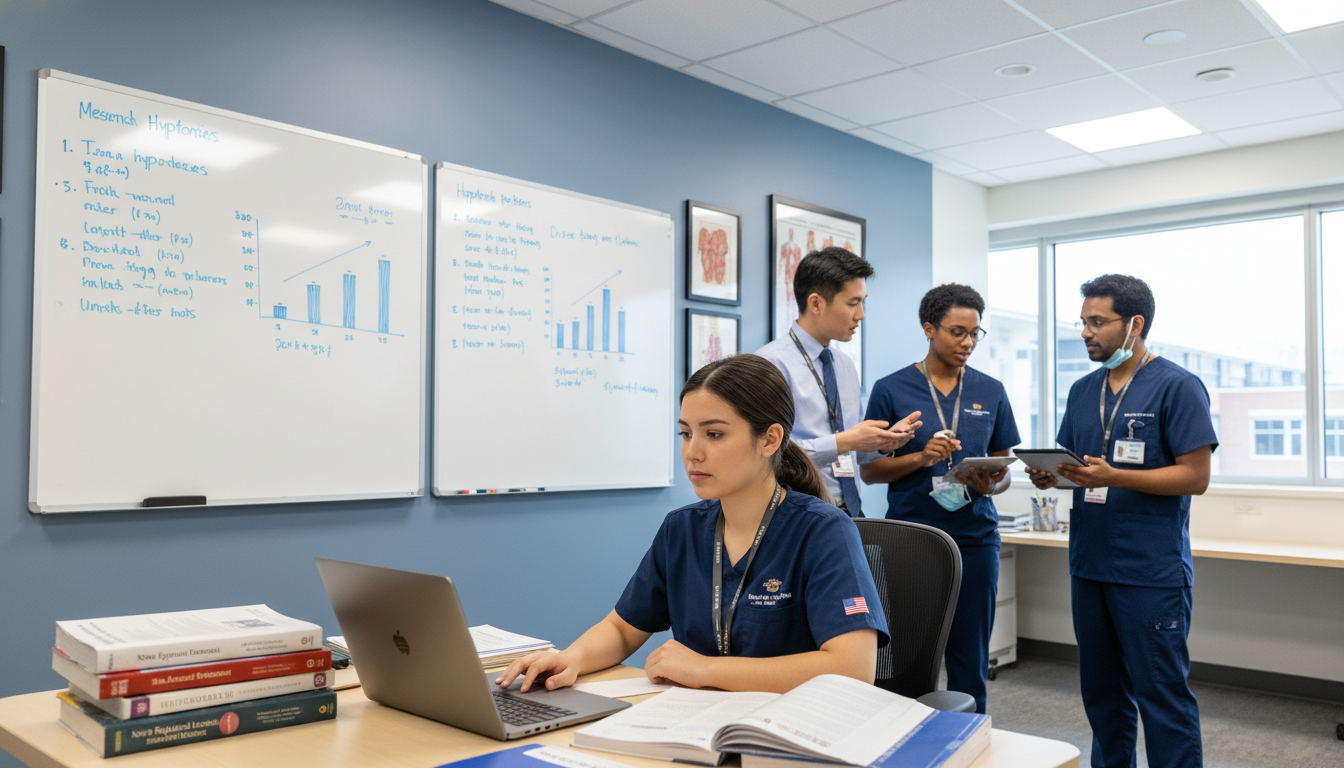
Understanding Research During a Preliminary Surgery Year as a US Citizen IMG
For a US citizen IMG in a preliminary surgery year, research is not just a “nice to have”—it can be one of the most powerful levers to improve your chances of matching into a categorical position (surgery or another specialty) and building an academic career. Yet prelim residents often feel they have the least time and support to pursue research during residency.
This article breaks down how to realistically engage in research during residency as a busy prelim surgery resident, with a specific focus on the unique challenges and opportunities for an American studying abroad who has returned to the US training system. You’ll learn how to identify research-friendly environments, build projects that actually get completed, and use your resident research projects strategically to strengthen your application for re-application or transfer.
1. Why Research Matters So Much for US Citizen IMGs in Preliminary Surgery
1.1 The Prelim Surgery Reality
A prelim surgery residency year is typically:
- Non-categorical, 1-year contract
- Heavy on service: floor work, consults, night float, cross-cover
- Less protected time and fewer formal supports than categorical colleagues
For many US citizen IMGs, the prelim year is:
- A bridge to a future categorical general surgery position
- A stepping stone to another specialty (e.g., anesthesiology, radiology, internal medicine, EM)
- A way to demonstrate clinical capability in the US system after training abroad
Because your time is limited and your position is not guaranteed to continue, your goal is to use the prelim year to:
- Prove you can function as a safe, reliable resident
- Build advocates (faculty who will strongly support you)
- Accumulate evidence of academic potential—most directly via research output
1.2 Why Research Has Extra Weight for US Citizen IMGs
Program directors often see large numbers of applications from IMGs. Research helps you stand out in concrete ways:
- Signals academic engagement in US medicine rather than only abroad
- Demonstrates follow-through and productivity in a demanding environment
- Creates tangible output (abstracts, posters, publications) you can list on ERAS
- Offers structured mentorship and networking with faculty who influence selection
- Can provide letters of recommendation that highlight your curiosity, initiative, and scholarly potential
For an American studying abroad, research shows you can integrate into the US academic system and contribute at a similar level as US grads. For some programs, this is the difference between “risky prelim” and “future colleague we want to invest in.”
1.3 Research vs. “Just Surviving” the Year
It’s common to feel that research is impossible when you’re:
- Q4 call on busy services
- Covering multiple floors
- Constantly catching up on notes and sign-outs
The mindset shift you need: Research during residency in a prelim year is not about leading a randomized controlled trial. It’s about:
- Targeted, high-yield, feasible projects
- Strategic collaboration on existing work
- Leveraging small time blocks consistently over months
Done right, even a few well-chosen projects can dramatically improve your academic residency track prospects.

2. Types of Research Prelim Surgery Residents Can Realistically Do
As a US citizen IMG in a rigorous prelim surgery residency, your best projects are:
- Retrospective chart reviews
- Case reports and case series
- Quality improvement (QI) projects
- Database or registry studies
- Education or simulation research
2.1 Retrospective Chart Reviews
These are usually the most feasible:
- Use existing EMR data
- Answer clinical or outcomes questions (e.g., complications, length of stay, readmission)
- Can often be done with a smaller team
Examples for preliminary surgery residents:
- Outcomes of emergency appendectomy in patients with high BMI
- Readmission rates after laparoscopic vs. open hernia repair
- Complication patterns in patients with delayed presentation of cholecystitis
Why it’s high-yield: You can often join projects where senior residents or faculty have already defined the question and IRB protocol. You may contribute data extraction, analysis, and drafting parts of the manuscript.
2.2 Case Reports and Case Series
These are especially accessible early in the year when you’re still learning systems:
- Identify an unusual or instructive case on your service
- Work with faculty to frame the case and perform a literature review
- Submit to surgical case report journals or specialty meetings
Examples:
- Rare variant of biliary anatomy encountered during laparoscopic cholecystectomy
- Unusual presentation of necrotizing fasciitis in an immunocompromised patient
- Complicated trauma case illustrating decision-making in damage control surgery
Pros: Fast turnaround, ideal first project, and showcases your ability to recognize meaningful clinical questions.
Cons: Lower academic weight than large studies; aim to move from case reports to larger observational studies over time.
2.3 Quality Improvement (QI) Projects
QI can count as scholarly work, particularly if:
- It’s systematic (Plan-Do-Study-Act cycles)
- You collect and analyze data
- You present the work internally or externally
Examples:
- Reducing postoperative Foley catheter days on your service
- Improving accuracy of DVT prophylaxis dosing in high-BMI patients
- Standardizing postoperative follow-up calls to reduce ED visits
QI projects can often be implemented quickly and are highly relevant to patient safety and systems-based practice—attributes program directors value.
2.4 Database or Registry Projects
If your institution participates in:
- NSQIP
- Trauma registries
- Institutional surgical registries
You may be able to join ongoing projects using these large datasets. This typically requires:
- A mentor with access and experience
- Statistical support (biostatistician or senior researcher)
These projects often have higher academic impact but require more coordination. As a prelim resident, you’ll usually join an existing project rather than start one from scratch.
2.5 Medical Education and Simulation Research
If you enjoy teaching or simulation:
- Assess the impact of a new simulation-based training for interns
- Evaluate a curriculum for teaching chest tube insertion or central lines
- Study resident performance or confidence before/after educational interventions
This type of work can be particularly compelling if you’re ultimately aiming for an academic residency track with teaching responsibilities.
3. Finding and Building Research Opportunities as a Prelim Surgery Resident
3.1 Start Before July If Possible
As a US citizen IMG, you may already know you’ll be in a prelim surgery year months before matriculation. Use that time to:
- Email program leadership with a concise note:
- Express interest in research during residency
- Ask if there are faculty who welcome prelim residents on projects
- Identify research-active faculty by:
- Searching PubMed for “general surgery [institution name]”
- Reviewing departmental web pages for research interests and recent publications
If you can establish a connection before orientation, you may hit the ground running with an ongoing project.
3.2 Identify Research-Friendly Faculty Once You Arrive
Early in your year:
- Pay attention to:
- Which attendings mention research on rounds
- Who refers to “our study,” “our QI project,” or “our residents present at…”
- Ask senior residents:
- “Which attendings are good mentors for resident research projects?”
- “Who actually helps prelims get on papers or abstracts?”
Prioritize faculty who:
- Have a history of co-authorship with residents
- Are responsive and organized
- Have at least one or two ongoing projects that match your interests or capacity
3.3 Introduce Yourself Strategically
When you identify a potential mentor:
Send a brief, focused email:
- 3–4 sentences max
- Mention you are a US citizen IMG in a preliminary surgery residency year
- Highlight 1–2 specific interests (e.g., acute care surgery, trauma outcomes, QI)
- Ask if you might briefly discuss potential roles in ongoing projects
Prepare for the meeting:
- Bring your current CV
- Be explicit about your schedule and constraints
- Offer to help with discrete tasks (data collection, chart review, literature review, drafting sections)
3.4 Be Transparent About Your Time and Goals
Prelim schedules are unpredictable. Set expectations:
- “My call schedule is heavy, but I can realistically commit 3–4 hours per week.”
- “My primary goal is to complete at least one project that can reach abstract or manuscript stage by [month].”
Most faculty appreciate honesty. They’re more likely to engage you if they see you as reliable and realistic, not overpromising.

4. Executing Research During a Busy Prelim Year: Time Management and Workflow
4.1 Accept the Constraints—and Work with Them
As a prelim surgery resident, your weeks will vary. Some will be so intense that research is nearly impossible; others will have small gaps you can use.
Think in terms of:
- Micro-blocks (20–40 minutes between cases or after sign-out)
- Protected half-days (post-call afternoons, lighter weekends, vacation blocks)
Use micro-blocks for:
- Literature searches
- Reading and annotating articles
- Updating data spreadsheets
- Drafting small sections (background, methods, simple tables)
Use larger blocks for:
- Deep work (data analysis, full manuscript drafting, responding to reviewer comments)
- IRB preparation if you’re leading a project
4.2 Define Roles and Deliverables Early
For each project, clarify:
- Your specific tasks (e.g., 100 charts to abstract, write Methods section, create figures)
- Deadlines that align with your rotation schedule
- Who is the project lead (often a senior resident or fellow)
This avoids the common problem where prelims remain “on the team” but never receive well-defined tasks—and end the year without authorship.
4.3 Aim for at Least One “Owned” Project
Try to have one project where you are clearly first or second author, even if it’s:
- A well-written case report
- A focused retrospective study with a limited dataset
- A robust QI project with pre/post data
Authorship matters. For future applications, being first or second author:
- Stands out on ERAS
- Strengthens your academic residency track appeal
- Gives faculty a concrete reason to write strong letters about your scholarship
4.4 Use Tools and Systems that Save Time
- Reference managers: Zotero, Mendeley, EndNote
- Secure data tools: REDCap, institution-approved spreadsheets
- Task managers: Simple to-do lists or apps (Todoist, Trello)
- Templates:
- Create a template for notes, data dictionaries, and standard method sections
- Reuse structures with appropriate modifications
The goal: Minimize friction so that when you do have 20 minutes, you can make real progress.
5. Positioning Your Research for Future Applications and Academic Careers
5.1 How Research Strengthens a Categorical Application
When you apply (or re-apply) to categorical programs in general surgery or another specialty, your research during residency supports you by showing:
- Trajectory: You didn’t just do research in medical school; you continued in residency
- Adaptability: You can function clinically and still produce scholarly work
- Integration: You are embedded in US academic medicine, not just “visiting” as a prelim
For a US citizen IMG, this is particularly important because it counters lingering concerns about:
- Limited exposure to US research culture in medical school
- Whether you can compete academically with US MD/DO graduates
5.2 Highlighting Your Work Effectively on ERAS
When you list resident research projects on ERAS:
- Be precise about your role (data collection, design, primary author, etc.)
- Include:
- Abstracts (even if not yet presented)
- Poster presentations
- Oral presentations
- Manuscripts (published, accepted, in submission, or in preparation—clearly labeled)
For ongoing work, avoid exaggeration. You can state:
- “Manuscript in preparation (anticipated submission to [journal] by [month/year]).”
Program directors can often recognize when a prelim year has been used strategically.
5.3 Letters of Recommendation with Academic Emphasis
A faculty mentor who has worked with you on research is uniquely positioned to:
- Comment on your analytic thinking and curiosity
- Describe how you managed deadlines despite demanding clinical duties
- Compare you favorably to categorical residents
For an American studying abroad, such letters may be especially impactful. They reassures selection committees that:
- You’re academically aligned with their environment
- You can contribute to the department’s research and scholarly output
- You belong in their academic residency track pipeline
5.4 Planning Beyond the Prelim Year: Gap Years and Research Fellowships
If you do not secure a categorical position immediately, you may consider:
- Dedicated research fellowships in surgery or related specialties
- Additional preliminary surgery years (less ideal unless clearly tied to future opportunity)
Your prelim-year research record can help you:
- Obtain funded research positions in surgical labs or outcomes groups
- Transition into T32 research tracks or formal academic residency tracks later
- Build stronger relationships with research-heavy departments for re-application
In such scenarios, your prelim-year projects become your portfolio—your evidence that you are worth a longer-term academic investment.
6. Common Pitfalls and How US Citizen IMGs Can Avoid Them
6.1 Overcommitting to Too Many Projects
Temptation: Saying “yes” to every opportunity out of fear nothing will pan out.
Problem:
- You’re spread too thin
- You miss deadlines
- You appear unreliable to mentors
Solution:
- Start with 1–2 core projects where you can realistically be a major contributor
- Add more only after you’ve demonstrated consistent productivity
6.2 Not Clarifying Authorship Expectations
Prelim residents sometimes work hard but end up buried in middle authorship or omitted entirely.
Avoid this by:
- Discussing authorship early: “If I complete [X tasks], would I be a candidate for [first/second/third] author?”
- Getting informal agreement in writing (an email recap is adequate and professional)
6.3 Waiting Too Long to Start
If you wait until January or later to begin:
- There may not be enough time for meaningful progress
- Faculty may already be committed to other mentees
- Abstract deadlines for key meetings may be missed
Aim to:
- Identify at least one mentor by September
- Be actively contributing to a project by October
- Target at least one abstract submission during your prelim year
6.4 Ignoring Your Long-Term Specialty Goals
As a prelim surgery resident, you might eventually apply to:
- Categorical general surgery
- Surgical subspecialties (with appropriate prelim/transitional paths)
- Other fields like anesthesiology, radiology, EM, or IM
Whenever possible:
- Align your resident research projects with your target specialty:
- Trauma outcomes if considering EM, trauma surgery, or critical care
- Perioperative medicine if considering anesthesiology or IM
- Imaging-heavy topics if considering radiology
But if that’s not possible, any well-executed project is better than none, as long as it shows rigor, follow-through, and scholarly engagement.
FAQs: Research During a Prelim Surgery Year for US Citizen IMGs
1. Is it realistic to do research during a busy prelim surgery residency year?
Yes—if you target feasible projects and manage expectations. Focus on:
- Smaller, high-yield efforts (case reports, retrospective reviews, QI)
- Joining existing projects with clear roles
- Using micro-blocks of time consistently
You are unlikely to lead a large prospective trial, but you can complete multiple smaller contributions that still significantly strengthen your application.
2. Will research really help me get a categorical spot as a US citizen IMG?
Research is not a guarantee, but it is a major positive signal:
- Demonstrates academic potential and follow-through
- Shows engagement with US academic surgery
- Provides strong, content-rich letters of recommendation
Combined with strong clinical performance and professionalism, research can meaningfully improve your competitiveness for categorical spots or an academic residency track.
3. What if my program has very little research infrastructure?
Even in less academic environments, you can:
- Develop case reports on unusual or instructive cases
- Take on QI projects that involve data collection and analysis
- Seek mentors outside your immediate institution (e.g., through alumni networks, prior medical school contacts, or professional societies)
- Collaborate remotely on literature reviews or database projects led by others
For a US citizen IMG, demonstrating resourcefulness in limited environments can impress program directors.
4. How many research projects should I aim to complete in my prelim year?
Quality matters more than raw count. A realistic and impactful goal is:
- 1–2 projects where you are first or second author
- 1–3 additional projects where you contribute meaningfully (middle authorship, abstracts, or QI initiatives)
Make sure at least one project progresses to an abstract, presentation, or manuscript stage before the next ERAS cycle so you can list it concretely.
By approaching research during residency with clear goals, strategic mentorship, and realistic expectations, a US citizen IMG in a preliminary surgery year can transform a potentially precarious position into a launching pad for a stronger, more academically grounded application to categorical training and future surgical or related specialties.