Understanding Research During Residency as a US Citizen IMG in EM–IM
For a US citizen IMG interested in Emergency Medicine–Internal Medicine (EM–IM), research during residency is one of the most powerful ways to strengthen your academic profile, shape your career path, and open doors to fellowships and academic careers. It can feel intimidating—especially if you trained abroad and are still adjusting to the US medical system—but resident research projects are absolutely attainable with the right approach, mentorship, and planning.
This article walks through how research fits into EM–IM combined training, how to get involved even if you have limited prior experience, and how to strategically use research during residency to build a long-term career advantage as an American studying abroad returning to the US.
Why Research Matters in EM–IM Combined Residency
The unique position of EM–IM residents
EM–IM combined programs train you to practice both emergency medicine and internal medicine. That dual perspective makes you uniquely suited for research that:
- Bridges acute and chronic care (e.g., sepsis outcomes after ED discharge, transitions of care).
- Connects inpatient medicine with ED operations (e.g., boarding, readmissions, handoff quality).
- Examines systems of care across settings (e.g., heart failure management beginning in the ED and continuing on the ward and in clinic).
Program directors and academic departments recognize that EM–IM residents often bring a broader systems view. Research during residency helps you:
- Demonstrate you can think beyond a single patient encounter.
- Engage with quality improvement (QI), health systems science, and implementation.
- Position yourself for leadership roles in academic medicine, hospital administration, or fellowship.
Why research is especially valuable for US citizen IMGs
As a US citizen IMG, you often face two perceptions in competitive academic spaces:
Uncertainty about your prior training environment
Research experience in a US setting shows that you can navigate US hospital systems, work with interdisciplinary teams, and produce scholarly work at a standard recognized nationally.Questions about your long-term trajectory
Ongoing involvement in research during residency signals commitment to academic growth, critical thinking, and contribution beyond clinical service.
In EM–IM combined residency, involvement in research can:
- Offset concerns about an IMG background by providing concrete academic achievements.
- Strengthen your application for EM- or IM-based fellowships (e.g., critical care, toxicology, ultrasound, palliative care, health services research).
- Help you build relationships with faculty who can later write strong letters for academic positions, fellowships, or an academic residency track faculty role.
Types of Research Opportunities in EM–IM Residency
Research doesn’t have to mean a massive randomized controlled trial. EM–IM residents can engage in many kinds of scholarly work tailored to their time and resources.
1. Clinical research
Common examples:
- Retrospective chart reviews (e.g., “Predictors of admission in patients presenting to the ED with syncope and high-risk comorbidities”).
- Prospective observational studies (e.g., “Outcomes of patients with COPD exacerbation admitted from the ED vs directly from clinic”).
- Comparative effectiveness research (e.g., “Use of high-sensitivity troponin pathways and 30-day MACE outcomes”).
Why it fits EM–IM:
You can leverage data from both ED and inpatient settings, examining:
- Continuity from ED diagnosis to inpatient course and discharge.
- Differences in management between specialties.
- Longitudinal outcomes of acutely ill patients.
2. Quality improvement (QI) and patient safety
QI projects are often more feasible than large clinical trials and frequently required by programs.
Examples:
- Reducing time-to-antibiotics for sepsis originating in the ED, with follow-up to inpatient ICU or floor.
- Improving medication reconciliation quality between ED, inpatient, and outpatient internal medicine clinic.
- Increasing appropriate use of VTE prophylaxis for high-risk ED admissions.
QI projects can produce:
- Internal reports and presentations.
- Abstracts for EM and IM conferences.
- Manuscripts in QI or systems-focused journals.
3. Health systems and operations research
Emergency medicine internal medicine physicians are often deeply involved in hospital operations.
Potential projects:
- ED boarding and its effect on inpatient length of stay or mortality.
- Impact of early ED interventions (e.g., lactate measurement, point-of-care ultrasound) on inpatient outcomes.
- Transitions of care from ED to floor, ICU, or observation units.
This area is particularly attractive if you’re interested in hospital leadership, administration, or academic residency track roles.
4. Education research
If you’re drawn to teaching, you can study educational interventions.
Examples:
- Simulation-based curriculum for EM–IM residents on managing undifferentiated shock.
- Evaluating a new feedback system for cross-cover calls on the medicine wards.
- Studying learner performance in combined EM–IM rotations vs categorical counterparts.
Education research often overlaps with your daily teaching activities and can be a gateway into academic medicine roles.
5. Case reports and case series
These are often the most accessible starting point, especially if you are new to US-based research.
Examples:
- A rare complication of a common emergency (e.g., unusual presentation of aortic dissection).
- Unexpected side effects of a widely used medication uncovered during an IM admission.
- Diagnostic challenges that span ED and inpatient care.
They help you:
- Learn the publication process.
- Develop writing skills.
- Establish an early scholarly track record during residency.
Getting Started: First-Year Strategy for US Citizen IMGs
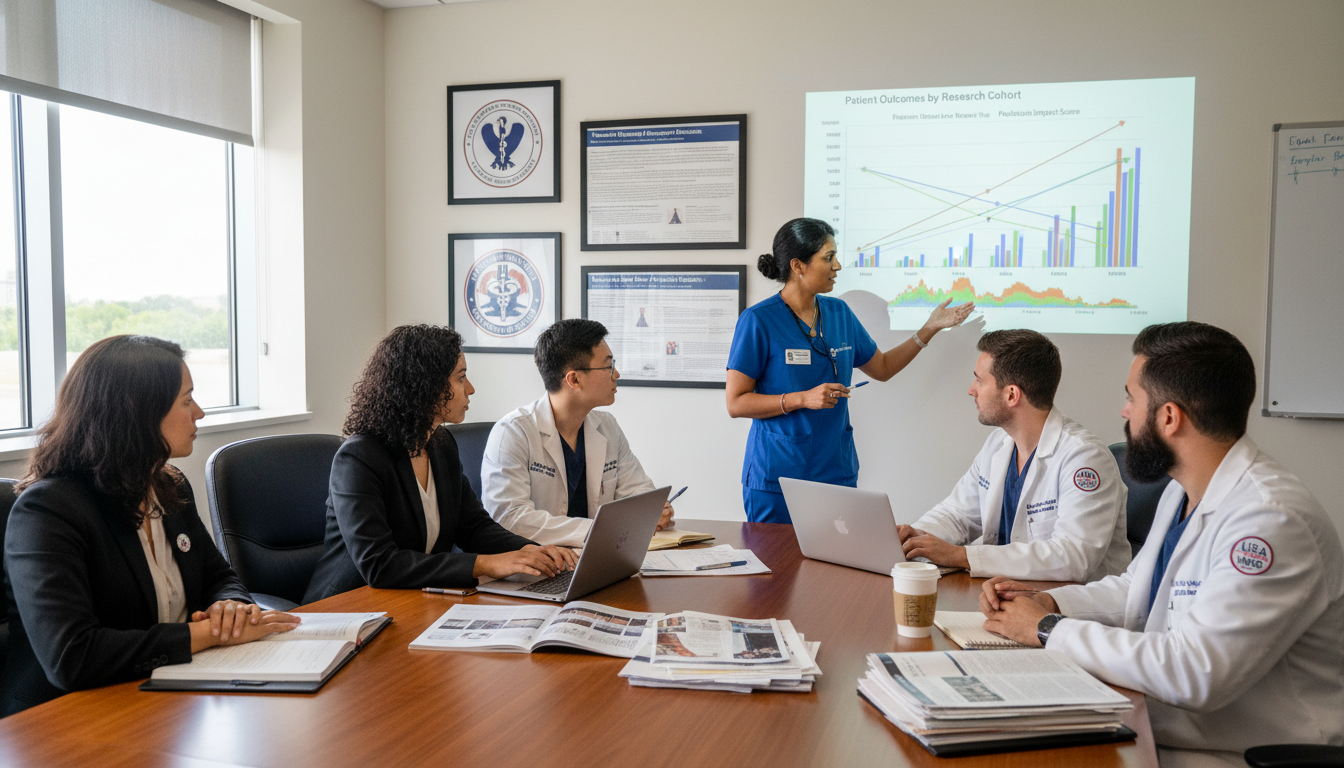
If you are a US citizen IMG starting your EM–IM combined residency, the first 6–12 months are critical for setting a sustainable research trajectory.
Step 1: Focus on clinical adjustment first, but don’t wait too long
Your primary job as an intern is to become a safe, reliable clinician. However, if you wait until PGY-3 or PGY-4 to explore research, you will run out of time. A reasonable roadmap:
Months 1–3:
- Observe how the system works.
- Ask senior residents which faculty are research-active and IMG-friendly.
- Attend any resident research seminars or orientation sessions.
Months 4–6:
- Meet at least 1–2 faculty members to discuss potential projects.
- Express that you are a US citizen IMG interested in emergency medicine internal medicine research and that you’re willing to start small but are committed.
Months 6–12:
- Join an ongoing project in a manageable role (data collection, literature review).
- Start a small parallel project of your own (e.g., case report, brief QI initiative).
Step 2: Identify the right mentors
For EM–IM research, you should ideally have:
Primary mentor:
Someone in EM, IM, or EM–IM who understands your clinical schedule and training structure.Secondary mentor(s):
Depending on your project, this could be:- A biostatistician.
- A health services researcher.
- A QI lead or hospitalist.
- An EM operations or ultrasound faculty.
As a US citizen IMG, explicitly look for mentors who:
- Have a track record of working with IMGs or US citizen IMGs.
- Are involved in academic residency track activities.
- Are known for being responsive and supportive (ask senior residents quietly who actually helps get projects across the finish line).
Step 3: Start with “low-friction” projects
You do not need to design a massive trial as a PGY-1. Instead:
Join an existing ongoing resident research project where:
- IRB approval is already in place.
- Data collection tools exist.
- Clear timelines and roles are defined.
Begin with:
- A case report based on a memorable ED or inpatient encounter.
- A QI project that aligns with departmental goals (e.g., sepsis bundle adherence).
- A retrospective chart review with a clearly defined question.
Early wins build confidence and establish you as someone who can deliver—which leads to more substantial opportunities by PGY-2/PGY-3.
Balancing Clinical Demands and Research in EM–IM
Time challenges unique to EM–IM combined residents
EM–IM residents face a particularly complex schedule:
- Alternating between EM shifts and IM ward months.
- Night shifts and irregular circadian rhythms in the ED.
- Clinic, ICU, floor, and ED commitments.
This can make it harder to protect continuous blocks of time for research during residency. However, it also offers strategic advantages:
- On ED blocks, you may have days off during the week that are perfect for meetings, data work, or writing.
- On IM blocks, you may have more predictability for scheduling longitudinal QI projects.
Practical strategies to make research manageable
Use micro-blocks of time
- 30–60 minutes between shifts or after sign-out can be dedicated to:
- Writing a paragraph of a manuscript.
- Screening 10–15 articles for a literature review.
- Updating your project spreadsheet.
- 30–60 minutes between shifts or after sign-out can be dedicated to:
Batch your work by task type
- Reading and literature review on post-night-shift days (low-cognitive-load tasks).
- Data analysis and writing on well-rested days.
- Emailing and scheduling meetings during small gaps between patients or at sign-out.
Plan around your rotation calendar
- Before each block, look at your ED and IM schedule:
- Identify 2–3 days where you can schedule longer research sessions.
- Let your mentor know in advance when you’ll be available.
- Before each block, look at your ED and IM schedule:
Negotiate protected research time if available
- Some EM–IM programs and academic residency track pathways offer:
- Dedicated research electives.
- Academic half-days.
- Scholarly tracks (e.g., EM operations, critical care, health services).
As a US citizen IMG, ask early about:
- What residents in the past have done.
- How to qualify for research electives.
- Whether there are institutional expectations to present or publish.
- Some EM–IM programs and academic residency track pathways offer:
Building a Strategic Research Portfolio During EM–IM Training
Think of your residency research portfolio as a way to tell a coherent story about your interests and capabilities rather than a random assortment of unrelated papers.
1. Pick a unifying theme (but stay flexible)
Examples of EM–IM-friendly themes:
Sepsis and shock across ED and ICU
- ED protocols, early recognition, inpatient outcomes.
Heart failure or COPD management
- ED presentations, admission decisions, readmission prevention.
Health systems and flow
- Boarding, ED crowding and mortality, length of stay, readmissions.
Transitions of care
- ED to hospitalist, hospitalist to outpatient, high-risk discharges.
Even 2–3 projects within one general area can:
- Help you develop real expertise.
- Make you more competitive for fellowships (e.g., critical care, hospital medicine, ultrasound, administration).
- Provide depth for interviews and promotions later.
2. Aim for a mix of project types
By the end of residency, a strong EM–IM resident research portfolio might include:
- 1–2 published case reports or case series.
- 1 education or QI project presented at local or regional conference.
- 1–2 larger clinical or health systems projects (even if only one reaches publication, the others may lead to abstracts/posters).
For a US citizen IMG, this balanced portfolio shows:
- You can see patients and also think like a scholar.
- You have tangible contributions in the US healthcare setting.
- You’re prepared for an academic or academic-leaning career path.
3. Present early and often
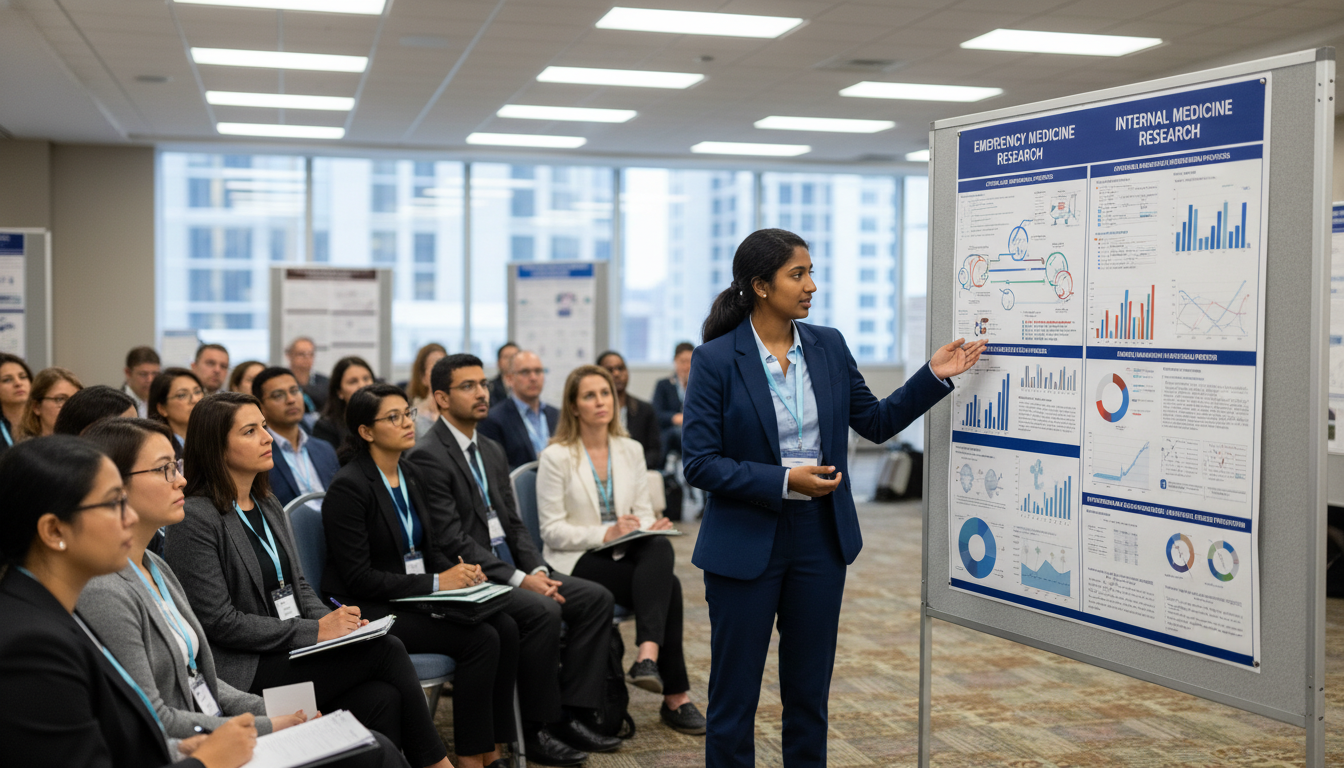
Use presentations to build your profile even before publications are finalized:
- Local departmental conferences (EM and IM grand rounds, resident research days).
- Regional EM or IM society meetings.
- National meetings (SAEM, ACEP, SCCM, SHM, ACP, and combined EM-IM sessions when available).
Every abstract and poster:
- Builds your CV.
- Increases your visibility.
- Helps you meet potential collaborators beyond your home institution.
Practical Tools and Tips for Resident Research Success
Leverage institutional resources
Most academic centers supporting EM–IM combined programs offer:
- Biostatistics consult services (often free to residents).
- Research coordinators who can help with:
- IRB submissions.
- Data collection tools (REDCap, EMR extracts).
- Medical library support:
- Systematic search strategies.
- Article retrieval.
- Citation management training.
As an American studying abroad returning for US training, these systems may be new to you. Don’t hesitate to openly say, “I haven’t used this system before; can you walk me through it?” Faculty appreciate honesty and initiative.
Become efficient with tools
Learn early to use:
- Reference managers like Zotero, Mendeley, or EndNote.
- Data tools: Excel, SPSS, R, or Stata (depending on institutional norm).
- Writing tools: Templates from previous resident manuscripts; standardized abstract formats.
Even spending a weekend early in PGY-1 familiarizing yourself with these platforms can save you enormous time later.
Common pitfalls for US citizen IMGs and how to avoid them
Overcommitting to too many projects
- Focus on 1–2 meaningful resident research projects rather than 6 incomplete ones.
- Ask mentors about realistic scope given your call schedule and EM shifts.
Not clarifying roles and expectations
- At the start of each project, ask:
- “What is the timeline?”
- “What will authorship look like?”
- “What are my specific responsibilities?”
- At the start of each project, ask:
Delaying writing until “things calm down”
- Residency rarely calms down.
- Write in small chunks: introduction one week, methods the next, etc.
Underutilizing your EM–IM identity
- Your dual-trained perspective is a strength—lean into topics that bridge both specialties.
- When discussing research ideas, explicitly say: “I’d like to design this project so it uses both my EM and IM training.”
Using Research to Shape Your Post-Residency Future
Academic residency track and faculty careers
If you envision an academic career:
- Research during residency is nearly essential.
- An academic residency track within your EM–IM program (if available) often offers:
- Protected research time.
- Formal mentorship structure.
- Teaching responsibility, which pairs well with education research.
As a US citizen IMG, involvement in these tracks:
- Demonstrates that you can thrive in structured academic environments.
- Provides strong letters of recommendation from academic leaders.
- Helps you develop a focused CV that meets faculty hiring committee expectations.
Fellowship applications
Many EM–IM graduates pursue fellowships such as:
- Critical Care Medicine
- Pulmonary/Critical Care
- Toxicology
- Ultrasound
- Palliative Care
- Health Services Research
- Hospital Medicine/Quality and Safety
Programs look favorably at:
- Resident research projects directly related to the fellowship focus (e.g., shock, ARDS, ED-to-ICU transfers for critical care).
- Demonstrated productivity (abstracts, posters, publications).
- Clear narrative connecting your EM–IM clinical experience with your scholarly work.
Non-academic careers and leadership
Even if you plan to pursue a primarily clinical role:
- Familiarity with research methods and QI principles is extremely valuable for:
- Medical directorships.
- Hospital leadership.
- Group-level quality and safety initiatives.
Experience with research during residency helps you:
- Interpret new evidence critically.
- Lead data-driven practice change.
- Contribute to institutional policies and protocols.
FAQs: Research During EM–IM Residency for US Citizen IMGs
1. I’m a US citizen IMG with almost no prior research. Is it too late to start in residency?
No. Many residents—even US grads—start research during residency with minimal prior experience. Begin with:
- Case reports and small QI projects.
- Joining ongoing studies with defined roles.
- Learning basics of study design and data interpretation.
The key is consistency and following projects through to completion. A few well-executed smaller projects are more valuable than many abandoned ideas.
2. How many publications do I need during EM–IM residency to be competitive for academic jobs?
There’s no absolute number, but a realistic and competitive range might be:
- 2–4 peer-reviewed publications (including case reports).
- Several abstracts/posters at regional or national meetings.
- Evidence of progressive involvement (e.g., from co-author to leading your own project).
Quality, relevance to your EM–IM identity, and clear mentorship are as important as raw numbers.
3. Can I realistically do research during residency given EM shift work and IM call schedules?
Yes, but it requires planning:
- Choose manageable projects with clear timelines.
- Use ED off-days and lighter rotations for writing and analysis.
- Negotiate elective time for research if your program allows.
- Communicate clearly with mentors about your schedule and constraints.
Many successful EM–IM residents complete significant research during residency by being deliberate with their time and project selection.
4. How should I highlight my status as a US citizen IMG when discussing research?
Frame it as part of your strength:
- Emphasize that training abroad gave you a broader global perspective.
- Show that you can integrate that experience into US-based research on systems, equity, or quality.
- Demonstrate adaptability and resilience: you navigated different healthcare systems and are now contributing to scholarly work in the US.
In CVs and interviews, connect your background, your EM–IM clinical training, and your research during residency into a unified story of growth, contribution, and long-term academic potential.
By approaching research during residency thoughtfully—choosing mentors wisely, focusing on feasible but meaningful projects, and leveraging your unique EM–IM perspective—you can turn your status as a US citizen IMG into a clear asset. Your resident research projects will not only enhance your training but also shape your future as a clinician, educator, and leader in emergency medicine internal medicine.