Understanding the Role of Research During Urology Residency
For a Caribbean IMG pursuing urology in the United States, research during residency is more than just a “nice to have.” It can shape your clinical skills, academic credibility, fellowship options, and future career trajectory. Whether you attended SGU, Ross, AUC, Saba, or another Caribbean medical school, residency—particularly an academic urology residency track—is often where you can overcome early disadvantages and distinguish yourself.
In urology, programs value residents who can think critically, interpret literature, and contribute to innovation. As an international graduate, structured resident research projects help you:
- Build a strong academic portfolio (abstracts, posters, manuscripts)
- Recover from a less traditional training path (e.g., Caribbean medical school residency route)
- Compete for fellowships and academic jobs
- Demonstrate commitment to evidence-based practice
This article walks you through how to leverage research during residency as a Caribbean IMG in urology: the types of projects you can do, how to get started, how to balance research with clinical demands, and how to build a long-term academic trajectory.
Why Research Matters So Much for Caribbean IMG Urology Residents
1. Leveling the Playing Field After a Caribbean Medical School
Even if you matched into a strong program—whether through an SGU residency match or another Caribbean medical school residency pathway—you may still be perceived differently than U.S. MD graduates. Research is one of the most effective ways to change that narrative.
Research productivity signals:
- Intellectual curiosity and discipline
- Ability to complete long-term projects
- Familiarity with academic culture and standards
- Commitment to urology beyond clinical duties
When faculty see your name consistently on abstracts and papers, they are less likely to dwell on where you went to medical school and more on the value you bring now.
2. Urology Is Highly Academic by Nature
Compared with many other surgical specialties, urology is heavily driven by:
- Rapidly evolving technology (robotics, lasers, implants)
- New systemic therapies (immunotherapy, targeted agents)
- Clinical trials (e.g., prostate, bladder, kidney cancer)
- Outcomes research and quality improvement
Residency is not just about learning surgical skills. You must be able to:
- Critically appraise literature
- Apply evidence to patient management
- Understand limitations of data and study design
- Contribute to guideline updates and protocol development
Doing research during residency forces you to engage with these skills in a structured way.
3. Fellowship and Academic Career Competitiveness
Many urology residents—especially Caribbean IMGs—aim for fellowships (oncology, endourology, female pelvic medicine, pediatrics, reconstruction, etc.). Programs often compare applicants by:
- Number and quality of publications
- National presentations (AUA, SUO, SUFU, etc.)
- Participation in clinical trials or large multi-center studies
- Evidence of long-term interest in a subspecialty
For an academic urology residency track, faculty may subtly expect that you are working toward a research niche. Showing consistent involvement in resident research projects makes it easier to:
- Get strong letters of recommendation
- Be selected for chief roles or leadership positions
- Transition into academic attendings positions

Types of Research Projects Urology Residents Can Do
You do not need to be in a basic science lab to be “doing real research.” In fact, for most Caribbean IMGs, clinically focused projects are more accessible and more directly relevant to residency.
1. Retrospective Chart Reviews
What it is:
You analyze existing medical records to answer a specific question (e.g., “Are postoperative complications higher in obese patients undergoing robotic prostatectomy at our institution?”).
Why it’s ideal for residents:
- Uses data already available in the EMR
- Can often be done without external funding
- Timelines are manageable (months, not years)
- Strong learning in statistics and study design
Example ideas in urology:
- Outcomes of ureteroscopy vs. shock-wave lithotripsy in your hospital’s stone population
- Predictors of positive margins in robotic radical prostatectomy
- Readmission rates after TURP and associated risk factors
- Impact of pre-habilitation on postoperative outcomes in major urologic oncology surgery
2. Prospective Observational Studies
What it is:
You identify patients going forward, collect specific data, and follow their outcomes.
Advantages:
- Stronger evidence than retrospective data
- You control exactly which variables are collected
- Great experience for learning research logistics (consent, IRB, data collection)
Example projects:
- Prospective registry of patients undergoing robotic partial nephrectomy, tracking warm ischemia time, complication rates, and renal function
- Patient-reported outcome measures (PROs) after surgery for stress urinary incontinence
- Prospective tracking of complications using Clavien-Dindo classification in all major urologic procedures
3. Quality Improvement (QI) and Implementation Projects
Many urology departments encourage QI as part of research during residency. These often count as scholarly work and are publishable.
Examples:
- Reducing Foley catheter–associated UTIs using a new insertion and maintenance protocol
- Implementing an ERAS (Enhanced Recovery After Surgery) pathway for cystectomy patients and measuring LOS (length of stay) and complication rates
- Standardizing time-out and instrument count for endoscopic procedures to reduce intraoperative errors
Quality improvement work is especially useful for Caribbean IMG residents in community-heavy programs or smaller centers where large randomized trials are unrealistic, but workflow changes are attainable.
4. Case Reports and Small Case Series
These are often the first publications for many residents and are particularly helpful early in training.
Examples:
- Rare urologic malignancies or unusual presentations (e.g., testicular tumor mimicking infection)
- Uncommon complications of common procedures
- Innovative surgical techniques or modifications relevant to resource-limited settings (adds a unique perspective many Caribbean IMGs can bring)
Case reports are great introductory projects that help you:
- Learn the publication process
- Practice medical writing
- Move quickly from idea to submission
5. Basic Science or Translational Research
If your institution has strong labs, you may get involved in:
- Tumor biology (prostate, bladder, kidney)
- Biomarker discovery
- Immunotherapy or molecular pathways
- Tissue engineering or device development
Basic science is high-yield for an academic career but typically:
- Requires more time and continuity
- Is best for those pursuing a research-heavy academic residency track or dedicated research years
As a Caribbean IMG, this can be extremely powerful if you’re aiming for elite fellowships or major academic centers—though it’s not mandatory for everyone.
6. Multi-center Studies and Registries
Some residents participate in:
- AUA, SUO, or society-sponsored collaborative projects
- National registries for stones, prostate cancer, or pediatric urology
- Institutional collaborations across hospitals
These can offer higher-impact publications and networking opportunities with leaders in the field.
How to Get Started: A Step-by-Step Guide for Caribbean IMG Urology Residents
Step 1: Map Out Your Research Goals Early
Ideally, you should start thinking about research during residency before you begin intern year or early PGY-2. Ask yourself:
- Do I see myself in academics or private practice with some academic involvement?
- Am I interested in a research-heavy fellowship (oncology, endourology, etc.)?
- What kind of projects are realistic at my institution?
If you matched via the SGU residency match or a similar Caribbean medical school residency pathway, use the months before residency to:
- Review your program’s website and faculty research interests
- Read recent publications from your department
- Note which faculty are most actively publishing
Step 2: Identify Research-Friendly Faculty Mentors
Look for attendings who:
- Have recent first- or senior-author publications
- Present regularly at conferences (AUA, SUFU, etc.)
- Are known within the program as “resident-friendly”
Approach them professionally:
- Send a brief email introducing yourself as a new or current resident
- Attach or reference a simple one-page CV
- Express clear interest in resident research projects, especially in their area of expertise
- Ask to meet for 15–20 minutes to discuss potential projects
Tip: As a Caribbean IMG, reliable follow-through is your biggest selling point. If you show you can meet deadlines and own your part of a project, attendings will keep working with you.
Step 3: Start Small but Finish What You Start
Early in residency:
- Aim for one or two manageable projects (e.g., a retrospective review and a case report)
- Avoid overcommitting to multiple large projects you cannot realistically complete
- Prioritize momentum—getting to submission teaches you more than five half-finished studies
Completion signals reliability. This matters more for your reputation than the perceived “impact factor” of your first paper.
Step 4: Learn Basic Research Skills Efficiently
At minimum, you should gain working knowledge of:
- Study design (cohort, case-control, cross-sectional, randomized trials)
- Basic statistics relevant to urology (t-tests, chi-square, logistic regression, survival analysis)
- Principles of bias, confounding, and sample size
Practical ways to do this:
- Use free resources:
- Coursera, edX, or university-provided research methodology courses
- AUA and subspecialty society webinars on statistics and study design
- Ask your program about:
- Biostatistics support
- Institutional access to REDCap or similar databases
- Structured resident research curriculum
You do not need to be a statistician. You do need to understand enough to design clean projects, ask good questions, and interpret your own results.
Step 5: Navigate the IRB Process
Virtually all clinical research projects require IRB (Institutional Review Board) review.
As a resident, your responsibilities usually include:
- Completing required human subjects training (e.g., CITI modules)
- Drafting or contributing to the IRB proposal:
- Background and rationale
- Research question and objectives
- Inclusion/exclusion criteria
- Data elements and collection methods
- Risk/benefit assessment
- Making revisions requested by the IRB
Work closely with your mentor—they should be the principal investigator, but being the “engine” behind the IRB submission teaches you valuable skills and demonstrates initiative.
Step 6: Build and Maintain a Clean Dataset
A good dataset is the backbone of your research. As you collect data:
- Use consistent variable names and clear definitions
- Maintain a data dictionary explaining each variable
- De-identify patient data following HIPAA guidelines
- Regularly back up your data on secure institutional platforms (never personal devices or unencrypted cloud storage)
If you’re not familiar with REDCap or similar tools, ask a senior resident for a quick walkthrough.
Presenting, Publishing, and Using Research to Build Your Career
Strategic Conference Presentations
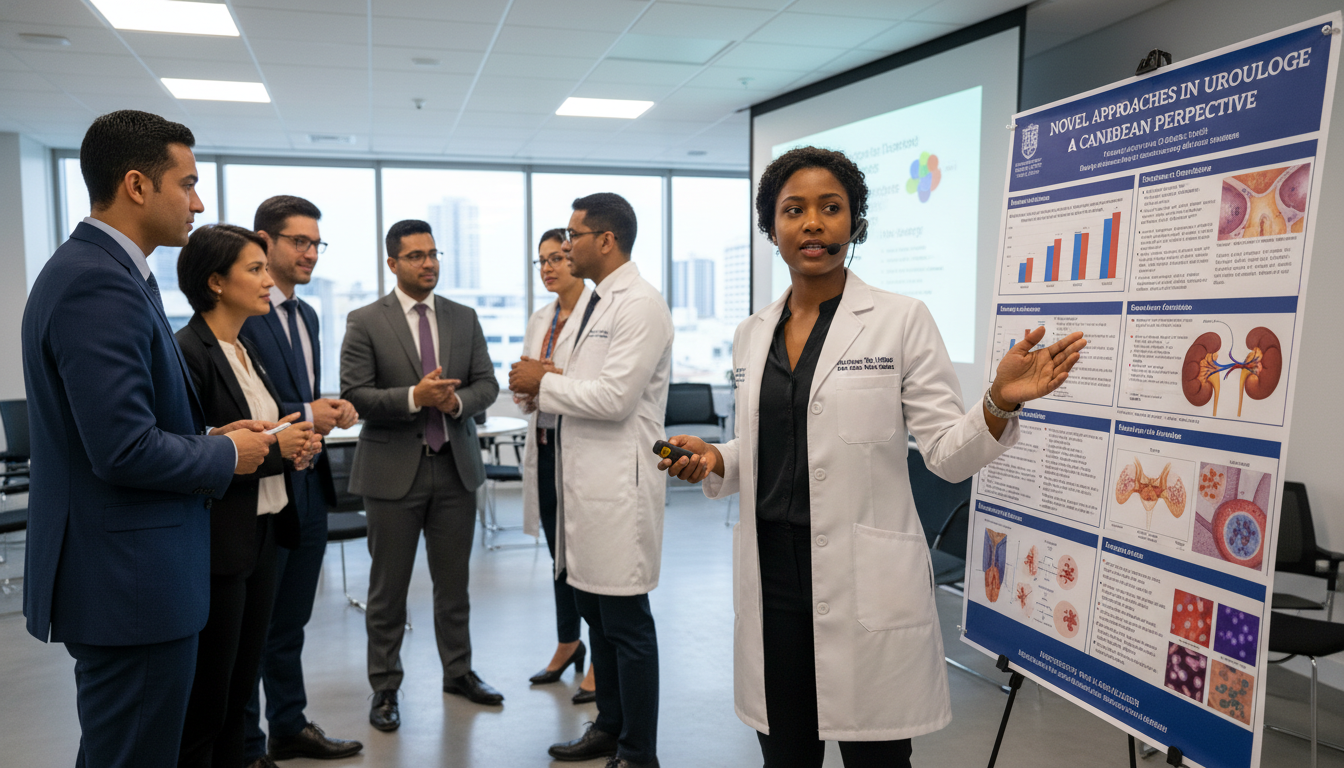
As your projects mature, target relevant meetings:
- AUA Annual Meeting: High visibility, great for networking
- Subspecialty meetings:
- SUO (Society of Urologic Oncology)
- SUFU (Society of Urodynamics, Female Pelvic Medicine & Urogenital Reconstruction)
- Endourology Society
- Pediatric Urology societies
Benefits for Caribbean IMG residents:
- Direct face time with potential fellowship directors
- Opportunities for awards and recognition
- Evidence that you’re integrated into the academic urology community
If funds are an issue:
- Ask your program about travel grants or academic funds
- Check if the AUA or subspecialty societies offer resident travel scholarships
- Consider virtual presentation options if available
Publishing Your Work
After a conference abstract, work toward full manuscript publication. Typical path:
- Draft manuscript with your mentor’s guidance
- Choose a journal appropriate to your project’s scope (e.g., specialty journals for smaller studies, larger journals for broader impact work)
- Respond to reviewer comments carefully and respectfully
- Track your CV and keep an updated list of all outputs (abstracts, posters, manuscripts, chapters)
For Caribbean IMGs, a consistent pattern of peer-reviewed publications significantly strengthens both fellowship and job applications.
Building a Coherent Academic “Story”
Over residency, you want your research to gradually form a recognizable focus, especially if you’re on an academic residency track. For example:
- A Caribbean IMG interested in stone disease may:
- Start with a retrospective study on ureteroscopy vs. SWL outcomes at their institution
- Present quality improvement data on reducing unplanned readmissions after ureteroscopy
- Collaborate on a multi-center registry of stone disease in specific populations
- Later apply for an endourology fellowship with this focused portfolio
This focused narrative is very compelling to fellowship directors and hiring committees.
Balancing Clinical Work, Research, and Long-Term Plans
Time Management Strategies That Actually Work
Protect small, consistent blocks of time
- Even 2–3 hours per week, consistently scheduled, can move projects forward.
- Treat these as non-negotiable appointments.
Use “micro-moments”
- Between cases: review articles, annotate PDFs, edit introductions
- Post-call afternoons: low-cognitive tasks like data entry or reference management
Leverage tools
- Reference managers (EndNote, Zotero, Mendeley)
- Citation plug-ins for word processors
- Templates for abstracts and posters
Avoiding Common Pitfalls for Caribbean IMGs
Overcommitting to too many projects:
You want quality and completion, not just a long “in progress” list.Not clarifying authorship upfront:
Discuss expectations clearly with your mentor—especially for first-author vs. middle-author roles.Waiting too long to get involved:
Do not “wait until PGY-4.” Early momentum compounds; late starts are difficult to overcome if you’re aiming for competitive fellowships.Ignoring mentorship and feedback:
As a Caribbean IMG, constructive feedback is your ally—especially around writing and presentation style.
Integrating Research Into Your Long-Term Career
Think about research during residency as foundational training:
If you go into academics, you’ll need:
- A research niche
- Ongoing projects and collaborations
- Grants or institutional support
If you go into private practice:
- You can still participate in registry data, multicenter studies, and practice-based research
- Your residency research skills will help you evaluate new technologies and treatments critically
In both scenarios, your research experience as a resident is part of your professional identity, especially as a Caribbean IMG who may need to show sustained achievement and growth.
Frequently Asked Questions (FAQ)
1. I’m a Caribbean IMG who just matched into urology. When should I start doing research?
Start as early as realistically possible. During intern year (if it’s a separate surgical prelim year), you can:
- Identify research mentors in urology
- Read their recent publications
- Join a small project (e.g., data collection or chart review)
By early PGY-2, you should ideally be actively involved in at least one ongoing project. Early engagement allows time to:
- Get IRB approval
- Collect data
- Present at a conference
- Submit a manuscript before graduation
2. My program is more clinically focused and less academic. Can I still build a strong research profile?
Yes. Even in non–research-heavy environments, you can:
- Do retrospective chart reviews using your hospital’s EMR
- Focus on quality improvement projects (which are often publishable)
- Collaborate with larger academic centers or your medical school alma mater (e.g., professors from SGU or another Caribbean medical school)
- Join multi-center studies or registries coordinated by national societies
The key is to find one or two motivated mentors and design projects that align with your program’s clinical strengths.
3. Do I need basic science research to get a good urology fellowship?
Not necessarily. Many successful fellowship applicants—especially those who were Caribbean IMGs—match with:
- Strong clinical research portfolios (retrospective and prospective studies)
- Multiple presentations at national and subspecialty meetings
- Clear academic focus (e.g., oncology, stones, female pelvic medicine)
Basic science or translational research is particularly valuable if you’re targeting top-tier academic institutions or heavily research-focused fellowships, but it is not a strict requirement for every fellowship path.
4. How many publications should I aim for by the end of residency?
There is no strict “cutoff,” but general benchmarks for a competitive urology resident (IMG or non-IMG) might include:
- Several conference abstracts or posters (e.g., AUA, subspecialty meetings)
- A handful of peer-reviewed publications (even 3–6 solid papers is meaningful)
- A coherent focus in at least one area of urology
For a Caribbean IMG, even a smaller number of well-executed projects—especially with you as first author—can go a long way if they show progression, responsibility, and alignment with your future goals.
Research during residency is not just a checkbox. For Caribbean IMGs in urology, it is one of the most powerful ways to demonstrate excellence, resilience, and long-term commitment to the specialty. With intentional project selection, reliable follow-through, and strong mentorship, you can build a research portfolio that opens doors to fellowships, academic positions, and leadership roles—regardless of where you started your medical education.