
Why Research During Transitional Year Matters for US Citizen IMGs
If you’re a US citizen IMG or an American studying abroad coming back to the US for residency, a Transitional Year (TY) can be a powerful springboard. One of the most high‑yield ways to leverage your TY is to build a strong research portfolio.
For many US citizen IMGs, the TY program is:
- A bridge into a competitive advanced specialty (radiology, anesthesiology, dermatology, PM&R, radiation oncology, etc.)
- A second chance to strengthen their application for future residency or fellowship
- A way to demonstrate academic commitment within the US system
Research during residency—especially during a transitional year—signals that you can:
- Think critically and analyze data
- Contribute to scholarly work and quality improvement
- Function in an academic residency track
- Compete more effectively for advanced positions and fellowships
This article lays out, in detail, how a US citizen IMG in a transitional year can identify, launch, and complete resident research projects, even with limited time and prior experience.
Understanding the Transitional Year Landscape for Research
A Transitional Year is typically a one‑year, broad‑based clinical training program. It can be:
- Community-based with limited formal research infrastructure, or
- University/academic-based with built-in resident research tracks and mentorship
As a US citizen IMG or American studying abroad, your priorities may differ from US MD graduates:
- You may feel pressure to “prove yourself” in the US system.
- You may need more US-based scholarly output to offset perceived disadvantages in your application.
- You may be pivoting specialty or aiming for a competitive advanced program where research is highly valued.
How TY Structure Impacts Research Opportunities
Most transitional year residency programs include:
- Inpatient medicine months
- Elective blocks
- Night float or ward rotations
- Possibly ICU, ER, ambulatory clinics, or subspecialty rotations
Each of these components can either help or hinder research:
Inpatient / ICU months
- Heavy workload and call.
- Best for idea generation and data collection (e.g., identifying patterns in patient presentations, outcomes, or workflow problems).
- Harder for writing and analysis; you must be realistic about what can be done.
Elective blocks
- Your primary window for focused research time—especially if you choose electives with active investigators.
- You can plan “research electives” or clinically lighter rotations with research-heavy mentors.
Clinic / ambulatory rotations
- Fertile ground for quality improvement (QI) and workflow studies.
- Provide continuity for prospectively tracking interventions.
Understanding your TY’s rhythm is crucial because you only have 12 months. Any resident research projects you start must fit within that timeline.
Setting Realistic Research Goals as a TY Resident
You do not need a full randomized controlled trial to benefit from research during residency. In fact, the most successful TY residents are those who aim for achievable projects and see them through to completion.
Decide What You Want Out of Research
As a US citizen IMG, think about your medium‑term goals:
If you’re going into a research-heavy specialty (e.g., radiology, neurology, internal medicine with academic aspirations):
- Aim for at least one first-author project (case report, short original study, or QI project).
- Participate in at least one multi-author project (chart review, systematic review, or database study).
- Present at a regional or national conference, if possible.
If you’re going into a more clinically focused specialty (e.g., anesthesiology, EM in many programs, PM&R in some settings):
- Aim for at least one concrete scholarly product: an abstract, poster, or co-authorship.
- Consider a QI project that shows leadership and systems-based practice.
If you’re unsure of future direction or considering an academic residency track:
- Prioritize broad exposure: help with multiple projects, learn basic research methods, and get at least one tangible output (poster, presentation, or paper).
- Use research as a way to meet faculty in different departments and see what appeals to you.
Types of Projects That Fit a One-Year TY
Within a single year, especially with heavy clinical demands, these are realistic project types:
Case reports and case series
- Great entry point if you’re new to research.
- Short timelines; can be started during a single rotation.
- High educational value, particularly in subspecialty or rare conditions.
Retrospective chart reviews
- Common for resident research projects; may align with faculty interests.
- Feasible if you narrow the scope appropriately (e.g., one disease, one unit, one time frame).
Quality Improvement (QI) projects
- Often supported or required by programs.
- Align well with ACGME competencies and patient safety initiatives.
- Can be done quickly if well designed and focused.
Narrative reviews or systematic reviews
- Good if your institution has limited clinical research infrastructure.
- Especially suitable if working remotely with a mentor (e.g., at your future advanced program).
Educational research
- Example: evaluating a new teaching tool for interns or studying the impact of a simulation curriculum.
- Particularly valuable if you’re interested in academic medicine and teaching.
Ambitious multi-year prospective studies are rarely realistic for a single transitional year resident unless you’re joining an ongoing project.
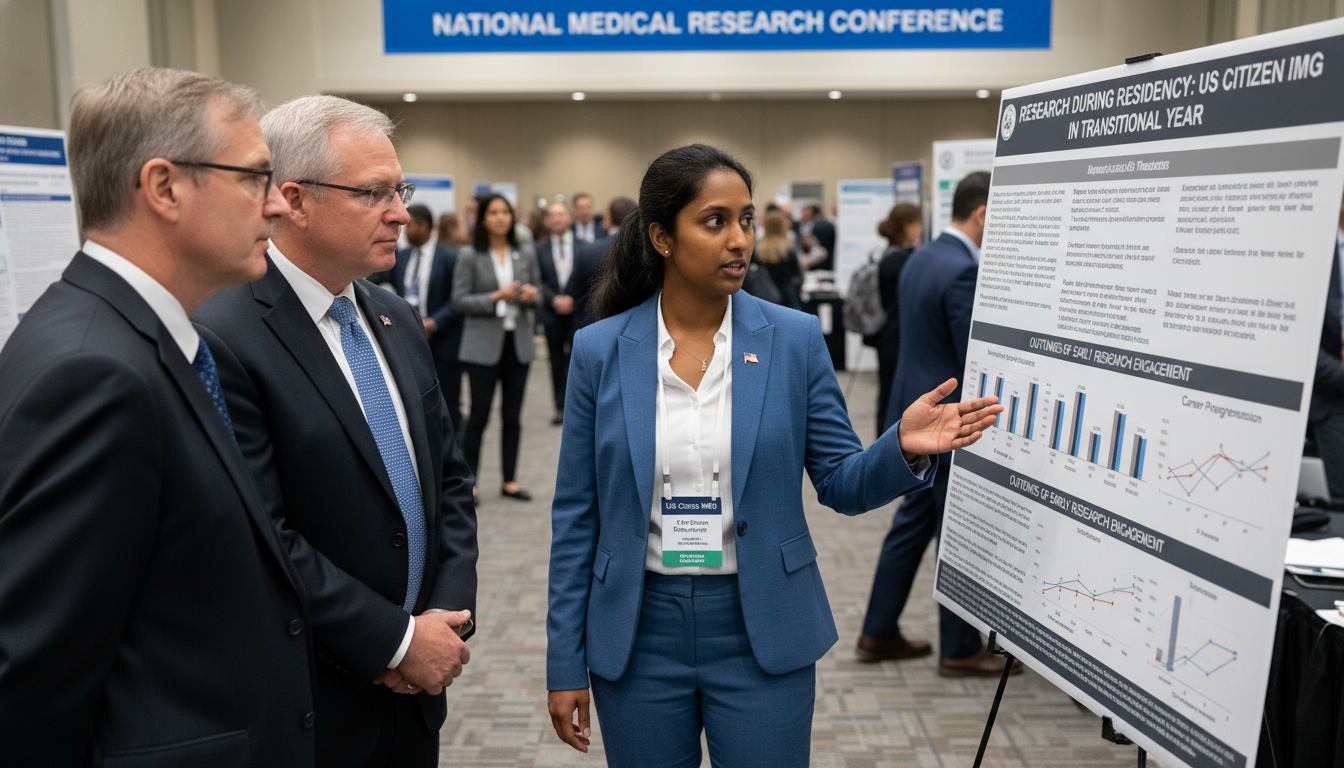
Finding Mentors and Research Opportunities as a US Citizen IMG
Your ability to do meaningful research during residency often depends on one factor: mentorship. This can feel intimidating if you’re new to the US system, but there are structured ways to find the right people.
Step 1: Map Out Where Research Lives in Your TY Program
Before day one, or during your orientation month:
Read your program website carefully
- Look for any mention of “resident research projects,” “scholarly activity,” or “academic residency track.”
- Identify faculty listed as research leads or scholarly activity directors.
Ask directly at orientation:
- “Is there a formal resident research program?”
- “Who oversees QI or scholarly projects?”
- “Which departments are most active in research with transitional year residents?”
Use GME resources:
- Many institutions have an Office of Research, Office of Graduate Medical Education, or a biostatistics core you can access.
- Ask if TY residents get protected time for research or QI.
Step 2: Identify Mentors in Your Target Specialty
If your transitional year precedes an advanced residency (e.g., radiology, anesthesiology, derm, PM&R, radiation oncology), your most valuable mentor may not even be in your TY department.
You can:
- Reach out to faculty in your future advanced program (if already matched) and ask to begin remote or hybrid research now.
- Identify faculty in related departments at your TY institution
- Example: If you’re headed into radiology, consider working with:
- Neuroradiologists
- MSK radiologists
- Oncologists or surgeons on imaging-heavy projects
- Example: If you’re headed into radiology, consider working with:
When emailing potential mentors, include:
- A brief introduction (US citizen IMG, where you studied, your TY program)
- Your future career goals (specialty and interest areas)
- Any previous research experience (even if from abroad or medical school)
- The type of project you’re looking for and your time constraints
Example email snippet:
I’m a US citizen IMG in the Transitional Year residency at [Institution], planning to pursue [Specialty] starting next year. I’m very interested in [specific interest area], and I’d like to get involved in a feasible research or QI project during this year. I have [brief description of prior experience, if any]. Would you be open to discussing potential projects where I could contribute meaningfully?
Step 3: Overcoming the “IMG Barrier” Perception
Being a US citizen IMG or American studying abroad can create unconscious bias. To mitigate this:
Show reliability early:
- If you’re given a small task (data entry, literature search), do it quickly and accurately.
- Communicate clearly about timelines and deliverables.
Demonstrate familiarity with US systems:
- Learn basic IRB processes, HIPAA rules, and how EMR data is typically extracted.
- Show that you’re serious about research during residency, not just checking a box.
Aim to become indispensable:
- Take charge of organization: maintain project spreadsheets, track deadlines, calendars, and manuscript drafts.
- Offer to coordinate meetings and keep minutes.
Faculty are far more likely to invest in you if they see you as dependable and proactive.
Launching and Completing a Resident Research Project in 12 Months
Once you have a mentor and a basic idea, the priority is efficient execution. The biggest pitfall for TY residents is starting projects that never finish.
Step 1: Define a Narrow, Answerable Question
Use the FINER framework (Feasible, Interesting, Novel, Ethical, Relevant):
- Feasible: Can you realistically collect and analyze the necessary data in < 9 months?
- Interesting: Does the question matter to your mentor and the field?
- Novel: Even a small angle (e.g., local data, specific subgroup) can be novel.
- Ethical: Check early if the project is QI or requires IRB approval.
- Relevant: Does it relate to your future specialty or generalizable patient care?
Example: Instead of
“Outcomes of all sepsis patients in our hospital,”
narrow to
“30-day readmission rates for sepsis patients discharged from the general medicine floor over a 2-year period.”
The second is more manageable during a transitional year.
Step 2: Clarify Roles and Authorship Early
Ask explicitly:
- What will be my role in this project?
- What are the expectations for authorship?
- Are there other residents or students involved?
If your mentor expects you to:
- Lead the literature review
- Collect most of the data
- Draft the initial manuscript
…then first- or second-author status is reasonable to discuss upfront.
Be polite but direct—this avoids conflicts later and ensures your effort translates into tangible outcomes.
Step 3: Understand Regulatory Needs (IRB vs QI)
For research (human subjects, generalizable knowledge), you likely need:
- Institutional Review Board (IRB) review or exemption.
For quality improvement (local process change, internal performance data):
- Often reviewed through a simplified QI pathway or may not need full IRB review.
Ask your mentor:
- “Will this require IRB submission or can it be done as QI?”
- “Who usually handles the IRB in your group? How can I help?”
As a resident, you won’t usually lead the IRB process alone, but reading previous IRB submissions can be a huge learning opportunity and signal motivation.
Step 4: Build a Structured Timeline (Month-by-Month)
Given a typical 12-month transitional year:
Months 1–2
- Identify mentors and project ideas.
- Perform initial literature review.
- Finalize your research question and study design.
Months 2–4
- Work on IRB submission (if applicable) with your mentor.
- Develop data collection tools (spreadsheets, REDCap forms, etc.).
- Start case identification or small pilot runs of data extraction.
Months 4–8
- Complete bulk of data collection.
- Meet biweekly or monthly with your mentor to monitor progress.
- Begin preliminary data analysis (with biostat support if available).
Months 8–10
- Draft abstract and manuscript sections (Intro, Methods first).
- Submit to a regional/national conference if timing allows.
- Refine results and discussion with feedback from your mentor.
Months 10–12
- Finalize manuscript and submit to a journal (even if acceptance comes later).
- Prepare presentations (grand rounds, local research day, or specialty conferences).
- Organize your CV and document your research during residency clearly.
This structure helps prevent the “I ran out of time” problem that plagues many resident research projects.
Step 5: Leverage Tools Efficiently
To maximize output during a busy TY:
- Reference managers: Use Zotero, Mendeley, or EndNote to organize citations.
- Data capture: REDCap or secure Excel files approved by your institution.
- Task management: Simple Trello board or shared Google Doc checklist with milestones and deadlines.
- Writing: Use shared documents (Google Docs, Microsoft Teams) to allow real-time feedback from mentors.
Tool competence can offset limited time and make you an appealing collaborator.

Aligning Your Transitional Year Research With Long-Term Goals
Research during residency is most powerful when it builds a coherent story for your future applications. As a US citizen IMG, you want your CV and narrative to show direction and growth, not just isolated projects.
Tailoring Projects to Your Future Specialty
Examples of high-yield alignments:
Future Radiology Resident
- Case report: Unusual imaging findings in a rare disease.
- Chart review: Diagnostic yield of CT vs MRI in a common clinical scenario.
- QI: Reducing contrast extravasation or improving imaging protocol adherence.
Future Anesthesiology Resident
- Case series: Perioperative management of complex comorbid patients.
- QI: Improving pre-op evaluation efficiency or post-op pain documentation.
- Resident research projects: Studying regional anesthesia outcomes or airway complication rates.
Future PM&R Resident
- QI: Fall reduction project on inpatient rehab unit.
- Retrospective study: Outcomes of stroke rehab pathways or TBI interventions.
- Educational research: Evaluating a new PT/OT training module.
Future Neurology or Internal Medicine Resident
- Stroke or seizure outcome studies.
- Sepsis or heart failure management QI.
- Hospitalist-type projects that translate directly to those fields.
Every project doesn’t need your final specialty’s name in the title, but it should be reasonably connected.
Using Research to Transition or Strengthen Your Application
If you’re using a transitional year because:
- You didn’t match into your preferred specialty, or
- You are pivoting from one specialty to another
…then research during residency can become a key component of your “reapplication strategy.”
To maximize that:
Coordinate with your TY program director
- Be transparent about your goals.
- Ask which faculty have successfully helped prior residents with research and matching.
Engage with your future specialty’s professional societies
- Many specialties have resident or student sections and conferences.
- Submit your work to those conferences to demonstrate genuine interest.
Highlight your US-based research
- Program directors often view US-based resident research projects as more directly translatable to their environment than overseas work.
- Emphasize your understanding of US healthcare systems, patient populations, and regulatory requirements.
Common Pitfalls and How to Avoid Them
Many residents—especially time-pressed TY residents—run into predictable obstacles when trying to do research during residency. Anticipating these can save months.
Pitfall 1: Overly Ambitious Projects
A multi-center, prospective study sounds impressive but is almost never realistic for a one-year TY with full clinical duties.
Solution:
Start with a small, tightly focused project that you can finish. One completed first-author case report is more valuable than a stalled mega-project.
Pitfall 2: Lack of Clear Ownership
If a project has many co-investigators but no assigned “project manager,” it will stall.
Solution:
Offer to be that project manager: keep track of tasks, timelines, and meeting agendas. Clarify roles early.
Pitfall 3: Delayed Start
Waiting until mid-year to begin research is a common mistake.
Solution:
Treat research like an urgent priority in the first 2–3 months. Even if IRB approval takes time, the groundwork should be laid early.
Pitfall 4: Poor Communication
Going silent for weeks during a busy rotation can erode mentor confidence.
Solution:
Send brief status updates:
- “I’m on nights this month; I’ll aim to complete X by [date] and will update you then.”
- “I’ve finished data collection for the first 30 patients; can we meet briefly to confirm I’m recording variables correctly?”
Pitfall 5: Ignoring Presentation Opportunities
Residents often underestimate the value of local/regional presentations.
Solution:
Submit abstracts to:
- Institutional research days
- State medical society or specialty society meetings
- National conferences if deadlines align
These presentations bolster your CV and show real engagement in scholarly activity.
FAQs: Research During Transitional Year Residency for US Citizen IMGs
1. I’m a US citizen IMG with almost no prior research. Is it still worth trying during my TY?
Yes. Even if you have no prior experience, a transitional year is an excellent time to start. Focus on:
- A case report or QI project (lower barrier to entry, faster turnaround)
- Joining an existing resident research project with clear structure
- Learning the basics of literature review, data collection, and writing
Programs value demonstrated growth and initiative, especially when it’s US-based scholarly activity.
2. How can I balance clinical duties and research during residency without burning out?
Strategies include:
- Front-loading project design and IRB work during lighter rotations or early in the year.
- Using 20–30 minute blocks between clinical tasks for small steps (reading one article, updating one section of the spreadsheet).
- Scheduling fixed, recurring research time on your calendar (e.g., Saturday morning, one evening per week).
- Communicating honestly with mentors about your rotation demands so expectations stay realistic.
Aim for consistency over intensity. Small, regular progress is more sustainable than rare, massive pushes.
3. Will research during my transitional year really help with an academic residency track or fellowship later?
Yes. Program directors and fellowship committees often look for:
- Evidence of scholarly productivity (posters, publications)
- Ability to work with mentors and teams
- Contribution to resident research projects or QI initiatives
Even a modest portfolio from your TY year can:
- Support applications to more academic departments
- Serve as a foundation you continue to build on in your advanced program
- Provide strong content for personal statements and interviews, where you can discuss your research thoughtfully
4. My TY program is small and community-based with limited research. What can I do?
Options include:
- Focusing on QI projects that improve patient care locally (these are often easier to start and complete).
- Collaborating remotely with faculty at your future advanced residency program or at your former medical school.
- Doing a narrative or systematic review in your area of interest with a willing mentor.
- Presenting your work at external conferences even if your home institution is not strongly research-oriented.
Being in a smaller TY program doesn’t block you from meaningful research during residency—it just requires more initiative and strategic networking.
By approaching your transitional year with a clear research strategy, realistic goals, and proactive mentorship-seeking, you can transform that single year into a powerful academic launching pad. As a US citizen IMG or American studying abroad returning to the US system, your research during residency can be the differentiating factor that showcases your capabilities, opens academic doors, and aligns your path with the specialty and career you want.