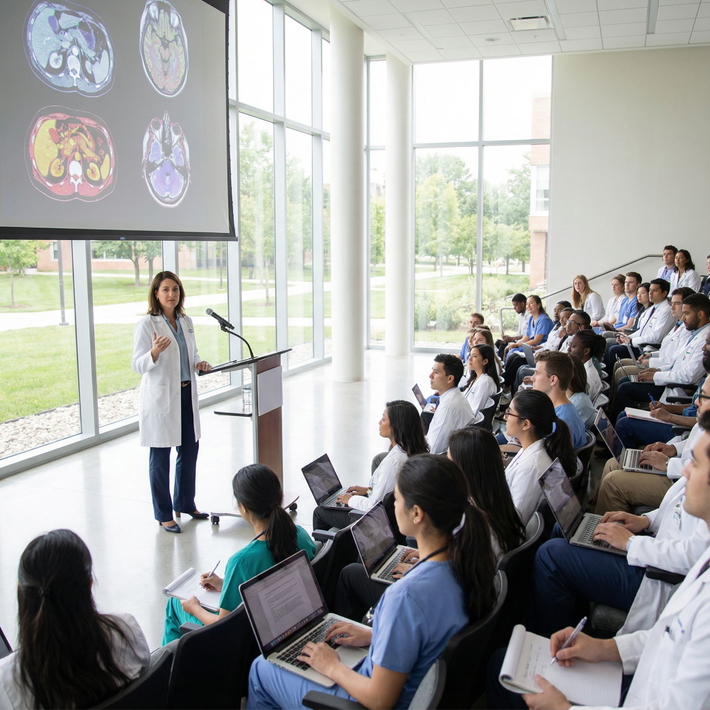
How many times have you stayed up until 2 AM perfecting a slide deck, convinced that your stellar teaching evaluations would be the golden ticket to your next promotion?
If you're nodding, you've fallen for the oldest trap in academic medicine. We tell junior faculty that teaching is the heart of the academic mission. We hand out "Teacher of the Year" plaques. We praise their dedication to the learners. But when promotion committee season rolls around, those plaques gather dust while the faculty member gets deferred for another year.
Here is the blunt reality: teaching alone will not promote you. Let's look at what the data actually shows and how you can pivot from being a good instructor to an undeniable academic force.
This article is for educational purposes only. It is not financial advice, not legal advice, and not tax advice. Figures vary by individual circumstances, so consult a qualified professional before acting.
The 'Good Teacher' Trap: Why Your Lecture Notes Won't Get You Tenure
There is a pervasive, toxic misconception in medical academia that "being a good teacher" is a primary driver for promotion. It's not. Teaching is the baseline requirement. It is the cost of entry, not the differentiator.
I've sat on departmental review boards. I've seen brilliant, beloved clinicians stall out at the associate professor level for a decade. Why? Because they confused volume with value. They taught 200 hours a year. They got 4.9 out of 5 on every resident evaluation. But they produced zero scholarship.

The evidence from promotion committees across major academic medical centers is overwhelming: research and scholarship heavily outweigh teaching in promotion decisions. When you spend six hours tweaking the animations on a PowerPoint, you are engaging in busy work masquerading as productivity. It feels good. It feels like you're contributing. But to a promotion committee, you are just doing your job.
To get promoted, you have to do more than your job. You have to advance the field.
The Data Doesn't Lie: What Promotion Committees Actually Want
Let's deconstruct the actual rubrics. If you look at ACGME milestones and departmental promotion matrices, the "Teaching" metric is almost always a pass/fail or "satisfactory" threshold. You either meet the teaching requirements, or you don't.
You cannot be "exceptional" at a pass/fail metric.
Scholarship is the metric that moves you from "competent" to "exceptional." It's the only lever you can pull to separate yourself from the pack. But here is where most clinicians get the impact factor wrong. They think impact means the sheer number of students they lectured to.
Wrong. Impact isn't about how many minds you spoke to; it's about how their outcomes changed. Did your teaching intervention reduce central line infection rates among interns? Did your simulation module decrease the time it takes residents to recognize sepsis? That is impact. That is what gets you promoted.
Redefining Scholarship: It's Not Just a Lab Coat
The biggest myth holding back clinical educators is the idea that scholarship equals bench research. You don't need a pipette, a wet lab, or a PhD in molecular biology to be a scholar.
We need to shatter this outdated definition and embrace the Scholarship of Teaching and Learning (SoTL). Educational innovation is rigorous, peer-reviewed scholarship.
Think about your daily clinical workflow. What annoys you? What do residents constantly get wrong? That frustration is your research gap.
- Curriculum Redesign: You noticed interns struggle with ventilator management. You build a new step-by-step cognitive aid, implement it, and measure the change in their clinical decisions.
- Simulation Validation: You design a new high-fidelity code blue scenario. You validate the scoring rubric to ensure it accurately measures resuscitation leadership.
- Educational Theory Application: You apply spaced repetition software to your didactic curriculum and track long-term knowledge retention compared to traditional lectures.
You leverage your daily clinical teaching to find these gaps. You don't need to invent a new drug. You just need to invent a better way to teach the people who prescribe it.
Building Your Scholarship Portfolio: A Contrarian Strategy
Stop waiting for a "big idea." Stop waiting for an NIH grant to magically appear in your inbox. The most successful educator-scientists I know use a "Micro-Scholarship" approach. They start small and iterate fast.

Here is your contrarian playbook:
- Ditch the solo genius myth: Collaboration is key. You don't need to be the Principal Investigator. Partner with an established educational researcher. You bring the clinical context and the Subject Matter Expertise; they bring the methodological rigor and the IRB know-how.
- Document everything: Your teaching notes, your precepting logs, your resident feedback, these aren't just administrative burdens. They are raw data. Start treating your educational environment like a laboratory.
- Publish the failures: Did your new teaching module flop? Write it up. The academic community desperately needs to know what doesn't work so they don't repeat your mistakes. Negative results are still scholarship.
Summary: From Instructor to Educator-Scientist
Teaching builds the foundation; scholarship builds the skyscraper. You simply cannot separate your clinical role from your educational role if you want to survive in academic medicine. The ultimate goal is to become an "Educator-Scientist", someone who doesn't just deliver knowledge, but scientifically investigates how that knowledge is acquired, retained, and applied.
Here are the core takeaways to reframe your career:
- Teaching is the cost of entry, not the promotion ticket.
- Scholarship is the currency of academic advancement.
- You don't need a lab to be a scholar; you need a question.
- Start small: Apply the scientific method to your teaching.
Pick one small problem in your teaching tomorrow. Just one. Don't just fix it anecdotally. Measure it, test an intervention, and publish the result. That is how you stop being just a good teacher and start being a promoted scholar.