This article is for educational purposes only. It is not financial advice, not legal advice, and not tax advice. Figures vary by individual circumstances, so consult a qualified professional before acting.
Introduction: The Fatal Flaw of the 'Grindset'
You know the culture. The chest-thumping about who stayed latest, who never sits, who can power through 28 hours on black coffee and stubbornness. We call it resilience. It's not. It's dangerous.
Here is the mistake I see every new class of residents make: They believe focus is a character trait you can will into existence. That if you just try harder, your brain will stay sharp.
Understanding the physiological reality of night shift adaptation is key to recognizing why your brain feels like it is failing at 4 AM.
It won't.
Cognitive precision is your ability to catch the subtle thing. Not the crashing patient with alarms screaming. The quiet one. The potassium that's 6.1 instead of 4.1 on a BMP you glanced at at hour 22. The slight ST depression in V2-V4 you dismiss as artifact. The mother who says her kid is "just not acting right." That precision is not loud when it leaves. You don't feel it go. There is no headache, no flashing warning light. It just... fades.
Your brain will lie to you about it. That's the most terrifying part. A fatigued brain is fundamentally incapable of recognizing how fatigued it is.
So stop trying to prove you can sustain focus. You can't. None of us can. What you can do is learn strategic disengagement. It's not weakness. It's the only thing that keeps your patients safe from you at 4 AM.
The Physiology of the 'False Peak'
That burst of energy at 2:30 AM after the trauma activation? That's not you being good at your job. That's adrenaline masking executive failure.
Around 3-5 AM you hit your circadian nadir. Core temperature drops, melatonin is still high, prefrontal cortex activity tanking. Your brain tries to save you with a survival dump of catecholamines when something exciting happens. Heart racing, you feel awake. Superhuman, even.
It's a false peak. And it's a trap.
Adrenaline gives you speed and confidence. It does not give you back judgment, working memory, or cognitive flexibility. Those live in your prefrontal cortex, and that area is the first to go offline when you're sleep-deprived. So you feel wired, but you get tunnel vision. You fixate on the airway and miss that the patient is hemorrhaging from somewhere else. You move fast. You decide badly.
Avoiding the worst ways to use caffeine can prevent the dangerous post-shift crash that ruins your recovery time.
The numbers should scare you straight:
- After 17 hours awake, your reaction time and decision accuracy is equivalent to a blood alcohol level of 0.05%.
- After 24 hours awake, it's 0.10%. Legally drunk. In most states, you cannot legally drive like that, but we let you place central lines.
- That 15-minute delay in recognizing sepsis? That fuzzy math on a heparin drip? That is not a knowledge gap. It's a fatigue gap.
Red flags of cognitive drift. Catch these before you catch a lawsuit:
- You re-read the same lab three times. That's not you being thorough. That's working memory failure.
- You get irritated by simple questions from nurses. Irritability is an early executive function failure, not a personality flaw.
- You default to "that's fine" or "just watch it". Cognitive tunneling makes you choose the easiest, lowest-effort disposition.
- You can't remember why you walked into the supply room. Prospective memory is gone. If you can't remember that, you can't remember to recheck that critical potassium.
- Charting gets terse and copy-pasted. Language complexity is one of the first things to flatten.
If you notice one, you are already impaired. Don't negotiate with it.
Look at that graph. See the gap? After hour 16, your actual precision falls off a cliff. But your perceived alertness? It pops back up a little around hour 20 when you get that second wind. That gap between what you think you can do and what you can actually do? That's where errors live.
The Mistake: Treating Recovery as a Sign of Weakness
The worst mistake I've seen? The resident who refuses a 20-minute break because "my co-residents are still out there working." Who brags about not eating, not sitting, not peeing for 12 hours straight.
Let me be blunt: That is not dedication. That is poor clinical judgment pointed at yourself.
Why do we hide it? Because medicine still subtly equates suffering with competence. If you needed to close your eyes for 15 minutes in the call room, you must not be tough enough for this specialty. So you don't. You tough it out.
And then you miss things.
I watched a sharp intern, hour 23, completely miss a subtle mushroom-shaped convex bleed on a head CT because she was scanning for the obvious big bleed and her brain literally couldn't sustain the visual pattern recognition anymore. She saw what she expected to see: nothing. Attending caught it on over-read. Patient was okay. But only by luck.
That's the high-stakes consequence. It's never the dramatic error. It's the missed clue. The rash that was actually meningococcemia. The "anxiety" that was a PE. Fatigue doesn't make you do crazy things. It makes you miss quiet things.
Comparing "toughing it out" to resilience is nonsense. Running a code while demonstrably, legally impaired is not resilience. It's negligence that we have normalized. An airline pilot would be grounded. A truck driver would be pulled off the road. You? You're expected to keep going.
Flip the script. Self-awareness is an expert skill. The best attendings I know are ruthless about their own limits. They'll say out loud, "I'm fried. I need you to double-check this EKG for me." That's not weakness. That's a senior clinician protecting a patient from human biology.
That flowchart? Every catastrophic night shift error I have reviewed follows that exact path. It never starts with "I didn't know." It starts with "I was too tired to notice I didn't know."
Strategic Disengagement: How to Recover Mid-Shift
You cannot prevent fatigue on nights. You can manage it. Strategic disengagement isn't scrolling your phone in the lounge. It's a deliberate, tactical intervention to buy back 60-90 minutes of real precision.
Here is what actually works:
1. The 15-Minute Brain Reset Protocol
You have two real options. Pick one. Don't combine them badly.
- Tactical Nap (The Gold Standard): 15-20 minutes, max. Set an alarm for 25 minutes to account for falling asleep. Dark room, eye mask if you have it, lying down. Even if you don't sleep, the eyes-closed, horizontal rest resets adenosine pressure. Warning: If you go over 25 minutes, you'll hit deep sleep and wake up in sleep inertia. You'll be worse for 30 minutes. Keep it short.
- Caffeine Nap: Drink your coffee/energy drink immediately before you close your eyes for that 15-minute nap. Caffeine takes ~20 minutes to hit your bloodstream. You wake up as it kicks in. It's the most effective combo we have.
What does NOT work: pounding coffee at hour 18 and thinking you're covered at hour 24. You're not.
2. Cognitive Offloading
Your working memory is the first casualty. Stop trying to hold 8 patients' labs in your head to look smart. That's how you drop something.
Write it down. Use a brain sheet. Make a hard checklist for your sickest patient and tape it to the monitor. Tell a nurse, "Can you remind me to recheck that BP in 15? My brain is at capacity." That is cognitive offloading. You are moving data from a failing hard drive (your tired prefrontal cortex) to a reliable system (paper, EMR, another human).
3. Establish Micro-Boundaries
This is the hardest one for new residents. You feel like you should handle everything.
Learn to say: "I need to hand this off to protect the patient."
If you've been up 20+ hours, you should not be the one doing the nuanced goals-of-care conversation, or re-drawing the complicated wound vac, or calculating the complex re-dosing. Ask for a double-check. Say, "Hey, I'm hitting the wall. Could you eyeball this order set before I hit send?"
No good team will judge you for that. They'll thank you.
4. Stop Falling for the Caffeine Trap
I love caffeine. You need caffeine. But caffeine does not make you rested. It blocks the sensor that tells you that you're tired. The fatigue is still there, building up underneath. It masks it, and then you crash harder.
The rule: No caffeine in the last 3 hours of your shift if you plan to sleep after. And never, ever use caffeine as a replacement for the nap. Caffeine alone makes you an alert-feeling person with impaired judgment. The nap gives you back a little bit of actual function.
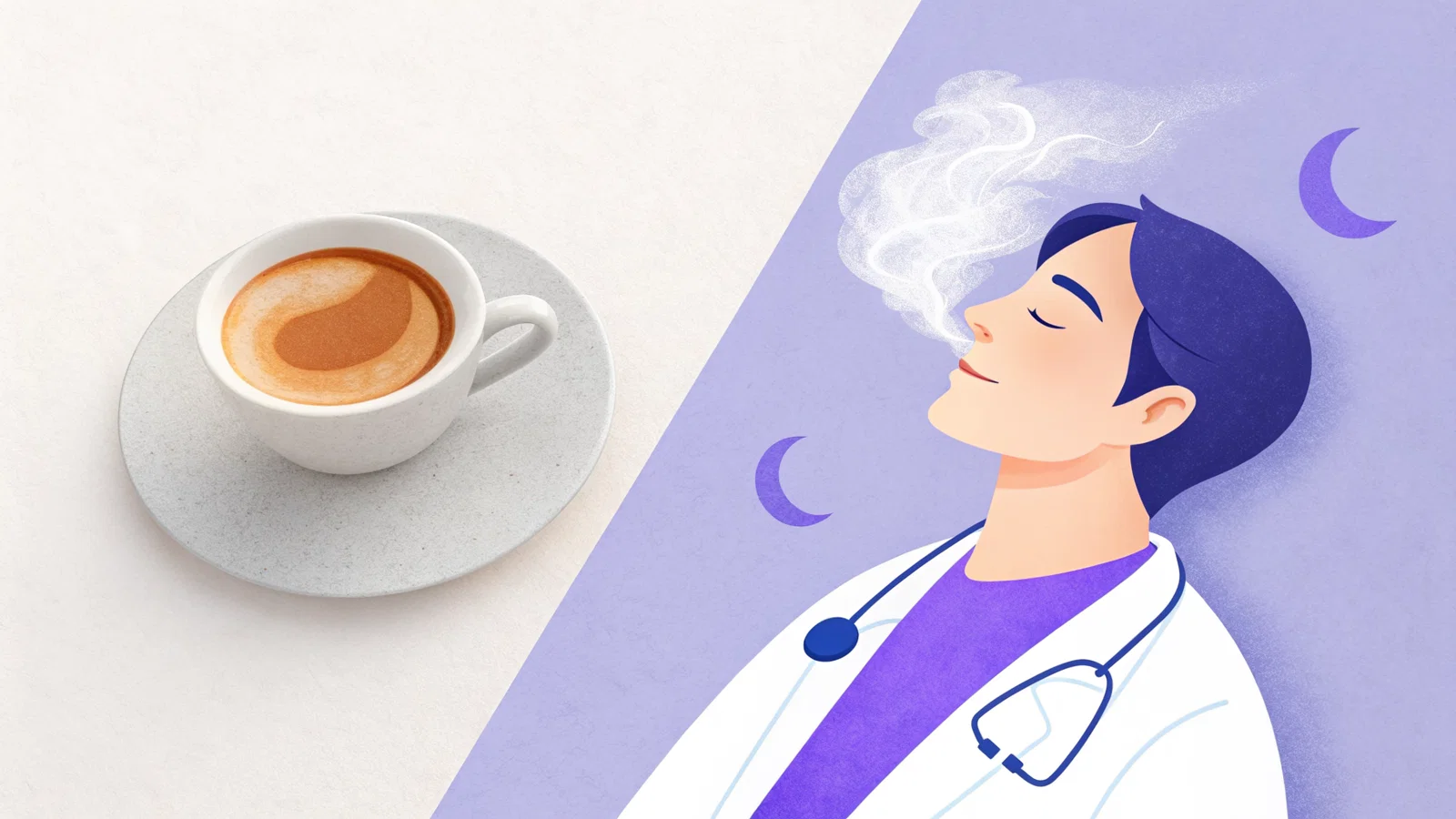
This pause is not slacking. It's maintenance. You wouldn't run an IV pump until the battery died in the middle of an infusion. Don't do it to yourself.
Conclusion: Your Duty to Your Future Self
Let's kill the myth for good.
Sustained focus for 12, 24, 28 hours is a biological impossibility. Your brain is not a machine that runs at 100% until it stops. It's a metabolic organ that degrades in a predictable, measurable curve. You are legally impaired at the end of a long night shift. That is not opinion. That's physiology.
So I need you to hear this final warning: Fatigue management is not a wellness perk. It's not a luxury benefit the hospital might get around to offering. It is a core professional responsibility, just like hand hygiene or informed consent. You are responsible for showing up with a cognitive engine that can do the job safely.
The shift you need to make is from Survivor to Sustainer.
Survivors brag about how little they slept and how much they suffered. Sustainers quietly protect their precision. They nap. They checklists. They ask for help. They live to be good doctors for 30 years, not just macho doctors for one night.
Your patient tonight needs you sharp. Your patients five years from now need you to not burn out. And right now, your own brain is trying to convince you you're fine when you're not.
Don't listen to it. Listen to the protocol.
You cannot help the patient if your cognitive engine is stalling. Protect the engine first.