
The romantic idea that night shifts are a “rite of passage” that forges great physicians is fiction. The data say something much less poetic: fatigue impairs your brain, increases patient harm, and is quietly wrecking residents’ health.
Let’s stop pretending this is hazing with educational value. It’s mostly a safety problem that we’ve normalized.
The Myth: Night Float Makes You Tough (And Better)
You’ve heard the script:
- “Everyone suffered through nights. It builds resilience.”
- “You learn autonomy when it’s just you and the cross-cover pager.”
- “If you can handle nights, you can handle anything.”
I’ve heard attendings say, verbatim, “You’re not really a doctor until you’ve done a brutal week of nights on wards.” It sounds hardcore. Also unscientific.
There are three big hidden assumptions baked into this:
- Sleep deprivation is a legitimate educational tool.
- Being miserable and being trained are the same thing.
- Harm from fatigue is the unavoidable cost of training.
All three collapse once you look at actual evidence.
What Sleep Deprivation Actually Does To You
Forget medicine for a second. Look at what we know from basic sleep science and high-risk industries.
After about 17–19 hours awake, cognitive performance drops to about the same as a blood alcohol level of 0.05%. Push that to 24 hours awake and you’re around 0.10%—legally drunk in most countries.
Residents routinely do “short call” that turns into 20–24+ effective hours awake.
Studies in residents have shown:
- More attentional failures on psychomotor vigilance tests after night shifts or extended duty.
- Slower reaction times, worse working memory, poorer decision-making.
- Higher rates of self-reported medical errors and near-misses after extended shifts.
This is not “you feel tired but you’re fine.” This is measurable brain impairment.
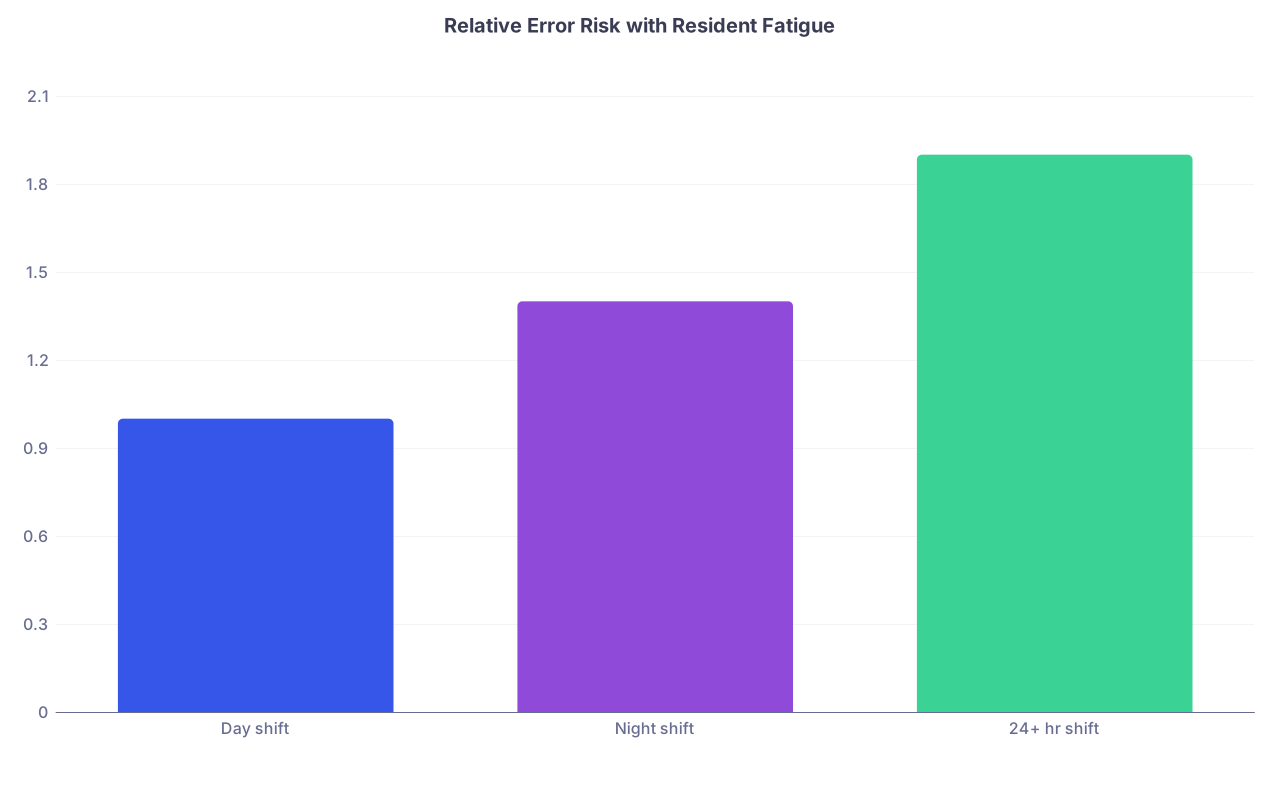
| Category | Value |
|---|---|
| Day shift | 1 |
| Night shift | 1.4 |
| 24+ hr shift | 1.9 |
And it doesn’t stop at cognitive tests.
Residents on extended or frequent night shifts have:
- Higher rates of needle-stick and sharps injuries
- More motor vehicle crashes and near-crashes post-call
- Disrupted glucose metabolism, increased blood pressure, weight gain
- Higher depression and burnout scores
This is not some soft “well-being” conversation. These are occupational injury and disease patterns.
If I told you a medication impaired reaction time, doubled crash risk, and increased error rates, you’d fight to get it off the market. But because it’s “just” sleep deprivation, we call it character-building.
Patient Safety: The Part Nobody Wants To Own
Here’s where the “rite of passage” mythology becomes actively dangerous.
Research comparing traditional 24–30 hour calls to shorter shifts has consistently found:
- More serious medical errors with extended shifts
- More diagnostic errors and more medication errors
- More preventable adverse events
Those aren’t feelings. They’re chart-reviewed, adjudicated events.
Cab companies pull drivers after a certain number of hours. Pilots have strict duty limits and mandated rest periods. Truck drivers are regulated with electronic logs. Every other safety-critical field treats fatigue as a systems hazard.
Medicine? We still talk like it’s a personality test.
Some programs cling to the idea that long or heavy night schedules increase continuity and therefore improve care. But continuity that’s delivered by someone cognitively equivalent to being drunk is not exactly high-value continuity.
And the “you learn autonomy at night” argument sounds less noble when you translate it honestly:
“We give the least experienced doctor the least supervision at the most dangerous hours while they’re the most fatigued. Then we act surprised when bad things happen.”
That is not training. That’s liability dressed up as tradition.
But Don’t You Need Nights To Learn?
Here’s where nuance matters. The enemy is not “working any nights.” The enemy is pretending that severe circadian disruption and chronic sleep debt are educational tools.
You do need exposure to:
- Nighttime presentations of common emergencies
- Reduced resources and staffing
- Handoffs and cross-coverage scenarios
- Making decisions when there is no attending physically present
You do not need:
- 28-hour shifts with 2 hours of fragmented sleep on a couch
- Seven 12-hour nights in a row, bouncing back to days 48 hours later
- Unsupervised cross-cover on dozens of patients you’ve never met, with a single senior resident also covering 60 more
There’s nothing magical about “3 a.m. decision-making” that can’t be taught at 9 p.m. or 5 a.m. after a protected daytime sleep period. The physiology of your brain doesn’t care that this is medicine and not aviation.
Well-designed night experiences can actually teach a lot:
- Focused exposure to acute issues (chest pain, decompensation, sepsis)
- Prioritization and triage when everything hits at once
- Efficient documentation and communication with skeleton staff
- Negotiating with consultants and ED docs from a disadvantaged position
But those are content and skill issues, not “stay awake 30 hours and see what happens” issues.
What The Better Programs Are Quietly Doing
Some residency leaders have stopped treating ACGME duty hour rules as a ceiling and started treating them as a bare legal floor. And they’re blunt about why: patient safety and resident retention.
Common patterns in better-run programs:
- True night float instead of Q4 28-hour calls on many services
- Capped consecutive nights (3–4 max) with real recovery time built in
- Protected daytime sleep windows (no mandatory didactics, meetings, or clinics right after a night)
- Attending or senior in-house coverage at night for high-risk specialties (ICU, OB, surgery)
- Limits on cross-cover lists so the night resident isn’t covering 80 patients they’ve never seen
They’re not doing this out of kindness. They’re doing it because the old way was bleeding them: more errors, more attrition, more burned-out PGY-2s trying to transfer or quit.
Here’s what that contrast roughly looks like:
| Feature | Traditional Call Model | Safer Night Float Model |
|---|---|---|
| Shift length | 24–30 hours | 10–14 hours |
| Consecutive nights | Q4 call, some weeks 3 calls | 3–5 nights in a row max |
| Post-call day | Theoretical; often interrupted | Protected, no mandatory activities |
| Cross-cover load | 40–80 patients | Capped list; team-based |
| Supervision | Attending at home, senior busy | In-house senior/attending for high-risk |
Are they perfect? No. Residents still get tired. Nights are still rough. But the difference between “extremely tiring” and “chronically unsafe” is not subtle when you live in those two systems.
The Gaslighting Problem: “We Did It, So You Can Too”
One of the most toxic parts of the “rite of passage” story is how it gets weaponized.
You complain about a string of seven nights and a post-call conference you’re required to attend. Someone smirks and says, “You think this is bad? We did Q2 36-hour call with no days off.”
Translation: “My suffering is the benchmark. If you suffer less, your training is inferior.”
This ignores three facts:
- Case mix and technology have changed. Patients are sicker, throughput is faster, documentation is heavier. Comparing call in 1995 to 2025 is apples and concrete blocks.
- We now have data they didn’t. We can actually measure error rates, injury rates, burnout scores. “We survived it” is not a safety metric.
- Survival is a hilariously low bar. The fact that previous generations weren’t wiped out en masse by fatigue does not mean the system was safe or rational.
You are not weak for recognizing that staying awake for 28 hours makes you a worse doctor. You’re literate in basic human physiology.
The people who cling hardest to the hazing narrative often do it because it’s the only way to make sense of their own suffering. Admitting that much of it was unnecessary and unsafe is painful. But that’s not a good enough reason to perpetuate it.
What You Can Actually Control As A Resident
You’re not the program director. You’re not rewriting call schedules solo. But you’re not powerless, either.
The goal is not to magically make nights “healthy.” They will never be. The goal is to move them from “needlessly dangerous” to “survivable and somewhat educational.”
Concrete moves you can make:
1. Treat sleep as a procedure, not a luxury.
Block it. Protect it. The day before your first night, shift your schedule: late wake-up, afternoon nap, caffeine only strategically after you wake up. On nights, if your system allows micro-naps and your work is done, take them. Not heroic, not lazy. Strategic.
2. Be ruthless about post-call obligations.
If conference is “required” but you’re post-call and barely coherent, pick the hill you’re willing to die on. Some attendings respect, “I’m not safe to be here right now,” more than you think. Others do not. But draw some line somewhere, or the system will consume all of you.
3. Document and report safety issues.
Fatigue-related errors, near-misses, car accidents after call—log them. Quiet, systematic reporting is much harder for leadership to ignore than one tired resident complaining.
4. Use your chief year and CCC rep roles strategically.
When you eventually get some leverage (chief, wellness committee, program council), push for small, specific changes: cap consecutive nights, formalize true post-call days, adjust cross-cover lists. Tiny system tweaks can do more than any personal “resilience hack.”
5. Stop glorifying the grind in front of juniors.
If you tell med students, “Yeah, I was up for 28 hours straight, saw 25 admits, it was sick,” you’re helping cement the exact culture you hate. It’s fine to say, “That shift was unsafe. We got through it, but this system needs work.”
None of this makes nights easy. It just reduces the degree to which the job is actively trying to break you.
The Real Question: Training For What?
Here’s the core lie underneath the “rite of passage” framing: that the purpose of residency is to prove you can function while abused.
That might have been the implicit goal 40 years ago. It should not be now.
What are you actually training for?
- Delivering safe care across an entire career, not just in your 20s
- Recognizing your own limits before they harm patients
- Working within and on systems to reduce error, not normalize it
- Leading teams that are safe, sustainable, and not dependent on heroics
You’ll still work nights after residency. Some specialties live there—EM, critical care, hospitalist medicine, OB. But attending-level nights done in a rational schedule with more control are not the same as chronic, poorly supervised, poorly structured resident nights.
So no, night shifts are not some sacred fire you must walk through to become “worthy.” They’re a mix of:
- Necessary clinical exposure to real-world patterns
- Poorly designed schedules inherited from an era that didn’t know or didn’t care about the data
- Cultural hazing dressed up as toughness
You can respect the first, fix the second, and reject the third.
, Depressive symptoms](https://cdn.residencyadvisor.com/images/articles_svg/chart-common-resident-night-related-risks-8120.svg "Common Resident Night-Related Risks")
| Category | Value |
|---|---|
| Medical error risk | 180 |
| Needle-stick injuries | 150 |
| [Post-call crashes](https://residencyadvisor.com/resources/night-shift-survival/is-it-safe-to-drive-home-after-a-28-hour-call-what-research-says) | 200 |
| Depressive symptoms | 160 |
Where This Leaves You
You’re not going to solve graduate medical education in one PGY-1 year. That’s fine. You do not need to. But you also do not have to buy the mythology.
Hold two things at once:
- Yes, some night work is essential to becoming a competent physician.
- No, chronic, extreme sleep deprivation is not an acceptable price of admission.
Challenge the idea that suffering is automatically educational. Look at what the data actually say about performance, safety, and health. Then, wherever you have even a sliver of control—over your own habits, over how you talk about nights, over small scheduling details when you have seniority—use it to move the needle away from “rite of passage” and toward “minimized hazard.”
Years from now, you will not impress anyone with stories of how long you stayed awake. What will matter is whether you’re still practicing, still healthy enough to care, and still sharp enough to trust your own judgment at 3 a.m.—because you trained in a system that valued your brain as much as your badge.