
Understanding Pre-Match Communication as a Caribbean IMG in Pathology
Pre-match communication can be one of the most confusing and stressful parts of the residency application process—especially for a Caribbean IMG targeting a pathology residency. You may hear rumors about “pre-match offers,” “early commitment,” or aggressive “program communication before Match,” and it can be hard to know what is ethical, what is allowed, and what is smart.
For Caribbean graduates—whether from SGU, Ross, AUC, Saba, or other Caribbean medical schools—strategic, professional communication can significantly influence how programs view you. This is particularly true in pathology, where programs pay attention to detail, professionalism, and long-term fit.
This article will walk you through:
- What “pre-match communication” actually is (and what it is not)
- How rules differ depending on whether you are in the NRMP Match
- How to approach Caribbean medical school residency applications in pathology specifically
- How to draft emails, thank-you notes, and “letters of intent” correctly
- Red flags to avoid in pre-match or early commitment conversations
Throughout, we’ll focus on the realities of a Caribbean IMG navigating the pathology match, including SGU residency match patterns and strategies that have worked for others in your position.
1. The Ground Rules: Match, Pre-Match, and Pathology
1.1 Defining Pre-Match Communication
“Pre-match communication” generally refers to any contact between you and a residency program after you submit your application but before the official Match results are released. This includes:
- Emails to and from program coordinators or directors
- Conversations during or after interviews
- Virtual meet-and-greet, second looks, or follow‑up calls
- Informal contact via mentors or attendings who know your target programs
For a Caribbean IMG in pathology, this is often where you:
- Signal serious interest (“I will rank you highly”)
- Clarify your fit (research interests, geographic ties, visa needs)
- Gather information about curriculum, case volume, or fellowship placement
1.2 NRMP Rules: What’s Allowed and What’s Not
The National Resident Matching Program (NRMP) has clear rules about Match-participating programs and applicants. Key points:
- Programs cannot ask you:
- How you will rank them
- Whether they are your first choice
- To sign any commitment before the Match
- You cannot be required to reveal your rank order list.
- You may voluntarily share that you intend to rank a program highly, or even #1, but it is not binding on either side.
For pathology residency programs that participate in the NRMP Match, true “pre-match offers” are not allowed in the traditional sense for PGY‑1 positions. Any request for you to commit to them or withdraw from the Match for a categorical PGY‑1 position is a red flag.
1.3 Where Pre-Match Actually Exists
Several scenarios can still involve pre-match style arrangements:
- Non-NRMP programs or tracks (some preliminary or off-cycle positions)
- Advanced positions that may pre-match into PGY‑2/PGY‑3 (rare in core pathology)
- Certain institutional or state processes that allow contracts outside the Main Residency Match
In pathology, most positions are ACGME-accredited and in the NRMP, so classic pre-match offers are uncommon. However, Caribbean IMGs sometimes encounter:
- Informal “if you rank us highly, we will rank you highly” messages
- Strong signals that they are “very likely to match here”
- Rare non-Match PGY‑1 research or hybrid positions
You must always compare what you are being told to NRMP rules and, when in doubt, ask an advisor or your Dean’s office.
2. Unique Considerations for Caribbean IMGs in Pathology
2.1 How Programs View Caribbean Medical School Graduates
Pathology program directors commonly look closely at:
- USMLE Step scores (especially Step 2 CK now that Step 1 is pass/fail)
- The strength of letters from pathologists in the U.S.
- Demonstrated interest in pathology (electives, research, case reports)
- Communication skills and professionalism
When a file is labeled as a “Caribbean medical school residency” applicant, programs may:
- Ask whether you had a clear reason for choosing that school
- Scrutinize your clinical evaluations and exam performance more closely
- Look for concrete evidence of your readiness for U.S. training
Pre-match communication is your opportunity to show you are more than a file: articulate, thoughtful, committed to pathology, and aware of your own gaps and strengths.
2.2 SGU Residency Match and Other Caribbean Outcomes
SGU residency match results and those of other Caribbean schools show that:
- Pathology is attainable for strong Caribbean IMGs who:
- Apply broadly
- Show consistent pathology engagement
- Communicate well with programs
- Many matches occur at community-based academic affiliates or university-affiliated programs open to IMGs
Programs that are IMG-friendly often value direct, professional communication because it:
- Helps them gauge your genuine interest
- Clarifies visa status and timing questions
- Distinguishes you from a large pool of similar applicants
2.3 Pathology-Specific Communication Needs
Pathology is a detail-oriented specialty. Program directors pay attention to:
- How you describe your pathology experiences
- Your ability to explain why pathology (vs. internal medicine, radiology, etc.)
- Your written tone in emails: precise, structured, courteous
Poorly written or overly casual messages can undermine your application—even if your scores are good. Conversely, a concise, professional email can move you from “maybe” to “invite this candidate.”
3. Key Types of Pre-Match Communication (and How to Use Them)
3.1 Before the Interview: Reaching Out to Show Interest
You may consider contacting programs in pathology before interviews are offered, especially if:
- You are a Caribbean IMG with strong but not stellar scores
- You have a specific tie to the region (family, spouse’s job, prior degree)
- You have a unique pathology interest (e.g., hematopathology, molecular) that the program is strong in
Goals of pre-interview communication:
- Place your name on the radar
- Highlight a specific reason you fit their program
- Provide updates (e.g., recent publications, improved Step 2 CK score)
Example email (pre-interview):
Subject: ERAS Applicant – Pathology Residency – [Your Name, AAMC ID #######]
Dear Dr. [Program Director Last Name],
My name is [Your Name], a final-year student at [Caribbean School, e.g., St. George’s University], applying to your AP/CP pathology residency via ERAS (AAMC ID #######). I am writing to express my strong interest in your program.
I completed several U.S.-based pathology electives, including at [Institution], where I gained experience in surgical pathology, frozen sections, and autopsy. I am particularly drawn to your program’s strengths in [e.g., hematopathology, community outreach, molecular diagnostics], as well as your strong fellowship placement record.
As an international medical graduate, I value structured teaching and graduated responsibility, both of which are highly emphasized in your curriculum. I would be honored to interview with your program and to demonstrate my commitment to a career in pathology.
Thank you for your time and consideration.
Sincerely,
[Your Name], MD (expected [Month, Year])
[Caribbean Medical School]
[Contact Information]
Keep it under 200–250 words, error-free, and specific to the program.
3.2 After the Interview: Thank-You Notes and Clarifying Interest
Following an interview, timely, thoughtful thank-you messages can:
- Reinforce your interest
- Clarify any points you felt you didn’t fully address
- Keep you memorable among many similar candidates
You can write:
- One email to the Program Director (PD)
- Separate emails to individual faculty interviewers (if you have their contact)
- A brief note to the coordinator thanking them for logistics
Example post-interview PD email:
Subject: Thank You for Pathology Interview – [Your Name, Interview Date]
Dear Dr. [Last Name],
Thank you for the opportunity to interview with the [Institution] pathology residency program on [Date]. I appreciated learning more about your training model, particularly the exposure to [e.g., high-volume surgical pathology, strong CP curriculum, resident-led conferences].
Our discussion about the importance of [e.g., clinicopathologic correlation, teaching medical students, quality improvement] resonated with my own goals for residency. I am especially enthusiastic about your program’s support for [e.g., research, fellowships, visa sponsorship], which would help me continue to grow as an international graduate committed to a career in academic pathology.
I remain very interested in your program and would be honored to train with your team. Thank you again for your time and consideration.
Sincerely,
[Your Name]
3.3 Post-Interview Updates and Letters of Intent
After all interviews are completed, program communication before Match often intensifies. As a Caribbean IMG, you should consider:
- One targeted “letter of intent” to your true #1 program
- Polite “letter of strong interest” emails to several other programs
- Updates if something major changes (Step result, new publication, award)
Letter of Intent (to #1 choice):
Subject: Continued Interest in [Program Name] Pathology Residency
Dear Dr. [Last Name],
I wanted to thank you again for the opportunity to interview at [Institution] on [Date] and to reiterate my strong interest in your pathology residency program.
After reflecting on my interview experiences, curriculum, case mix, and resident culture at the programs where I interviewed, I am writing to let you know that [Program Name] is my first choice, and I intend to rank it #1 on my NRMP rank order list.
I believe your program’s strengths in [specific features you genuinely value] align perfectly with my goals to become a well-rounded anatomic and clinical pathologist with a focus on [subspecialty/research/academic teaching]. As a Caribbean IMG, I particularly value your structured teaching and the supportive resident community I observed during my interview day.
Thank you for your continued consideration of my application. I would be honored to join your program.
Sincerely,
[Your Name]
Ethical note: Only send one true letter of intent. Telling multiple programs “you are my #1” is dishonest and can damage your reputation.

4. Handling Pre-Match Offers, Early Commitment, and Gray Zones
4.1 Recognizing a True Pre-Match Offer
Although standard pathology PGY‑1 spots in NRMP programs should not have binding pre-match offers, you may encounter:
- Non-NRMP programs: They might issue a contract outside the Match.
- Research-year or hybrid positions: A pathology department may offer a research or “junior staff” position with a strong suggestion it will help you enter their residency later.
- Off-cycle PGY‑2/PGY‑3 spots: Occasionally offered outside the Match.
Characteristics of a true pre-match offer:
- You are asked to sign a contract or formally commit before Match Day.
- Your acceptance might require withdrawing from the NRMP Match (for that specialty or entirely).
- There is a clear timeline and usually a written document to sign.
For a Caribbean IMG desperate for a U.S. training position, this can be tempting. But you must consider:
- Is this an ACGME-accredited pathology residency?
- Does it support visa sponsorship (if needed)?
- What is the program’s reputation and board pass rate?
- Are you prepared to forgo the chance to match at other programs you ranked?
4.2 “Early Commitment” Without a Formal Offer
More commonly, pathology applicants encounter softer forms of early commitment hints, like:
- “We are ranking you very highly.”
- “You would fit well here; I’m optimistic.”
- “If you rank us high, there is a strong chance you will match here.”
These are not binding. They are signs of interest but not guarantees.
Your response should be:
- Appreciative
- Noncommittal if you are not certain
- Honest about your general enthusiasm, without promising a rank position you might not give
Example response:
Thank you very much for your kind feedback, Dr. [Last Name]. I truly enjoyed my interview day and remain very interested in your program. I will be carefully considering [Program Name] as I finalize my rank order list. I appreciate your time and support.
Avoid saying “I will rank you #1” unless it is absolutely true.
4.3 Evaluating Whether to Accept a Non-Match Offer
If a non-Match pathology or research offer comes your way:
Confirm accreditation and status
- Is it a residency or a research/observership position?
- Check ACGME accreditation for the program.
Ask directly about future residency
- “Does this position guarantee, or strongly favor, transition into a categorical pathology residency at your institution?”
- “Have prior IMGs in this role successfully transitioned to residency?”
Compare to your current Match chances
- How many interviews did you have?
- Were they at IMG-friendly programs with a fair history of Caribbean IMG matches?
- Did any programs signal strong interest?
If you have very few interviews and a credible, accredited pre-match offer from a supportive pathology department, it may be worth strong consideration, even if not ideal. Discuss it with:
- Your Caribbean school’s Dean’s office (e.g., SGU, Ross, AUC advising)
- Trusted mentors in U.S. pathology
- Possibly the ECFMG or NRMP helpline if it affects your Match participation
5. Strategy and Best Practices for Program Communication Before Match
5.1 General Communication Principles
As a Caribbean IMG in pathology, every email you send is part of your professional “package.” Follow these rules:
- Use formal salutations (“Dear Dr. [Last Name]”)
- Professional email address (e.g., firstname.lastname@…)
- Check spelling and grammar meticulously
- Do not over-email: 1–2 meaningful messages per program is usually enough
- Respect boundaries: Avoid texting or social media unless explicitly invited
5.2 What to Share (and What to Avoid)
Appropriate content:
- Updates: new publication, poster presentation, additional elective
- Genuine interest and specific reasons for it
- Geographic/family ties or long-term plans in that area
- Clarification of your visa status or timeline, if relevant
Avoid:
- Desperation (“You are my only hope, please rank me”)
- Overly personal stories not relevant to training
- Pressuring programs to disclose rank list information
- Complaints about other programs, your school, or Step exam results
5.3 Using Mentors and Advocates Wisely
For Caribbean IMGs, having U.S.-based pathology mentors is crucial. They can:
- Email PDs on your behalf, reinforcing your interest and abilities
- Clarify unwritten expectations of individual programs
- Help you interpret vague communication or semi-promises
Ask tactfully:
“Dr. [Mentor Name], I am very interested in [Program]. If you feel comfortable and believe it is appropriate, would you be willing to reach out to the program director on my behalf to express your support?”
Do not pressure mentors if they seem hesitant; their credibility depends on only advocating when truly appropriate.
5.4 Timing Your Messages
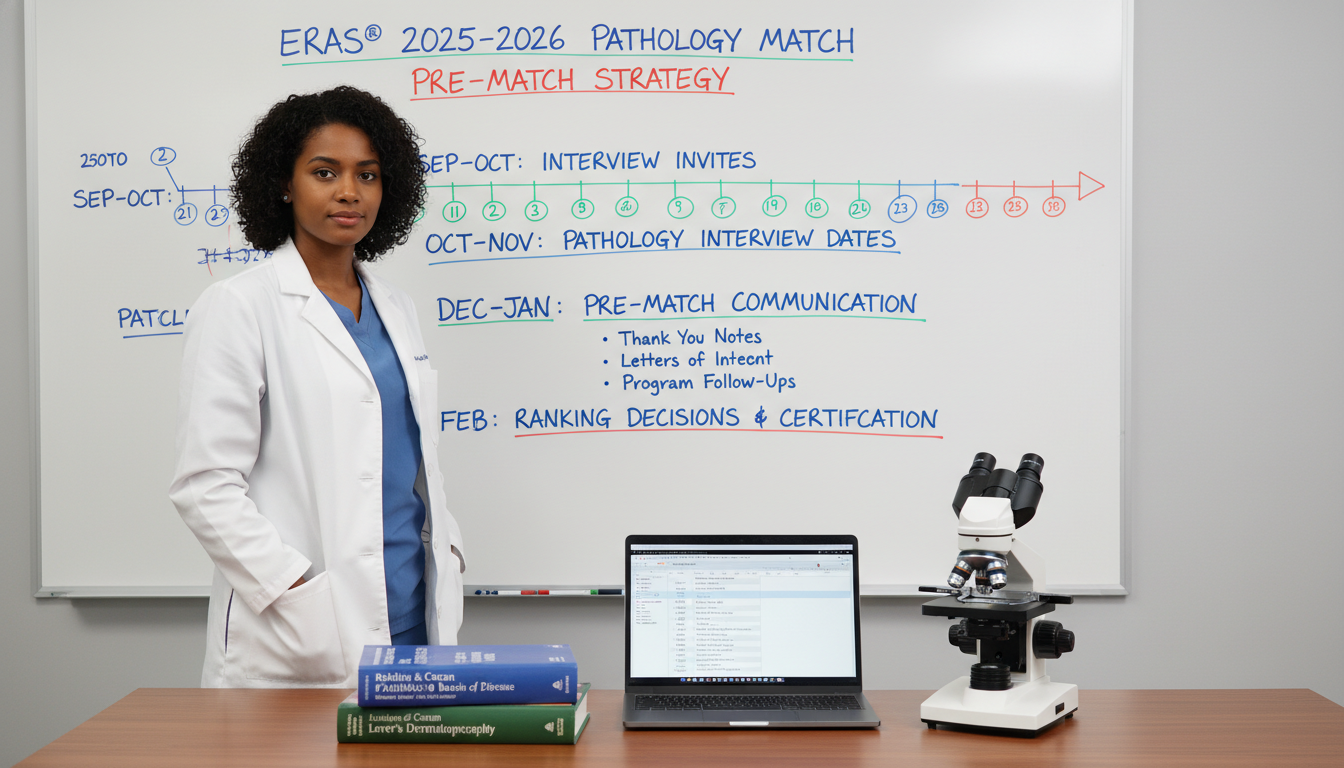
A sensible timeline for pre-match communication in pathology:
- Immediately after submitting ERAS: Optional targeted pre-interview emails to top-priority programs.
- 24–72 hours after each interview: Send thank-you notes.
- Late interview season (January–February):
- One letter of intent to your #1 program.
- Short “continued interest” notes to 3–6 other programs that are high on your list.
- If major update occurs: Send an update at any time, but not more than once every few weeks.
6. Common Pitfalls and How to Avoid Them
6.1 Over-Communicating or Spamming Programs
Programs share information internally. If you:
- Send multiple long emails
- Ask basic questions that are clearly answered on their website
- Repeatedly ask where you stand on their rank list
…you risk being labeled as unprofessional, overly anxious, or difficult. This matters in pathology, where calm, steady, detail-oriented behavior is valued.
6.2 Misrepresenting Your Intentions
Common missteps:
- Telling more than one program “you are my #1.”
- Claiming you have no other interviews when you do.
- Exaggerating publications that are not yet accepted.
Residency is a small world. Dishonesty can follow you and damage your reputation long-term. Also, deliberate misrepresentation can violate NRMP professional conduct rules.
6.3 Ignoring Visa and Credentialing Issues
As a Caribbean IMG, visa and ECFMG-related questions naturally arise. Avoid:
- Being vague about visa needs when asked directly.
- Failing to clarify that you will be ECFMG certified on time.
Instead, proactively state:
“I will be ECFMG certified by [Month, Year], and I am eligible for [J-1 / H-1B] sponsorship. My USMLE Steps are complete.”
Programs appreciate clarity; it helps them plan and can actually help, not hurt, your chances.
6.4 Allowing Anxiety to Drive Decisions
Pre-match communication often stirs anxiety—especially if you hear nothing while others report “love letters” from programs. Remember:
- Many pathology programs do not send explicit interest emails.
- Silence does not equal rejection.
- Rank programs in the order you genuinely prefer them, not based on who emailed you the nicest note.
When evaluating anything that feels like a pre-match or early commitment scenario, pause, discuss with mentors, and make a decision aligned with your long-term goals, not short-term fear.
FAQs: Pre-Match Communication for Caribbean IMG in Pathology
1. As a Caribbean IMG, should I email every pathology program I apply to?
No. Focus on targeted, high-priority programs where you have a specific fit—geographic ties, strong interest in their subspecialty strengths, or an existing mentor connection. For many programs, a strong ERAS application alone is sufficient. Over-emailing can hurt your image.
2. Are “pre-match offers” common in pathology residency?
For standard PGY‑1 categorical pathology positions in NRMP-participating programs, true pre-match offers are rare and generally not permitted. You may encounter non-Match research positions or off-cycle opportunities, but these are distinct from typical residency pre-matches. Always confirm accreditation and implications for your Match participation.
3. Can I tell a pathology program they are my first choice?
Yes, you may voluntarily tell one program that they are your first choice and that you plan to rank them #1. This is ethical and acceptable if it is true. Do not send multiple letters of intent claiming different #1 programs. Your statement is not legally binding, but your integrity and reputation are.
4. How much does pre-match communication really influence the pathology match for Caribbean IMGs?
It can matter, but it does not override fundamentals like USMLE scores, clinical performance, letters, and demonstrated pathology interest. Thoughtful, professional communication can:
- Tip the scale between two similar candidates
- Move you from “maybe” to “interview” in borderline cases
- Reinforce your fit and seriousness as a candidate
However, no amount of emailing can compensate for poor fundamentals. Treat pre-match communication as a strategic supplement, not the core of your application.
By understanding the rules, communicating professionally, and using pre-match interactions to highlight your genuine interest and strengths, you can significantly improve your chances of a successful pathology match as a Caribbean IMG—whether you’re aiming to mirror strong SGU residency match outcomes or carving your own unique path into U.S. pathology.