
Understanding Pre-Match Communication in Addiction Medicine
For an international medical graduate (IMG) pursuing addiction medicine, the period before the Match often feels like a gray zone: programs are reviewing applications, interviews are happening, and you may receive emails or calls that sound encouraging—but not definitive. Knowing how to navigate pre-match communication is essential to avoid ethical pitfalls, protect your chances, and show genuine interest without overstepping.
This IMG residency guide focuses specifically on pre-match communication for addiction medicine. While many addiction medicine programs now participate in the NRMP Match and follow its rules strictly, real-world communication remains nuanced: programs may hint at interest, ask about your ranking intentions, or even describe their “unofficial” stance. You must understand:
- What is allowed and not allowed (especially for programs in the Match)
- How to professionally communicate before the rank list deadline
- How pre-match offers and early commitment historically worked—and where they still appear
- How to show interest as an IMG without violating policies or sounding desperate
By the end of this article, you’ll have a structured approach for program communication before Match, specifically tailored to addiction medicine and the unique circumstances IMGs face.
The Rules and Realities: What “Pre-Match” Means Today
1. Match Participation vs. Non-Match Positions
Addiction medicine training in the U.S. exists in two main structures:
- ACGME-accredited Addiction Medicine Fellowship (commonly pursued after primary residency in Psychiatry, Internal Medicine, Family Medicine, etc.)
- Addiction-focused residency tracks or primary-care residencies with strong substance abuse training components
Most ACGME-accredited addiction medicine fellowships now use a structured matching process (often through NRMP or specialty-specific matches), but some positions may still be offered outside the Match—especially in community programs, newer fellowships, or certain institutional arrangements.
As an IMG, you must first:
- Verify for each program:
- Are they in the NRMP Match?
- Do they fill all positions through the Match?
- Do they have “off-cycle” or out-of-Match spots?
- Check:
- Program website “How to Apply” section
- Fellowship/residency coordinator via email
- NRMP or ERAS listings for that cycle
This distinction is critical because the rules for pre-match offers and early commitment differ greatly depending on whether the program participates in the Match.
2. NRMP Rules: What Programs and Applicants Can and Cannot Do
Programs participating in the NRMP must follow the Match Participation Agreement, which restricts certain types of pre-match behavior.
For programs in the NRMP:
They cannot:
- Ask you to reveal how you will rank them.
- Ask for a verbal or written commitment that you will rank them first.
- Make offers or contracts outside the Match for positions covered by the Match.
They can:
- Express interest (e.g., “You are a strong candidate and we hope you rank us highly”).
- Send post-interview communication (thank you messages, updates, “we are ranking you highly”).
- Clarify curriculum, clinical exposure, or specific substance abuse training opportunities.
For applicants (you):
You cannot:
- Sign a contract for a Match-covered position before Match Day.
- Misrepresent your intentions or accept multiple binding agreements.
You can:
- Express sincere interest in a program.
- Say that you “plan to rank them very highly” or even “first” if and only if it is true.
- Stay in professional, non-coercive communication.
When addiction medicine fellowship positions or addiction-focused training tracks lie partly outside NRMP, practices may be looser. That’s where true pre-match offers and early commitments can still occur, and IMGs need to be especially cautious.
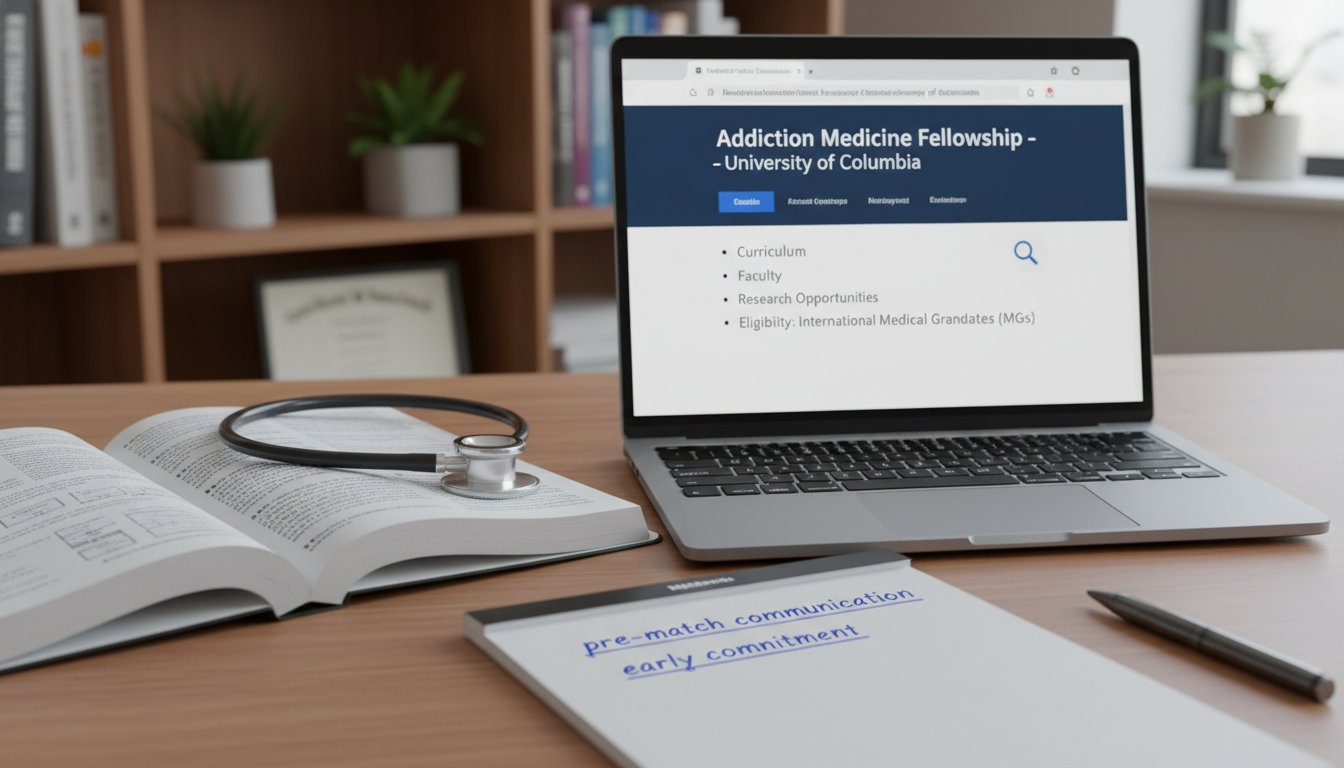
Pre-Match Offers and Early Commitment: How They Affect IMGs
1. What Is a Pre-Match Offer?
A pre-match offer is when a program offers you a position before the official Match (or outside any formal matching system). It may come in several forms:
- “We would like to offer you a position starting July 1, contingent on visa approval.”
- “We don’t participate in the Match; if you commit now, the spot is yours.”
- “We have one off-cycle, non-Match addiction medicine fellowship slot; are you interested in accepting it?”
These can be especially tempting for an international medical graduate, as they may:
- Provide early security (you have a confirmed training position).
- Offer visa sponsorship (J-1 or H-1B), which is critical for many IMGs.
- Reduce the stress of waiting for Match results.
However, if the job is subject to a Match, accepting such a “pre-match” may be against rules for the program and may put you at risk if commitments conflict.
2. Addiction Medicine Context: Why Early Offers Might Arise
Addiction medicine is a growing field, with rising demand for clinicians trained in substance abuse training, opioid use disorder management, and integrated behavioral health. Some institutions:
- Run small, hospital-based addiction medicine fellowships.
- Have variable funding and may open or close positions late.
- Sometimes recruit off-cycle or outside the Match (especially in newer or pilot programs).
For IMGs, these off-cycle or non-Match pathways may be more open to international candidates. But they can also be less standardized, meaning:
- Less clarity about duty hours, supervision, benefits.
- Fewer formalized structures for evaluation and remediation.
- Less oversight regarding fair recruitment practices.
When you’re offered an early commitment, think beyond “Will I get in?” and consider “Is this a safe, accredited, and educational environment for addiction medicine training?”
3. Evaluating a Pre-Match or Early Commitment Offer
Ask yourself and, if appropriate, the program:
Is this position accredited and recognized?
- Is it an ACGME-accredited addiction medicine fellowship?
- Is it a recognized residency with a clear substance abuse training pathway?
Is it inside or outside the Match?
- Does the program fill all positions through Match?
- Is this an additional, off-cycle slot not covered by NRMP?
What are the visa and contract terms (for IMGs)?
- Will they sponsor J-1 vs. H-1B?
- Is the contract contingent on ECFMG certification, USMLE completion, and visa approval?
How committed will you be, and what if something better appears?
- If you accept, can you withdraw ethically and legally?
- Could withdrawing harm your reputation, especially in a small subspecialty like addiction medicine?
When dealing with potential early commitment, it may be wise to speak with:
- A trusted mentor or advisor (especially someone familiar with addiction medicine fellowship).
- ECFMG or your school’s international office.
- The NRMP (if there is any doubt about rules).
Strategic Program Communication Before the Match
1. Structuring Your Pre-Match Communication Timeline
Your communication strategy as an IMG in addiction medicine should follow a phased approach:
Phase 1: Before Interviews
- Goal: Secure interviews.
- Communication:
- Initial contact if your application might be overlooked (e.g., you applied late, or you have a unique background in addiction medicine but average scores).
- Brief emails to program coordinators or directors highlighting:
- Your addiction medicine interest (e.g., research in opioid use disorders, clinical experience in detox units).
- Your status as an international medical graduate and visa needs, clearly but non-defensively.
Phase 2: After Interview Invitations but Before Interviews
- Goal: Prepare a foundation for professional rapport.
- Communication:
- Confirm interview details promptly.
- Ask specific, non-obvious questions if necessary (e.g., “Will there be opportunities for integrated substance abuse training within primary care rotations?”).
Phase 3: Post-Interview but Before Rank List Deadline
- Goal: Demonstrate continued interest and alignment.
- Communication:
- Thoughtful thank-you emails.
- One to two follow-up updates if you have meaningful new information (a publication, new addiction-related project, improved language exam scores).
Phase 4: After Rank List Submission (Both Sides)
- Goal: Maintain professionalism.
- Communication:
- Avoid excessive messaging; only send communications if truly important.
- Do not attempt to renegotiate or fish for promises.
2. Writing Effective Emails as an IMG in Addiction Medicine
Your emails should be concise, focused, and specific to addiction medicine and substance abuse training. Below is a practical structure:
Subject line examples:
- “Prospective Addiction Medicine Fellow – [Your Name, IMG Applicant]”
- “Post-Interview Thank You and Continued Interest – Addiction Medicine Fellowship Applicant”
Opening:
- Address by correct title: “Dear Dr. [Program Director],” or “Dear [Program Coordinator’s Name],”
- Identify yourself clearly:
- Name, medical school, year of graduation.
- Pathway (e.g., Internal Medicine IMG applying to Addiction Medicine Fellowship).
- ERAS or AAMC ID if applicable.
Body content tips:
Reference something specific:
- “Our discussion about integrating buprenorphine treatment in primary care clinics was particularly meaningful to me.”
- “I was impressed by your team’s work on harm-reduction strategies.”
Connect your background as an IMG:
- Highlight experiences managing substance use disorders in resource-limited settings.
- Emphasize cross-cultural communication skills with patients facing addiction.
State your level of interest honestly but carefully:
- You may say:
- “Your program remains one of my top choices.”
- “If matched, I would be honored to complete my addiction medicine fellowship at your institution.”
- Only state “I plan to rank your program first” if you truly mean it.
- You may say:
Closing:
- Keep it simple and professional:
- “Thank you again for your time and for considering my application.”
- “Sincerely, [Full Name, Credentials]”
3. Handling Implied Pressure or Ranking Questions
Programs should not directly ask you how you will rank them. However, some may still try indirect approaches, such as:
- “Where do we stand on your list?”
- “If we rank you highly, can we expect you to do the same?”
- “Would you accept an offer from us if we could make one?”
Recommended responses:
- Emphasize enthusiasm without making binding promises:
- “I was very impressed by your program, especially the depth of substance abuse training and integration with psychiatry. I can say that your program is among the top programs I am considering.”
- Keep statements truthful:
- If they are truly your first choice:
- “I intend to rank your program first, as it aligns best with my career goals in addiction medicine.”
- If they are truly your first choice:
- Gently redirect:
- “As you know, the Match process encourages all parties to submit rank lists independently and honestly, but I want to emphasize that I remain very interested in training with your team.”
Your credibility is a long-term asset, especially in a small field like addiction medicine; avoid telling multiple programs that they are your “definite number one” if that is not true.

Special Considerations for International Medical Graduates
1. Addressing Visa Issues in Pre-Match Communication
For IMGs, visa sponsorship is often decisive. Programs want clarity early; you want not to be screened out automatically.
Best practices:
- State your visa needs clearly but briefly:
- “As an ECFMG-certified international medical graduate, I will require J-1 visa sponsorship.”
- If flexible:
- “I am eligible for J-1 and am exploring the possibility of H-1B sponsorship if available.”
- Avoid long explanations in initial communication; keep it focused and factual.
If a program seems enthusiastic but unclear about visas:
- Ask directly but professionally:
- “I am very interested in your addiction medicine fellowship. May I please confirm whether your institution sponsors J-1 visas for fellows?”
Being upfront avoids misunderstandings later and allows programs to advocate for you internally if they wish.
2. Highlighting Your Unique Strengths as an IMG in Addiction Medicine
Many IMGs bring powerful, distinctive experiences relevant to addiction medicine:
- Work in regions heavily impacted by substance use, HIV, or hepatitis.
- Exposure to culturally-specific patterns of addiction (e.g., alcohol, opioids, stimulants, regional substances).
- Experience with stigma, legal barriers, or limited resources in treating addiction.
In pre-match communication and interviews, emphasize:
- Your comfort in working with diverse, marginalized populations.
- Your resilience and adaptability—valuable in complex addiction care settings.
- Language skills that may help with patient populations served by the program.
Tie these explicitly to the program’s mission or patient demographics whenever possible.
3. Managing Expectations and Emotional Stress
Pre-match communication can be emotionally taxing:
- Some programs are very responsive; others are silent.
- You may receive warm, encouraging notes that still do not guarantee a position.
- As an IMG, rejection may feel magnified by visa and relocation anxieties.
Practical coping strategies:
- Create a communication log: track which programs you contacted, when, and how they replied. This prevents over-sending or missed follow-ups.
- Set rules for yourself:
- For example, one thoughtful thank-you email per program, plus one meaningful update if available.
- Limit comparisons with others:
- Different applicants receive different styles of feedback; some programs never send post-interview signals at all.
Remember: the rank algorithm favors applicant preferences when both parties rank each other. You are not obligated to rank programs higher simply because they communicated warmly. Rank based on where you genuinely want to train and thrive.
Practical Examples of Pre-Match Communication Scenarios
Scenario 1: A Strong Signal from a Program in the Match
You are an IMG applicant to an addiction medicine fellowship that clearly states it participates fully in the NRMP. After the interview, the program director emails:
“We were very impressed with your background in substance abuse training and your work in opioid harm reduction. You would be an excellent fit here, and we are planning to rank you highly.”
How to respond:
- Thank them.
- Express enthusiasm.
- Do not ask for a guarantee or counter-commitment.
Example reply:
Dear Dr. [Name],
Thank you very much for your kind message and for the opportunity to interview with your addiction medicine fellowship. I greatly appreciated learning about your inpatient consultation service and community-based buprenorphine program.
I remain very interested in training at [Institution], and I believe your program would provide outstanding preparation for my career caring for patients with substance use disorders.
Sincerely,
[Your Full Name], MD (ECFMG-certified IMG)
You do not need to disclose exactly where you will rank them, unless you wish to and it is truthful.
Scenario 2: A Non-Match Pre-Match Offer with Visa Sponsorship
A smaller hospital’s addiction medicine fellowship emails:
“We do not participate in the NRMP Match. Based on your interview, we would like to offer you a one-year addiction medicine fellowship position starting July 1, with J-1 visa sponsorship, if you are willing to commit within the next two weeks.”
Steps:
Confirm there is indeed no Match obligation.
Request details:
- Contract terms
- Salary, benefits, call schedule
- Accreditation status and board eligibility
Consider:
- Is this your only realistic pathway this year?
- Does the clinical exposure align with your goals?
- Are you comfortable stopping your search and committing?
Example response:
Dear Dr. [Name],
Thank you very much for the offer to join your addiction medicine fellowship. I am honored by your confidence in me. Before I make a decision, may I please confirm that this position is entirely outside of the NRMP Match and that you do not use any matching process for your fellows?
I would also be grateful to receive a sample contract or details regarding salary, benefits, typical weekly schedule, and accreditation status of the fellowship, so I can make an informed decision.
I remain very interested, particularly given the strong emphasis on substance abuse training and community outreach that we discussed.
Sincerely,
[Your Full Name], MD
Seek advice from mentors and, if needed, legal or visa advisors before signing anything.
Scenario 3: Silence After Interview Despite Your Interest
You interviewed at a top-choice addiction medicine program, but you have heard nothing since. You already sent a thank-you email.
What you can do:
- If you have a significant update (e.g., a new publication in addiction medicine, a major additional clinical experience, or ECFMG certification completion), send one well-crafted update email.
Example:
Dear Dr. [Name],
I hope you are well. Since our interview on [Date], I wanted to share a brief update: I have recently [published a case report on alcohol withdrawal management / completed an additional rotation in an inpatient detox unit / received my ECFMG certification].
My interest in your addiction medicine fellowship remains very strong, especially given your program’s focus on integrating substance use disorder treatment into primary care settings.
Thank you again for considering my application.
Sincerely,
[Your Full Name], MD
What you should avoid:
- Multiple repeated emails without new content.
- Emotional language (“Please choose me—I have no other options”).
- Asking directly, “Will I match with you?” or “What are my chances?”
FAQs: Pre-Match Communication for IMGs in Addiction Medicine
1. Can I tell more than one program they are my “first choice”?
You should not tell multiple programs that they are each your definitive “first choice.” This is considered misleading and unethical. You may, however, appropriately state:
- “Your program is one of my top choices.”
- “I will rank your program highly.”
Reserve “I will rank your program first” for the single program that truly holds that position.
2. As an IMG, should I mention my visa needs in early communication?
Yes, but keep it concise and factual. Early clarity benefits both sides. You can say:
- “As an international medical graduate, I will require J-1 visa sponsorship.”
This avoids later surprises and lets programs quickly determine whether they can support you.
3. How different is pre-match communication for addiction medicine compared to other specialties?
The general Match rules are the same, but addiction medicine has some unique features:
- Some programs or positions, particularly newer fellowships, may still operate outside the Match.
- There is often strong emphasis on community outreach, integrated care, and harm-reduction—topics you should highlight in your communication.
- The field is relatively small, so reputation and honesty carry significant long-term weight.
Overall, the principles of professionalism, transparency, and respect for NRMP rules remain the same.
4. If I receive a pre-match offer outside the NRMP, should I still apply to other programs?
That depends on:
- Whether you have already signed a contract.
- Your comfort with the offer’s quality, accreditation, and visa support.
- The ethical and legal implications of continuing to seek positions after accepting a binding offer.
Before accepting early commitment, compare it carefully with your broader goals and get advice from mentors experienced in addiction medicine fellowship and IMG pathways.
Navigating pre-match communication as an international medical graduate in addiction medicine requires a balance of assertiveness and integrity. Understand the rules, communicate clearly and respectfully, and ensure that any early commitments truly match your professional goals in treating patients with substance use disorders.