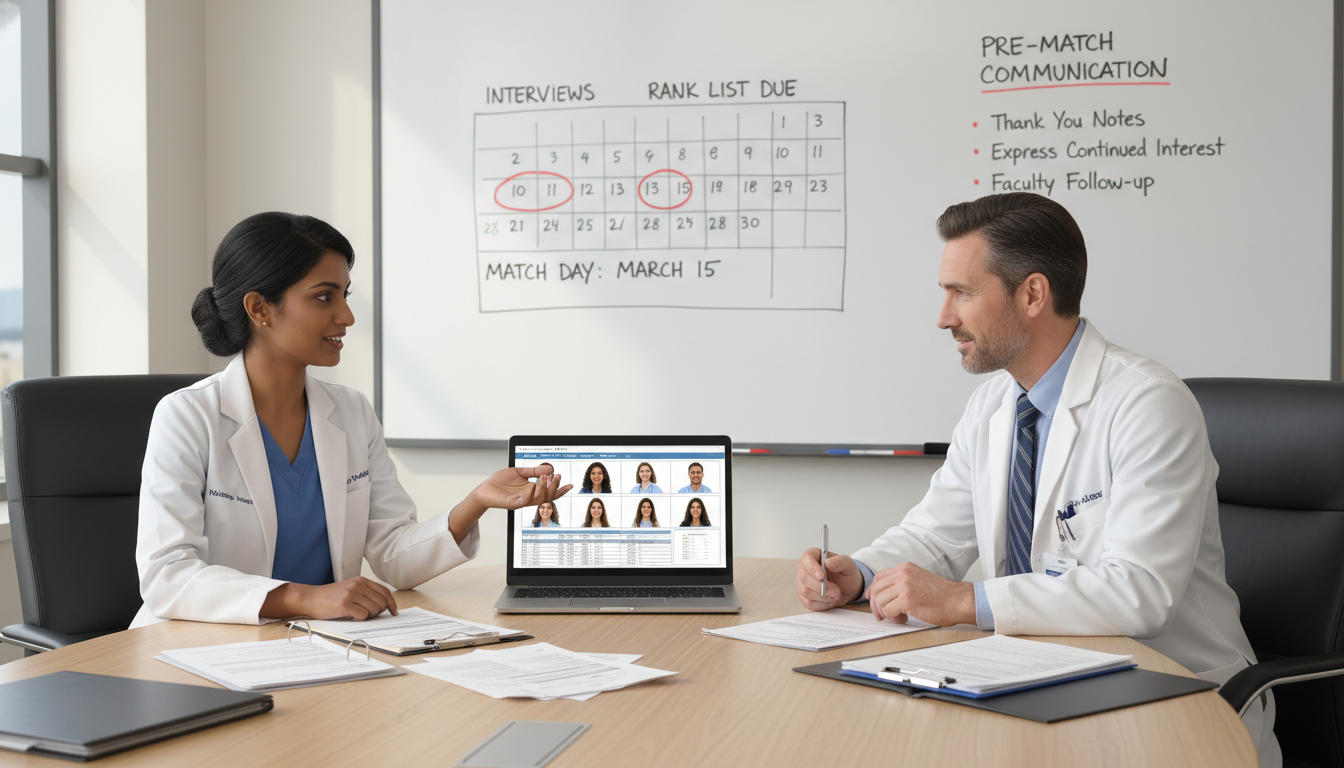
Pre-match communication is one of the most confusing and anxiety‑provoking parts of the residency process for many Caribbean IMGs, especially those targeting a Preliminary Medicine (prelim IM) year. You’re navigating not only the NRMP rules, but also different expectations about early commitment, pre-match offers, and how far you can go with program communication before match without crossing ethical or legal lines.
This guide breaks down how to approach pre-match communication strategically and professionally—so you can maximize your chances of a Caribbean medical school residency match (including pathways like the SGU residency match) and avoid common mistakes.
Understanding the Landscape: Prelim Medicine and Pre-Match Communication
What makes Preliminary Medicine unique?
A Preliminary Medicine year is typically a 1‑year internal medicine internship that you often pair with:
- An advanced position (e.g., Neurology, Anesthesiology, Radiology, PM&R)
- A categorical application the following year
- A backup year if you haven’t secured a categorical spot
For Caribbean IMGs, prelim IM positions can:
- Provide U.S. clinical experience and evaluations
- Help secure strong letters for future applications
- Offer a temporary clinical foothold while you reapply or wait for an advanced spot
Because these positions are one‑year and service-heavy, programs tend to:
- Place high value on reliability and professionalism
- Focus heavily on communication behavior during interview season
- See more applicants who are very anxious about securing “any” US position
This makes pre-match communication especially important—and visible.
What is and isn’t allowed: NRMP basics (high level)
As an NRMP-participating applicant:
You can:
- Tell programs you are very interested or that they are your “top choice”
- Ask for clarification on ranking, visa support, or training structure
- Express gratitude and maintain professional contact after interviews
You cannot:
- Ask a program “Where will you rank me?”
- Ask for a “guarantee” of matching
- Try to force a program into making promises outside NRMP rules
- Misrepresent your intentions (e.g., promising a program you will rank them #1 when you won’t)
Programs cannot (under NRMP rules):
- Ask you directly to disclose your rank list
- Demand your commitment in exchange for ranking you
- Make binding offers outside of the Match (for NRMP-participating spots)
Some institutions and states also have policies limiting pre-match offers entirely. Others may still offer non-NRMP contract positions (less common in Internal Medicine prelim, but you might see it in certain institutions or for non-ACGME or off-cycle spots). For Caribbean IMGs, any such offer should be carefully assessed with your dean’s office or advisor.
Strategic Goals of Pre-Match Communication for Caribbean IMGs
1. Signal genuine interest (without overstepping)
Programs use your communication patterns as a “professionalism litmus test.” They’re asking:
- Does this person communicate clearly and respectfully?
- Are they honest about their intentions?
- Do they understand boundaries?
For prelim IM, where reliability and work ethic are paramount, this impression can be decisive.
Your goals:
- Show you are serious, mature, and dependable
- Clarify genuine interest in specific programs, not everyone
- Avoid desperation or excessive messaging
2. Correct misconceptions about Caribbean graduates
Some programs still harbor biases about Caribbean medical school residency applicants. Thoughtful communication can help:
- Highlight your US clinical experience and performance
- Reference outcomes like the SGU residency match or similar track records of your school
- Show that you understand the U.S. healthcare context
Example phrases:
- “During my internal medicine sub-internship at [US Hospital], I managed typical resident-level responsibilities including cross-coverage, order entry, and daily notes, under supervision.”
- “My training at [Caribbean school] emphasized early clinical exposure and high patient volumes, which I believe prepared me well for a busy preliminary medicine year.”
3. Protect your flexibility for advanced/categorical positions
Many IMG applicants target:
- Advanced positions (e.g., Neurology, Anesthesia) + Prelim IM backup
- Categorical IM as Plan A, Prelim IM as Plan B
Your communication should:
- Keep prelim programs reassured you’ll be present and engaged for the full year
- Avoid explicitly stating that you “won’t stay” or “are only using prelim as a stepping stone”
- Still be honest about your career goals, framed professionally (e.g., “Ultimately pursuing Neurology, but fully committed to being an excellent Preliminary Medicine intern.”)

Key Types of Pre-Match Communication (and How to Use Them)
1. Pre-interview communication
This happens before you receive an interview, and often includes:
- Thank-you responses to interview invitations
- Clarifying visa eligibility
- Inquiries about application status (used sparingly)
When it can help a Caribbean IMG in prelim IM:
- If you have a strong connection (rotated there, local ties, mentor who knows the PD)
- If you have a meaningful update (new Step 2 CK score, publication, strong letter from a U.S. IM attending)
Example pre-interview email (interest + update)
Subject: Application Update and Continued Interest – Preliminary Medicine
Dear Dr. [Last Name] and the Preliminary Medicine Selection Committee,
I hope this message finds you well. I am writing to reiterate my strong interest in the Preliminary Medicine program at [Institution]. As a Caribbean IMG from [School Name] with recent U.S. clinical experience in internal medicine at [Hospital Name], I am particularly drawn to your program’s emphasis on [specific feature: high-volume inpatient training, resident autonomy, strong subspecialty exposure, etc.].
Since submitting my ERAS application, I received my Step 2 CK score of [XXX], and I have attached an updated USMLE transcript to reflect this. I also recently completed a sub-internship at [US hospital], where I served in a resident-like role, managing cross-coverage and daily notes for a busy general medicine service.
I would be honored to interview with your program and would be happy to provide any additional information that may assist in your review.
Thank you very much for your time and consideration.
Sincerely,
[Full Name], MD
AAMC ID: [XXXXXX]
Keep this type of outreach to a few high-yield programs where you have a realistic chance and a genuine connection.
2. Post-interview thank-you notes
This is one of the most important parts of program communication before match.
Purpose:
- Reinforce your interest
- Reflect specifically on what you liked about the program
- Create a positive, professional lasting impression
Best practices:
- Send within 24–72 hours after the interview
- Email the Program Director and optionally the Coordinator
- Short, specific, and genuine
Example post-interview thank-you (prelim IM)
Subject: Thank You for the Interview – Preliminary Medicine
Dear Dr. [Last Name],
Thank you for the opportunity to interview with the Preliminary Medicine program at [Institution] on [date]. I appreciated learning more about your focus on preparing interns to excel in both categorical internal medicine roles and advanced specialties.
I was particularly impressed by the supportive culture described by your residents, especially the way senior residents and faculty mentor preliminary interns as they prepare for their next steps. As a Caribbean IMG with strong interest in [e.g., Neurology/Anesthesiology/Radiology], I value how your program offers robust internal medicine training while acknowledging and supporting diverse long-term career goals.
Our discussion about [specific topic discussed with PD or faculty: e.g., night float structure, educational conferences, subspecialty rotations] reinforced my belief that I would thrive in your program’s high-acuity, teaching-oriented environment.
Thank you again for your time and consideration.
Sincerely,
[Full Name], MD
AAMC ID: [XXXXXX]
Avoid adding ranking language here. Save ranking clarity (e.g., “top choice”) for a dedicated post-interview interest email later in the season if appropriate.
3. Post-interview “interest” or “rank” communication
Later in the season (usually late January to mid-February), it’s reasonable to send a follow-up message to:
- Programs you are seriously considering ranking highly
- Your genuine top prelim choice
This is often where questions about “pre-match” or “early commitment” arise.
A. Expressing strong interest (but not necessarily #1)
Use words like:
- “I plan to rank your program highly”
- “You are among my top choices”
- “Your program remains one of my preferred sites for a preliminary medicine year”
Example: “high on my list” email
Subject: Continued Strong Interest – Preliminary Medicine
Dear Dr. [Last Name],
I hope you are well. I wanted to express my continued strong interest in the Preliminary Medicine program at [Institution]. After completing my interviews, your program stands out to me as one of my top choices for a preliminary medicine year.
The combination of rigorous internal medicine training, exposure to diverse pathology, and the evident support for preliminary residents was unique among the programs I visited. As a Caribbean IMG with prior U.S. internal medicine experience, I feel I could contribute meaningfully to your team while growing under your faculty’s mentorship.
Thank you again for considering my application. I would be grateful for the opportunity to train at [Institution].
Warm regards,
[Full Name], MD
B. Stating “top choice” (when you mean it)
If you are certain a program will be your #1 prelim IM choice, it is acceptable (and often appreciated) to state this clearly—once.
But this comes with strict rules:
- Only one prelim program should receive “you are my top choice” language.
- Do not send this to multiple programs.
- Only say it if you truly intend to rank them #1.
Example: “top choice” email
Subject: [Institution] as My Top Choice for Preliminary Medicine
Dear Dr. [Last Name],
I hope you are doing well. I am writing to let you know that the Preliminary Medicine program at [Institution] is my top choice for internship training, and I will be ranking it first on my NRMP list.
After reflecting on all my interviews, your program aligns best with my goals as a Caribbean IMG pursuing an advanced position in [field, if applicable] while seeking a demanding and supportive internal medicine training environment. I was especially drawn to [specific features: strong resident camaraderie, teaching rounds, subspecialty exposure, etc.].
Regardless of the outcome in March, I want to sincerely thank you and your team for the opportunity to interview and learn more about your program.
Respectfully,
[Full Name], MD
This is not a binding contract, but it is an ethical and professional commitment. Programs often appreciate this clarity and may choose to rank you more favorably as a result.
4. Responding to program-initiated communication
Some programs (especially in prelim-heavy institutions) may reach out after interviews with:
- Expressions of interest (“We will rank you highly”)
- Questions about your level of interest
- Clarifications related to visa status or advanced positions
How to respond:
- Always respond politely and promptly
- Thank them for the update or information
- You may state your interest level honestly, without committing beyond NRMP rules
Example response to “We will rank you highly”
Dear Dr. [Last Name],
Thank you very much for your kind message and for your consideration. I truly appreciate the opportunity to have interviewed with [Institution], and I remain very interested in your Preliminary Medicine program. I will certainly keep this in mind as I finalize my rank list.
Sincerely,
[Full Name], MD
Avoid pushing them for more details (“How high?” “Does that mean top 5?”) and don’t ask for guarantees.

Pre-Match Offers, Early Commitment, and Risk Management
Are “pre-match offers” common in Preliminary Medicine?
For ACGME-accredited, NRMP-participating prelim IM programs, formal pre-match offers (i.e., signing a contract outside the Match) are relatively rare and often not allowed by institutional policy.
However, you might encounter:
- Non-NRMP positions (some community or off-cycle spots)
- Transitional offers from hospitals with special arrangements
- Informal wording that sounds like early commitment (e.g., “If you rank us highly, we will rank you highly”)
As a Caribbean IMG, especially from large schools like SGU, AUC, or Ross, you may hear stories of older graduates who received pre-match offers. Be aware that:
- NRMP has tightened regulations over time.
- Many institutions now avoid formal pre-match deals for IM.
How to evaluate any early offer or hint of early commitment
If a program suggests anything like:
- “If you commit to us, we can skip the Match process”
- “We would like to offer you a position now”
You should:
Clarify the structure:
- “Is this position within the NRMP Match or outside of it?”
- “Would this require me to withdraw from the Match?”
Loop in your school:
- Talk to your Dean’s office or residency advising office
- Ask about the reputation of the program and any known match issues
Consider the downstream impact:
- Will you be able to still pursue your intended advanced specialty?
- Is this position ACGME-accredited?
- Does it provide strong internal medicine training and supervision?
Review NRMP rules:
- If it’s a Match-participating program, a direct outside-offer may violate NRMP rules.
- Accepting a contract outside the Match with a Match-participating program can jeopardize both parties.
When in doubt, do not rush. Programs that pressure heavily for immediate commitment may be a red flag.
Practical Tips for Caribbean IMGs: How to Communicate Effectively
1. Be selective and strategic
Resist the urge to send mass emails to every program.
Prioritize:
- Programs where you interviewed and felt a real fit
- Locations where you can realistically live and perform well
- Programs that have previously taken Caribbean graduates (look at current residents)
Use pre-match communication mostly to refine relationships, not to manufacture interest out of nowhere.
2. Maintain a professional tone and format
- Use a clear subject line (e.g., “Thank You for the Interview – Preliminary Medicine”)
- Keep paragraphs short and focused
- Avoid overly personal or emotional language
- Proofread for grammar and spelling—ask a friend or mentor to review
3. Stay aligned with your long-term plan
If your ultimate goal is:
Neurology / Anesthesia / Radiology / PM&R:
- Frame your prelim IM interest as building a strong foundation.
- Reassure programs you will fully commit to being an excellent intern even if your long-term specialty is elsewhere.
Categorical IM next cycle:
- Emphasize the value of one rigorous year of internal medicine.
- Highlight how you plan to contribute academically, not just clinically (QIs, case reports, etc.).
4. Remember: Rank list beats email
Despite all the anxiety around communication:
- Your NRMP rank list is what truly determines where you match.
- Programs cannot see your rank list.
- Pre-match communication is a supporting strategy, not a substitute for ranking programs according to your true preference.
Never rank a program higher solely because they seemed more interested in you. Consider:
- Training quality
- Location, support, call schedule
- Visa/audit/board pass history
- Resident happiness
5. Red flags to avoid in communication
- Over-emailing (e.g., weekly messages)
- Sending “You are my top choice” to more than one program
- Asking for explicit ranking information (“Will you rank me in your top 5?”)
- Overly informal language, or emotional pleas (“Please, I need this spot; I have no other options”)
- Criticizing other programs in your messages
For Caribbean IMGs, programs will be especially attentive to any signals of unprofessionalism, given the large applicant pool.
FAQs: Pre-Match Communication for Caribbean IMGs in Preliminary Medicine
1. As a Caribbean IMG, should I always tell a program it’s my “top choice” to increase my chances?
No. You should only tell one program it is your top choice, and only if that is genuinely true. Programs value honesty; sending the same message to multiple programs is unethical and potentially damaging if discovered. Instead, tell other programs they are “high” or “among your top choices” if that is true.
2. How important are thank-you emails and follow-ups compared to my USMLE scores and letters?
Your USMLE scores, MSPE, letters, and clinical evaluations remain the primary selection factors. However, for borderline cases—especially for Caribbean medical school residency applicants—professional, thoughtful communication can tip decisions:
- To offer you an interview from the waitlist
- To rank you slightly higher versus another similar applicant
They will never compensate for major deficits, but they can make a meaningful difference, especially in competitive prelim IM programs.
3. Can I ask programs directly if they sponsor visas during pre-match communication?
Yes, and you should—ideally before or during interview season. Visa questions (J-1 vs. H-1B) are completely appropriate and often crucial for Caribbean IMGs. You can ask:
“Could you please confirm whether your Preliminary Medicine program sponsors [J-1/H-1B] visas for interns?”
Ask respectfully and concisely. This is considered appropriate program communication before match.
4. Are pre-match or early commitment offers safer in preliminary medicine because it’s only a one-year position?
Not necessarily. Even for a 1‑year preliminary medicine year, you must ensure:
- The position is ACGME-accredited
- It does not violate NRMP rules or require you to withdraw improperly
- It supports your long-term goals (e.g., advanced specialty planning)
Accepting a poorly structured or non-accredited prelim year can delay or complicate your pathway to your ultimate specialty. Always involve your school’s advising office and verify details before accepting any early offer.
Thoughtful, honest, and well-timed pre-match communication will not magically create opportunities that don’t exist—but for a Caribbean IMG pursuing a preliminary medicine year, it can significantly strengthen your candidacy, correct misconceptions, and position you as a professional and reliable future intern. Use it as a strategic tool alongside strong applications, smart program selection, and a realistic ranking strategy to maximize your chance of a successful Match.