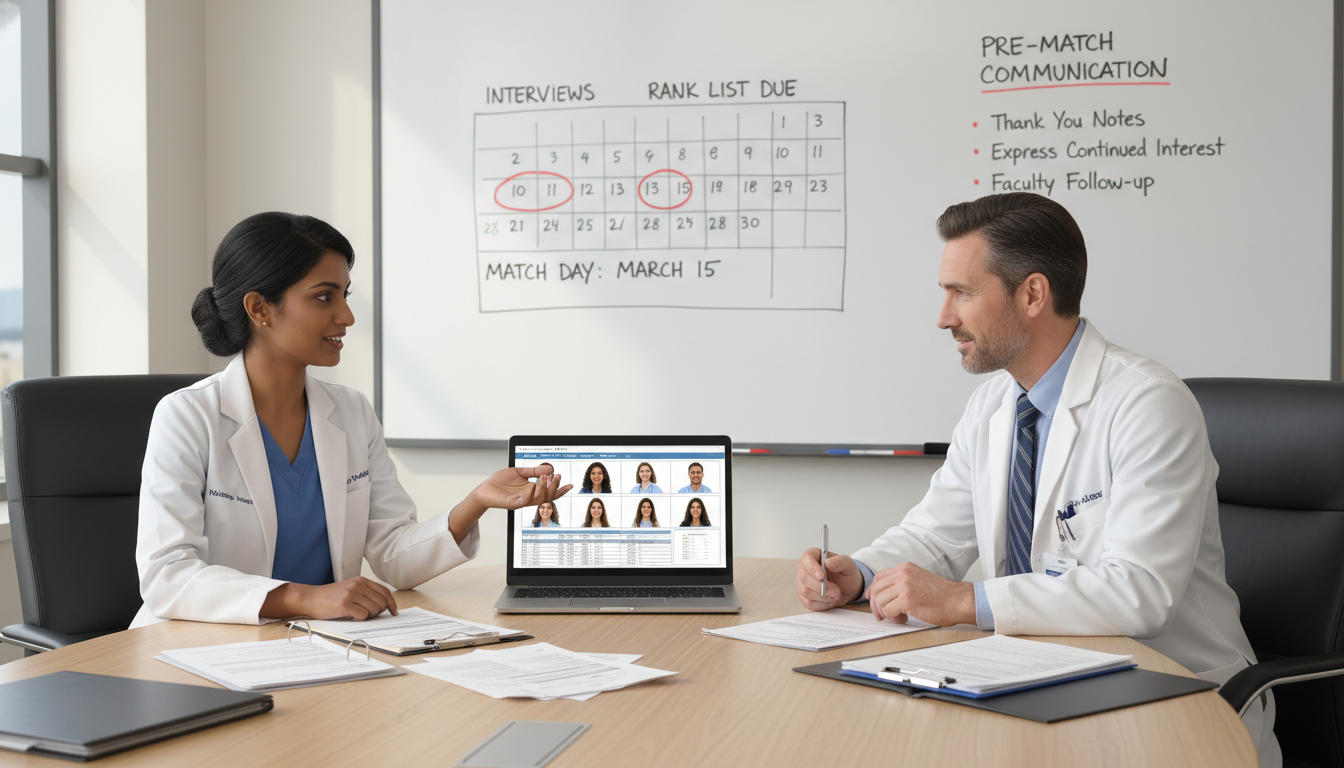
Pre-match communication is one of the most misunderstood aspects of the residency process—especially for a DO graduate targeting a PM&R residency. You’re told to “be professional but not pushy,” to “advocate for yourself but don’t ask about ranking,” and to “build relationships but don’t violate the Match.” That’s a lot of vague advice.
This article breaks it down clearly, with specific examples tailored to a DO graduate pursuing Physical Medicine & Rehabilitation (PM&R). You’ll learn how to communicate with programs ethically and effectively, how pre-match conversations differ from pre-match offers, and how to strategically present yourself as a strong candidate in the physiatry match.
Understanding Pre-Match Communication vs. Pre-Match Offers
Before diving into emails and calls, it’s crucial to separate two very different concepts:
- Pre-match communication = routine, allowed contact with programs
- Pre-match offers / early commitment = actual offers of positions outside the NRMP Match (which are not standard for accredited PM&R programs in the NRMP)
What Is Pre-Match Communication?
Pre-match communication refers to any contact with a residency program before the official rank order list deadline, including:
- Introductory or update emails
- Thank-you messages after interviews
- Clarification questions about curriculum, call, or fellowship
- Expressions of interest (e.g., “I am very interested in your program”)
- Faculty or mentor advocacy emails on your behalf
- Networking at conferences or virtual events
In NRMP-participating PM&R programs, this communication must not involve discussions of:
- How a program will rank you
- How you will rank a program
- Conditional statements like “If you rank us #1, we will rank you highly”
- Guarantees or implied guarantees of a spot
These violate NRMP Match Participation Agreement rules and can put both you and the program at risk.
What Are Pre-Match Offers and Early Commitment?
Historically, in some specialties and locations, programs made pre-match offers—positions offered outside the Match, asking applicants to accept early. This is called early commitment.
Key points for your situation as a DO graduate in PM&R:
- ACGME-accredited PM&R residencies that participate in the NRMP may not offer pre-match positions. They must fill positions through the Match, with rare exceptions for off-cycle vacancies.
- Some non-NRMP positions (like certain osteopathic-only, military, or special pathway positions) may still function with direct offers or early commitments—but these are now far less common in classic PM&R training.
- If you encounter anything that sounds like a pre-match offer from a program in the NRMP, be cautious and, if needed, seek guidance from your school’s GME office or the NRMP.
So when we talk about “pre-match communication” in the osteopathic residency match or the physiatry match context now, we’re usually referring to ethical, NRMP-compliant communication that helps programs and applicants get to know each other and stay on each other’s radar—not to pre-match offers.
The DO Graduate Landscape in PM&R: Why Communication Matters
As a DO graduate, you bring strengths that align naturally with PM&R—holistic care, musculoskeletal expertise, and a rehabilitation-focused mindset. At the same time, the PM&R residency landscape has become increasingly competitive and ACGME-integrated.
Strategic communication can help you:
- Overcome bias or unfamiliarity at historically MD-heavy programs
- Highlight your fit with physiatry’s functional and holistic philosophy
- Maximize the impact of your audition rotations and letters
- Clarify program expectations regarding board scores, COMLEX/USMLE, and DO training
- Stay visible among many applicants with similar numbers
Programs often remember applicants who:
- Communicate clearly and respectfully,
- Demonstrate genuine interest in PM&R, and
- Show they understand that program’s specific mission and patient population.
For DOs, this can help distinguish you not only from other DO candidates but also from MD peers with similar metrics.
Types of Pre-Match Communication and How to Use Them
Think of pre-match communication in three phases:
- Pre-interview
- Post-interview but pre-rank list
- Through mentors and indirect advocacy
1. Pre-Interview Communication
This includes:
- Introducing yourself when you have a specific, legitimate reason
- Asking targeted questions about the program
- Communicating about away rotations or visiting student experiences
- Clarifying points about DO/COMLEX policies
When to Reach Out Before Interviews
You might email a program before interview season when:
- You did (or are scheduled to do) an away rotation there
- The program states they accept COMLEX only but you want to clarify expectations
- You have a genuine regional or personal connection (e.g., grew up locally, spouse’s job)
- You noticed a specific alignment with your interests (e.g., SCI, MSK ultrasound, pain, pedi rehab) and want to express that succinctly
Avoid sending generic “please interview me” emails to every program. These are rarely effective and can feel spammy.
Example: Introductory Email for a DO PM&R Applicant
Subject: Prospective PM&R Applicant with Upcoming Rotation – [Your Name]
Dear Dr. [Program Director’s Last Name],
My name is [Your Name], a 4th-year DO student at [Your School]. I am applying to PM&R this cycle and will be rotating with your service in [Month, Year]. I am particularly interested in [specific feature of the program – e.g., your strong inpatient TBI service and integration of MSK ultrasound in continuity clinic].
As a DO graduate with a strong interest in [e.g., neuromuscular rehab and electrodiagnostics], I’m excited to learn more about your approach to resident education and how DO graduates have historically integrated into your program.
If there are any recommended readings or expectations you have for rotating students, I would be grateful to receive them so I can prepare appropriately.
Thank you for your time, and I look forward to joining your team in [Month].
Sincerely,
[Full Name], DO Candidate
[School] | AAMC ID: [#######]
Email: [email] | Phone: [phone]
This email:
- Demonstrates interest thoughtfully
- Signals you are a DO applicant without making it the only focus
- Offers a simple, professional request (resources/expectations)
2. Post-Interview Communication and Showing Genuine Interest
After interviews, program communication before Match becomes especially sensitive. Your goals:
- Reinforce your interest and fit
- Thank the program for their time
- Clarify remaining questions
- Avoid NRMP violations or pressuring language
Thank-You Emails
While some programs explicitly say “no thank-you emails,” many still accept them. Check the program’s communications or website first.
A good thank-you email for a DO graduate in PM&R should:
- Be specific to that program and that interview
- Reflect on a few meaningful aspects of the day
- Mention any DO-relevant elements (e.g., OMM integration, MSK emphasis) if relevant
- Avoid explicit ranking statements (unless your school advisors confirm it’s both ethical and norm in your specialty—many now advise against stating rank order outright)
Example:
Subject: Thank You – [Program Name] PM&R Interview on [Date]
Dear Dr. [Last Name],
Thank you for the opportunity to interview with [Program Name] PM&R on [Date]. I appreciated learning more about your emphasis on [e.g., longitudinal outpatient exposure and early EMG training], as well as the supportive culture described by the residents.
As a DO graduate with a strong interest in [e.g., musculoskeletal medicine and functional recovery], I was particularly drawn to the way your program integrates multidisciplinary care in the inpatient rehab hospital and the opportunities to work with [e.g., adaptive sports or specialized SCI clinic].
I am very grateful for your time and for the chance to meet your faculty and residents. Please extend my thanks to the entire interview team.
Sincerely,
[Your Name], DO
[School] | AAMC ID: [#######]
You’ve expressed clear, sincere interest without making any ranking promises.
“Love Letters” and Rank Statements
There is debate about telling a program, “I will rank you #1.” The NRMP allows expressions of interest but prohibits coercion or soliciting such statements. Many advisors now recommend:
- Avoid explicit rank order statements like “I will rank you first”
- Instead, use phrases such as:
- “I remain very enthusiastic about your program.”
- “Your program is one of the places where I could most clearly see myself training.”
- “If I am fortunate to match at [Program], I would be thrilled to train there.”
For DO graduates, this still allows you to show commitment without stepping into ethically ambiguous territory.
3. Indirect Communication: Faculty Advocacy on Your Behalf
Program directors often place substantial weight on advocacy from trusted colleagues. This can be especially powerful for DO graduates who:
- Rotated at a PM&R program and made a strong impression
- Are coming from a DO school or region less familiar to that program
- Are on the borderline numerically but strong clinically and interpersonally
You may ask a mentor or attending:
“Would you feel comfortable reaching out to [Program Director] at [Program] as an advocate once interviews have gone out or after I’ve interviewed, if you feel I’d be a good fit?”
Make this request:
- Only if the mentor genuinely knows your work
- Only if you’re confident you would accept that program if matched
- With the understanding that they will decide if and when to reach out
Advocacy might sound like:
“I recently worked with [Your Name], a DO student from [School], on our inpatient rehab service. They showed excellent clinical reasoning, bedside manner, and strong interests aligned with PM&R. I believe they’d be an asset to your residency and wanted to make sure they’re on your radar.”
This type of communication is within bounds and often quite helpful.
Special Considerations for DO Graduates in the Physiatry Match
As a DO graduate in the osteopathic residency match context (now largely unified with ACGME/NRMP), there are a few unique issues you’ll want to address through pre-match communication.
COMLEX vs. USMLE: Clarifying Early
Some PM&R programs:
- Accept COMLEX alone
- Prefer or require USMLE scores in addition to COMLEX
- Are unfamiliar with interpreting COMLEX levels compared to USMLE
Strategic, professional communication can clarify this:
- Before applying, check program websites and FREIDA listings.
- If unclear, one concise email to the program coordinator or director is reasonable.
Example:
Subject: Question About COMLEX for PM&R Applicants
Dear [Coordinator’s Name or Dr. Last Name],
My name is [Your Name], a DO candidate from [School]. I am very interested in applying to your PM&R residency program. I have taken COMLEX Level 1 and Level 2-CE, but I have not taken the USMLE exams.
I wanted to confirm whether your program considers applicants who have COMLEX scores only, or if USMLE scores are required for consideration.
Thank you for your time and clarification.
Best regards,
[Your Name], DO Candidate
[School]
Direct, respectful, and efficient.
Highlighting DO Strengths That Align With PM&R
In your communications (and interviews), weave in strengths that often characterize DO training:
- Osteopathic philosophy – focus on function, whole-person care
- Hands-on MSK skills – OMM/OMT experience can be highly relevant in outpatient PM&R
- Primary care-style continuity – fits well with longitudinal rehab and chronic disease
For example, in a post-interview message you might say:
“My osteopathic training, particularly the emphasis on musculoskeletal and functional assessment, strongly aligns with the goals of PM&R, and I felt that alignment clearly during my interview day with your program.”
This subtly reinforces why being a DO is an asset—not a liability.
Addressing Bias or Lack of Familiarity
If you sense a program is less familiar with DO graduates:
- Keep communications particularly professional, polished, and specific.
- Let your performance, letters, and interview presence demonstrate parity with MD peers.
- If you did an away rotation, ask attendings who know you well to potentially advocate for you.
You do not need to explicitly raise the “DO vs MD” issue in emails unless you’re clarifying exam requirements or licensure pathways.
What Not to Do: Common Pitfalls in Pre-Match Communication
To protect your candidacy and reputation, avoid these missteps in PM&R pre-match communication:
1. Asking How You Will Be Ranked
Questions like:
- “Where do I stand on your list?”
- “Will I match there if I rank you highly?”
Are inappropriate and put the program in an unethical position. Programs are not allowed to tell you how they’ll rank you.
2. Making Conditional or Pressuring Statements
Examples to avoid:
- “If you guarantee I’ll match, I’ll rank you #1.”
- “I received other offers and need to know your ranking decision.”
- “Can we come to some sort of pre-match agreement?”
These cross ethical lines and may raise concerns about your professionalism.
3. Over-Emailing or Being Vague
Sending multiple generic emails such as:
- “Any updates?”
- “Do you plan to invite me?”
- “Just checking in again.”
This can hurt more than help. Limit your emails to substantive, purposeful communication:
- One intro or clarification email if truly needed
- One thank-you after interview (if not discouraged by program)
- Possibly one brief update later in the season if you have significant new information (e.g., new high-impact publication, AOA/Gold Humanism induction, or a meaningful change like a new couple match partner affecting location preference)
4. Overstating or Misrepresenting Your Intentions
Don’t tell multiple programs, “I will rank you #1,” even if you present it as “enthusiasm.” If you do choose to express very strong preference to one program, reserve that language for the single place you truly mean it—though again, many advisors now recommend avoiding explicit rank promises altogether.
Practical Strategy: Building a Thoughtful Communication Plan
To handle pre-match communication without stress, create a simple plan:
Step 1: Categorize Your Programs
Group your PM&R programs into:
- High-priority / dream programs
- Moderate-priority / very interested
- Backup / safety options (where available)
You’ll communicate similarly with all, but may give slightly more targeted attention to group 1 and 2 programs.
Step 2: Identify Legitimate Reasons to Reach Out
For each high-priority program, list:
- Did I rotate there?
- Do I have a geographic tie?
- Is there a faculty connection through my mentors?
- Is there a COMLEX/USMLE clarification needed?
- Is there a unique feature that truly aligns with my interest (e.g., strong SCI program, sports and MSK focus, pedi rehab, robust research)?
Only reach out when a clear, program-specific reason exists.
Step 3: Draft Templates in Advance
Prepare:
- A pre-rotation or pre-interview intro email template
- A post-interview thank-you template
- An update email template (only if you later have important news)
Then individualize each email with specific program details. Never send them unchanged.
Step 4: Involve Your Mentors Strategically
Talk with:
- Your PM&R faculty
- Your home institution’s GME dean or advising office
- Any program director-level mentors
Ask:
- “Are there programs where an advocacy email would be appropriate?”
- “If I perform strongly on this away rotation, would you consider calling or emailing the PD on my behalf?”
This is especially relevant in PM&R, where the community is small and word-of-mouth carries weight.
Step 5: Keep a Communication Log
Track:
- Date emailed
- Type (intro / clarification / thank-you / update)
- Any response received
This prevents over-contacting and helps you stay organized across many programs.
Frequently Asked Questions (FAQ)
1. As a DO graduate, should I mention explicitly that I’m a DO in my emails to PM&R programs?
Your DO status will already be clear in your application. In emails, it’s fine to briefly reference being a DO when it’s relevant—for example, clarifying COMLEX policies or highlighting osteopathic strengths aligned with PM&R (e.g., MSK skills, holistic care). It doesn’t need to be the main focus of your message; emphasize your fit with PM&R and that specific program, not just your degree.
2. Are pre-match offers still a thing in PM&R?
For ACGME-accredited PM&R residencies that participate in the NRMP Match, true pre-match offers (i.e., contractual early commitments to bypass the Match) are not allowed. A program indicating, “We’re ranking you highly,” or “We hope you’ll rank us highly,” is not a formal offer and must still comply with NRMP communication rules. If you are approached with anything that seems like a pre-match offer from an NRMP-participating program, seek guidance from your dean’s office or the NRMP before responding.
3. How many times is it reasonable to email a program before the Match?
For most applicants, 1–3 contacts per program over the entire season is plenty:
- 0–1 pre-interview (only if there is a meaningful reason)
- 1 post-interview thank-you (if not discouraged)
- 0–1 later-season update (only if you have something significant to convey)
Frequent or repetitive emails—especially without new information—can backfire and be seen as unprofessional or anxious.
4. Can I tell a PM&R program it is my top choice or that I will rank it #1?
You can express strong interest, but be careful. NRMP rules prohibit coercion and misleading statements. Many advisors now recommend avoiding explicit “I will rank you #1” promises and instead using language like:
- “I remain extremely enthusiastic about your program.”
- “I could very much see myself training at [Program], and it is one of my top choices.”
If you do choose to make a very strong preference statement, reserve it for only one program and make sure it is truthful and not phrased in a way that pressures the program to respond in kind.
Thoughtful, ethical pre-match communication won’t magically guarantee a PM&R residency position—but for a DO graduate, it can meaningfully enhance your visibility, clarify your fit, and demonstrate the professionalism programs are actively seeking. Use communication to augment your application, not to replace its core elements of strong clinical performance, solid letters, and a clear commitment to physiatry’s mission: helping patients maximize function and quality of life.