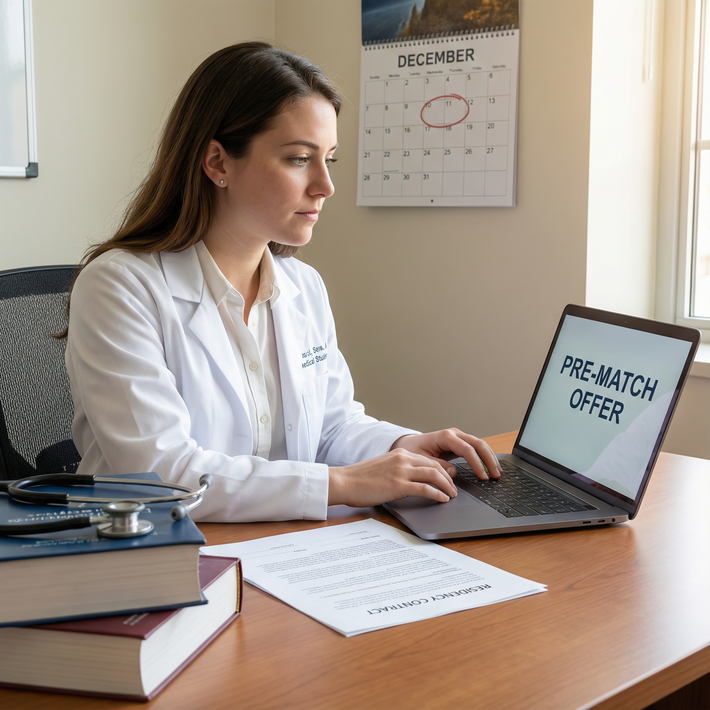
Understanding Pre-Match Communication in Diagnostic Radiology
For a DO graduate aiming for a diagnostic radiology residency, pre-match communication can feel like a high-stakes, poorly defined part of the process. You’ve heard about pre-match offers, early commitment, and the do’s and don’ts of program communication before Match, but the rules often seem vague—especially when you’re trying to stand out in a competitive specialty like radiology.
This article focuses specifically on pre-match communication for DO graduates in Diagnostic Radiology, helping you understand what’s allowed, what’s smart, and how to strategically communicate with programs without crossing ethical or NRMP boundaries.
We’ll cover:
- What pre-match communication is (and isn’t) in the current NRMP era
- How this plays out specifically for DO applicants and the osteopathic residency match legacy
- How to email, call, or update diagnostic radiology programs effectively
- Handling “signals” of interest, ambiguous conversations, and “love letters”
- Navigating potential pre-match offers or apparent early commitment pressure
Throughout, the focus is on DO graduates seeking a radiology residency—whether you’re applying mainly to categorical DR, advanced DR, or integrated IR/DR with a diagnostic base.
1. Core Rules: What Pre-Match Communication Really Means Now
1.1. Pre-Match vs. the Match Era
Historically, “pre-match” literally meant signing a contract with a program before the official Match, outside the main matching system. This was especially common in some specialties and in the former AOA (osteopathic) match for DO graduates.
In the current unified environment (NRMP Match, ACGME-accredited programs):
- Most ACGME diagnostic radiology residency positions participate in the NRMP Match.
- True, binding pre-match offers (contracts signed before Match) are rare and, for NRMP-participating positions, generally not permitted if they circumvent NRMP rules.
- What people now call “pre-match communication” typically means:
- Emails to and from programs between interview and rank list certification
- Phone calls/Zoom follow-ups
- Expressions of interest (“I will rank you highly”)
- Program signals that you are “high on their list”
The NRMP focuses on how programs and applicants communicate about ranking and commitments, not on normal professional interaction.
1.2. NRMP Rules You Must Know
You don’t have to memorize the rulebook, but these concepts are critical:
No soliciting ranking information
- Programs cannot require that you disclose how you will rank them.
- You cannot be required to promise to rank a program #1 as a condition of being ranked or chosen.
No binding commitments outside the Match (for participating programs)
- Programs can’t ask you to enter a binding pre-match agreement that conflicts with NRMP policies.
- You also can’t sign something that effectively bypasses the Match for an NRMP-participating position.
Voluntary statements of interest are allowed
- You can tell a program: “You are my top choice and I plan to rank you #1” (if it’s true).
- Programs can say: “We think you’d be a great fit; you are competitive here; we hope you rank us highly.”
- Neither side can treat these as binding or enforceable.
No coercion or undue pressure
- Any attempt by a program to pressure you into revealing your rank list or to commit to them in a binding way is inappropriate—and reportable.
For a DO graduate aiming for a diagnostic radiology match, it’s crucial to remember: honesty and professionalism are non-negotiable. You can communicate your preferences, but you can’t mislead multiple programs with conflicting promises.
2. DO Graduate Perspective: Unique Considerations in Radiology
2.1. The Changing Landscape for DO Graduates
As a DO, you may be navigating:
- A fully ACGME-accredited radiology landscape (no separate osteopathic diagnostic radiology programs in the old sense)
- Historical bias concerns or questions about COMLEX vs USMLE
- A larger applicant pool, with MD, DO, and increasingly international candidates competing for similar spots
For a DO graduate:
- Pre-match communication is one way to counteract biases—by showcasing your fit, professionalism, and genuine interest.
- Many PDs openly value osteopathic training, especially if you demonstrate strong clinical performance and imaging-related exposure.
2.2. DO Graduate vs. Osteopathic “Residency Match”
The term osteopathic residency match historically referred to the AOA match; now, DO graduates apply through the NRMP. Some DO graduates still use the term informally, but in diagnostic radiology:
- Nearly all positions are in the NRMP diagnostic radiology match.
- You are competing in the same main Match pool as MD graduates.
- Pre-match communications follow NRMP standards, without separate AOA rules.
2.3. Diagnosing Your Position as a DO Radiology Applicant
Before planning communication, you need to realistically assess your profile:
Academic metrics
- COMLEX and/or USMLE Step scores
- Class rank, honors, remediation history
Radiology-specific experiences
- Radiology electives or sub-internships (home or away)
- Research in imaging, case reports, quality improvement projects
- Radiology interest group leadership, conferences, posters
Program type you are targeting
- University vs community programs
- Geographic priorities (e.g., regions with historically strong DO representation)
- Advanced DR programs with separate prelim/transitional year vs categorical
Your communication strategy should be tailored to:
- Programs where you are realistically competitive
- Places you are truly interested in ranking highly
- Settings where a DO applicant may want to proactively affirm fit and interest

3. Types of Pre-Match Communication: What, When, and How
3.1. Common Communication Channels
For DO graduates in radiology, the main forms of program communication before Match are:
Pre-interview contact
- Clarifying interest in the program
- Updating application materials (new publication, improved score, etc.)
- Occasionally inquiring about interview availability if you’re on a waitlist
Post-interview thank-you emails
- Short, professional messages to interviewers and/or PD
- Opportunity to reaffirm specific elements of fit
Targeted update/interest letters (late season)
- Inform PDs of new publications, awards, or rotations
- Clarify that you remain highly interested in their program
- In some cases, explicitly stating intent to rank the program highly
Top-choice communication (“love letters”)
- One carefully written email where you truthfully state that a program is your top choice and you will rank them #1
- Reserved for a single program
Occasional phone calls (less common, higher stakes)
- Typically from programs (PD, APD, or faculty) reaching out to express interest
- Rarely initiated by applicants unless invited or clearly appropriate
3.2. General Principles for Effective Communication
To use pre-match communication strategically as a DO radiology applicant:
Be concise and specific
- Avoid long, rambling messages. 1–3 short paragraphs are usually enough.
- Highlight 1–3 concrete reasons you fit the program (case volume, teaching style, research, geographic ties, osteopathic-friendly culture).
Be honest
- Do not tell multiple programs they are your “#1.”
- Avoid vague or misleading language about ranking.
Be professional
- Proper email format, no texting abbreviations.
- Address recipients by title (e.g., “Dr. [Last Name]”) unless instructed otherwise.
Be respectful of boundaries
- Don’t repeatedly email or call programs that don’t respond.
- One thank-you, and maybe one follow-up/update later in the season, is usually enough.
3.3. Example: Post-Interview Thank-You Email for a DO Radiology Applicant
Subject: Thank You – Diagnostic Radiology Interview on [Date]
Dear Dr. [Last Name],
Thank you for the opportunity to interview at the [Program Name] Diagnostic Radiology Residency on [date]. I particularly appreciated learning about your emphasis on resident autonomy in the reading room and the strong fellowship match outcomes.
As a DO graduate with a strong interest in abdominal imaging and teaching, I was excited by the combination of high-volume, diverse pathology and the supportive culture you and the residents described. I remain very interested in your program and believe it would be an excellent fit for my training and future career in academic radiology.
Thank you again for your time and consideration.
Sincerely,
[Your Full Name], DO
[Medical School]
AAMC/ERAS ID: [#####]
4. Navigating Interest Signals, Early Commitment, and “Pre-Match Offers”
4.1. What Counts as an Interest Signal from Programs?
Programs may communicate in ways that suggest strong interest, for example:
- “You are a very competitive applicant for our program.”
- “We think you’d fit well here and hope you rank us highly.”
- “You will be ranked to match.”
- An informal phone call or email from the PD or faculty after the interview.
These are not binding, and they don’t guarantee a match. But they can guide you in how you rank them and whether you want to send a “top choice” email.
For a DO graduate, such signals may help:
- Reassure you that your osteopathic background is welcomed
- Confirm that your profile aligns with the program’s selection priorities
- Inform your decisions when weighing multiple radiology residency options
4.2. Handling Apparent “Pre-Match Offers” in the NRMP Era
Occasionally, you may encounter language that feels like a pre-match offer or early commitment:
- “If you tell us we’re your #1, we’ll rank you to match.”
- “We want to make sure you’re committed to us before we commit to you.”
- “We expect applicants we rank highly to rank us #1 in return.”
These are problematic for several reasons:
- They violate the spirit of NRMP rules about not forcing disclosures or commitments.
- They can put unfair pressure on you to promise something prematurely.
- They may not be honored if the program later changes its rank list.
How to respond:
- Stay neutral, professional, and avoid explicit promises about your rank list.
- You can say:
- “I remain very interested in your program and can see myself training there happily.”
- “I will certainly consider your program very highly on my rank list.”
- “I hope our interests align in March.”
If a program explicitly demands a ranking commitment or requires you to disclose your rank list, that’s inappropriate. You’re allowed to:
- Decline to answer
- Politely redirect the conversation
- Report the behavior to NRMP if it feels coercive
4.3. True Pre-Match Contracts: Rare but Possible Corner Cases
A small number of programs or positions (often non-standard or non-NRMP) may offer contracts outside the Match, for example:
- Non-NRMP community radiology positions
- Off-cycle or start-date-shifted positions
- Transitional year or preliminary year spots that don’t participate in the Match
If you are presented with such a contract:
- Confirm whether the position is part of the NRMP diagnostic radiology match or separate.
- Carefully review the terms—start date, salary, location, expectations.
- Understand that accepting a non-NRMP position may make you ineligible for the Match in that specialty for that cycle.
- Consult your dean’s office, a trusted advisor, or the NRMP for clarity.
For most DO graduates seeking a standard diagnostic radiology residency, the goal is to participate fully in the NRMP Match, not to sign pre-match contracts.

5. Strategic Communication Timeline for DO Applicants in Diagnostic Radiology
5.1. Before Interview Invites (Early to Mid-Season)
At this stage, your primary focus is on:
- Submitting a strong ERAS application
- Ensuring your letters of recommendation (ideally including at least one radiologist) are uploaded
- Completing any USMLE/COMLEX exams if applicable
Pre-interview communication might include:
- A brief email to programs where you have:
- Strong geographic ties
- Completed a radiology rotation or audition rotation
- A specific osteopathic or curricular synergy (e.g., OMT integration, community health focus)
Template idea:
Dear Dr. [Last Name],
I recently applied to the [Program Name] Diagnostic Radiology Residency through ERAS and wanted to briefly express my strong interest. I completed a radiology elective at [Institution/Location] and am particularly drawn to programs like yours that emphasize [e.g., early resident independence in the reading room and robust teaching in abdominal imaging].
As a DO graduate from [School], I have developed a strong foundation in clinical medicine and a specific interest in [e.g., musculoskeletal imaging, neuroimaging]. I also have ties to [region/city] and hope to practice in this area long term.
Thank you for considering my application. I would be honored to interview if given the opportunity.
Sincerely,
[Your Full Name], DO
AAMC/ERAS ID: [#####]
Use this sparingly—only for a limited number of high-priority programs where you have genuine, specific reasons.
5.2. During Interview Season
After each interview:
- Send thank-you emails within 24–48 hours.
- Mention something specific from your conversation or the program day.
- Reaffirm your interest if applicable, but avoid overpromising.
If you are a DO graduate and sense uncertainty about your background during the interview (e.g., questions about COMLEX vs USMLE):
- You can briefly reinforce in your thank-you note that your osteopathic training has prepared you well for rigorous diagnostic radiology training.
- If relevant, mention strong performance on USMLE (if taken), or COMLEX equivalence, or your success on radiology electives.
5.3. Late Interview Season to Rank List Deadline
This is the critical window for higher-impact pre-match communication:
Update/interest letters
- If you publish a paper, present at RSNA, or complete a high-yield imaging-related project, email an update.
- Reaffirm your interest and state that you will rank them highly (if true).
Single “top-choice” message
- Choose one program that truly is your first choice.
- Send a clear, honest, concise email to the PD:
- “You are my top choice for diagnostic radiology residency, and I plan to rank your program #1.”
Example:
Dear Dr. [Last Name],
I wanted to thank you again for the opportunity to interview at the [Program Name] Diagnostic Radiology Residency. After completing all of my interviews and carefully reflecting on where I see myself training, I have decided that [Program Name] is my top choice. I plan to rank your program #1 on my rank list.
The combination of strong resident camaraderie, high case volume, and your emphasis on structured teaching in the reading room aligns perfectly with my goals as a future diagnostic radiologist. As a DO graduate with deep ties to [region/city] and a strong interest in [imaging area], I believe I would thrive in your program and contribute meaningfully to the department.
Thank you again for your consideration. I hope to have the opportunity to train at [Program Name].
Sincerely,
[Your Full Name], DO
AAMC/ERAS ID: [#####]
Never send this type of message to more than one program. It is an ethical commitment, even though it is not contractually binding.
- Responding to program outreach
If a program reaches out by phone or email later in the season:
- Be appreciative and professional.
- You may clarify that you will “strongly consider” them or “rank them highly,” if that’s true.
- You are not obligated to disclose your exact rank order.
6. Common Pitfalls and Best Practices for DO Applicants
6.1. Pitfalls to Avoid
Over-communicating
- Multiple emails every few weeks with no new information can be counterproductive.
- Respect PDs’ time—concise and purposeful messages stand out positively.
Sending identical generic emails
- Programs recognize copy-paste language.
- Customize at least a few sentences to show true knowledge of and connection to the program.
Misrepresenting your intentions
- Saying a program is your #1 when it’s not is unethical and can backfire if discovered.
- Stay truthful, even if it feels risky.
Arguing or pushing back
- If you don’t get an interview or are waitlisted, repeated demands or complaints will not help.
- Focus your energy on the programs that are engaging with you positively.
Ignoring your DO identity
- Don’t apologize for being a DO. Instead, frame your training as a strength (holistic care, physical exam skills, patient communication).
6.2. Best Practices to Strengthen Your Position
Leverage radiology rotations
- Ask faculty from your radiology electives to advocate for you (emails, phone calls) at programs where they have connections.
- A call from a known radiologist often carries more weight than another email from you.
Align your messaging with your application
- If your application emphasizes interest in neuroimaging, tie that into your emails to programs strong in neuro.
- If you have a geographic preference, be explicit about it in communication.
Be consistent
- What you say in interview, what appears in your personal statement, and what you write in emails should match.
- Inconsistency can raise red flags.
Stay organized
- Keep a spreadsheet documenting:
- Program name
- Interview date
- People you met
- Whether you sent thank-you emails
- Whether/when you sent an update or top-choice email
- Keep a spreadsheet documenting:
This helps prevent mistakes like sending the wrong program name or sending conflicting messages.
FAQs: Pre-Match Communication for DO Graduates in Diagnostic Radiology
1. As a DO graduate, do I need to communicate more aggressively with programs to match into radiology?
No. You don’t need to be aggressive; you need to be strategic and professional. A few well-timed, thoughtful communications (pre-interview for top-choice programs, post-interview thank-yous, and possibly a single top-choice email) are enough. Over-communication can hurt you more than help.
2. Can I tell more than one program they are my “top choice” in the diagnostic radiology match?
You should not. While it’s not illegal in an NRMP sense, it is ethically problematic and unprofessional. You can tell several programs you are “very interested” or that you will “rank them highly,” but reserve a “#1” statement for only one program—and only if it’s true.
3. How important are thank-you emails and update letters for matching into radiology as a DO?
They usually won’t rescue a weak application, but they can help:
- Reinforce strong impressions
- Signal commitment to a particular region or program
- Keep you on a PD’s radar when final rank lists are created
For a DO radiology applicant, this can be especially helpful at programs that are open to osteopathic graduates but receive many applications.
4. What should I do if a program pressures me to disclose my rank list or make a binding early commitment?
Stay calm and professional. You can respond with a neutral statement like, “I’m very interested in your program and will consider it highly on my rank list,” without giving exact details. If you feel coerced or if the program indicates your ranking is contingent on disclosing your list, this may violate NRMP policies. Discuss with your dean’s office and consider contacting NRMP for guidance.
By understanding the rules, respecting ethical boundaries, and crafting clear, professional messages, you can use pre-match communication to enhance your chances of a successful diagnostic radiology match as a DO graduate—without compromising your integrity or violating NRMP standards.