
Understanding Pre-Match Communication in Neurology as a DO Graduate
Pre-match communication can feel like one of the murkiest parts of the neurology residency application process—especially for a DO graduate navigating the osteopathic residency match landscape, ACGME programs, and evolving expectations about how and when to talk with programs.
As a DO applicant to neurology, you’re balancing:
- Building authentic relationships with programs
- Avoiding any NRMP violations
- Deciding how to respond if you receive pre-match offers or early commitment signals
- Figuring out how much program communication before match is “too much” or “too little”
This guide focuses specifically on pre-match communication for DO graduates applying to neurology residency, with practical scripts, timelines, and strategies you can apply immediately.
1. Core Principles: What “Pre-Match Communication” Really Means
Before getting tactical, you need to understand how pre-match communication fits into the rules and the culture of the residency match.
1.1 Definitions You Need to Know
Pre-match communication
Any interaction with a residency program between submitting your ERAS application and Match Day: emails, phone calls, second-look visits, interviews, thank-you notes, post-interview updates, and informal chats.Pre-match offers / early commitment
In the old osteopathic residency match era, some programs explicitly offered positions outside the match. In the current single accreditation system, NRMP rules prohibit programs from making binding pre-match offers for NRMP-participating positions. However, you may still encounter:- Strong “signals” of intent (“We will rank you very highly.”)
- Pressure-like language (“If you rank us highly, we’ll make sure you match here.”)
These are not binding offers but can feel like them.
Program communication before match
All contact to and from programs—invites, clarifications, expressions of interest, or updates. This is where you can strategically (and ethically) influence how a program perceives you.
1.2 What’s Different for DO Graduates?
As a DO graduate aiming for neurology:
- Some programs historically leaned more MD-heavy; you may feel more pressure to “explain” your background or board choices.
- You may be using COMLEX alone, or COMLEX + USMLE; programs may need clarification.
- You might be targeting a mix of community, academic, and former osteopathic neurology programs, each with different cultures around pre-match communication.
Implication: Effective, professional communication can counteract bias and emphasize your strengths as a DO trainee—especially your procedural comfort, holistic approach, and often strong clinical acumen.
2. Timeline: When and How to Communicate with Neurology Programs
Neurology has become increasingly competitive, and timing your outreach matters.
2.1 High-Level Communication Timeline
1. Pre-submission (July–September):
- Goal: Networking and information gathering
- Actions:
- Reach out to alumni or mentors from your school who matched into neurology
- Attend virtual open houses or information sessions
- Introduce yourself (briefly) to program coordinators or APDs only if you have a clear reason (e.g., confirming COMLEX policy, visa issues, or research fit)
2. Application submission to interview invites (September–November):
- Goal: Clarify key questions and help programs see your fit
- Actions:
- Do not mass-email programs asking, “Have you reviewed my application?”
- Targeted communication only for:
- Major updates (new Step 2/Level 2 scores, new publication)
- Clarifying COMLEX-only vs. COMLEX + USMLE consideration
- Explaining a major red-flag that is better contextualized
3. Interview season (October–January):
- Goal: Professionalism, gratitude, and honest interest
- Actions:
- Send tailored thank-you emails
- Occasionally send short updates if something substantial changes
- If you’re very interested in a program, a concise, genuine expression of interest is appropriate
4. Rank list period / pre-Match (February–early March):
- Goal: Clarify your own preferences and maintain integrity
- Actions:
- If you are truly ranking a program #1, you may choose to tell them (see scripts below)
- Avoid pressuring programs or sounding transactional
- Never ask for their exact rank-list position
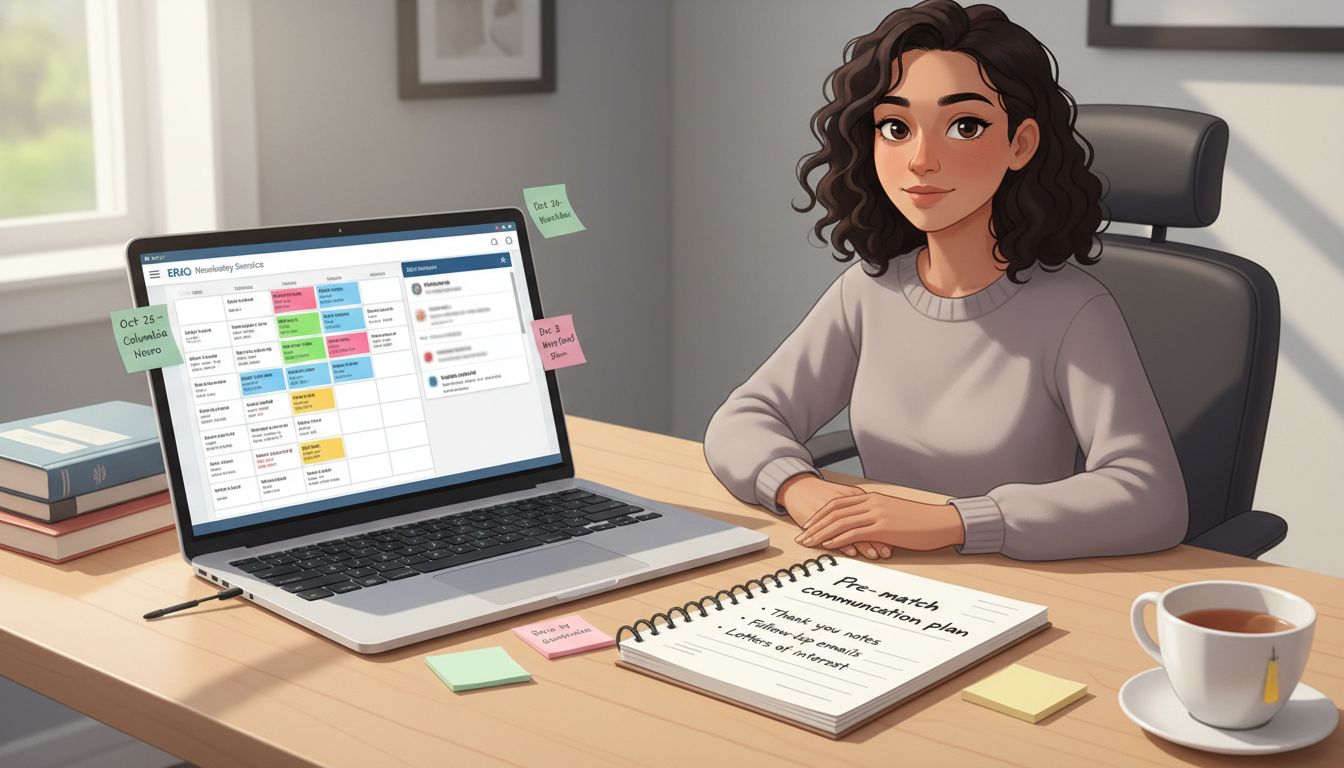
3. Rules, Ethics, and Red Lines: Staying NRMP-Compliant
Understanding what you can and cannot do is critical, especially around anything that looks like pre-match offers or early commitments.
3.1 NRMP and Match Communication Rules (Key Points)
While you should review the current NRMP Match Participation Agreement yourself, some practical takeaways:
Programs cannot:
- Require you to make a verbal or written commitment ahead of the Match
- Ask you how you will rank them versus other programs
- Make promises like “If you rank us #1, you are guaranteed to match here”
Applicants cannot:
- Ask programs to promise they will rank you in a specific position
- Try to negotiate a “contract” outside of the match for NRMP-participating spots
What is allowed:
- Programs may state that you are “ranked to match” or “very competitive for our program”
- You may tell a program you plan to rank them highly or #1
- Both sides may express interest, but no binding deals
3.2 How This Relates to “Pre-Match Offers” Now
In the current neurology residency world:
- Genuine pre-match offers for NRMP spots are essentially not allowed
- You may still experience strong language that sounds like an early commitment or pre-match:
- “We’re going to rank you very highly; if you rank us highly you’ll almost certainly match.”
- “We really want you here, you’d be perfect for us.”
Your response strategy:
- Stay gracious but non-committal unless you’ve truly decided.
- Never imply a ranking order that isn’t true.
- Keep decisions based on your goals, not pressure.
Example response if you feel pressured:
Thank you so much for your kind words and for the opportunity to interview. I really enjoyed learning more about your neurology program and could see myself thriving there. I’m still in the process of finalizing my rank list based on fit, training environment, and location, but your program is under strong consideration.
4. What to Say (and Not Say): Email Scripts and Communication Examples
This section provides practical wording for the most common scenarios DO neurology applicants face.
4.1 First Contact / Clarification Email (Before or Shortly After Applying)
Use this sparingly and only when needed. Here’s an example tailored for DO graduates:
Scenario: Confirming COMLEX and/or USMLE policy for a neurology residency program.
Subject: Question Regarding DO Applicants and COMLEX/USMLE – [Your Name]
Dear [Program Coordinator/Dr. Last Name],
I hope you are well. My name is [Your Name], a DO graduate from [Your School], applying to the upcoming neurology residency match. I am very interested in your program, particularly because of [1–2 specific reasons: strong EEG training, stroke exposure, friendly culture, etc.].
I wanted to clarify your policy regarding DO applicants and board examinations. I have taken [COMLEX Level 1/2, USMLE if applicable], and I want to ensure my application will be reviewed with these scores.
Thank you very much for your time and for any guidance you can provide.
Sincerely,
[Your Name], DO
AAMC/ERAS ID: [xxxx]
Keep it brief, specific, and respectful.
4.2 Post-Interview Thank-You Email
A short, pointed message is enough. You don’t need to send a note to every single interviewer if that feels forced, but writing to the PD and maybe a key interviewer is common practice.
Subject: Thank You – Neurology Interview on [Date]
Dear Dr. [Last Name],
Thank you for the opportunity to interview at [Program Name] on [date]. I enjoyed learning about your program’s approach to [something specific you heard—stroke care, neurocritical care, resident education, night float, etc.].
As a DO graduate with strong clinical neurology interests in [e.g., stroke, epilepsy, neurohospitalist medicine], I especially appreciated hearing how your residents gain early responsibility while maintaining strong mentorship.
I would be grateful for the opportunity to train at [Program Name] and will keep your program under serious consideration as I finalize my rank list.
Sincerely,
[Your Name], DO
AAMC/ERAS ID: [xxxx]
4.3 Update Letter (Scores, Publications, or Significant Changes)
Use sparingly and only when there is a meaningful update.
Subject: Application Update – [Your Name], Neurology Applicant
Dear [Program Coordinator/Dr. Last Name],
I hope you are well. I am writing to provide a brief update to my application for your neurology residency program.
Since submitting my ERAS application, I have:
- Received a score of [xxx] on [COMLEX Level 2 / USMLE Step 2 CK]
- [And/or] had a manuscript accepted for publication: “[Title]” in [Journal].
I remain very interested in [Program Name], particularly due to [brief tailored reason]. Thank you for your consideration of my application.
Best regards,
[Your Name], DO
AAMC/ERAS ID: [xxxx]
4.4 “You Are My #1” or “Very High on My List” Letters
Use these only when true, and typically only once for a #1 letter.
Option A – True #1 Rank Letter
Subject: Expression of Strong Interest – [Your Name]
Dear Dr. [Program Director],
Thank you again for the opportunity to interview at [Program Name]. After carefully considering my experiences and goals, I want to let you know that I intend to rank [Program Name] as my first choice on my rank list.
I was particularly drawn to [2–3 specific qualities: the collegial culture among residents and faculty, strong stroke service and neurocritical care exposure, commitment to DO trainees, etc.]. I believe your program offers the ideal environment for me to grow into a compassionate and competent neurologist.
I understand that the Match is binding for both programs and applicants, and I wanted to share my genuine enthusiasm and commitment to [Program Name].
Sincerely,
[Your Name], DO
Option B – “High On My List” Letter (if you’re not sure about #1)
Subject: Continued Interest – [Your Name]
Dear Dr. [Program Director],
I wanted to thank you again for the opportunity to interview at [Program Name]. After completing my interviews, I remain very enthusiastic about your neurology residency.
I was particularly impressed by [specific points: EEG training, resident autonomy, DO-friendly environment, mentorship structure]. I plan to rank your program highly on my list.
Thank you again for your time and consideration.
Sincerely,
[Your Name], DO
4.5 What You Should Never Say
Avoid wording that:
- Implies multiple programs are your #1
- Sounds like a transaction: “If you rank me to match, I will rank you #1.”
- Pressures programs: “I need to know where I am on your list before I rank you.”
Stick to: honest interest, specific reasons, and respect for the Match process.

5. Strategy for DO Neurology Applicants: How to Use Communication to Your Advantage
Pre-match communication won’t substitute for exam scores, letters, or clinical performance—but it can make a real difference at the margins, especially for DO graduates aiming for neurology.
5.1 Highlighting Your DO Strengths
In your emails and discussions, subtly reinforce the value you bring as a DO:
- Emphasize:
- Strong clinical performance and patient-centered care
- Exposure to diverse patient populations and community care
- Procedural comfort (e.g., lumbar punctures) if applicable
- Your adaptability and resilience (often seen in DO applicants balancing rotations, COMLEX/USMLE, research)
Example phrase for an interview or email:
As a DO graduate from [School], I’ve had extensive exposure to hands-on patient care, which I believe prepared me well for the demands of neurology residency, especially in high-acuity settings like stroke and neurocritical care.
5.2 Targeting Programs Wisely
When planning communication, understand that not every program weighs messages equally:
More responsive to communication:
- Community-based neurology residencies
- Former osteopathic neurology residency programs now under ACGME
- Mid-sized academic programs with a strong interest in DO graduates
Less influenced by communication:
- Very large, ultra-competitive academic centers
- Programs that openly state they rarely adjust ranks based on post-interview communication
Your time is limited. Focus your most personalized communication on:
- Programs where you are a realistic match candidate
- Places you would truly be happy to attend
- Programs where DOs have historically matched or where leadership is DO-friendly
5.3 Managing Neuro Match Anxiety and Expectations
You may hear stories from peers:
- “I matched at my top choice after telling them they were my #1!”
- “I never emailed anyone and still matched solidly!”
The reality:
- Programs use a complex ranking strategy; your email is just one data point
- You cannot “game” the system by over-emailing
- You can absolutely hurt your brand by being pushy, unprofessional, or inauthentic
Your goal:
Use communication to reinforce what your application already says—motivated, thoughtful, mature, and genuinely interested in neurology.
6. Handling Tricky Situations and Common Scenarios
6.1 If a Program Says, “You’re Ranked to Match”
This is a positive signal but not a contract. Possible responses:
Thank you so much for your kind words and for updating me. I really enjoyed my interview day and am strongly considering [Program Name] as I finalize my rank list.
Do not:
- Ask, “What exact number am I on your list?”
- Take this as a guarantee—other applicants’ rank lists can change the outcome.
6.2 If You Receive Confusing or Vague “Early Commitment” Language
Example:
“We hope you rank us highly; if you do, I’m confident it will work out.”
Your response can be:
I appreciate your encouragement and the time you and your team have invested in getting to know me. I was very impressed with [specific detail], and I’ll be giving serious consideration to [Program Name] as I complete my rank list.
Then decide your ranking independently based on:
- Fit
- Training quality
- Location/support system
- Long-term career goals (fellowship opportunities, academic vs. community)
6.3 If You Have a Red Flag (Score, Leave, Failure) and Need to Communicate
For example, a failed COMLEX or USMLE attempt, a leave of absence, or professionalism concern.
- Before interviews:
Usually, you should address this in your personal statement or a note to PD if necessary. - After interviews:
If it came up, a brief follow-up may help, showing insight and growth.
Thank you again for discussing my [issue] so openly during the interview. I appreciated the chance to explain the circumstances and the steps I’ve taken since then, including [specific remediation, success, or growth]. I remain confident in my readiness to meet the demands of neurology residency.
6.4 If You Get No Responses to Emails
If you’ve sent a thank-you note or a single update and receive no reply:
- Assume the message was received
- Do not keep resending or ask, “Did you get my email?”
- Many PDs and coordinators are inundated; lack of response is not a negative signal
You’ve done your part by communicating once clearly and professionally.
FAQs: Pre-Match Communication for DO Neurology Applicants
1. As a DO graduate, do I need to communicate more aggressively to match into neurology?
No. Being a DO does not mean you should email more often or more intensely. What you need is strategic, high-quality communication—clear, respectful, and focused on programs where you are realistically competitive and genuinely interested. Over-communication can hurt more than help. Your core strength remains your application: rotations, letters, scores (COMLEX and/or USMLE), and fit.
2. Can pre-match communication change my chances of matching into a specific neurology program?
It can help at the margins. A thoughtful thank-you message or clear expression of interest can:
- Make you more memorable to the PD or faculty
- Reassure them you would come if ranked to match But it will not override serious concerns (low clinical performance, lack of interest, unprofessional behavior). Think of communication as “fine-tuning,” not “rescuing” your application.
3. Is it okay to tell more than one program they are my #1 choice?
Ethically, no. You should only tell one program they are your true #1, and only if you mean it. Programs and PDs talk; being caught in a lie will damage your reputation. If you like multiple programs, you can tell them they are “high” on your list without claiming they are your top choice.
4. How different is pre-match communication for neurology compared to other specialties?
Neurology sits somewhere in the middle:
- It’s not as rigid or protocol-driven in communication norms as some surgical subspecialties.
- But it is academically oriented enough that professionalism and authenticity are crucial. For DO applicants, neurology offers many programs that are DO-friendly and open to COMLEX scores, but your communication strategy—targeted, respectful, and honest—remains fundamentally similar to other medical specialties.
By understanding the rules, using thoughtful communication, and staying grounded in integrity, you can navigate pre-match communication in the neurology residency process as a DO graduate with confidence—and without compromising your ethics or your sanity.