
Understanding Pre-Match Communication in Emergency Medicine
For a non-US citizen IMG aspiring to match into emergency medicine, “pre-match communication” can feel mysterious and risky. You may worry: How much should I email programs? Am I allowed to say I’ll rank them #1? Can I ask about pre-match offers or early commitment? Will I hurt my chances by saying the wrong thing?
In emergency medicine—where programs are busy, decisions are fast, and your immigration status adds complexity—strategic communication before the Match is critical. Done well, it can:
- Clarify whether programs sponsor visas
- Keep you on a program’s radar
- Signal serious interest without crossing ethical lines
- Help you interpret subtle signals about your position on their rank list
Done poorly, it can appear pushy, unprofessional, or even make programs uncomfortable.
This guide will walk you through a structured, ethical, and practical approach to pre-match communication as a non-US citizen IMG applying to emergency medicine residency in the US. It will focus on typical NRMP Match processes (where “pre-match offers” are rare in EM) but also address early commitment and communication nuances relevant to foreign national medical graduates.
1. The Rules and Realities: Pre-Match Communication vs. Pre-Match Offers
Before deciding how to communicate, you must understand what is allowed and what programs are actually doing in EM.
1.1 Key Definitions
Pre-match communication
Any contact between you and a residency program before Rank Order Lists are due (emails, thank-you notes, updates, preference signals, interest letters, phone calls).Pre-match offers / early commitment
Informal or formal agreements to offer a position outside the NRMP Match, or strong “wink-wink” suggestions that you are guaranteed a spot if you rank a program first.- These are rare in ACGME-accredited emergency medicine residency programs that participate in the NRMP Match.
- Most US EM programs fill positions entirely through the Match, not via pre-match contracts.
Program communication before Match
Includes:- Invitations to interview
- Interview-related messages
- Expressions of interest (e.g., “We will rank you highly,” “We enjoyed meeting you”)
- Follow-up questions from either side
1.2 The NRMP and Ethical Rules You Must Know
While you should review NRMP rules yourself, these core principles apply:
No binding commitments before the Match:
Programs and applicants must not make binding commitments about ranking (“If you rank us #1, you’re guaranteed to match here”).You may express preferences honestly:
You can say:- “You are my top choice.”
- “I plan to rank your program highly.” But you must be honest and avoid claiming multiple programs are your absolute #1.
Programs can express interest but not make guarantees:
They may say:- “We intend to rank you highly.”
- “We would love to work with you.” But they should not say:
- “We guarantee you a spot if you rank us first.”
No pressure or coercion:
Programs cannot pressure you to reveal your rank list or to commit to them in exchange for a presumed Match advantage.
For a non-US citizen IMG, this means:
- You should not ask for a “pre-match contract” in EM.
- You can communicate genuine interest clearly and professionally.
- You must avoid misrepresenting your intentions or immigration status.
2. Strategy Timeline: What to Communicate and When
Your pre-match communication strategy should evolve as the season progresses. Below is a timeline tailored for a foreign national medical graduate applying to emergency medicine residency.

2.1 Before ERAS Opens and Early Season (Preparation Phase)
Goals:
- Build a targeted program list that realistically sponsors your visa type.
- Prepare your communication templates and information.
Actions:
Research visa policies thoroughly.
For each EM program:Check if they sponsor J-1 and/or H-1B visas.
Look at prior residents’ backgrounds (many websites list their med schools; look for other IMGs/foreign national medical graduates).
If unclear, you may send one short, focused email to the program coordinator:
Example:
- “I am a non-US citizen IMG requiring J-1 visa sponsorship. Does your emergency medicine residency program sponsor J-1 visas and consider IMGs for categorical positions?”
Prepare email templates:
- Polite initial inquiry template (for visa/program questions)
- Thank-you email template (post-interview)
- Update letter template (for later in the season)
- “Top choice” / preference letter template (for one individual program, if you decide to send such a letter)
Clarify your own boundaries:
- Decide your preferred region, visa type, and program size.
- Determine whether you’re willing to move for 3–4 years for a program that sponsors your visa reliably.
2.2 After Applications Are Submitted but Before Interviews
Goals:
- Confirm that your application is complete.
- Avoid spamming programs or appearing desperate.
Actions:
Minimal pre-interview outreach.
Emergency medicine receives many applications; overly aggressive messaging can backfire. Appropriate reasons to contact a program at this stage:- You realized a critical error in your application (wrong USMLE transcript, missing document).
- You have new, major achievements (new publication, US clinical experience in EM, upgraded Step scores) and want to ensure they are seen.
Targeted, concise emails only.
For a non-US citizen IMG, communication is especially justified if:- The program’s website is unclear about visa sponsorship.
- You completed a Sub-I or EM rotation there and want to briefly reiterate interest (but only once).
2.3 During Interview Season
Goals:
- Make a professional impression.
- Clarify any uncertainties, especially regarding visas, support for non-US grads, and EM training culture.
- Lay the groundwork for ethical post-interview communication.
Actions:
On interview day: Ask targeted questions.
Good questions for a foreign national medical graduate:- “How many non-US citizen IMGs are currently in your program?”
- “Can you describe your experience sponsoring J-1/H-1B visas in recent cycles?”
- “Are there any challenges with starting on time for IMGs because of visa processing?”
Take detailed notes.
Immediately after each EM interview:- List 3–5 specific things you liked (curriculum, simulation, ultrasound, trauma exposure, wellness structure, IMG support).
- Note anything that seemed unclear or concerning (visa logistics, board pass rates, off-service rotations).
These notes will power your later personalized thank-you emails and preference statements.
2.4 After Each Interview: Thank-You Emails
Goals:
- Demonstrate professionalism.
- Reinforce your interest.
- Keep your name and face connected in the program’s memory.
Timing: Within 24–72 hours after the interview.
Content guidance:
- Subject: “Thank you – [Your Name], EM Interview on [Date]”
- Body:
- 1–2 sentences thanking them for their time.
- 2–3 specific things you appreciated (e.g., ultrasound training, trauma experience, inclusive culture, support for IMGs).
- 1 line reiterating your interest.
- Brief, professional closing.
Example (for a non-US citizen IMG):
Dear Dr. Smith,
Thank you for the opportunity to interview with the [Program Name] Emergency Medicine Residency on [date]. I especially appreciated learning about your simulation-based resuscitation curriculum and the support you provide to non-US citizen IMG residents navigating visa and relocation challenges.
The combination of high-acuity clinical exposure and the welcoming culture I observed makes your program a very attractive option for my EM training.
Best regards,
[Your Full Name]
AAMC ID: [#######]
Avoid:
- Mentioning rank order at this stage.
- Asking for special treatment.
- Repeating your CV in detail.
2.5 Late Interview Season: Updates and Expressions of Interest
Goals:
- Provide meaningful updates.
- Signal genuine interest to a small number of programs you’re seriously considering ranking highly.
When to send an update:
- You have substantial, new information, such as:
- New EM publication or presentation.
- Strong new SLOE or US EM rotation.
- Significant score or visa status change.
- Or it’s been several weeks since your interview and you have a clear, sincere message of interest (especially if the program is in your top tier).
What to include:
- Brief re-introduction (who you are, when you interviewed).
- Short description of major updates (1–3 bullets).
- Clear, professional sentence about your continuing interest in their EM program.
3. Communicating Interest Ethically: “Top Choice” and Preference Letters
One of the most confusing aspects of pre-match communication in EM is whether you should tell a program they are your #1 choice.
3.1 Should You Tell a Program You Will Rank Them #1?
For many non-US citizen IMGs, a single visa-sponsoring EM program in a supportive environment can be life-changing. If you have a true top choice, it is appropriate and ethical to tell them:
- Only if it is actually true.
- Only once (do not tell multiple programs they are #1).
A sincere “top choice” message may slightly increase the chance that the program will rank you favorably, but:
- There are no guarantees.
- It should not change your own rank list strategy: Always rank programs in your true order of preference, regardless of what they say.
3.2 How to Phrase a “Top Choice” or “High Interest” Message
“You are my top choice” letter (use only once):
Dear Dr. [PD Name],
Thank you again for the opportunity to interview with the [Program Name] Emergency Medicine Residency on [date]. Since our conversation, I have reflected carefully on what I seek in a training program as a non-US citizen IMG.
I am writing to let you know that [Program Name] is my top choice, and I plan to rank your program first. The combination of your strong emergency ultrasound training, commitment to high-acuity care, and demonstrated support for international graduates aligns perfectly with my goals. I would be honored to train as an emergency medicine resident in your program.
Regardless of the outcome in the Match, I remain deeply grateful for the chance to learn more about your program.
Sincerely,
[Your Full Name]
AAMC ID: [#######]
“I will rank you highly” (for other strong programs):
Dear Dr. [PD Name],
I wanted to thank you again for my interview at [Program Name] Emergency Medicine on [date]. The opportunity to care for a diverse, high-acuity patient population and the supportive, collegial culture among residents left a strong impression on me.
As I finalize my rank list, I wanted to let you know that I remain very interested in your program and intend to rank [Program Name] highly.
Thank you again for your consideration.
Best regards,
[Your Full Name]
AAMC ID: [#######]
3.3 What Not to Do in Preference Communication
Avoid:
- Dishonesty: Do not tell more than one program they are your #1.
- Pressure: Do not imply they should rank you highly because of your message.
- Desperation: Avoid phrases like “I have no other options” or “Please accept me.”
- Over-communication: One thoughtful message is better than multiple repetitive emails.
4. Visa, Status, and the Special Concerns of Non-US Citizen IMGs
As a non-US citizen IMG, your pre-match communication must also clarify technical and logistical concerns that US graduates don’t face.
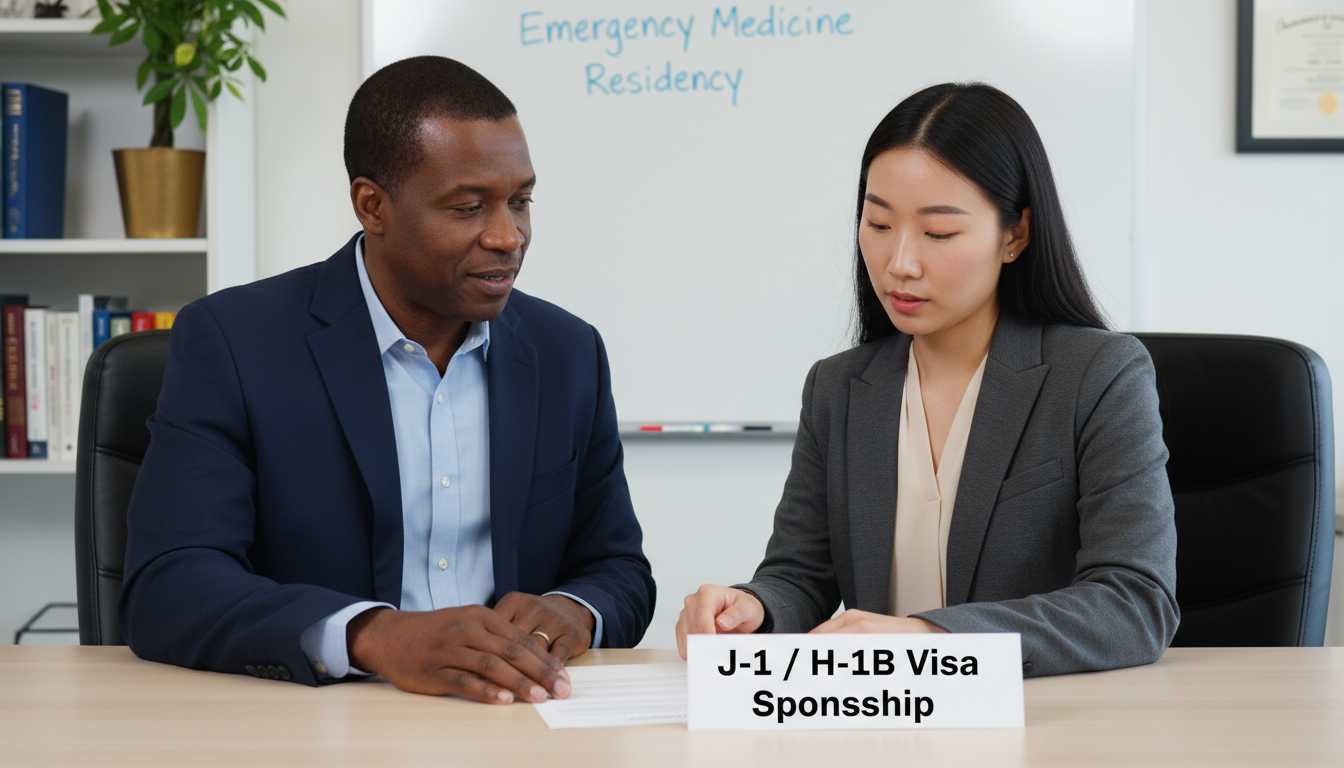
4.1 Clarifying Visa Sponsorship Without Overwhelming Programs
You should not send long emails about visa law or your immigration history. Instead, keep it concise.
When to ask about visas:
- Before applying, if it’s unclear whether they sponsor J-1/H-1B.
- During your interview day or in a short follow-up email, if the information remains unclear.
Sample concise question (pre-application or pre-interview):
I am a non-US citizen IMG currently on [visa type / abroad] and will require [J-1 / H-1B] sponsorship to begin residency in July [year]. Could you please confirm whether your program sponsors this visa type for incoming PGY-1 categorical residents in emergency medicine?
4.2 Handling Complex Immigration Situations
If your situation is more complex (e.g., change of status from F-1 to J-1, pending green card, gap between graduation and Match):
- Avoid overwhelming the program with long legal explanations.
- Clarify the bottom line:
- What visa you expect to be on at residency start.
- Whether it is a standard category (J-1, H-1B).
- If needed, ask your future program to connect you with their GME or international office after you match, not before.
4.3 What Programs Worry About with Non-US Citizen IMGs—and How to Address It
Programs may quietly worry about:
- Visa delays preventing a July 1 start.
- Complex paperwork with H-1B or change of status.
- Exam or language readiness for busy ED environments.
You can indirectly address these concerns by:
- Demonstrating organized, timely communication.
- Showing strong US clinical EM experience and SLOEs.
- Highlighting USMLE performance, particularly Step 2 CK.
- Speaking clearly and confidently during interviews.
You do not need to oversell or apologize for your status; simply show that you understand the timeline and are prepared.
5. Interpreting Program Signals and Responding Wisely
As Rank List deadlines approach, some applicants receive mixed messages:
- “We’re ranking you highly.”
- “We really hope you match here.”
- Silence, despite believing the interview went well.
5.1 What Positive Signals Usually Mean—And Don’t Mean
When a program says:
- “We will rank you highly.”
- “You are very competitive here.”
- “We hope to work with you.”
It could mean:
- They genuinely liked you.
- You are somewhere in the upper or middle portion of their rank list.
But it does not guarantee:
- That you will match there.
- That you should move them to #1 solely because of their message.
For the EM match, most programs rank many more candidates than they have spots. A positive sign is good, but it is not a contract.
5.2 When Programs Are Silent
Silence does not automatically mean:
- You are low on their list.
- You did something wrong.
Many programs—especially in busy EM departments—simply don’t have time to send many personalized messages. For a non-US citizen IMG, this can be anxiety-provoking, but your strategy remains:
- Rank programs by your true preference, not by how much they email you.
- Use your own judgment based on interview-day experiences, resident interactions, and program characteristics.
5.3 Responding to Program Messages
If you receive a positive email from a program:
- Reply once, briefly and professionally.
- Do not over-promise unless they really are your top choice.
Example:
Dear Dr. [PD Name],
Thank you very much for your message and for your consideration of my application. I truly enjoyed interviewing at [Program Name] and would be excited to join your emergency medicine residency team if I am fortunate enough to match there.
Sincerely,
[Your Name]
If they are your genuine #1 and you haven’t yet sent a “top choice” message, you can add that carefully (as discussed earlier).
6. Putting It All Together: Practical Do’s and Don’ts for Pre-Match Communication
To close, here is a consolidated checklist tailored to a non-US citizen IMG targeting emergency medicine residency:
6.1 Do
- Research visa policies early and prioritize EM programs that have clearly trained IMGs/foreign national medical graduates on J-1 or H-1B.
- Prepare professional templates for:
- Visa inquiries
- Thank-you emails
- Update letters
- Preference messages
- Send focused, specific thank-you emails after each interview.
- Provide meaningful updates (new SLOEs, publications, rotations) only when they truly add value.
- Honestly tell one program if they are your true #1 and you plan to rank them first.
- Rank programs by your genuine preference, not by perceived likelihood of matching or the volume of emails you receive.
- Communicate clearly and concisely about your visa needs, without long legal explanations.
- Maintain professionalism in every interaction—every email and call is part of your application.
6.2 Don’t
- Don’t request pre-match offers or contracts in EM programs that participate in the NRMP Match.
- Don’t email programs repeatedly or with trivial updates.
- Don’t misrepresent your intentions (e.g., telling multiple programs they are your #1).
- Don’t pressure programs to reveal where they will rank you.
- Don’t share your exact rank list with programs or ask them for theirs.
- Don’t apologize excessively for being a non-US citizen IMG; instead, show preparedness and professionalism.
- Don’t let fear about the EM match push you into unethical or desperate-sounding communication.
FAQs: Pre-Match Communication for Non-US Citizen IMGs in Emergency Medicine
1. As a non-US citizen IMG, can I ask an emergency medicine program for a pre-match offer or early commitment?
In almost all ACGME-accredited emergency medicine residencies that participate in the NRMP Match, no. These programs fill their positions through the Match. Asking for a pre-match offer can signal that you do not understand the process. Instead, focus on ethical pre-match communication: thanking programs, updating them with new achievements, and honestly expressing your interest and preferences.
2. How many emails is too many when communicating with EM programs before the Match?
A general safe pattern:
- 1 pre-interview email only if necessary (visa clarification or critical application fix).
- 1 thank-you email per interview.
- 1 substantive update if you have significant new information.
- 1 preference message to your true top program (and possibly brief “rank you highly” messages to a few others).
Beyond this, additional emails often add risk without benefit. Quality matters more than quantity.
3. Will telling a program they are my top choice significantly increase my chance of matching there?
It can help at the margins if the program is deciding how high to rank you among similar candidates, but it does not guarantee anything. Programs must balance many factors (class diversity, performance metrics, SLOEs, interview impressions). Use such a message sparingly, honestly, and professionally, and still rank programs based on your true preference order.
4. Should I explain my entire visa and immigration history in my emails to EM programs?
No. Programs need to know what visa you will likely require at the start of residency and whether they can sponsor it. Keep it simple:
- State that you are a non-US citizen IMG.
- Specify whether you will require J-1 or H-1B at residency start.
- Ask if they sponsor that visa type for EM residents.
Only go into more detail if a program specifically requests it or once you have matched and are working with their GME office.
By approaching pre-match communication strategically—grounded in integrity, clarity, and professionalism—you can navigate the EM match as a non-US citizen IMG with confidence. Thoughtful emails will not replace strong scores, SLOEs, and interviews, but they can reinforce a positive impression and help you and programs find the best possible fit.