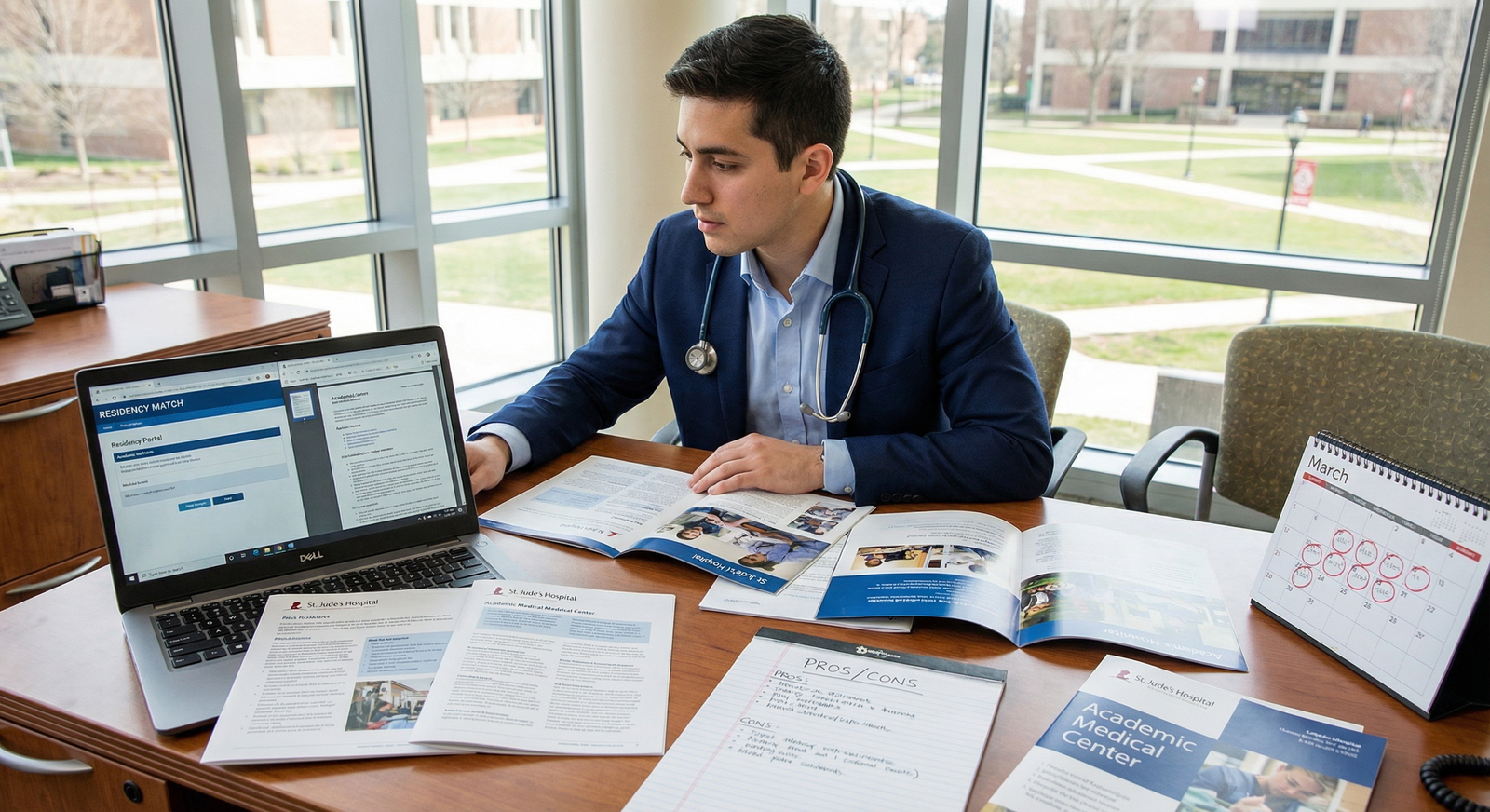
Pre-match communication is one of the least understood—and most anxiety-provoking—parts of the residency application process. Between rumors on student forums, myths passed down from upperclassmen, and vague program emails, it can be hard to know what is appropriate, what actually helps, and what might hurt your chances.
This guide breaks down everything you need to know about pre-match communication, from first contact through potential pre-match offers and early commitment conversations. You’ll learn what to say (and what not to say), how to time your messages, and how to stay ethical and professional while still advocating for yourself.
Understanding Pre-Match Communication: What It Is—and Isn’t
Pre-match communication refers to any interaction between you and a residency program that occurs before the Rank Order List (ROL) certification deadline—and, in some specialties and locations, before a formal pre-match offer. It includes:
- Emails from you to programs (updates, letters of intent, thank-you messages)
- Emails/calls from programs to you (expressing interest, signaling rank intentions)
- Conversations on interview day (or at second looks, virtual or in-person)
- Informal networking at conferences or through mentors
- In some systems (e.g., Texas pre-match or certain non-NRMP programs): pre-match offers or discussions of early commitment
Just as important is what pre-match communication is not:
- It is not an opportunity to negotiate a contract (except in specific pre-match systems outside NRMP)
- It is not a way to “force” a program to rank you higher than they otherwise would
- It is not a substitute for a strong application, solid interview performance, and well-researched rank list
The NRMP Rules You Need to Know
If you are participating in the NRMP Match, there are clear guidelines (the Match Participation Agreement) that govern program communication before match:
- Programs cannot ask you how you intend to rank them.
- You cannot ask programs how they intend to rank you.
- Both sides may express interest (e.g., “You are ranked highly on our list,” “Your program is my top choice”), but any statements are not binding.
- Any attempt to pressure an applicant to reveal rank intentions, or to offer guaranteed spots in the NRMP Match outside of the official process, violates NRMP policy.
Understanding these rules helps you respond confidently if you encounter inappropriate questions or pressure. You can always redirect by saying:
“I’m still finalizing my rank list and plan to follow the NRMP guidelines, but I’m very interested in your program and appreciate the opportunity to interview.”
Pre-Match Offers vs. General Pre-Match Communication
You will see the phrase pre-match offers used in two distinct ways:
Formal pre-match systems (e.g., some Texas MD/DO programs outside the NRMP Match, certain military or independent programs):
- Programs can extend a binding offer before Match Day.
- If you accept, you are committed to that program and usually withdrawn from the Match for that specialty.
Informal “pre-match” interest within NRMP:
- Programs may say things like “We plan to rank you very highly” or “We hope to see you here next year.”
- These are not actual offers and are not binding for either side.
- You still submit a rank list, and the algorithm determines the outcome.
This article focuses on communication in both contexts: how to manage early commitment conversations in true pre-match systems and how to navigate program communication before match in the standard NRMP process.
Types of Pre-Match Communication and How to Handle Them

Pre-match communication typically falls into three broad categories: your outreach to programs, program outreach to you, and ongoing relationship-building via mentors or networking.
1. Your Outreach to Programs
These are messages you initiate, usually via email. Common reasons to reach out include:
- Expressing strong interest in a program
- Providing application updates (new publications, Step/COMLEX scores, honors)
- Clarifying logistics (interview, second look, away rotations)
- After-interview communication (thank-you notes, letters of interest/intent)
A. Before Interview Season: When (and When Not) to Email
Useful situations to email before interviews:
Signal meaningful interest:
- You have a genuine, specific reason for interest (geographic ties, research fit, unique program feature).
- You are from an “underrepresented” region for that program and want to appear on their radar.
Update a significant application change:
- New Step 2 / Level 2 score if it strengthens your application.
- Major publication or significant award.
Less useful, or potentially counterproductive:
- Mass, generic “I’m very interested in your program” emails sent to dozens of programs.
- Asking for an interview directly in a way that pressures or guilt-trips the program.
Practical template – Pre-interview interest/update email
Subject: Application Update and Continued Interest – [Your Name], [AAMC ID / ERAS ID]
Dear Dr. [Program Director Last Name] and the [Program Name] Residency Selection Committee,
I hope this message finds you well. My name is [Your Name], a fourth-year medical student at [Your School]. I recently applied to the [Specialty] residency program at [Program Name] and wanted to share a brief update and reiterate my strong interest.
Since submitting my application, I [received a Step 2 CK score of ___ / had a manuscript accepted in ___ / received the ___ award]. This experience further confirmed my interest in [specific aspect of the specialty or program, e.g., academic general pediatrics, underserved care, trauma surgery].
I am particularly drawn to [Program Name] because of [1–2 concrete reasons – e.g., your emphasis on resident autonomy in a safety-net setting, your global health track, your strong mentorship in clinician-educator careers]. Having grown up in [relevant geographic tie] and with family in [city/region], I am especially excited by the prospect of training in [location].
Thank you for your time and for considering my application. I would be grateful for the opportunity to interview with your program.
Sincerely,
[Your Full Name]
[Medical School, Class of ____]
[AAMC/ERAS ID]
Keep it short (under ~250 words), specific, and professional.
B. After the Interview: Thank-You Notes and Letters of Interest
Programs widely differ on how much they value post-interview communication. Still, thoughtful, concise messages can reinforce fit and interest.
Thank-you emails:
- Best sent within 24–72 hours.
- Individualized to highlight something specific you discussed or learned.
- Short is better (3–6 sentences).
Template – Thank-you email
Dear Dr. [Interviewer Last Name],
Thank you for taking the time to speak with me during my interview at [Program Name] on [date]. I appreciated our conversation about [specific topic – e.g., resident research support in quality improvement, your approach to teaching at the bedside, your work with refugee populations].
Our discussion reinforced my impression that [Program Name] offers the kind of [community, mentorship, academic environment, operative experience] I am seeking for residency. I would be excited to contribute to your program’s [specific project/mission if applicable].
Thank you again for your time and consideration.
Best regards,
[Your Name]
Letters of interest vs. letters of intent:
- Letter of interest: expresses enthusiasm and strong consideration; you might send this to several programs.
- Letter of intent: clearly states that a program is your first choice and that you plan to rank them #1.
Use a letter of intent only when:
- You are genuinely committed to ranking that program first.
- You understand it is not binding but it is an ethical commitment on your part.
- You plan to send this to one program only.
2. Program Outreach to You
Programs may contact you in various ways before match:
- “We enjoyed meeting you and think you’d be a great fit.”
- “You will be ranked to match” or “We intend to rank you highly.”
- Invitations to second-look visits or additional conversations with faculty/residents.
- In formal pre-match systems: pre-match offers describing early commitment terms.
Decoding Common Program Phrases
Programs are often intentionally vague to avoid NRMP violations and to preserve flexibility in their rank lists. Rough, non-official interpretations:
“We enjoyed meeting you and think you’d be a great fit.”
→ You interviewed well; they’re leaving the door open but making no promises.“You will be ranked to match.”
→ Strong expression of interest, but still not guaranteed. Their list may change; they may say this to more candidates than they can ultimately match.“You are among our top applicants.”
→ You are competitive there, but exact rank position is unknown.
Whenever you receive such messages, thank them, express appreciation and interest if it is genuine, but do not alter your entire strategy based solely on one email.
Example response:
Dear Dr. [PD Last Name],
Thank you very much for your kind message and for the opportunity to interview at [Program Name]. I truly enjoyed meeting the residents and faculty and learning more about [specific program feature].
I remain very interested in [Program Name] and will be giving your program serious consideration as I finalize my rank list. I appreciate your time and support.
Sincerely,
[Your Name]
Remain non-committal unless you are sending a deliberate letter of intent.
3. Mentor-Mediated and Network Communication
Faculty mentors, away rotation supervisors, and research advisors can often help with program communication before match:
- They may email colleagues at your target program to advocate for you.
- They can give you realistic feedback about the strength of your application.
- They can clarify how a particular program interprets pre-match offers or communicates interest.
Actionable steps:
- Provide your mentor with an updated CV and short “brag sheet” (bullet points of key strengths and experiences).
- Be explicit about which programs are top priorities and why.
- Ask if they feel comfortable reaching out on your behalf; never pressure them.
This type of behind-the-scenes communication can be more influential than any email you send yourself.
Early Commitment and Pre-Match Offers: Strategy and Decision-Making

In some systems and specialties, pre-match offers and early commitment decisions are a formal part of recruitment. Understanding how they work—and whether you should accept—is critical.
Where Pre-Match Offers Commonly Occur
- Texas (historically through the TMDSAS/Texas Match): Some programs used non-NRMP or early offer systems, although policies evolve; always check current year rules.
- Military residencies: Often use separate match systems and may involve early selection.
- Certain independent or non-NRMP programs (e.g., some advanced or specialty programs): May recruit and contract directly with applicants.
- International systems (e.g., some Canadian or other national matches): May have different timelines and offer structures.
Always confirm with your dean’s office or official match websites what rules apply in your year and specialty.
What a Pre-Match Offer Typically Includes
A true pre-match offer usually spells out:
- The specific position and start year
- Program name and track (categorical, advanced, preliminary)
- Conditions (e.g., passing certain exams, graduation, visa constraints)
- Instructions for formal acceptance and whether it withdraws you from other match processes
If the language is vague (“We’d really like you to come here, and if you tell us now we can take you off the interview trail”), ask for clarification in writing. If you are in the NRMP Match, binding acceptance of a position outside NRMP may be a violation—unless the program is explicitly outside or exempt from the Match.
Questions to Ask Yourself Before Accepting an Early Commitment
Deciding on a pre-match offer is a major career choice. Consider:
If I went through the full Match, is this realistically the kind of program I’d hope to match at—or better?
- Are you accepting from a position of strength or fear?
Does this program align with my long-term goals?
- Academic vs. community practice
- Fellowship aspirations
- Geographic and family considerations
How competitive am I in this specialty overall?
- If you’re strong and broadly competitive, early commitment may “cap your upside.”
- If your application is at higher risk (exam failures, few interviews, major red flags), an early secure spot may be very smart.
What are the specific terms and consequences?
- Are you withdrawn from the main Match entirely or only for this specialty?
- What happens if you later change your mind?
How to Respond to a Pre-Match Offer
If you receive a clear pre-match offer:
Acknowledge promptly.
- Thank them and express appreciation.
- Let them know you take the offer seriously and need a brief period to decide.
Ask for a decision deadline.
- Often 24–72 hours, sometimes longer.
- This sets clear expectations and gives you permission to think.
Consult mentors and your dean’s office.
- They can help assess the program’s reputation, your competitiveness, and match rules.
Sample response acknowledging an offer:
Dear Dr. [PD Last Name],
Thank you very much for your generous offer to join the [Program Name] [Specialty] residency. I am honored by your confidence in me and very appreciative of the opportunity.
This is an important decision, and I would like to take a short amount of time to consider it carefully and speak with my family and mentors. Would it be possible to have until [specific date, usually within a few days] to provide you with a final answer?
Thank you again for your consideration and for the opportunity to train at [Program Name].
Sincerely,
[Your Name]
If you decide to accept, confirm explicitly in writing, and clarify any next steps (paperwork, withdrawal from other matches). If you decline, do so graciously and respectfully—medicine is a small world.
Professionalism, Ethics, and Staying Within the Rules
Pre-match communication sits at a sensitive intersection of honesty, advocacy, and policy. How you handle it reflects on your professionalism.
Key Ethical Principles
Honesty in your statements.
- Do not tell multiple programs “You are my first choice” or send multiple letters of intent claiming they’re #1.
- Do not imply you will rank a program highly if you already know you won’t.
Respect boundaries.
- Follow NRMP rules: don’t ask about rank lists, don’t share your exact rank order with programs.
- If a program asks you directly how you will rank them, gently redirect.
No coercion or quid pro quo.
- You should never promise to do additional unpaid work, donate, or offer anything in exchange for a higher rank.
Handling Inappropriate or Uncomfortable Communication
If a program:
- Asks you to reveal your rank list
- Suggests that you must rank them first to remain ranked
- Makes you feel pressured into an early commitment
You can respond with:
“I understand the importance of finding a good mutual fit. I plan to follow NRMP guidelines and will finalize my rank list closer to the deadline, but I truly enjoyed your program and appreciate your consideration.”
If behavior clearly violates policies or feels unethical, discuss it with your dean’s office or advisor. They can guide you on whether to report it to the NRMP or handle it informally.
Common Myths About Pre-Match Communication
Myth: “If I don’t send a letter of intent, programs will think I’m not interested.”
Reality: Many programs either don’t weigh these letters heavily or are skeptical of them. A solid interview plus genuine but not overbearing follow-up is enough.Myth: “Programs decide their rank list entirely based on who emails them the most.”
Reality: Communication can reinforce interest, but performance, application strength, and perceived fit matter far more.Myth: “If a program says I’m ranked highly, I am guaranteed to match there.”
Reality: Nothing is guaranteed until Match Day—always create a thoughtful, honest rank list that reflects your true preferences.
Practical Communication Timeline and Strategy
To keep things manageable, think about your communication in phases.
Phase 1: Before Interview Invitations
Focus on:
- Building your core application (ERAS, personal statement, letters).
- Strategic, limited outreach to a small number of priority programs:
- Clear geographic ties
- Strong research/interest alignment
- Special program features you deeply value
Goal: Raise your visibility slightly at programs where you are a particularly good match—not to blanket-email everywhere.
Phase 2: During Interview Season
Key actions:
Send individualized thank-you emails after interviews.
Keep a spreadsheet of:
- Interview dates
- People you met
- Specific pros/cons
- Any program messages expressing interest
Use this period to ask clarifying questions:
- Call schedule realism
- Moonlighting, fellowship match rates, research opportunities
- Support for parental leave, wellness, visas
Do this respectfully—coordinators and PDs are busy, but most are happy to answer focused questions.
Phase 3: Post-Interview, Pre-Rank List
This is when program communication before match intensifies.
Your strategy:
Identify your top tier of programs (e.g., top 3–5).
Consider sending:
- A single letter of intent (if you have a clear #1).
- Short, sincere letters of interest to a few others expressing strong consideration.
Avoid:
- Weekly emails checking in.
- Fishing for information about your rank position.
Make it clear in your mind: communication may inform your rank decisions, but your list should be based on genuine preferences about training environment, not flattery from programs.
Phase 4: If You Are in a Pre-Match Offer System
Layer onto the above:
- Be mentally prepared for the possibility of early offers.
- Before the season starts, discuss with mentors:
- “At what level program would I be comfortable saying ‘yes’ early?”
- “When would it be better to wait for the main Match?”
If an early commitment opportunity arises, you’ll already have a framework for deciding, rather than reacting from panic or flattery.
Frequently Asked Questions (FAQ)
1. Should I tell a program they are my first choice?
Yes, but only if it’s true and you mean it. A single letter of intent to your genuine first-choice program can be appropriate. However:
- It is not binding for either party.
- It doesn’t guarantee a match.
- Sending this to multiple programs is unethical and may backfire.
If you’re unsure who your #1 is, you can send letters of interest instead, expressing strong enthusiasm without promising a rank position.
2. How many emails is “too many” to a program?
As a rough guideline:
- 1 pre-interview update/interest email (if you have something meaningful to say)
- 1 thank-you email per interviewer
- 1 post-interview letter of interest or intent (if applicable)
Beyond that, repeat “just checking in” messages rarely help and may become annoying. If you have a major new update (new publication, exam score), it’s reasonable to send a concise message, but don’t email programs monthly.
3. If a program tells me I am “ranked to match,” can I rely on that?
You should take it as a strong expression of interest, not a guarantee. Programs may:
- Change their rank lists based on late-breaking information.
- Tell more applicants “ranked to match” than they can actually match.
Use the information to feel more confident that they like you, but still build your rank list purely in order of your true preferences.
4. Can pre-match communication actually hurt my chances?
Yes, if it is:
- Dishonest (e.g., telling multiple programs they are your #1)
- Excessive or demanding (repeated emails, pressure for feedback)
- In violation of NRMP rules (asking about your exact rank position)
On the other hand, polite, concise, thoughtful communication rarely hurts—and can help reinforce your fit and professionalism.
By understanding the landscape of pre-match communication—what’s appropriate, what’s helpful, and what’s risky—you can navigate this phase of the residency process with confidence. Focus on clear, honest messaging; respect the boundaries of the Match; and let your true program preferences, not anxiety or flattery, guide your final decisions.