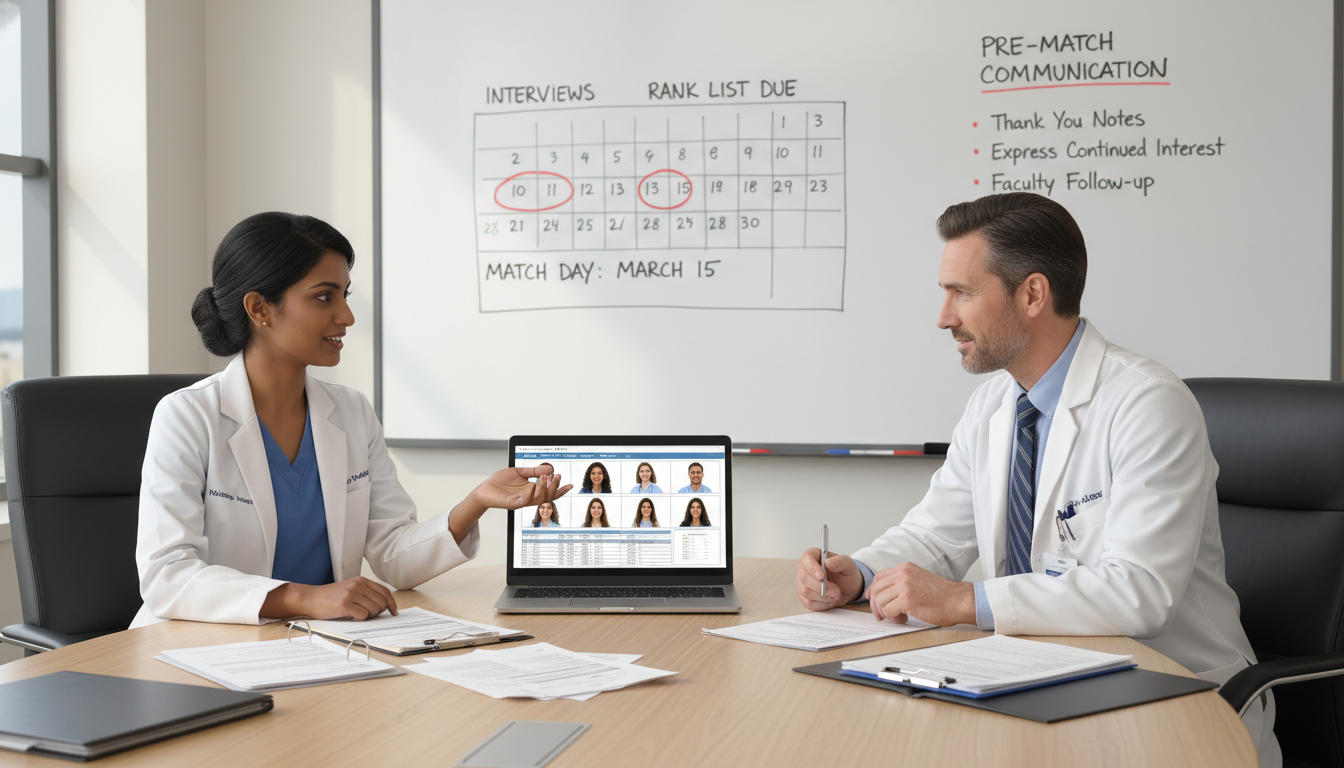
Understanding Pre-Match Communication as a US Citizen IMG in Emergency Medicine
Pre-match communication is one of the most confusing parts of the EM match for an American studying abroad. You hear stories of pre-match offers, “you’re a lock here,” and “we’ll rank you highly,” but you’re also warned about NRMP Match violations and misleading promises.
As a US citizen IMG targeting emergency medicine residency, your ability to communicate strategically with programs—without crossing ethical lines—can strongly influence how programs perceive you and, indirectly, your place on their rank list.
This article focuses on pre-match communication (not signing contracts outside the Match), and how to use it effectively and professionally as a US citizen IMG in EM.
We’ll cover:
- How emergency medicine programs actually use pre-match communication
- What’s allowed—and what’s not—under NRMP rules
- How to email programs before, during, and after interviews
- What to do if you’re interested in early commitment or pre-match offers from non-NRMP programs
- Practical templates and examples tailored to US citizen IMGs in EM
1. The Reality of Pre-Match Communication in Emergency Medicine
1.1 What “Pre-Match Communication” Really Means
For most EM programs participating in the NRMP Match, pre-match communication refers to:
- Emails to request interviews or express interest
- Thank-you notes after interviews
- “Letters of interest” or “letters of intent”
- Occasional phone calls or meetings at conferences
- Clarifying logistics, second looks, and program questions
Importantly:
- These are not binding agreements.
- Programs cannot require you to reveal your rank list or promise to rank them first.
- You cannot sign a contract with an NRMP-participating EM program before Match Day.
So when you hear “pre-match offers” within EM, be careful: true contractual pre-match offers usually refer to non-NRMP programs or to other specialties in different systems (e.g., some military or independent processes).
For EM in the Main Match, you are dealing primarily with non-binding communication, not actual contracts.
1.2 Why Pre-Match Communication Matters More for US Citizen IMGs
As a US citizen IMG or an American studying abroad, you often face:
- Fewer EM interview invitations compared to US MD/DO seniors
- Lower baseline familiarity—programs don’t know your school as well
- Concerns about clinical training environment, grading scales, and letters
Thoughtful program communication before the Match can:
- Put you on a program’s radar when they’re screening a large pool
- Show that you truly understand emergency medicine as a specialty
- Highlight your US clinical experience (especially EM rotations)
- Demonstrate maturity and professionalism—critical in EM
You cannot talk your way into a rank list position you don’t deserve, but you can make sure your genuine interest and strengths are visible.

2. Rules, Ethics, and NRMP Guidelines: What You Can and Cannot Say
2.1 NRMP Policies You Should Know
The NRMP Match has clear guidelines about program communication before Match. As an EM applicant, you should know the key points:
Programs may:
- Ask about your interest in their program
- Tell you that you’re ranked highly (but not exactly where)
- Ask if you’re still considering them seriously
Programs may not:
- Ask you to reveal your rank list
- Ask you to state explicitly whether you will rank them first
- Require you to make any commitment before the Match
- Require or pressure you to share which other programs you are ranking higher/lower
You may:
- Express genuine interest in a program
- Say that you intend to rank them highly
- If truthful, say you plan to rank them #1
- Ask about program features, schedule, curriculum, and culture
You may not:
- Make promises you don’t intend to keep (“I will rank you #1” when you won’t)
- Pressure the program to reveal your exact rank position
- Attempt to negotiate contracts or sign agreements for NRMP-participating EM spots
While not all vague or aspirational statements are “violations,” dishonesty or explicit pressure can damage your reputation and future career.
2.2 Honesty vs. Strategy
As a US citizen IMG, you might feel tempted to overstate your interest to every program in the hope of improving your position. This is risky for several reasons:
- EM is a small specialty. Program directors talk to each other.
- Being caught sending multiple “You’re my #1” emails can harm you.
- People remember applicants who were not straightforward, especially when they later apply for fellowships or faculty positions.
Balanced strategy:
- You can have one true “letter of intent” to your actual #1 program.
- You can send “letters of strong interest” to several programs you genuinely like, stating you will rank them “highly” without saying “first.”
- Avoid formulaic, generic emails—PDs can spot them easily.
3. Communicating Before Interviews: Getting Noticed as a US Citizen IMG
3.1 When Should You Email Programs Before Invitations?
As an American studying abroad, pre-interview communication can sometimes lead to:
- Getting off a “maybe” pile and into the interview list
- Being considered for an interview when you’re borderline
Appropriate times to contact EM programs:
- Early in the interview season (late September–October)
- Brief email to a few carefully chosen programs where you have a realistic shot.
- After you complete an EM away rotation at that institution
- Highlight performance, SLOE, and interest.
- If you have a genuine geographic tie (family, spouse job, etc.)
- EM programs value stability and local ties.
3.2 What to Include in a Pre-Interview Email
Aim for one short, high-impact email (200–300 words). Include:
- Who you are: “US citizen IMG at [school], currently applying to emergency medicine residency.”
- Why you’re specifically interested in their program (2–3 specific points).
- Any connections: away rotation, mentor, geographic tie, alumni, research.
- A brief “value add” as a candidate: USMLE scores, EM Sub-I performance, SLOEs, or unique background.
- A polite note that you’d be honored to be considered for an interview.
Example (Pre-Interview Interest Email):
Subject: EM Application – US Citizen IMG with Strong Interest in [Program Name]
Dear Dr. [PD Last Name],
My name is [Your Name], a US citizen IMG at [School Name], currently applying to emergency medicine residency. I am writing to express my strong interest in [Program Name].
I am particularly drawn to your program’s [specific feature—e.g., high-acuity county experience, ultrasound curriculum, regional toxicology center, strong fellowship placement]. Having grown up in [Region/City], I hope to train in a community where I can eventually practice long-term and contribute as an emergency physician.
I have completed two EM clerkships in the US, including [specific site if notable], earning [brief performance summary—“honors level evaluations and strong SLOEs”]. I believe my background as a US citizen IMG with substantial US clinical experience and commitment to underserved populations would allow me to add value to your team.
Thank you for considering my application. I would be truly honored to interview at [Program Name].
Sincerely,
[Your Full Name, AAMC ID, Contact Info]
Send this kind of email to a small, targeted list (not 40 programs). Quality > quantity.

4. Communication After Interviews: Thank-You Notes, Updates, and Letters of Intent
Once you start receiving interview invitations for emergency medicine residency, your communication strategy shifts from “get noticed” to “reinforce interest and fit.”
4.1 Thank-You Emails: Are They Necessary?
Many EM program directors say thank-you notes do not significantly affect rank lists, but they are still helpful for:
- Demonstrating professionalism
- Keeping your name familiar in the PD’s mind
- Clarifying genuine interest in the program
Best practice:
- Send one concise thank-you to the PD and/or program coordinator within 24–72 hours.
- If you had a particularly good conversation with a faculty member or resident, you may send a brief separate note to that person as well.
Example (Post-Interview Thank-You):
Subject: Thank you for the opportunity to interview – [Your Name]
Dear Dr. [PD Last Name],
Thank you for the opportunity to interview with [Program Name] on [Date]. I appreciated learning more about your emergency department’s high-acuity exposure, resident autonomy, and the strong sense of support among your residents and faculty.
Our conversation about [specific detail from the day—e.g., simulation training, ultrasound education, social EM initiatives, or wellness program] reinforced my impression that [Program Name] would be an excellent place to train.
I remain very interested in your program and would be honored to join your team.
Sincerely,
[Your Name]
Short, genuine, and specific works best.
4.2 Post-Interview Updates and Significant Changes
You may send a brief update email if you have:
- A new SLOE uploaded (especially from a strong US EM rotation)
- USMLE Step 2 CK score (if significantly strengthens your application)
- New EM research, poster, or publication
- Major life update affecting geographic preference (spouse job, visa status change not relevant here as US citizen IMG, but relocation changes may matter)
Keep it factual and concise. Over-communicating can backfire; program leadership is very busy during EM match season.
4.3 Letters of Interest vs. Letters of Intent
There are two distinct categories, with different strengths:
Letter of Interest
Use when:
- You genuinely like a program and plan to rank it somewhere in your top choices.
- You want to signal that they are high on your list, but they may not be your #1.
Sample phrasing:
- “I plan to rank [Program Name] highly on my list.”
- “Your program is one of my top choices for residency training.”
This is honest yet flexible, and doesn’t bind you to rank order.
Letter of Intent
This is a stronger promise: you clearly state that this program is your #1 choice.
Use only when:
- You are 100% certain you will rank that program first.
- You are comfortable keeping your word even if another program later sends flattery.
Sample phrasing:
“I am writing to let you know that [Program Name] is my first choice. I intend to rank your program #1 on my rank list.”
Only send one such letter. If you tell more than one program they are #1, you may not be breaking NRMP rules explicitly, but you are violating basic professional integrity—and word travels.
4.4 How Much Impact Do These Letters Have on the EM Match?
The effect varies by program:
- Some PDs appreciate clear, sincere expressions of interest and may use them as tie-breakers between similar applicants.
- Others say letters rarely change rank order significantly, especially in large programs.
For a US citizen IMG, a well-structured, honest letter can:
- Reinforce to a program that you would actually come if matched (important for smaller or less well-known locations).
- Remind them of your specific strengths (EM rotations, US clinical experience, language skills, rural/urban commitment, etc.).
They are not magic, but they are one more tool—especially valuable when used selectively.
5. Pre-Match Offers, Early Commitment, and Non-NRMP Situations
5.1 True “Pre-Match Offers” in EM: Rare in NRMP Programs
For emergency medicine programs that participate in the NRMP Main Match, true contractual pre-match offers are not allowed. All positions must be filled through the Match.
However, you may encounter variations:
- Non-NRMP EM programs (rare in the US, but may exist in some systems) that offer contracts outside the Match.
- Combined or special tracks (e.g., EM/IM, EM/FM) that may have separate matching or early commitment rules—usually still through NRMP or a similar matching system.
If anyone offers you:
- A contract to sign before Match Day for an EM residency position that should be in the NRMP:
- This is likely an NRMP violation; seek guidance from your dean’s office or NRMP directly.
5.2 Early Commitment Signals and “Soft Offers”
You may hear phrases like:
- “You are very competitive here.”
- “We plan to rank you highly.”
- “You would have a great chance of matching if you rank us highly.”
These are non-binding and somewhat vague. Programs sometimes use them to:
- Encourage you to seriously consider them
- Communicate enthusiasm without stating exact rank positions
What you should do:
- Acknowledge politely: “Thank you, I really appreciate your support and remain very interested in your program.”
- Do not interpret this as a guarantee of matching.
- Continue building a balanced rank list; do not rank fewer programs just because you received strong signals from one.
5.3 Evaluating a Non-NRMP Pre-Match Offer (If Encountered)
If you do encounter a true contractual offer outside the NRMP (e.g., from a non-NRMP EM program or another specialty), consider:
Accreditation and quality
- Is the program ACGME-accredited?
- Will graduating from this program make you board-eligible in EM (if applicable)?
Career goals
- Does training there align with your long-term plans (fellowship, location, practice type)?
Risk tolerance
- Accepting a firm pre-match offer may require withdrawing from the Match for that specialty or entirely, depending on rules. That’s a major decision.
Mentor input
- Discuss with advisors who understand EM, IMG issues, and the US residency system.
When in doubt, ask for guidance before signing anything that would affect your status in the Main Match.
6. Practical Tips to Optimize Program Communication as a US Citizen IMG
6.1 Mindset: Professional, Calm, and Consistent
Emergency medicine is high-stakes, fast-paced, and team-based. Programs are watching for:
- Professionalism – respectful emails, punctual responses, no emotional outbursts
- Judgment – not flooding them with messages, not overstepping boundaries
- Communication skills – clear, concise, polite language
Your pre-match communication is essentially a preview of how you will handle critical communication in the ED.
6.2 Email Best Practices
- Use a professional email address (e.g., firstname.lastname@…).
- Always include your full name and AAMC ID in your signature.
- Use clear subject lines:
- “EM Application – [Your Name], US Citizen IMG”
- “Thank you – [Your Name], EM Interview on [Date]”
- Keep emails short and focused. Avoid large blocks of text.
- Proofread; errors suggest lack of attention to detail.
6.3 What Not to Do
Avoid:
- Mass emails with programs in CC; this appears unprofessional.
- Repeated emails asking, “What are my chances of matching at your program?”
- Pressuring programs: “If you tell me I will match, I’ll rank you first.”
- Emotional pleas or comparisons to other candidates (“As an IMG, I deserve a chance more than…”).
- Multiple conflicting promises about your rank list.
6.4 Leveraging Your US Citizen IMG Background Positively
Frame your background as an asset, not a limitation:
- Emphasize adaptability: training in a different system has made you flexible and resilient.
- Highlight US clinical experience, particularly EM rotations, SLOEs, and any US-based research.
- Mention any bilingual ability or experience serving diverse populations—valuable in many EDs.
- Explain briefly (if asked or relevant) why you chose to study abroad yet want to return to practice in the US.
6.5 Using Mentors and Networks
As an American studying abroad, you may feel disconnected from US EM networks. You can still:
- Ask US EM faculty who supervised you (on away rotations) if they are willing to:
- Serve as references
- Place a brief phone call or email to a program on your behalf (used sparingly, for a handful of programs where you’re a strong fit).
- Reach out to alumni from your school now in EM residencies to ask:
- How their programs view US citizen IMGs
- Whether pre-match communication made any difference for them
- Any specific advice for their region or program type
Programs respect substantive, targeted advocacy from people they trust.
FAQ: Pre-Match Communication for US Citizen IMG in EM
1. As a US citizen IMG, should I tell an EM program they are my #1 choice?
Yes—but only if it’s actually true. A clear, single letter of intent stating that a program is your first choice can help them feel confident you will come if they rank you highly. Do not send this to more than one program, and do not make a promise you are not prepared to keep.
2. Do pre-match emails and thank-you notes really change my EM match outcome?
They are rarely decisive on their own, but they can:
- Serve as tie-breakers between similar applicants
- Reinforce your interest and fit, especially as a US citizen IMG
- Keep you on the program’s radar
Performance on EM rotations, SLOEs, USMLE scores, and interview impressions remain far more important.
3. A program told me I am “ranked highly.” Does that mean I’ll match there?
No. Statements like “ranked highly” or “we’re very interested” are non-binding and often intentionally vague. You might be ranked highly, but if they prioritize many applicants above you and fill their positions first, you won’t match there. Continue to rank a robust list of programs rather than relying on verbal signals.
4. Can I negotiate or sign a pre-match contract for an EM residency position in the NRMP Match?
For ACGME-accredited emergency medicine programs participating in the NRMP Main Match, no—you cannot sign pre-match contracts for those positions. Any attempt to secure or offer a binding agreement before the Match is likely a violation. If you receive such an offer, contact your dean’s office or NRMP for guidance before signing anything.
By approaching pre-match communication with clarity, honesty, and professionalism, you, as a US citizen IMG, can present yourself as the kind of future emergency physician EM programs want: thoughtful, reliable, and effective in high-stakes communication.