US citizen IMGs (American studying abroad in medical schools outside the U.S.) often feel particularly anxious about pre-match communication. You’re competing in a crowded field, your status as a US citizen IMG can be misunderstood, and rules around contact with programs before rank lists are certified can feel confusing or risky.
This guide explains how to approach pre-match communication strategically and ethically, so you can build program relationships, signal genuine interest, and avoid crossing important boundaries.
Understanding Pre-Match Communication vs. Pre-Match Offers
Before designing your strategy, you need to distinguish a few related—but very different—concepts.
What is pre-match communication?
Pre-match communication includes any contact you have with residency programs between:
- ERAS submission and
- The time rank order lists are certified (and even slightly beyond, until Match Week).
Common examples:
- Thank-you emails after interviews
- Updates on new publications, exam scores, or visas
- Clarification questions about curriculum, call schedules, or fellowship paths
- Expressions of interest (e.g., “I will rank your program highly”)
- Post-interview letters to the program director or coordinator
This is not unique to IMGs, but US citizen IMGs often feel they must “do more” to be visible and competitive.
What are pre-match offers?
Pre-match offers are direct, early commitments outside the standard NRMP Match process. Historically, some programs—especially in non-NRMP specialties or certain states—could offer:
- An early, binding contract: “Sign now and we will take you, outside the Match.”
- A “guaranteed spot if unmatched,” sometimes in writing, sometimes informally.
In many ACGME-accredited specialties that participate in the NRMP Match, true pre-match offers are prohibited. Programs and applicants are expected to participate in the Match in good faith. Still, you may encounter:
- Strong “signals” from programs (“You’re ranked to match here”)
- Implied expectations of early commitment (“If you rank us number one, we’ll rank you highly”)
As a US citizen IMG, be cautious. Understand the NRMP Code of Conduct and your specialty’s participation rules. When in doubt, keep everything non-binding and professional.
Why pre-match communication matters for US citizen IMGs
As an American studying abroad, you often:
- Don’t have a home program in the U.S. vouching for you
- Have limited access to away rotations in your target region
- May be screened more heavily based on school reputation or visa assumptions (even as a US citizen)
Effective pre-match communication allows you to:
- Correct misconceptions about your status (e.g., “I am a US citizen and do not require visa sponsorship.”)
- Emphasize your strong US ties, regional preferences, and commitment to the program’s community
- Stay visible among many international applicants
- Convey professionalism and maturity—critical in borderline decisions
Ethical and NRMP-Safe Communication: What Is and Isn’t Allowed
The biggest fear many applicants have is “saying the wrong thing” and getting in trouble. Understanding the rules will help you communicate confidently.
Key NRMP principles
While you should always check the latest NRMP and specialty-specific rules, a few general principles apply:
No binding commitments before the Match
- Programs cannot require you to state how you will rank them.
- You cannot be forced (ethically) to promise to rank a program #1.
- Any verbal assurances are non-binding until rank lists are submitted and the algorithm runs.
Expressing interest is allowed
You can say:- “I am very interested in your program.”
- “Your program is among my top choices.”
- After careful consideration: “I intend to rank your program highly” or even “I plan to rank your program first.”
Programs can express interest but not guarantees
Programs might say:- “You will be ranked highly on our list.”
- “We believe you are an excellent fit and hope you will rank us well.”
They should not promise you a position outright or pressure you for commitment.
No coercion or requirements based on ranking details
- No one can require you to disclose your rank list order.
- You don’t have to answer questions like “Where will you rank us?”
Safe vs. risky language
Safe examples:
- “Your program is at the top of my list, and I would be thrilled to train there.”
- “After my interview, I can confidently say that I will rank your program highly.”
- “I remain very enthusiastic about joining your team if I am fortunate enough to match with you.”
Risky or misleading examples (to avoid unless 100% truthful):
- “I will rank your program #1,” if you are not actually certain.
- “I won’t rank any other program above you,” if you’re telling multiple programs the same thing.
- Anything that sounds like a contract (“I commit to accepting an offer from you if available before the Match”).
As a US citizen IMG, your reputation and integrity matter even more, especially given how smaller specialties and communities talk. Dishonest communication can quietly damage your candidacy.
Pre-Match Communication Timeline and Strategy
A strong approach isn’t about sending more emails; it’s about sending the right emails at the right times. Below is an organized timeline that a typical US citizen IMG might follow.
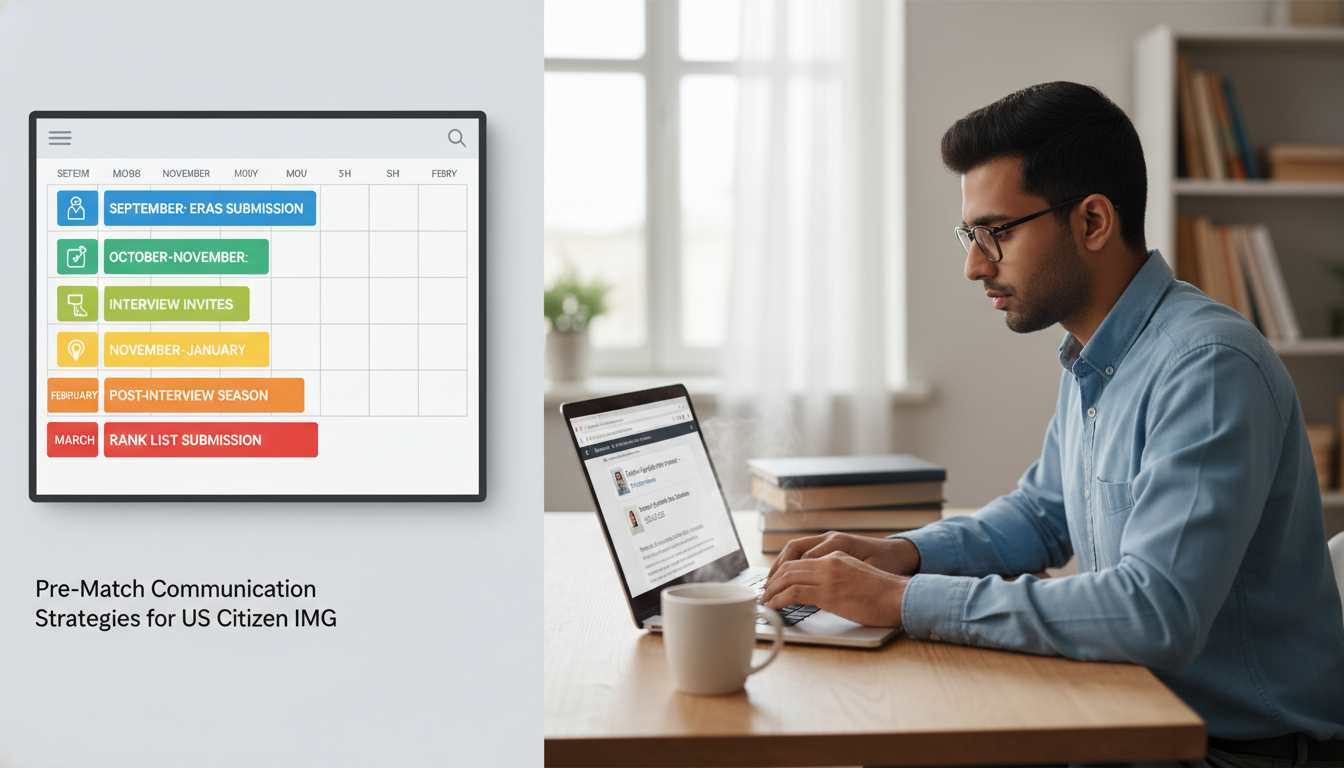
Phase 1: Application submission to interview invitations
Primary goal: Get noticed and secure interviews.
Most programs do not appreciate unsolicited emails immediately after ERAS opens asking, “Did you review my application?” But there are strategic exceptions, especially for a US citizen IMG:
US citizen clarification email (if needed)
If your school is outside the U.S. and you suspect programs might wrongly assume you need visa sponsorship, a short, targeted clarification can be helpful.Example (to the program coordinator):
Subject: Clarification of Citizenship Status – [Your Name], ERAS AAMC ID [Number]
Dear [Ms./Mr./Mx. Last Name],
I hope this message finds you well. I recently applied to the [Specialty] residency program at [Institution] through ERAS. I wanted to briefly clarify that although I am an international medical graduate, I am a United States citizen and do not require visa sponsorship.
Thank you very much for your time and consideration of my application. I am very interested in training at [Institution] given [1–2 specific, genuine reasons].
Sincerely,
[Full Name]
[AAMC ID]
[Phone]Use sparingly, only for programs where your citizenship status is likely to impact screening.
US clinical experience and connection highlight
If you rotated at that institution or have a strong regional tie (family nearby, grew up there), you may send one brief interest email emphasizing this, especially if your rotation was recent and your performance was strong.
- Keep it to a single message per program.
- Reference specific mentors or experiences, not generic praise.
Phase 2: Receipts of interview invitations
Primary goal: Confirm logistics and display professionalism.
Timely responses
- Respond quickly (ideally within 24 hours) to interview invitations.
- If scheduling via Interview Broker or Thalamus, follow all instructions precisely.
Clarifying travel or technical questions
If you’re overseas during the season (common for American studying abroad), communicate time zone constraints clearly and early.- Example: “I’m currently in [Country, Time Zone] completing my clinical rotations and want to ensure I join at the correct local time. Could you confirm the time zone for the interview schedule?”
Phase 3: Interview day and immediate post-interview
Primary goal: Solidify a strong impression and open a channel for later communication.
During the interview: ask informed questions
Prepare 4–6 tailored questions for each program. For US citizen IMG applicants, useful topics include:
- Support for IMGs transitioning back into the US system
- Opportunities for mentorship in research or subspecialty interests
- Graduates’ fellowship or job placements in your target region
- Culture of wellness for residents, especially those new to the area
This shows that you’re thinking seriously about fit and long-term commitment, not just trying to get any spot.
Post-interview thank-you email (within 24–48 hours)
You can write to:
- Program director
- Key faculty interviewers
- Program coordinator (brief thank-you)
Sample to program director:
Subject: Thank You – [Your Name], [Interview Date]
Dear Dr. [Last Name],
Thank you very much for the opportunity to interview for the [Specialty] residency at [Institution] on [Date]. I appreciated our conversation about [specific topic, e.g., curriculum, patient population, research opportunity] and learning more about the program’s commitment to [key theme, e.g., resident autonomy, underserved care].
As a US citizen IMG with a strong interest in [specific area], I especially valued hearing how your residents are supported in [example: fellowship placement, community engagement, or procedural training].
I left the interview even more enthusiastic about the prospect of joining your team. Thank you again for your time and consideration.
Sincerely,
[Your Name]
[AAMC ID]Keep it concise, specific, and sincere.
Phase 4: Post-interview season, before rank list deadline
Primary goal: Reaffirm interest, provide updates, and clarify final impressions.
This is where program communication before match can become most impactful.
A. Priority program letters
You do not need to email every program multiple times. Focus on:
- Programs where you feel strong fit and genuine interest
- Programs where your interview feedback was positive (as inferred from tone, not explicit promises)
- Programs in your highest-priority regions (e.g., near family or future practice goals)
A US citizen IMG can especially leverage:
- Long-term plans to live and practice in the area
- Family ties or prior education in the region
- Evidence of commitment to underserved or specific patient populations
Sample “continued interest” email (mid-late season):
Subject: Continued Interest – [Your Name], [Specialty] Applicant
Dear Dr. [Last Name],
I hope you are well. I wanted to thank you again for the opportunity to interview with the [Specialty] residency at [Institution] on [Date] and to express my continued strong interest in your program.
Since our interview, I have [brief update: e.g., submitted a manuscript, received COMLEX/USMLE Step result, completed a rotation in X]. These experiences have further reinforced my desire to train in a program with strong [highlight: e.g., clinical exposure to diverse patients, procedural training, emphasis on teaching].
As a US citizen IMG originally from [Region/State/City if applicable], I am particularly excited about the possibility of returning to [Institution’s city/region] to serve the community and grow within your training environment.
Thank you again for your time and consideration.
Sincerely,
[Your Name]
[AAMC ID]
Use this kind of email once per program, usually 2–4 weeks before rank list deadlines.
B. Rank signal letters (if you choose)
If you genuinely know your #1 program, you may choose to send a “rank-to-match” style letter:
“I plan to rank your program first.”
Only do this if:
- You are absolutely sure, and
- You will not send similar promises to other programs.
This can help as a tie-breaker in their ranking decisions. For a US citizen IMG, a clear #1 commitment to a program that values trainees likely to stay in the region can be meaningful.
Special Considerations for US Citizen IMGs

Your status as a US citizen IMG can be both a challenge and an asset. How and when you communicate about it matters.
1. Clarify your citizenship and visa needs early
Many programs do quick application screens based on:
- Need for visa sponsorship
- Medical school location
- USMLE/COMLEX attempt history
Avoid being lumped into the “visa required” category by:
- Clearly indicating US citizenship in ERAS
- Choosing a personal statement that references your American background (without overemphasis)
- Sending a brief, professionally worded clarification (as shown earlier) to programs you suspect might misclassify you
This is not begging for an interview; it is simply ensuring accurate categorization.
2. Emphasize US clinical exposure and adaptability
In interviews and follow-up communication, highlight:
- US clinical rotations (core or electives), especially in ACGME-accredited hospitals
- Strong letters of recommendation from US faculty
- Your familiarity with the U.S. healthcare system, EMR use, and multidisciplinary team dynamics
Programs sometimes worry that IMGs—even US citizen IMG applicants—will struggle with:
- Communication nuances
- EHR systems
- U.S.-style hierarchy and team-based care
Your communication should calmly and proactively address these concerns.
Example interview talking point:
“Although I’ve completed my degree abroad, I’ve done [X months] of US clinical rotations at [Institutions], where I had the chance to work within multidisciplinary teams, use Epic EMR, and care for a diverse patient population under direct faculty supervision.”
You can reinforce similar points in post-interview emails, when relevant.
3. Highlight geographic and long-term commitment
Programs often fear that IMGs will:
- Use them as a stepping stone and leave the region
- Transfer out if they get a more “prestigious” option
As an American studying abroad, you may have:
- Family, prior education, or long-term plans in specific cities or states
- Personal connections to the region’s culture or patient population
Bring this into communication thoughtfully, e.g.:
“Growing up in [City/State] and having family in the area, I’m eager to return long term to serve this community. Your program’s mission aligns closely with my goal to practice as a [specialty] physician here after residency.”
This kind of signal can strongly influence how high programs rank you, especially if they’re deciding between several similar candidates.
Common Communication Mistakes to Avoid
Even well-intentioned applicants can sabotage themselves with poor pre-match communication. Here are pitfalls particularly relevant for US citizen IMGs.
1. Over-emailing or sounding desperate
Signs of over-communication:
- Sending multiple “Have you reviewed my application?” messages
- Emailing additional faculty repeatedly without prior relationship
- Following up more than once in a short span without new information
Programs are busy. Excessive emailing can create an impression of poor boundaries or anxiety management.
Guideline:
One pre-interview clarification (if needed) → one thank-you → at most one follow-up interest/update email.
2. Generic, copy-paste messages
Program directors can immediately recognize:
- “Your program is my top choice because of your excellent teaching and research.” (Said to 50 places)
- Vague compliments without specific program details
Always include at least one concrete detail that shows genuine familiarity:
- A specific aspect of curriculum, call structure, or continuity clinic
- A distinct patient population served
- A talk or resident interaction that stood out during the interview day
3. Dishonest or conflicting statements about rank
Saying “I will rank you #1” to multiple programs is not just unethical; it’s risky. Faculty talk, especially in small specialties or regions.
Instead, use graduated language:
- For one program: “I plan to rank your program first.”
- For others you still really like: “I will rank your program highly.”
Honesty preserves your professional reputation and reduces your own anxiety.
4. Asking programs for their rank list
Do not ask:
- “Where will I be on your rank list?”
- “Am I ranked to match?”
Programs cannot ethically disclose detailed ranking decisions. Such questions may make you seem unfamiliar with match principles.
5. Ignoring coordinators and basic professionalism
Program coordinators:
- Track communication and applicant behavior
- Influence the program’s perception of you
Always:
- Use correct titles and names
- Write clear, polite emails
- Avoid informal language, abbreviations, or texting style
Professionalism in small interactions often becomes a quiet tie-breaker in your favor.
Actionable Checklist for US Citizen IMGs
Use this condensed checklist to guide your approach to pre-match communication and early commitment concerns:
Before applications open
- Clarify in your CV and personal statement that you are a US citizen IMG.
- List US clinical experiences and obtain strong US letters of recommendation.
Right after ERAS submission
- Identify a small subset of programs where clarifying citizenship could significantly influence screening.
- Send a short, targeted clarification email only where appropriate.
After each interview
- Send tailored thank-you emails to the PD and key interviewers within 24–48 hours.
- Note specific program strengths and how they align with your goals.
Mid-late interview season
- Draft 1–2 update/interest emails for your top programs, including any concrete updates (scores, publications, rotations).
- Emphasize geographic commitment, US citizenship, and readiness to train in the U.S. system.
Before rank lists are due
- Decide, honestly, on your #1 program.
- If you choose, send a single, clear #1 letter only to that program, using respectful, non-binding language.
Throughout
- Respect NRMP rules and avoid binding promises.
- Keep all communication professional, concise, and specific.
- Avoid repeated “checking in” or pressure on programs for information.
FAQs: Pre-Match Communication for US Citizen IMGs
1. As a US citizen IMG, should I mention my citizenship in every email?
Not in every message, but you should ensure it’s:
- Clearly reflected in ERAS demographics
- Mentioned in at least one early, targeted communication to programs where it might affect screening (especially if they typically sponsor visas or limit non-US graduates)
After that, you might restate it briefly only when relevant—for example, when contrasting your international medical education with your strong ties to the U.S.
2. Can I safely tell a program they are my #1 choice?
Yes, if:
- You genuinely intend to rank them first
- You do not send similar claims to other programs
- You phrase it respectfully and without requesting a reciprocal promise
This type of statement is ethical and can help programs when finalizing their own lists, especially if they value committed candidates.
3. Should I send multiple follow-up emails if I haven’t heard back?
No. For most programs:
- 0–1 pre-interview clarification email (if justified)
- 1 thank-you email after interview
- 0–1 post-interview update/interest email
If you never hear back, persistently emailing will not change their rank list but may negatively affect their perception of your professionalism.
4. What if a program hints at an early commitment or “pre-match offer”?
Clarify politely and protect yourself:
- Ask whether the program participates fully in the NRMP Match.
- If they suggest ranking commitments (“We’ll rank you high if you rank us high”), remember that all such talk is non-binding.
- You should always rank programs in your true order of preference, regardless of what they say.
If you’re ever unsure, consult your dean’s office, a trusted mentor, or NRMP resources rather than making a rushed decision.
Navigating pre-match communication as a US citizen IMG requires balance: being assertive without being pushy, enthusiastic without overpromising, and honest while still advocating strongly for yourself. With a clear understanding of the rules, strategic timing, and focused messaging, you can use pre-match communication to highlight your strengths, correct misconceptions, and signal genuine interest—helping programs see you as the capable, committed future colleague you are.