
Pre-match communication is one of the most misunderstood parts of the residency application process, especially for a non-US citizen IMG targeting a competitive, small-field niche like Pediatrics-Psychiatry (Triple Board). Because there are relatively few peds psych residency positions and many programs that do not routinely sponsor visas, the way you communicate with programs before Match Day can significantly influence:
- Whether you receive interviews
- How strongly a program ranks you
- Whether you encounter any pre-match offers or early commitment situations
This guide breaks down how to navigate program communication before Match as a foreign national medical graduate targeting triple board, while staying fully within NRMP rules and professional norms.
Understanding Pre-Match Communication in the US System
Before you can use pre-match communication effectively, you need clarity on what it is—and what it is not.
What does “pre-match communication” mean?
In the context of US residency applications, pre-match communication includes:
- Any email you send to a program (before and after interview)
- Messages through ERAS or a program portal
- Phone calls or virtual meetings
- In-person conversations at away rotations, conferences, or open houses
- Thank-you notes and update letters
These are all communications that happen before the official NRMP Match results are released. For a non-US citizen IMG, these communications are often the primary way to:
- Clarify visa sponsorship (J-1, H-1B)
- Express continued or “top choice” interest
- Clarify peds psych residency training structure and expectations
- Demonstrate professionalism and maturity—critical in psychiatry-related fields
What pre-match communication is NOT
There are common misconceptions, especially among IMGs:
- It is not a secret backdoor to bypass the Match system (for NRMP-participating programs).
- It is not an invitation to negotiate rank positions or to ask directly: “Will you rank me?”
- It is not supposed to involve coercion, pressure, or binding commitments before Rank Order Lists are certified.
Match-participating vs. non-participating programs
Most Pediatrics-Psychiatry (Triple Board) programs participate in the NRMP Match. That means:
- They do not typically give binding pre-match offers outside the Match
- They are bound by NRMP rules on communication and coercion
However, some institutions or related categorical tracks (e.g., pediatrics only, psychiatry only, prelim or transitional years) may have different policies, particularly at community hospitals or non-ACGME settings. Those may, in some specialties, offer early commitment or off-cycle contracts, but this is less common in triple board.
As a foreign national medical graduate, you must distinguish:
- NRMP-participating triple board programs → no binding pre-match contracts
- Non-NRMP or off-cycle positions → may potentially discuss early offers
If you are unsure, you can ask programs directly:
“Does your triple board program participate fully in the NRMP Match?”
Unique Challenges for Non-US Citizen IMGs in Triple Board
For a non-US citizen IMG targeting peds psych residency, pre-match communication has extra layers: visa questions, limited spots, and the dual nature of pediatrics and psychiatry requirements.
1. Visa sponsorship concerns
Many triple board programs are university-based and may prefer or require J-1 visas. H-1B sponsorship can be more limited due to:
- Cost and institutional policies
- USMLE Step 3 timing
- HR or GME-office restrictions
You cannot rely on assumptions. You must use pre-match communication to clarify:
- Do you sponsor J-1 visas for triple board?
- Do you sponsor H-1B for this combined program specifically?
- Have you taken non-US citizen IMGs in the last few years?
2. Small program size and highly curated selection
Many triple board programs have 2–4 positions per year. That means:
- Every communication is more visible—both positively and negatively
- Unprofessional or excessive emails stand out
- Thoughtful, reflective, and well-timed communication can help differentiate you from other IMGs
Your goal is not to email more often than others, but to communicate better.
3. Integrated expectations: pediatrics + psychiatry
Programs are selecting residents who can handle:
- Intensive inpatient pediatrics
- Child and adolescent psychiatry
- Complex developmental and behavioral cases over a 5-year curriculum
So your pre-match communication should consistently highlight:
- Comfort with pediatric medicine
- Genuine interest in child and adolescent mental health
- Long-term commitment to this niche path (not a “backup” for pediatrics or psychiatry alone)
Strategic Pre-Match Communication: Before, During, and After Interviews
The most effective approach is structured. Think in three phases:
- Pre-interview communication – to get noticed and secure interviews
- During the interview season – to build rapport and clarify key details
- Post-interview communication – to signal genuine interest and maintain professionalism

Phase 1: Pre-interview communication
This phase starts as soon as you submit ERAS and continues until the interview invitations stabilize.
A. Targeted introduction emails (optional but useful for IMGs)
Especially as a non-US citizen IMG, a brief, high-quality introductory email to Triple Board Program Directors (PDs) or coordinators can:
- Put your name on their radar
- Clarify your visa status and eligibility
- Highlight a specific, genuine reason you are applying to their program
Key elements of a pre-interview email:
Concise subject line:
“Applicant Inquiry – Triple Board, Non-US Citizen IMG (ERAS ID: XXXXXXXX)”1–2 sentences introducing who you are:
- Medical school (country)
- Current status (student, graduate, research fellow)
- Exam status (e.g., “USMLE Steps 1 and 2 completed”)
One very specific reason you are interested in their program:
- A particular clinic (e.g., autism, developmental disabilities)
- Emphasis on trauma-informed care
- Interdisciplinary collaboration with schools or child welfare
Clarify your visa:
- “I will require J-1 sponsorship” or
- “I am ECFMG certified and eligible for J-1; I will also be eligible for H-1B after Step 3.”
Short closing expressing gratitude and openness to questions—no begging for interviews.
What not to do:
- Do not send a generic mass email to every program.
- Do not attach numerous PDF documents (ERAS already has them).
- Do not ask directly, “Can you grant me an interview?”
Instead, gently indicate interest and let your application speak for itself.
B. Clarifying eligibility and visa questions early
Some programs do not sponsor visas, or sponsor only J-1. Early, polite emails can save you time and money:
Example question:
“Before applying, may I clarify whether your Triple Board program sponsors J-1 visas for non-US citizen IMGs?”
If a program says:
- “We do not sponsor visas” → You can reasonably skip that program
- “We sponsor J-1 only” → Ensure you will be eligible with ECFMG certification
This is strategic communication, not desperation.
Phase 2: Communication during interview season
Once interviews are offered, communication goals shift:
- Confirm logistics and show professionalism
- Deepen your understanding of program culture and expectations
- Establish rapport with interviewers and leadership
A. Before the interview
Professional communication here is basic but important:
- Respond promptly to interview offers
- If schedules conflict, request changes with gratitude and flexibility
- Address the coordinator respectfully; they are often influential in the process
For non-US citizen IMGs, a common pre-interview question is whether to mention visa in these emails. Generally:
- If visa was already clarified in earlier communication → no need to repeat
- If you are unsure and it’s critical → you may ask once, politely
Example:
“I look forward to interviewing with your Triple Board program on [date]. If possible, could you please confirm whether the program sponsors [J-1/H-1B] visas for incoming residents? This will help me plan my application strategy as a non-US citizen IMG. Thank you very much.”
B. During interviews: verbal communication strategy
While this article focuses on emails and messages, your in-person or virtual communication is also “pre-match communication.” For peds-psych especially, PDs pay close attention to:
- Your maturity in discussing mental health
- How you talk about children, families, and cultural differences
- Your insight about being a foreign national medical graduate working with US families
Be prepared to address:
- Why Triple Board rather than pediatrics or psychiatry alone
- How your background (country, language, culture) will help you care for diverse families
- Any gaps, visa delays, or attempts at previous Matches
Use examples from your experience:
- Working with children who have developmental disorders
- Supporting families dealing with trauma or chronic illness
- Multilingual encounters where you bridged cultural misunderstandings
Phase 3: Post-interview communication
This is the most sensitive area for program communication before Match. You want to:
- Express genuine interest
- Strengthen positive impressions
- Avoid ethical or NRMP violations (and avoid pressuring programs)
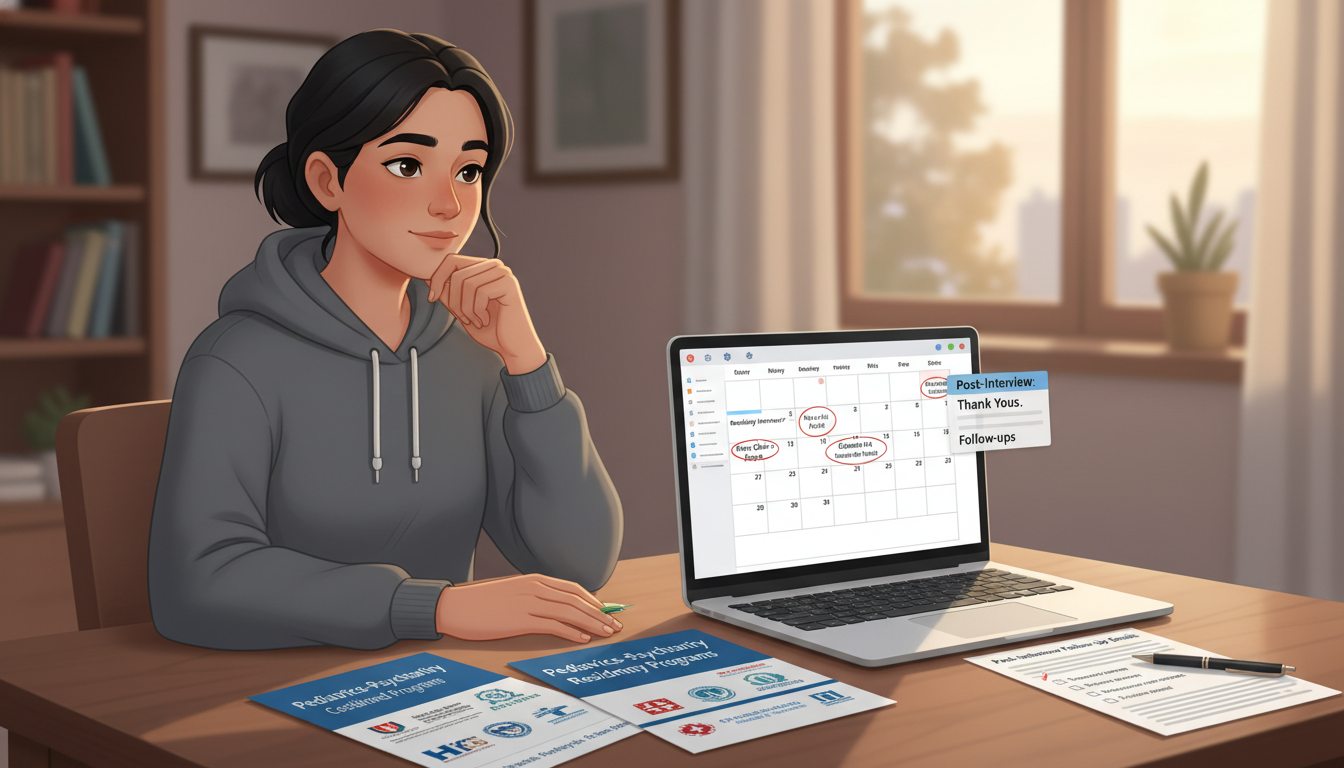
A. Thank-you emails: When and how
Short, thoughtful thank-you emails can be sent:
- Within 48–72 hours after the interview
- To the Program Director and key faculty you met
- Possibly to residents if they explicitly invited follow-up
Key content:
- Brief appreciation for their time
- One or two specific aspects of the program that resonated with you
- A subtle reminder of your fit as an IMG interested in both pediatrics and psychiatry
Example structure:
- Thank them for the interview day.
- Mention something concrete (e.g., integrated clinics, trauma rotation, developmental pediatrics).
- One line reinforcing your enthusiasm:
- “Our conversation further confirmed that your Triple Board program aligns closely with my long-term goal of serving children with complex medical and psychiatric needs.”
- Professional closing.
Avoid:
- Overly emotional language
- Repeating your entire CV
- Statements that sound like you’re fishing for rank information
B. Update letters and signals of interest
As a non-US citizen IMG in a small specialty, you might consider one or two update letters during the season, especially if:
- You passed a new exam (Step 3)
- You obtained a relevant publication in child psychiatry or pediatrics
- You completed a new clinical or research experience
The key is to keep them rare, meaningful, and concise.
You may also wish to indicate strong interest or “top choice” status once your rank list is clearer. NRMP rules allow applicants to say:
- “Your program is my top choice, and I plan to rank you highly.”
- Or “I intend to rank your program very highly.”
But you must be truthful. Do not tell multiple programs they are your number one.
For a foreign national medical graduate, it is often helpful to explicitly connect your long-term vision:
- Working in child and adolescent mental health
- Serving immigrant or underserved populations
- Doing research or advocacy related to pediatric mental health policy
C. Red lines: What you should NOT say or ask
To remain ethical and professional:
- Don’t ask: “Where will you rank me?” or “Am I ranked to match?”
- Don’t pressure: “If you rank me highly, I’ll definitely rank you first.”
- Don’t imply any binding agreement outside of the formal NRMP system.
If a program voluntarily expresses strong interest (e.g., “We hope to see you here next year”), respond professionally and warmly, but do not assume a guarantee.
Pre-Match Offers and Early Commitment: What IMGs Need to Know
Because the user’s context includes pre-match offers and early commitment, it’s important to clarify how they fit into this specialty and your situation as a non-US citizen IMG.
Are pre-match offers common in Pediatrics-Psychiatry (Triple Board)?
- In most cases, triple board positions are filled through the NRMP Match, not via independent pre-match contracts.
- The concept of pre-match offers is more widely discussed in other specialties (e.g., some internal medicine or family medicine positions historically), particularly at programs that did not fully participate in the Match.
For triple board:
- You should not expect a program to offer you a contract outside of the Match.
- If something like that occurs, immediately verify:
- Is this program participating in the NRMP Match?
- Does this offer violate any NRMP policies?
What if a program hints at “early commitment”?
Occasionally, a program might say something like:
- “You are a very strong candidate; we are very interested in having you join us.”
- “We hope to see you in July.”
These are verbal or written expressions of strong interest, but they are not binding offers.
To handle this:
- Thank them sincerely.
- Do not demand a written “promise” or ranking confirmation.
- Remember that both you and the program must still submit rank lists honestly.
If you feel pressured or confused, consult:
- Your medical school dean’s office or advisor
- The NRMP (they offer guidance on communication policies)
How to evaluate off-cycle or non-match offers (rare but possible)
On occasion, a non-NRMP track (e.g., a research or preliminary pediatrics year) might approach you with an early offer, especially if you are a foreign national medical graduate already in the US. Before accepting:
- Clarify: Is this directly connected to triple board, or is it separate?
- Would accepting this position limit your ability to enter triple board later?
- Would visa sponsorship be secure?
If the offer is truly outside the NRMP system (and complies with NRMP rules), seek legal and academic advice before committing.
Practical Communication Templates for Non-US Citizen IMGs
Here are streamlined templates you can adapt.
1. Pre-interview inquiry (visa + interest)
Subject: Applicant Inquiry – Triple Board, Non-US Citizen IMG (ERAS ID: XXXXXXXX)
Dear Dr. [Last Name] / Program Coordinator,
I am a [non-US citizen] international medical graduate from [Country, Medical School], applying to Pediatrics-Psychiatry/Child and Adolescent Psychiatry (Triple Board) programs this cycle (ERAS ID: XXXXXXXX).
I am particularly interested in your program because of [specific feature: e.g., integrated developmental pediatrics and child psychiatry clinic, emphasis on trauma-informed care, connection with public schools, etc.].
As a foreign national medical graduate, I wanted to kindly ask whether your Triple Board program sponsors [J-1/H-1B] visas for incoming residents and whether you have historically considered non-US citizen IMGs. This information will help me plan my application strategy responsibly.
Thank you very much for your time and consideration.
Sincerely,
[Full Name, Degree]
[Contact info]
2. Post-interview thank-you (Program Director)
Subject: Thank You – Triple Board Interview on [Date]
Dear Dr. [Last Name],
Thank you very much for the opportunity to interview with your Pediatrics-Psychiatry/Child and Adolescent Psychiatry (Triple Board) program on [date]. It was a pleasure to learn more about the curriculum and your vision for training physicians who are equally comfortable in pediatrics and psychiatry.
I was especially impressed by [specific program feature: e.g., the longitudinal developmental clinic, the focus on early childhood trauma, collaborative work with schools/child protective services]. These align closely with my long-term goal as a non-US citizen IMG to care for children with complex medical and psychiatric needs, particularly those from underserved and immigrant communities.
I truly appreciated your time and insight and remain very enthusiastic about the possibility of training at [Institution Name].
Sincerely,
[Full Name]
3. Post-interview “strong interest” letter (use sparingly and honestly)
Subject: Continued Interest in [Program Name] Triple Board Program
Dear Dr. [Last Name],
I hope you are doing well. I wanted to express my continued, strong interest in the [Institution Name] Triple Board program following my interview on [date].
Since our conversations, I have reflected further on my goals as a physician who hopes to integrate pediatric care with child and adolescent psychiatry, particularly for children in immigrant and underserved communities. Your program’s [specific features: e.g., integrated training sites, mentorship in child psychiatry research, focus on developmental disabilities] make it an excellent fit for my aspirations.
[Optional: mention a brief update if relevant—e.g., “I have recently passed USMLE Step 3,” or “I have submitted a manuscript on child mental health in refugee populations.”]
I plan to rank [Institution Name] very highly on my rank list and would be honored to train in your program.
Thank you again for your time and consideration.
Sincerely,
[Full Name]
FAQs: Pre-Match Communication for Non-US Citizen IMGs in Pediatrics-Psychiatry
1. As a non-US citizen IMG, should I email every triple board program before interviews?
Not necessarily. Quality is more important than quantity. Consider emailing programs when:
- Visa policies are unclear and essential for your eligibility
- You have a specific, genuine reason to connect with that program
- You are applying from a non-US school with little prior presence at that institution
A short, well-targeted email is far better than a generic mass mailing.
2. Can I tell more than one program that they are my “top choice”?
You should not tell multiple programs they are your absolute number one. That is considered misleading and unprofessional. You may:
- Tell one program they are your “top choice” (if true)
- Tell others that you will “rank them highly” or that you are “very interested”
Honesty is critical, especially in a small field like triple board where faculty know each other.
3. How much should I discuss my visa needs in pre-match communication?
You should:
- Clarify visa sponsorship early enough to avoid wasted applications
- Mention your visa category (J-1 or H-1B) concisely, without making it the center of your communication
- Avoid repeatedly emphasizing visa in each email or conversation once it’s been addressed
Programs want to know you are logistically feasible, but they are primarily evaluating your fit, motivation, and clinical potential.
4. Do triple board programs ever give formal pre-match offers or contracts?
In general, no—most triple board programs fill positions through the NRMP Match. Formal pre-match offers or early commitment contracts are rare and may conflict with NRMP policies if the program participates in the Match. If you receive something that seems like a binding offer before Match Day, seek guidance from your dean’s office and, if needed, the NRMP.
Thoughtful, honest, and well-timed program communication before Match can be a powerful asset for a non-US citizen IMG pursuing peds psych residency. Focus on clarity, professionalism, and authenticity about why this demanding but rewarding triple board pathway is right for you—and why you are right for it.