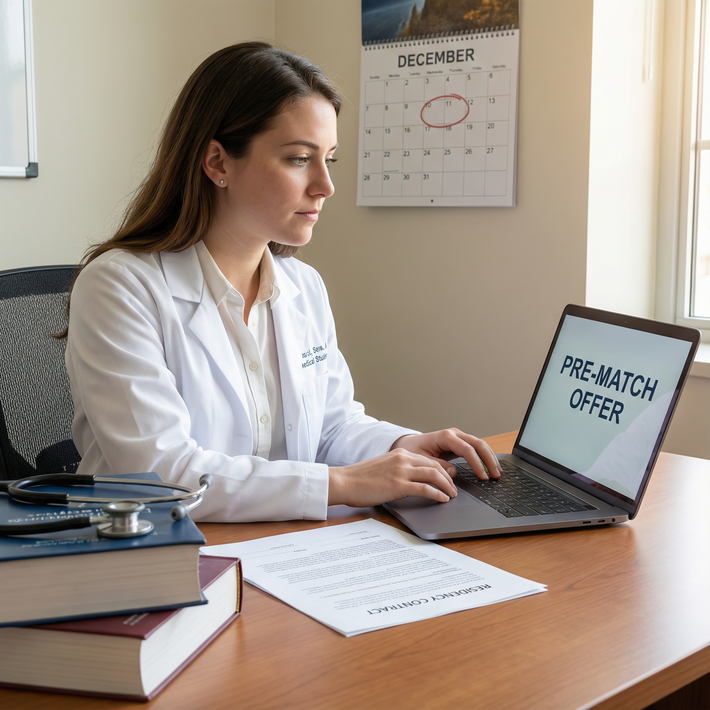
Pre-match communication in pathology has become increasingly important as the specialty grows more competitive and more applicants apply broadly. Understanding what’s appropriate, what’s ethical, and what’s actually helpful can make a meaningful difference in your pathology residency application and pathology match outcome—without risking NRMP violations or awkward misunderstandings.
This guide walks you through the landscape of pre-match communication in pathology: what it is, what programs expect, how to communicate interest effectively, how to handle pre-match offers or early commitment conversations, and how to protect both your integrity and your options.
Understanding Pre-Match Communication in Pathology
Before you plan your strategy, you need a clear understanding of what “pre-match communication” includes and how it fits into the overall structure of the pathology match.
What is “pre-match communication”?
In the context of pathology residency, pre-match communication refers to any interaction between applicants and programs outside of the official NRMP match results, including:
- Emails to program directors (PDs), associate PDs, or coordinators
- Thank-you notes and follow-up messages after interviews
- Updates about new achievements (publications, Step 3, visas, etc.)
- Clarification or logistics messages (interview scheduling, cancellations)
- Expressions of interest (e.g., “You are my top choice”)
- Conversations about pre-match offers or early commitment (in systems that allow this)
These communications can occur:
- Before interview invitations (e.g., targeted outreach)
- Between invitation and interview
- After interview but before rank list certification
- Between rank list submission and Match Day (less common but still relevant)
Pathology-specific considerations
Pathology has several unique characteristics that shape pre-match communication:
Smaller specialty, tighter community
- PDs and faculty often know each other across institutions.
- Your professionalism in communications can quickly become part of your reputation.
Highly academic and detail-oriented culture
- Quality of writing, clarity of thought, and how you present cases, research, or interests matter.
- Thoughtful, specific communication is noticed more than generic messages.
Program priorities
Pathology programs often value:- Demonstrated, sustained interest in pathology
- Commitment to diagnostic thinking and laboratory medicine
- Evidence of curiosity, scholarship, or teaching
- Clinical reliability and communication skills
Your pre-match communications can help highlight these traits.
Variability in pre-match offers by region/institution
- In the U.S. NRMP system, most ACGME-accredited pathology residencies fill via the Match, and “true” binding pre-match offers are rare and heavily regulated.
- Outside the U.S., or in non-NRMP pathways (e.g., some military or special tracks), early commitment and pre-match offers are more common.
- Always check the rules for the specific system you’re in.
The Rules: What’s Allowed and What’s Risky?
Understanding the regulatory and ethical framework is crucial. Your goal is to communicate interest without violating NRMP rules or putting programs in a difficult position.
NRMP and ACGME framework (U.S.-focused)
For most U.S.-based pathology residency positions:
- Positions are filled via the NRMP Match.
- Programs and applicants sign agreements to abide by NRMP rules.
Key principles relevant to pre-match communication:
No soliciting or requiring verbal commitments
- Programs cannot ask you to state how you will rank them.
- You are not required to tell a program where you will rank them.
- You may voluntarily express your preferences, but such statements are non-binding.
No guaranteed positions outside the Match (for Match-participating programs)
- Programs should not offer binding positions outside the Match if they are participating in the NRMP for that year/track.
- Any suggestion of a guaranteed position before the Match should raise a red flag; it may violate rules or, at minimum, create ethical concerns.
Honest and professional communication
- Both applicants and programs are expected to be truthful.
- Telling multiple programs “You are my absolute #1” is considered unethical and can seriously damage your reputation.
No coercion
- Programs may not pressure you to rank them highly by hinting at negative consequences if you don’t.
- You should never feel forced to disclose your rank list order.
Program communication before Match: what’s typical?
Programs vary a lot in their practices, but in pathology, you may see:
- Routine logistics emails (invites, schedules, links)
- Friendly but non-committal follow-up messages from PDs or faculty
- Sometimes, “We will rank you highly” or “You will be ranked to match” types of messages (some programs avoid this; others use it sparingly)
Important:
- These messages are not binding.
- Programs may send similar messages to multiple applicants.
- Use them as data points, not guarantees.
Are true “pre-match offers” still a thing in pathology?
In mainstream U.S. ACGME-accredited pathology programs that participate fully in the NRMP, true pre-match offers (binding contracts outside the Match) are generally not used and may violate match agreements.
However:
- Certain non-NRMP tracks, military positions, or international systems may use early commitment models.
- Some institutions may discuss informal early commitment (e.g., “If you rank us #1, we will rank you to match”). This is still within the Match process, not a legal pre-match offer.
If you encounter what appears to be a pre-match offer:
- Clarify whether the program participates in the NRMP for that slot.
- If they do, ask for written clarification and be cautious; consider seeking guidance from your dean’s office or a trusted mentor.
- Never sign any legally binding employment agreement that conflicts with an NRMP commitment without expert advice.

Strategic Pre-Match Communication: Before, During, and After Interviews
Thoughtful communication can highlight your interest in pathology, strengthen relationships with programs, and occasionally make a marginal difference in your pathology match outcome. The key is authenticity + professionalism + timing.
Before interviews: outreach vs spam
When outreach can help:
- When you have a genuine connection:
- Medical school affiliation with the institution
- Prior research, rotation, or observership at that program
- Shared mentor who knows the PD or faculty
- When you have a strong, specific reason for interest:
- Geographic ties
- Specific subspecialty strengths (e.g., renowned hematopathology division)
- Unique career plan the program clearly supports
How to write a pre-interview interest email:
- Keep it short (150–250 words) and specific.
- Address it to the program director (and optionally cc the coordinator).
- Include:
- Who you are (name, medical school, current status, AAMC ID or ERAS ID)
- One or two specific reasons you’re interested in their pathology residency
- Any connection (prior rotation, shared mentor, regional tie)
- A brief highlight (e.g., recent abstract, Step 3 pass, new publication)
- A polite closing, without demanding an interview
Avoid:
- Mass-sending identical emails to 40+ programs.
- Begging for interviews or sharing personal hardship in a way that feels manipulative.
- Attaching your entire CV or multiple documents (ERAS already has them).
During the interview season: professional engagement
During interviews, your real-time communication (Zoom, in-person, virtual socials) matters more than any email.
Key points:
- Be consistently engaged and courteous to everyone—from faculty to residents to coordinators.
- Ask intentional questions that show you researched the program:
- “How is autopsy volume structured for residents?”
- “How do residents get involved in QA or lab management?”
- “Can you share examples of recent resident research in molecular pathology?”
Follow-up during interview season:
- If you’re particularly interested, you may schedule a brief follow-up with a faculty member or PD to clarify training or research aspects—if the program’s culture welcomes that.
- Continue to send timely responses to scheduling or logistics emails; being reliable also signals professionalism.
After interviews: thank-you notes and updates
Most programs do not require thank-you notes, but many applicants send them. In pathology, they are generally neutral to mildly helpful if done well.
Best practices for thank-you notes:
- Send them within 3–7 days of the interview.
- Personalize each message:
- Refer to a specific conversation, case, or subspecialty discussed.
- Mention why the program fits your pathology goals.
- Keep it concise (3–5 sentences).
Thank-you notes are most appropriate to:
- Program director / associate PD
- Primary faculty interviewer(s)
- Occasionally, chief residents or resident leads if you had substantial conversations
Post-interview updates:
Appropriate updates include:
- New publications, presentations, major awards
- USMLE Step 3 results (especially helpful for international medical graduates)
- New visa status or ability to accept certain sponsorship types
- Major pathology-related experience (e.g., elective in hematopathology, rotation in transfusion medicine)
Send:
- No more than 1–2 update emails per program unless invited.
- Only when you have materially new information.
Expressing Interest, Early Commitment, and Pre-Match Offers
This is where many applicants feel the most uncertain: how to show interest in a pathology residency program without overstepping or cornering themselves.
Signaling strong interest ethically
You are allowed to:
- Tell a single program, truthfully, that they are your top choice.
- Tell several programs that you are ranking them highly (if accurate).
- Express strong enthusiasm for multiple programs without ranking statements.
Examples of acceptable, honest statements:
- “After completing my interviews, I can say that [Program] is my top choice, and I plan to rank it #1.” (Use this only for one program.)
- “Your program is among the top programs on my list, and I’m very enthusiastic about the possibility of training with you.”
- “I greatly appreciate your emphasis on [subspecialty], and I will be ranking [Program] very highly.”
Avoid:
- Telling multiple programs “You are my #1.”
- Making promises you are not certain you’ll keep.
- Fishing for reciprocal ranking promises.
When a program expresses strong interest in you
Sometimes programs will say:
- “You will be ranked to match.”
- “We plan to rank you very highly.”
- “We would be very excited to have you join us.”
How to interpret this:
- It usually means you are competitive at that program.
- It may indicate you are within their realistic match range, but there are no guarantees.
- Programs may convey similar enthusiasm to several applicants.
How to respond:
- Thank them for the information and reiterate your appreciation for the program.
- You do not have to disclose your exact ranking order.
- It’s acceptable to say:
- “Thank you for sharing that. I remain very interested in your program and will be ranking it highly.”
Handling apparent pre-match offers or early commitment language
Occasionally, you may hear something that feels like a pre-match offer, such as:
- “If you rank us #1, you will match here.”
- “We don’t usually miss on applicants we really want.”
- “You can feel safe ranking us at the top.”
Steps to handle this:
Stay calm and professional.
Treat these statements as non-binding expressions, not contracts.
Do not rely solely on them to structure your entire rank list.
Continue to build a rank list that reflects:
- Your genuine preferences
- Objective factors (training quality, support, geography, visa/board pass rates, etc.)
- Long-term career compatibility
If a program implies a binding or conditional offer (especially outside the NRMP’s Supplemental Offer and Acceptance Program, SOAP):
- Clarify in writing:
- “To avoid any misunderstanding, I want to confirm whether your program is fully participating in the NRMP Match for this position.”
- If unclear, seek advice from:
- Your dean’s office
- A pathology mentor
- NRMP support (if applicable)
Remember:
The integrity of the Match depends on everyone ranking honestly based on preference, not on behind-the-scenes promises.

Practical Communication Templates and Common Scenarios
To make all of this actionable, here are concrete examples of how to handle frequent pre-match communication situations in pathology.
1. Pre-interview interest email
Scenario: You completed a pathology elective at Institution X and haven’t received an interview yet.
Template (adapted as needed):
Subject: Interest in [Program Name] Pathology Residency – [Your Name, AAMC ID #######]
Dear Dr. [Last Name],
My name is [Your Name], a [MS4/graduate] from [Your Medical School]. I recently applied to the [Program Name] pathology residency through ERAS (AAMC ID: #######), and I wanted to briefly reiterate my strong interest in your program.
I had the opportunity to complete a [4-week elective/sub-internship/observership] with your department in [month/year], where I especially enjoyed working with Dr. [Faculty] on cases in [subspecialty, e.g., hematopathology] and attending your daily consensus conference. The combination of strong diagnostic training, subspecialty expertise in [X], and a supportive teaching environment aligns closely with my goals of becoming a [academic/community] pathologist.
I remain very interested in the possibility of training at [Institution], and I would be grateful for consideration if additional interview spots become available. Thank you for your time and for considering my application.
Sincerely,
[Your Name], [Degrees]
[Medical School], Class of [Year]
[Contact Information]
2. Post-interview thank-you note to the PD
Subject: Thank You – [Program Name] Pathology Interview, [Your Name]
Dear Dr. [Last Name],
Thank you for the opportunity to interview with the [Program Name] pathology residency on [date]. I especially appreciated our discussion about resident involvement in [tumor boards/QA projects/lab management] and the program’s emphasis on graduated responsibility in surgical pathology.
The collegial atmosphere among residents and faculty, along with the strong training in [key strengths you noticed, e.g., hematopathology and molecular pathology], further solidified my interest in your program. I would be thrilled to have the opportunity to train at [Institution].
Thank you again for your time and consideration.
Sincerely,
[Your Name]
3. Post-interview update with new achievement
Subject: Application Update – [New Publication/Step 3 Result], [Your Name]
Dear Dr. [Last Name] and [Program Coordinator Name],
I hope you are doing well. I wanted to share a brief update to my application for the [Program Name] pathology residency. Since our interview on [date], I [have passed USMLE Step 3 / had a manuscript accepted as first author in (journal)/presented a poster at (meeting) on (topic relevant to pathology)].
I remain very interested in your program, particularly because of [specific element: e.g., mentorship structure, subspecialty training, research opportunities], and I would be honored to train at [Institution].
Thank you again for your time and consideration.
Best regards,
[Your Name]
4. Expressing genuine “#1” intent to a single program
Use this only when you are certain.
Subject: Expression of Strong Interest – [Program Name] Pathology Residency
Dear Dr. [Last Name],
I wanted to sincerely thank you and your team again for the opportunity to interview at [Program Name] and to learn more about your pathology residency. After completing my interviews and carefully reflecting on my career goals, I have decided to rank [Program Name] as my first choice in the Match.
The combination of [e.g., comprehensive exposure to subspecialty sign-out, supportive teaching environment, and strong preparation for fellowship] aligns exactly with the training I am seeking. I would be truly honored to join your program if given the opportunity.
Thank you again for your consideration.
Sincerely,
[Your Name]
5. Responding when a program says “We’ll rank you highly”
Dear Dr. [Last Name],
Thank you very much for your kind message and for sharing that information. I greatly appreciate your confidence in me and your consideration of my application.
I remain very enthusiastic about the possibility of training at [Program Name], and I will be ranking your program highly.
Thank you again for your time and support.
Best regards,
[Your Name]
Building a Healthy Mindset Around the Pathology Match
Finally, it’s important to keep pre-match communication in perspective within the broader pathology residency journey.
What matters most to programs
While communication can help, most programs primarily base decisions on:
- Strength and coherence of your overall application (transcript, USMLE/COMLEX, letters, MSPE)
- Evidence of sustained interest in pathology (electives, research, pathology-related activities)
- Interview performance and perceived fit with their culture
- Quality of letters of recommendation from pathologists
- Your ability to learn, communicate, and collaborate—critical for diagnostic work
Pre-match communication is a supporting factor, not the foundation.
What you can control
You cannot fully control which pathology residency programs rank you or how high, but you can control:
- The honesty, professionalism, and clarity of your communication
- The respect you show coordinators, residents, faculty, and peers
- Your preparation for interviews and for questions about your application
- Your attitude toward uncertainty and the match process
- Building a rank list that reflects your true preferences, not fear or speculation
Protecting your integrity
In a specialty as close-knit as pathology, your reputation matters long after Match Day. To protect it:
- Never misrepresent your rank intentions.
- Don’t disparage programs or other applicants in communications.
- Avoid inflammatory posts about the Match or specific programs on social media.
- When in doubt about a communication, run it by a mentor or advisor.
Your future colleagues may one day be at the same conferences, on the same tumor boards, or reviewing the same difficult cases with you. Your integrity now sets the tone for your career.
FAQ: Pre-Match Communication in Pathology
1. Can sending interest emails or thank-you notes significantly improve my chances of matching at a particular pathology residency?
They can marginally help, especially if they highlight a genuine connection or strong fit, but they rarely overturn major application weaknesses. Strong communication may help a program remember you positively, nudge them to review your file again, or slightly influence your position on their rank list—but it is not a substitute for a solid application and strong interview.
2. Is it okay to tell more than one program they are “among my top choices”?
Yes, as long as it is honest. It’s common to have multiple programs in your top tier. Use non-exclusive language for multiple programs (“rank highly,” “among my top choices”) and reserve exclusive language (“my #1 choice”) for one program only, if you choose to share that.
3. What if I regret telling a program they are my #1 choice and change my mind later?
This is exactly why you should only make that statement when you are absolutely sure. If you change your mind, you have already made an explicit commitment in writing, which can be ethically problematic. In small specialties like pathology, this can harm your professional reputation. When in doubt, avoid making a #1 statement and instead say you will “rank them highly.”
4. Do programs in pathology expect thank-you emails? Will not sending them hurt me?
Most pathology programs do not expect thank-you emails as a requirement. Many PDs explicitly say they do not factor them into ranking. Not sending thank-you notes will not hurt you at most programs. If you do send them, make them genuine, concise, and specific—avoid formulaic or excessively long messages.
Used wisely, pre-match communication in pathology can help you express your authentic interests, clarify program fit, and reinforce the professionalism you bring to the specialty. Focus on truthful, respectful, and well-timed messages—and let your genuine enthusiasm for pathology and patient care guide how you interact with each program.