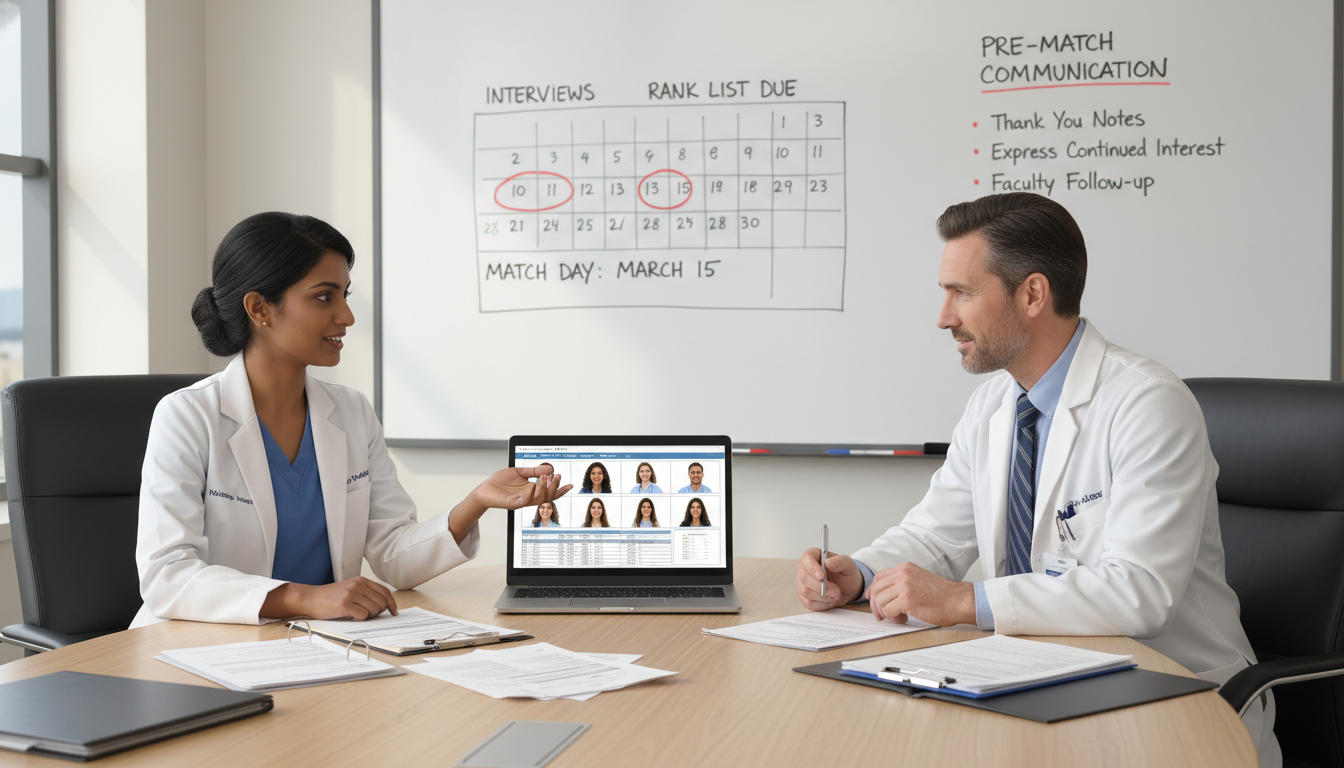
Pre-match communication in plastic surgery residency is one of the most confusing and anxiety-provoking parts of the application process. Between formal policies, informal practices, and the very real possibility of pre-match offers and early commitment, applicants often feel unsure about what is allowed, what is ethical, and what is strategically smart.
This guide is designed specifically for plastic surgery residency applicants—especially those targeting an integrated plastics match—to clarify expectations, protect you from missteps, and help you communicate professionally and confidently with programs.
Understanding Pre-Match Communication in Plastic Surgery
Pre-match communication refers to any contact between you and a residency program after your application is submitted but before the official Match results are released. This includes:
- Emails with program directors (PDs) or coordinators
- Conversations at interviews and second looks
- Phone calls or Zoom meetings after interviews
- Thank-you notes and follow-up messages
- Informal outreach via mentors on your behalf
- Rare but critical: discussion of pre-match offers or early commitment
Why Plastic Surgery Is Unique
Plastic surgery is a small, relationship-driven specialty. Compared to larger fields:
- Programs are fewer, and applicant pools are relatively tight-knit.
- Faculty across institutions often know each other by reputation.
- Rotations (home and away) are crucial, and your behavior and communication are remembered.
- The stakes are high: integrated plastics match spots are extremely limited, and a single program’s decision can make or break your outcome.
Because of this, every interaction—email, interview question, thank-you note—matters more. Programs pay close attention not only to your CV but to how you communicate, how you handle uncertainty, and how you respect boundaries.
Match Rules You Must Know
Regardless of specialty, all accredited programs and applicants are bound by NRMP (National Resident Matching Program) rules and, increasingly, APDS and ACS guidelines for surgical recruitment. These key principles apply:
- Programs cannot ask you to:
- State how you will rank them.
- Disclose where else you interviewed or will rank highly.
- Commit to them in exchange for a promised spot.
- You cannot:
- Ask for a guarantee of ranking position.
- Attempt to negotiate a pre-match deal that violates Match rules at NRMP-participating programs.
- Both sides may:
- Express interest.
- Clarify program details.
- Communicate professionally about fit, education, and logistics.
The gray area is where anxiety lives. You’ll hear phrases like “You’re ranking us highly, right?” or “We hope to see you here in July.” Knowing how to navigate that ambiguity is essential.
Types of Pre-Match Communication You’ll Encounter
Not all pre-match communication is equal. Some is routine and expected; other situations require extra caution.
1. Standard Administrative Communication
This includes:
- Interview invitations and scheduling logistics
- Updates about interview format, technical details, and agendas
- Reminders, thank-you auto-emails, and post-interview surveys
These are straightforward. Respond promptly, courteously, and concisely. Use professional language and avoid overly casual tone.
Example: Professional Reply to Interview Invite
“Dear [Coordinator Name],
Thank you very much for the invitation to interview at [Program Name]. I am delighted to accept and would be happy to participate on [date options]. Please let me know which time slot works best.
Best regards,
[Your Full Name], MS4
[Medical School]”
2. Thank-You Notes and Follow-Up Messages
Most integrated plastic surgery residency applicants send brief thank-you notes after interviews. While not required, they are common and, when done well, they can reinforce professionalism and interest.
General principles:
- Send within 24–72 hours.
- Keep it concise (1–3 short paragraphs).
- Reference specific aspects of the interview or program.
- Avoid any language that sounds like you are requesting special consideration.
Example: Appropriate Thank-You Note to a PD
“Dear Dr. [PD Name],
Thank you for the opportunity to interview with [Program Name] on [date]. I especially appreciated our discussion about the early exposure to microsurgery and the emphasis on graduated autonomy in the chief years.
The culture of mentorship and the strong collaboration between residents and faculty resonated with my goals for training. I am grateful for your time and consideration.
Sincerely,
[Your Full Name]”
Notice what’s not here: no mention of rank order, no implied commitment, and no attempt to pressure the PD for feedback.
3. Program-Initiated Post-Interview Contact
Programs may reach out after interviews for several reasons:
- Clarifying application details (research, publications, leaves).
- Inviting you to a “second look” (virtual or in-person).
- Sharing more information about the program’s strengths.
- Expressing general enthusiasm about your candidacy.
How to interpret these messages:
- Positive tone ≠ guaranteed high rank. Warm language is common and often genuine but not necessarily predictive.
- Responses should be polite and appreciative, not over-disclosing about your rank list.
- You can express that you’re “very interested” or that they are “one of your top choices,” but avoid precise rank statements unless you truly mean “I will rank you first.”

Pre-Match Offers, Early Commitment, and Ethics in Plastic Surgery
The terms pre-match offers and early commitment generate a lot of confusion in the integrated plastics match.
What Is a Pre-Match Offer?
In this context, a pre-match offer is when a program informally (or explicitly) indicates:
- “If you rank us number one, you can be confident we will rank you to match,” or
- “We would really like to have you; if you commit to ranking us first, we will commit to you informally.”
For NRMP-participating programs, formal pre-match contracts are not allowed. However, in some institutions or specific pathways (e.g., independent positions outside NRMP, or special institution-based commitments), there may be non-NRMP agreements. Always verify:
- Is the program in the Main Residency Match?
- Are they offering something outside the NRMP rules?
- Is this an integrated plastics match position or a separate track?
If you are unsure, speak confidentially with your home PD or an advisor you trust before responding.
Early Commitment: Yes, No, or Maybe?
An “early commitment” typically refers to:
- You telling a program you will rank them #1.
- A program strongly suggesting they will rank you to match if you do so.
A few key realities:
- No one can guarantee a match result. Rank lists interact in complex ways, and even a very strong applicant and program may not match if not truly aligned.
- Plastic surgery is small; dishonesty spreads fast. If you tell multiple programs they’re your #1, assume faculty will find out.
- Ethically, if you choose to tell a program “I will rank you first,” you should:
- Mean it.
- Be prepared to follow through.
- Be comfortable explaining that decision to mentors.
In many cases, it is enough to say:
- “Your program is one of my very top choices and an excellent fit for my goals.”
- “I can see myself thriving in your program and would be excited to train there.”
These convey enthusiasm without binding you to a specific rank promise.
How Programs View “Signals” of Interest
In an ultra-competitive specialty like integrated plastics, programs try to gauge your:
- Sincerity of interest (Do you truly want to be here, or is this just one of many?)
- Fit with their culture and clinical volume
- Likelihood to stay the full duration and contribute academically
Signals of interest may include:
- Away rotation performance
- Thoughtful interview questions
- Specific follow-up emails referencing their curriculum, case mix, or research
- Engagement with residents during socials
- Reasonable, professional communication from your home mentors
Remember: You never need to oversell or exaggerate. Calm, consistent, and honest interest is more powerful than grand statements you can’t back up.
How to Communicate with Programs Before the Match: Practical Strategies
This section focuses on what you can actively do to navigate pre-match communication with confidence.
1. Clarify Your Own Priorities First
Before you send any “interest” signals:
- List what matters most to you:
- Location (family, partner, cost of living)
- Case volume and operative exposure
- Microsurgery vs. hand vs. craniofacial emphasis
- Resident wellness and culture
- Research infrastructure and dedicated time
- Sort your programs into informal tiers:
- Strongly preferred
- Good fit
- Acceptable but less ideal
These internal tiers help you tailor your communication realistically and avoid promising what you can’t deliver.
2. Craft Professional, Targeted Interest Emails
Should you ever email a PD or program expressing particular interest after interviews? Yes—but selectively.
When it may be appropriate:
- You genuinely feel a certain program is among your top choices.
- You have a clear, specific reason (clinical interest, mentorship, research fit).
- You’re not sending similar emails to 20 programs with identical wording.
Sample Structure for a Targeted Interest Email
Subject: Appreciation and Continued Interest – [Your Name]
“Dear Dr. [PD Name],
Thank you again for the opportunity to interview at [Program Name]. After reflecting on my interviews and learning more about the program, I wanted to express my continued strong interest.
I was especially impressed by [specific feature: e.g., ‘the high volume of complex reconstructive cases at your county hospital’ or ‘the integrated PGY-1 plastics exposure and the structured microsurgery curriculum’]. This aligns closely with my goals to pursue a career in [e.g., microsurgery, academic plastic surgery, craniofacial reconstruction].
I would be honored to train at [Program Name] and deeply appreciate your consideration.
Sincerely,
[Your Name]
[Medical School]”
This message:
- Signals sincere, informed interest.
- Respects boundaries; no pressure or expectation for a reply.
- Can be sent to several (not all) of your top programs.
3. Avoid Common Pitfalls in Program Communication Before Match
Pitfall 1: Overcommunication
- Daily or repeated emails, multiple “updates” (minor abstracts, etc.) without substantive change, or excessive follow-up can appear needy or unprofessional.
- Limit outreach to:
- Thank-you notes.
- One or two targeted follow-ups if there is something important to share (new publication, major award, Step score release).
Pitfall 2: Vague or Dishonest Statements
Avoid:
- “I will definitely rank your program highly” when you’re uncertain.
- Telling multiple programs they are your “number one” or “top choice” when that’s untrue.
- Agreeing to wording suggested by faculty that doesn’t reflect your actual intentions.
Pitfall 3: Violating Confidentiality or Bad-Mouthing Other Programs
Plastic surgery is small. Emails that disparage other programs, cities, or applicant peers can rapidly damage your reputation.
Focus only on what you value about the program you’re writing to, not what you dislike elsewhere.

Working with Mentors and Home Programs on Pre-Match Strategy
You are not meant to navigate this alone. The best applicants in the integrated plastics match use their mentors strategically and transparently.
How Mentors Can Help
Program Communication Before Match
- Home PDs or faculty may reach out to programs where they have personal connections.
- They can share their positive experiences with you, clarify your strengths, and vouch for your professionalism.
Ensure:
- You know who is contacting which programs on your behalf.
- Messages sent by faculty align with your true preferences and rank strategy.
Interpreting Signals from Programs
- Mentors with experience in plastic surgery residency selection can help decode:
- “We really liked you” vs. “You are our top choice.”
- The tone and timing of PD emails or calls.
- They can provide a reality check so you don’t over- or under-interpret vague language.
- Mentors with experience in plastic surgery residency selection can help decode:
Ethical Guardrails
- A trusted advisor can tell you honestly if a proposed email or “interest statement” crosses a line or seems misleading.
- They can help you decline or navigate pre-match offers that seem to violate norms or your comfort.
How to Involve Mentors Effectively
Schedule a dedicated meeting in the post-interview, pre-rank period.
Bring:
- A tentative rank list.
- Copies of any communication you’ve received that feels ambiguous.
- Drafts of emails you’re considering sending for feedback.
Be honest about:
- Which programs you truly prefer.
- Any pressure you feel from faculty or family.
- Any “nudges” you’ve received from programs regarding early commitment.
This is also the time to address Plan B (e.g., re-applying, considering general surgery first, or research years) in case the integrated plastics match doesn’t work out.
Frequently Asked Questions About Pre-Match Communication in Plastic Surgery
1. Is it ever okay to tell a program they are my number-one choice?
Yes—but only if:
- You are genuinely committed to ranking them first.
- You are comfortable standing by that statement if asked by mentors.
- You do not tell more than one program the same thing.
A possible phrasing:
“After careful reflection, I plan to rank [Program Name] as my first choice. I believe your program’s [specific features] and mentorship culture align best with my career goals in plastic surgery. I would be honored to train with your team.”
You should not expect any guarantee in return. Programs may appreciate the clarity but may still avoid promising anything explicit to remain compliant with Match rules.
2. Do I need to send thank-you emails to every interviewer?
It’s not mandatory, but it is customary in many plastic surgery programs. Options:
- Individual emails to each faculty interviewer and the PD.
- A single email addressed to the PD (and possibly the coordinator), thanking the whole team.
If time is limited, prioritize:
- Program director.
- Chair or division chief.
- Faculty you had extended or particularly meaningful conversations with.
Quality matters more than quantity; generic, copy-pasted emails to 20 faculty are less impactful than a few thoughtful messages.
3. How should I respond if a program hints that I should rank them highly?
If a faculty member or PD says something like:
- “We hope you’ll rank us very highly,” or
- “We think you’d be a great fit here and would love to have you,”
You can respond:
“Thank you very much. I truly enjoyed learning more about your program and feel it would be an excellent environment for my training.”
You do not need to commit to ranking them first or disclose your rank list. Keep your response appreciative, professional, and non-committal unless you are ready to make a clear, truthful statement.
4. Can programs contact me after the interview day, and should I read into it?
Yes, some programs will reach out:
- To offer a second look.
- To clarify application details.
- To share enthusiasm.
However:
- Lack of contact does not mean lack of interest.
- Extra contact does not guarantee a high rank.
Read post-interview communication as mildly positive signals, but build your rank list based on:
- Program fit.
- Training quality.
- Your personal priorities.
- What you experienced on the interview day and, if applicable, on rotations.
Final Thoughts
Pre-match communication in plastic surgery is less about clever tactics and more about integrity, clarity, and professionalism.
If you:
- Understand the rules and ethical boundaries,
- Communicate honestly with programs and mentors,
- Avoid overpromising or overselling,
- And ground your decisions in what you know about yourself and each program,
you will navigate this challenging phase of the integrated plastics match with confidence—and you’ll arrive at residency with your reputation and relationships intact.
Use every email, call, and conversation to demonstrate not just that you are a strong candidate, but that you are the kind of future plastic surgeon others will trust, collaborate with, and gladly call a colleague.