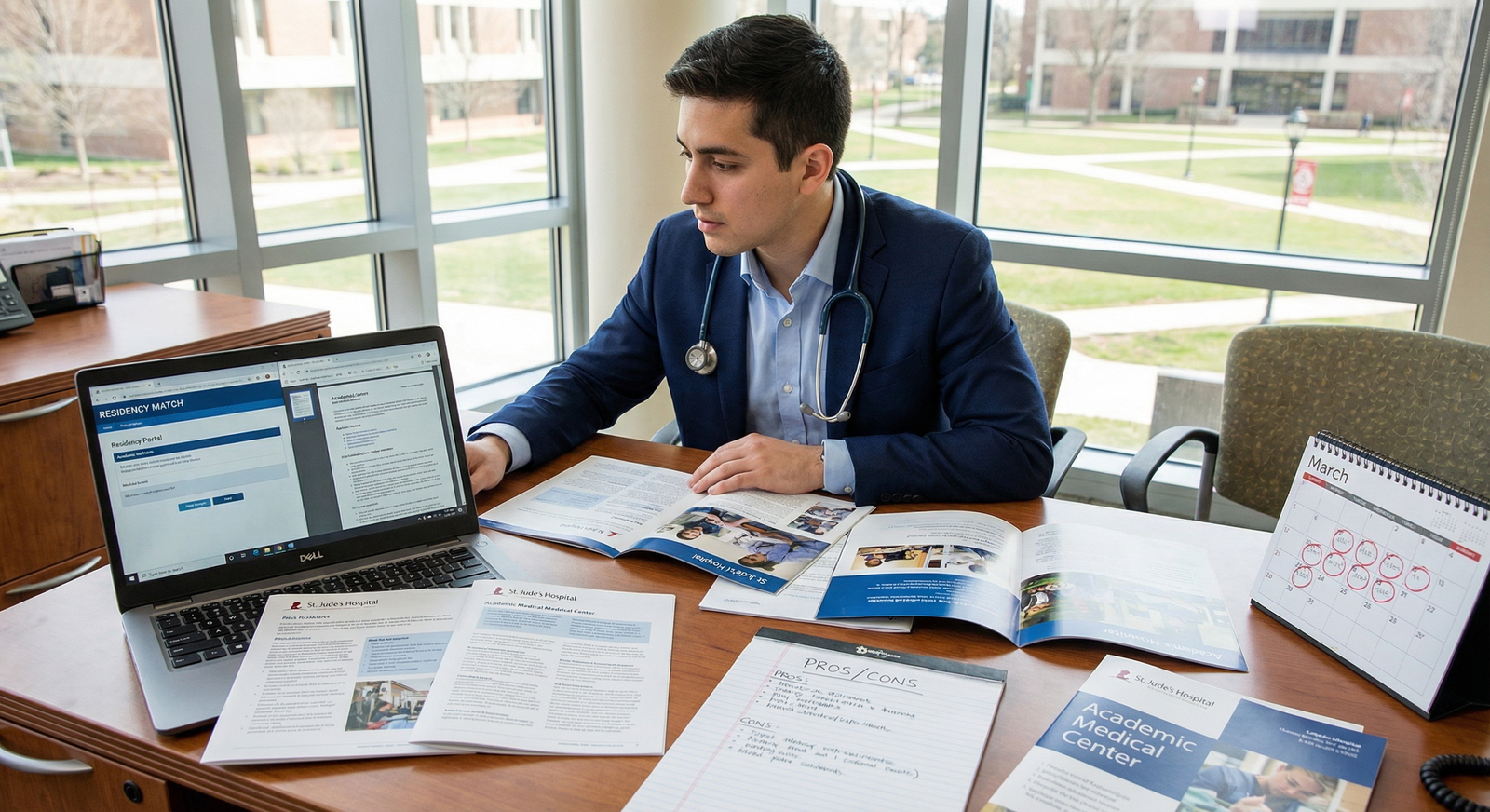
Understanding Pre-Match Communication in Preliminary Surgery
Pre-match communication in preliminary surgery is uniquely nuanced. Preliminary surgery year positions often have different timelines, goals, and levels of urgency compared with categorical surgery spots. Applicants may encounter informal interest emails, “rank-to-match” hints, and even pre-match offers and early commitment conversations—sometimes before they fully understand the implications.
This guide focuses on how to handle program communication before match, especially for those targeting a prelim surgery residency or considering a preliminary surgery year as a bridge to categorical positions, another specialty, or simply to gain strong operative and clinical experience.
We will walk through:
- How pre-match communication works in the preliminary surgery space
- Types of messages you might receive—and what they really mean
- How to reply professionally and strategically
- When (and if) to consider early commitment outside the Match
- Common pitfalls and how to avoid them
Important disclaimer: Policies and legality around pre-match offers vary by country, state, and even institution, and are governed in the U.S. by NRMP rules. Always review the latest NRMP Applicant Agreement and your specific country or region’s regulations, and when in doubt, seek advice from your dean’s office or GME office.
How Prelim Surgery Differs from Categorical Surgery in the Match
Preliminary surgery is structurally and strategically different from categorical general surgery, and that difference shapes what pre-match communication looks like.
1. Role of a Preliminary Surgery Year
A preliminary surgery year can serve several purposes:
- Gap or bridge year for applicants reapplying to another specialty (e.g., radiology, anesthesia, urology, IR, ortho)
- Step toward categorical general surgery or other surgical subspecialties
- Visa-friendly or “foot in the door” year for international graduates seeking U.S. training
- Skill-building year for those wanting strong operative/ICU exposure before another path (e.g., emergency medicine, critical care research, military service)
Because prelim positions are typically one-year contracts and not guaranteed progression, programs are often juggling:
- Uncertain future staffing needs
- Variable attrition from categorical residents
- Service coverage across busy surgical services
This leads to more fluid and sometimes time-pressured communication before match, including late-season interviews, quick decisions, and, occasionally, pre-match offers.
2. Match Dynamics for Prelim Surgery Positions
Key differences from categorical spots:
- More positions may be unfilled after the Match and picked up in SOAP
- Some programs decide late how many prelims they truly need
- A significant portion of prelim positions are offered to applicants who did not match elsewhere
- International medical graduates (IMGs) and DOs may be heavily represented, particularly in non-university settings
All of this means:
- Programs may reach out actively to candidates they see as reliable, hard-working, and likely to accept.
- Applicants may feel pressure to signal strong interest or accept an early commitment, especially if they are concerned about matching at all.
Understanding this environment helps you interpret the tone, timing, and intent of the communications you receive.
Types of Pre-Match Communication You May Encounter
Not all messages are equal. Many applicants misinterpret routine or generic communication as a guarantee—or dismiss meaningful signals because they seem informal.
1. Administrative and Logistical Messages
Examples:
- “Thank you for interviewing with us; please complete this survey.”
- “Final reminder to upload your photograph.”
- “We enjoyed meeting you; feel free to reach out with questions.”
Interpretation:
- These are standard communications. They indicate you’re in the pool, but they say nothing about your rank position or a pre-match offer.
- Respond courteously and promptly when appropriate, but don’t over-read them.
2. “We Really Liked You” / Positive Feedback Emails
Examples:
- “Our committee was very impressed with you and we think you would be a great fit here.”
- “You are among the candidates we are strongly considering for one of our preliminary positions.”
- “We plan to rank you highly on our list.”
Interpretation:
- These are generally encouraging but non-binding.
- Programs are often careful not to violate NRMP rules around commitments.
- In prelim surgery, particularly in community or non-NRMP programs (if applicable), these can occasionally be semi-coded signals of strong intent, but still not guarantees.
Your response should be:
- Professional, appreciative, and non-committal regarding rank specifics:
- “Thank you for your kind note. I truly enjoyed meeting your team and was impressed by the breadth of operative experience and collegial atmosphere. Your program remains one of my top choices, and I would be honored to train there.”
Avoid:
- Asking directly, “Where will you rank me?” or stating, “I will rank you #1” unless you are absolutely certain and understand the implications of that commitment.
3. “Rank-to-Match” Style Messages
Examples:
- “If you rank us highly, you have an excellent chance of matching here.”
- “We will rank you in a position where we expect to match with you, provided you rank us competitively.”
- “You would match with us if you place our program near the top of your list.”
Interpretation:
- These are not official contracts, but they are stronger signals than generic positive feedback.
- Programs may be trying to secure reliable prelim residents for service coverage.
- Still, there is no guarantee. The program might send similar messages to several candidates.
How to respond:
- Express appreciation and genuine interest if true:
- “I appreciate your message and the confidence you’ve expressed in my candidacy. I remain very interested in your preliminary surgery residency and believe your program aligns well with my clinical and educational goals.”
- Avoid overly specific promises like “I will rank you #1” unless that is your firm decision.
4. Explicit Pre-Match Offers / Early Commitment Conversations
These may appear in two main forms:
Within NRMP rules (U.S.-based NRMP-participating programs):
- Program expresses strong interest but does not ask you to withdraw from the Match or accept outside NRMP.
- They may say: “We would love to have you here; we hope you will rank us highly.”
Outside or at the Edge of NRMP Rules:
- Program asks you to commit verbally to ranking them #1, or to withdraw from certain applications.
- Rarely, some non-NRMP or institutionally exempt positions (e.g., certain military or non-U.S. programs) may explicitly offer a contract outside the Match.
Interpretation:
- In an NRMP-bound context, binding pre-match offers are not allowed for positions participating in the Match.
- A program can express interest and hopes, but cannot lawfully guarantee you a Match position or require your commitment prior to the official Match process.
When you sense you’re being pushed into early commitment:
- Pause and seek guidance from:
- Your dean’s office or student affairs
- A trusted mentor in surgery
- Your home program’s GME or NRMP advisor

Crafting Professional Responses: What to Say and What to Avoid
Your email and phone responses are a crucial part of program communication before match. They shape how programs perceive your professionalism, maturity, and judgment.
1. Core Principles for All Responses
- Be prompt: Aim to reply within 24 hours, especially in late January–February when programs finalize rank lists.
- Be clear but honest: You can express strong interest without making promises you don’t intend to keep.
- Keep it concise: 1–2 short paragraphs is usually enough.
- Maintain professionalism: Formal greetings, clear sign-off, no slang.
Sample structure:
- Thank them for the communication and for the interview.
- Reflect briefly on what you liked about the program.
- Convey your level of interest truthfully (without overcommitting).
- Invite further contact if needed.
2. Example Responses to Common Scenarios
Scenario A: Generic Positive Feedback
Program email:
“We enjoyed meeting you and were impressed with your background. We think you’d be a great fit for our preliminary surgery residency. Please let us know if you have any questions.”
Good response:
Dear Dr. [Last Name],
Thank you very much for your kind note and for the opportunity to interview with [Program Name]. I was particularly impressed by the operative exposure your preliminary residents receive and the supportive culture among the faculty and residents.
I remain highly interested in your program and would be excited to contribute as a preliminary surgery resident. Please let me know if I can provide any additional information.
Sincerely,
[Your Name], [Credentials]
AAMC ID: [XXXXXXX]
This response:
- Shows appreciation
- Highlights program-specific details (signals genuine interest)
- Expresses strong but non-committal enthusiasm
Scenario B: Rank-to-Match Style Message
Program email:
“As we finalize our rank list, I want to let you know you are among our top candidates for a preliminary surgery spot. If you rank us highly, we believe there is an excellent chance we could work together next year.”
Good response:
Dear Dr. [Last Name],
Thank you for sharing this update and for your confidence in my application. I greatly enjoyed my visit and continue to feel that [Program Name] offers an outstanding environment for a preliminary surgery year, especially given the high-volume operative experience and strong mentorship you described.
I remain very interested in training at [Program Name] and will give your program serious consideration when finalizing my rank list.
With appreciation,
[Your Name]
This:
- Acknowledges their signal
- Emphasizes real interest
- Avoids premature commitment
Scenario C: Pressure Toward Early Commitment
Program call or email:
“We really want you here. If you can assure us you’ll rank us #1, we’ll rank you in a position where you should definitely match with us for a preliminary surgery year.”
Cautious, professional response:
Dear Dr. [Last Name],
Thank you for your generous feedback and for expressing such strong interest in my candidacy. I was very impressed with [Program Name] and could absolutely see myself thriving there as a preliminary surgery resident.
In accordance with NRMP guidelines, I plan to finalize my rank order list after considering all of my interviews carefully. That said, your program remains one of my top choices, and I truly appreciate the support and enthusiasm you’ve expressed.
Sincerely,
[Your Name]
This:
- Respects NRMP rules
- Signals serious interest
- Protects you from making binding verbal commitments
3. What to Avoid Saying
- Absolute promises you aren’t sure about:
- “I guarantee I will rank you #1” (unless it is true and you understand the ethical implications).
- Rank comparisons:
- “I am ranking you above all other programs” to more than one program.
- Desperation signals:
- “I will accept any position you offer, even outside the Match, I just need a spot.”
- Informal or emotional responses:
- “OMG thank you so much, this made my day!” (Even if true, keep the tone professional.)
Strategy: Using Pre-Match Communication to Your Advantage
Pre-match communication in a prelim surgery residency context should inform, not control, your decisions.
1. Calibrating the Signal: How Much Does This Email Really Mean?
Ask yourself:
- Is it personalized or generic?
- Does it reference specific aspects of your application or interview?
- Is it from the PD, APD, or coordinator?
- Does it include any “rank-to-match” type language?
In general:
- PD or APD emails with specific praise carry more weight than mass emails.
- Even strong messages are not guarantees—especially if the program is popular.
Use these communications to:
- Refine your sense of where you are competitive.
- Set realistic expectations about match probabilities.
- Guide what you share in your own “interest signals” back to programs.
2. Deciding How Strongly to Signal Interest
For a preliminary surgery year, your strategic goals may vary:
- If prelim surgery is your top priority (e.g., you want to stay in surgery long term or in that specific institution):
- It can be appropriate to send one program a single, clear statement of primacy:
- “I plan to rank [Program Name] as my top choice for a preliminary surgery position.”
- Do this only if it’s truly your top choice.
- It can be appropriate to send one program a single, clear statement of primacy:
- If prelim is your backup plan while you aim for categorical or another specialty:
- It’s acceptable to express strong interest without specifying rank order.
- Focus on fit, learning environment, and how prelim training advances your goals.
3. Balancing Early Commitment vs. Keeping Options Open
You may be tempted to lock in any hint of security, especially if:
- Your scores or attempts are borderline
- You are an IMG or DO with limited interviews
- You are reapplying and anxious about repeating the cycle
However:
- Overcommitting to one program too early can limit your flexibility, especially if:
- Another program later shows more genuine fit or better opportunity.
- You discover concerning red flags (malignant culture, poor support, unclear visa policies).
Your approach should be:
- Honest but non-binding language for most programs.
- Possibly one clear “#1” signal if ethically appropriate and if you’re certain.
- No participation in any arrangement that violates Match rules or makes you uncomfortable.

Special Considerations for Specific Applicant Situations
Because preliminary surgery attracts a wide variety of applicants, communication strategy can differ slightly depending on your context.
1. For International Medical Graduates (IMGs)
- Visa policies: Clarify early (before rank list) whether the program sponsors the type of visa you need (J-1 vs. H-1B). Communication about visas is common and appropriate.
- Show reliability and commitment: Programs worry about prelims leaving mid-year or not adapting well. Use your emails and conversations to emphasize:
- Work ethic
- Teamwork
- Prior U.S. clinical experience, if any
- Ask clarifying but not aggressive questions:
- “Could you share how previous preliminary residents have transitioned to categorical positions or other specialties after their year with you?”
2. For Reapplicants or Those Switching Specialties
If you’re using a preliminary surgery year as a bridge:
- Be transparent but strategic in how you describe your goals:
- Programs understand that many prelims are reapplying elsewhere.
- Emphasize how you’ll be a strong team member during that year, even if your long-term plan is a different specialty.
- In your pre-match communication:
- Highlight your resilience and growth since your last cycle.
- Avoid sounding like you view prelim solely as a placeholder; show genuine interest in surgical training and patient care.
3. For Applicants with Limited Interviews
If you have only a small number of prelim interviews:
- Consider sending a brief, well-crafted letter of interest to your most desired program after the interview, even if they haven’t reached out first.
- Focus on:
- Why their specific program is a strong fit
- How your skills align with their needs
- Your readiness to work hard and learn
Example:
Dear Dr. [Last Name],
I wanted to follow up after my interview on [Date] to reiterate my strong interest in the preliminary surgery position at [Program Name]. The combination of robust operative experience, early responsibility, and supportive faculty mentorship strongly aligns with my goals for the upcoming year.
I believe my prior [ICU research / surgical sub-internship / international surgery experience] and strong work ethic would allow me to contribute meaningfully to your team. Thank you again for your consideration.
Sincerely,
[Your Name]
This kind of message can put you on the radar of a busy PD finalizing rank lists.
Frequently Asked Questions (FAQ)
1. Is it ethical or allowed to tell a program they are my top choice?
Yes, if it is true. The NRMP allows applicants and programs to express interest and even state ranking intentions, as long as:
- There is no coercion.
- You do not make false statements.
If you tell a preliminary surgery program they are your “#1 choice,” you should follow through and rank them accordingly. It’s considered unethical to send that same message to multiple programs.
2. Do pre-match emails from programs mean I am guaranteed to match there?
No. Even very enthusiastic emails are not guarantees. Rank lists can change, other candidates can rank the program higher, and institutional needs can shift. Treat positive communication as a good sign, not a promise. Still create a thoughtful, realistic rank list that reflects both your preferences and your assessment of competitiveness.
3. Should I reach out to programs that haven’t contacted me after my interview?
Yes, a single, courteous follow-up to express continued interest is reasonable, especially in a preliminary surgery context where service coverage needs are high. Keep it:
- Short (1–2 paragraphs)
- Specific to that program
- Free of pressure (avoid asking where you’ll be ranked)
If the program doesn’t respond, do not send multiple follow-ups.
4. How do pre-match offers work for prelim surgery spots outside the NRMP?
Some institutions, certain military programs, or non-U.S. systems may not participate in NRMP and can legally offer positions outside the Match. In those scenarios:
- Offers may be legally binding job contracts.
- Ask for clarity in writing about:
- Duration and terms (exactly 1 year? any renewal options?)
- Salary, benefits, and call schedule
- Visa sponsorship if applicable
Before accepting an early commitment outside the Match, carefully consider:
- Whether this aligns with your long-term goals
- If the institution has a track record of supporting prelim residents’ next steps
And when in doubt, seek advice from experienced mentors who understand both surgery training and the Match landscape.
Handled thoughtfully, pre-match communication in preliminary surgery can be a powerful tool rather than a source of confusion. Use it to gather information, express genuine interest, and maintain professionalism—while protecting your integrity, your options, and your long-term career goals.