Understanding Pre-Match Communication in Neurology as a US Citizen IMG
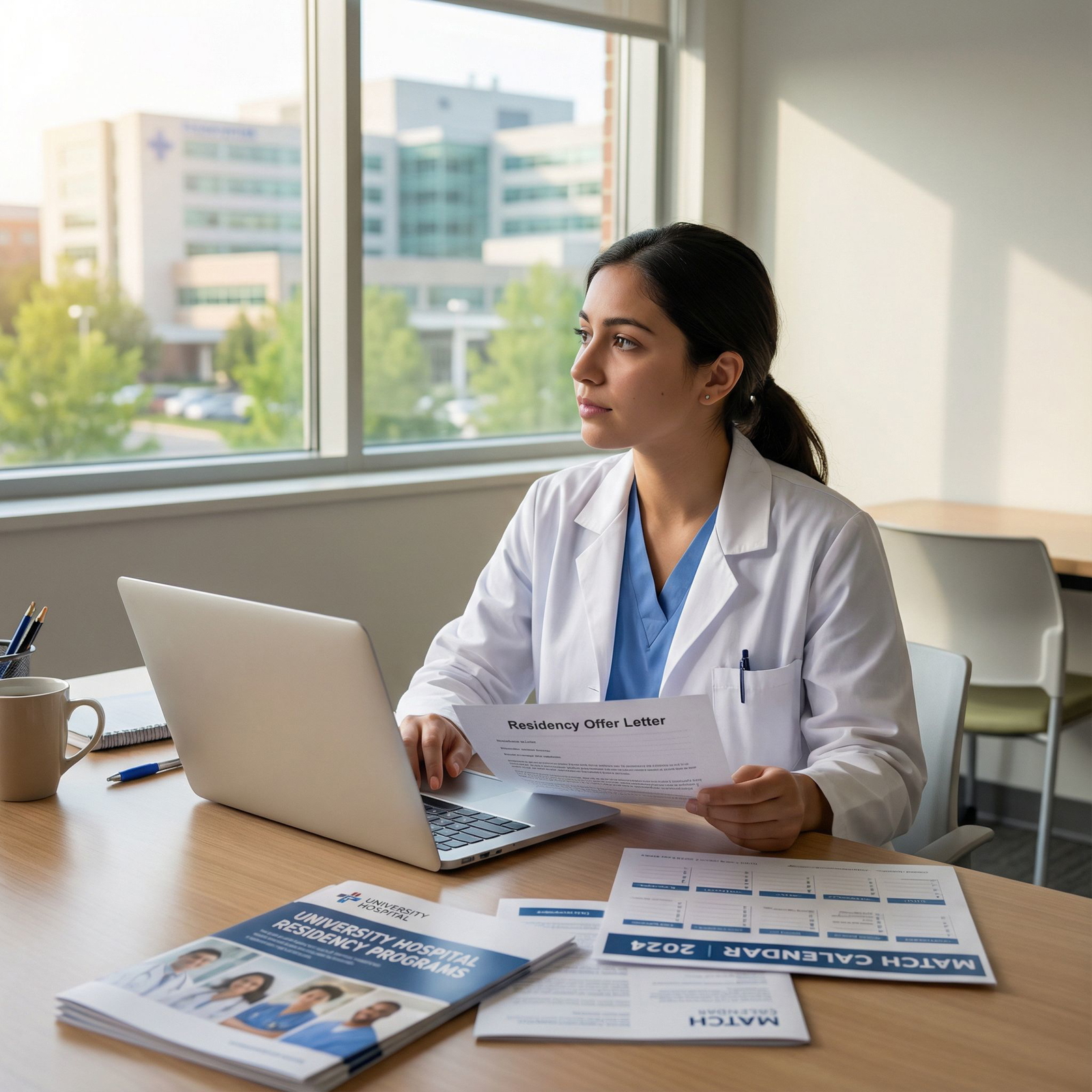
Pre-match communication is one of the most confusing and anxiety-provoking parts of the neuro match process, especially for a US citizen IMG or American studying abroad. You’ve worked hard on exams, rotations, and letters; now you’re trying to interpret every email, phone call, and informal comment to understand what it really means.
This article will walk you through:
- What pre-match communication actually is (and what it is not)
- How it specifically plays out in neurology residency
- What you can and can’t say under NRMP rules
- How pre-match offers and “early commitment” work in neurology (including non-NRMP situations)
- Concrete email templates and talking points
- How a US citizen IMG can strategically use communication to improve match chances
Throughout, the emphasis is on being ethical, professional, and effective.
1. What Counts as Pre-Match Communication in Neurology?
Pre-match communication means any interaction between you and a residency program that happens before the official NRMP Match results—from ERAS submission through the rank list deadline.
This includes:
- Emails to or from the program director (PD), associate PD, or coordinator
- Phone calls and Zoom calls
- Conversations during or right after the interview
- Follow-up thank-you notes and “interest letters”
- Updates (new scores, publications, visas, etc.)
- Any talk of “rank,” “commitment,” “pre-match,” or “early contract”
Common Types of Pre-Match Communication
You reaching out to programs
- Initial interest emails (especially with strong ties or home/affiliated programs)
- Updates: Step scores, publications, graduation, new evaluations
- Letters of interest or intent late in the season
Programs reaching out to you
- Interview invitations or waitlist messages
- Follow-up “just checking your interest level” emails
- Post-interview thank-you notes or “we enjoyed meeting you” messages
- Rarely, discussions that feel like pre-match offers or early commitment language
Neurology-Specific Context
Neurology has grown more competitive, but it still tends to be friendlier and more transparent than some surgical specialties. For a US citizen IMG or American studying abroad:
Programs may be particularly interested in:
- Demonstrated commitment to neurology (electives, research, publications)
- US clinical experience in neurology
- Reliable long-term interest (someone likely to stay in neurology and in the region)
You may rely more heavily on:
- Strong pre-interview outreach to get noticed
- Thoughtful post-interview communication to demonstrate genuine interest
However, regardless of specialty, programs must follow NRMP rules about what they can and cannot say.
2. Rules, Ethics, and Reality: What’s Allowed Before the Match?
Understanding the rules protects you from feeling pressured into commitments that are not allowed and helps you communicate confidently.
The NRMP Framework (Applies to Most Neurology Programs)
For almost all ACGME-accredited neurology residencies in the US, positions are filled through the NRMP Match. That means:
- No program can offer you a contract outside the Match for those NRMP positions.
- No binding pre-match offers or “early contracts” are allowed for NRMP-participating positions.
- You are free to express your interest and how you plan to rank a program, and they are free to do the same—but:
- Neither side can demand or require a statement of ranking,
- and no statement can be binding.
What Programs Cannot Legally Do
Programs cannot:
- Ask: “Where are you ranking us?”
- Say: “If you rank us first, we will rank you to match.”
- Offer: “We will give you a contract now if you commit before the Match.”
- Threaten: “If you interview elsewhere or don’t respond, we will not rank you.”
If this happens, you are not required to agree, and you can (if needed) confidentially report it to the NRMP.
What Programs Can Say
Programs may:
- Tell you: “We enjoyed meeting you.”
- Indicate: “You are a strong candidate for us.”
- Sometimes hint: “We plan to rank you highly,” or “We hope you will rank us highly.”
- Ask: “Are you still interested in our program?”
This is non-binding “recruitment-style” language.
What You Can and Cannot Say
You are allowed to:
- Express genuine interest:
- “I plan to rank your program highly.”
- “I am very interested in training at your program.”
- Make a personal, non-binding statement:
- “You are my top choice” or “I intend to rank your program first.”
You are not entering a contract when you say this; the NRMP algorithm ultimately determines where you match. However:
- Ethically, you should not tell more than one program that they are your “top choice” or “number one.”
- If you’re unsure, use softer—but still positive—language (see templates below).
For a US citizen IMG, your reputation and honesty matter. PDs talk to each other; sending multiple conflicting “you are my #1” letters can backfire.

3. Strategic Communication Before, During, and After Interviews
Pre-match communication is not just about “pre-match offers.” It’s about structured, professional communication throughout the season.
Before Interviews: Standing Out as a US Citizen IMG
If you are an American studying abroad, your first challenge is often getting the interview.
Use targeted, professional outreach:
When to Email Before Interviews
- You have a clear tie to the program or region:
- You grew up in the area, your family lives nearby, or you went to college there.
- You did an away rotation or observership in that department.
- You have a faculty mentor at that institution advocating for you.
- You recently had a significant update:
- Step 2 CK score improvement, publication, US neurology rotation, graduation.
Sample Pre-Interview Interest Email
Subject: ERAS Application – [Your Name], US Citizen IMG with Neurology Interest
Dear Dr. [Program Director Last Name] and Dr. [Associate PD Last Name],
My name is [Your Name], a US citizen IMG from [Your Medical School, Country]. I have applied to the [Program Name] Neurology Residency this cycle and wanted to briefly express my strong interest in your program.
I completed [X weeks] of US clinical experience in neurology, including [specific rotation or institution], and am particularly drawn to your program’s strengths in [e.g., stroke care, epilepsy, neurocritical care, resident research]. I have a long-term goal of practicing neurology in [region/state], and as a US citizen IMG, I am fully eligible to work in the US without visa sponsorship.
If my application is under consideration, I would be truly honored to interview and learn more about how I can contribute to your team.
Thank you very much for your time and consideration.
Sincerely,
[Your Name], MD (expected [Year])
AAMC ID: [ID]
This type of message is short, respectful, and focused on fit.
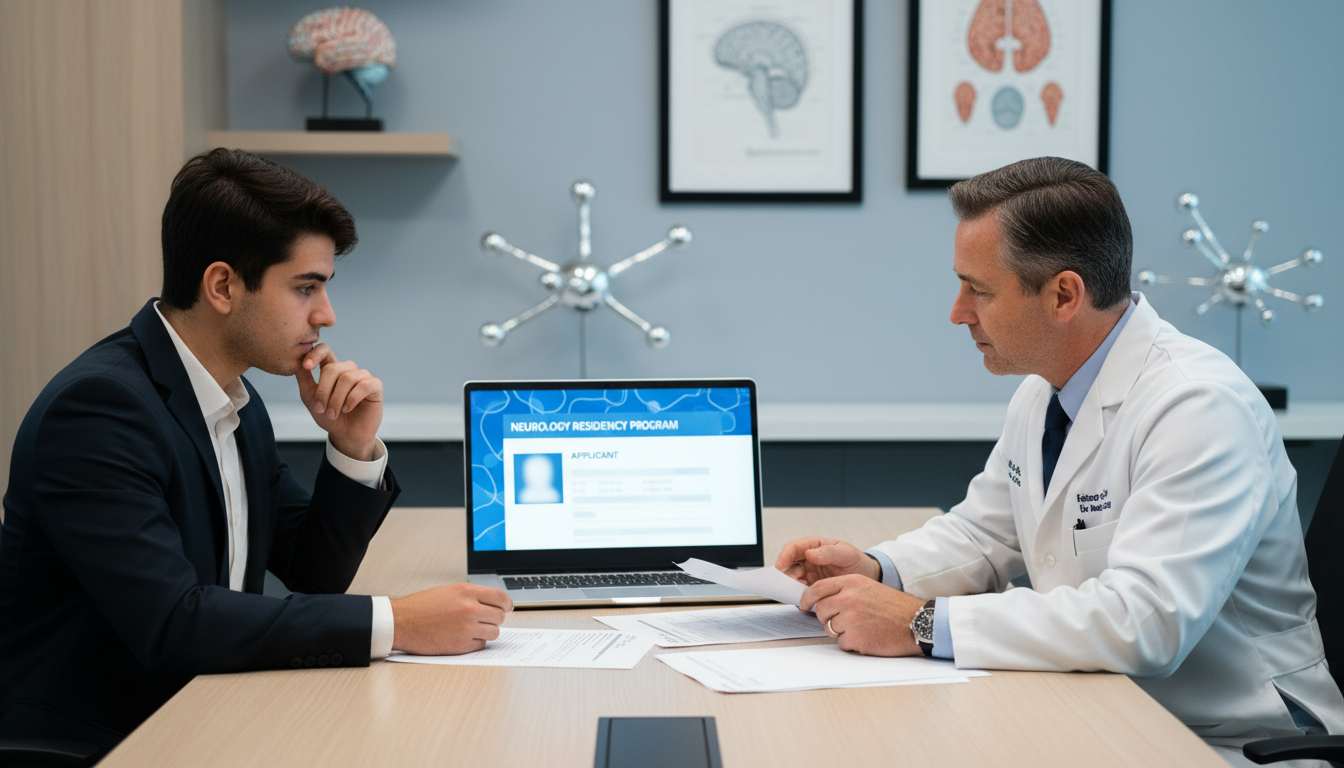
During the Interview: Reading and Responding to Signals
On interview day, programs may:
- Give generic positive feedback: “You’re a strong candidate.”
- Use vague enthusiasm: “We’d be happy to have you here.”
- Rarely, use stronger language: “We will likely rank you highly.”
As a rule:
- Assume all such statements are non-binding.
- Do not ask directly: “Am I ranked to match?” or “How high will you rank me?”
- Focus instead on:
- Asking thoughtful questions
- Demonstrating your genuine interest in neurology and their program
- Understanding the culture and training environment
After the Interview: Thank-You Notes and Updates
Thank-You Emails
- Send within 24–72 hours of each interview.
- Keep them brief, personalized, and specific.
Sample Post-Interview Thank-You Email
Subject: Thank You – [Interview Date], Neurology Residency
Dear Dr. [Last Name],
Thank you very much for the opportunity to interview at [Program Name] on [date]. I appreciated learning more about your curriculum, especially the [e.g., dedicated EEG rotation, continuity clinic model, research track].
I was particularly impressed by [specific aspect discussed during the day], and I can clearly see myself growing as a neurologist in your program’s supportive and academically rigorous environment.
I remain very interested in [Program Name] and would be honored to train with your team.
Sincerely,
[Your Name]
Updates During the Season
You can email programs (especially those where you interviewed) when you have:
- New US neurology clinical experience
- New publications, abstracts, or presentations in neurology
- Updated Step 2 CK score or other exam completion
- Relevant awards or significant achievements
Keep updates concise and directly relevant to neurology or clinical performance.
4. Pre-Match Offers, Early Commitment, and Non-NRMP Situations
For standard ACGME-accredited neurology residencies in the US, true pre-match offers are generally not allowed because they participate in the NRMP Match. However, you might still encounter situations that feel like early commitment.
Understanding “Pre-Match Offers” in Neurology
In some specialties and in some prior eras, “pre-match offers” meant:
- A formal contract offered before the NRMP Match
- Acceptance that took the seat out of the Match process
Currently, for accredited neurology programs that are NRMP-participating, this is not permitted. Still, you may see:
- Non-NRMP positions (rare in US neurology, sometimes in combined research fellowships, non-ACGME programs, or pre-residency fellowships)
- Outside-the-US neurology training programs offering positions on a different system
- Categorial vs. advanced positions where some confusion arises
If a US neurology program participating in the NRMP explicitly offers you a contract outside the Match, that is likely a violation and you should approach carefully.
Early Commitment Language: What It Really Means
You might hear phrases like:
- “We are very interested in you and hope you will rank us highly.”
- “If you rank us highly, we anticipate ranking you to match.”
- “We’d love to have you here next year.”
These are not binding pre-match offers. You should:
- Thank them for their interest
- Express your appreciation and interest
- Still rank programs in the order of your true preference
The NRMP algorithm is applicant-favoring; your best strategy is always to rank based on where you most want to train, not on perceived chance.
When a Program Asks for “Early Commitment” Informally
Sometimes, a program might hint:
- “We want to make sure you are serious about us.”
- “Where do we stand on your list?”
You can respond with honest but non-committal language, unless they are truly your #1 choice:
If they are your true #1 program:
“I am very enthusiastic about your program, and I intend to rank [Program Name] first on my rank list.”
If you are very interested but not certain:
“I remain very interested in [Program Name] and anticipate ranking your program highly.”
Avoid giving false guarantees.
Special Considerations for US Citizen IMG Applicants
As a US citizen IMG, early communication often serves to:
- Clarify that you do not need a visa, which can be an advantage
- Demonstrate your seriousness and long-term plans to practice neurology in the US
- Highlight any US-based ties, such as family, prior education, or long-term regional plans
In all communication, emphasize:
- Your neurology commitment (rotations, research, long-term goals)
- Your reliability and professionalism
- Your ability to adapt quickly to US healthcare systems (citing concrete examples)

5. How to Use Pre-Match Communication Strategically (Without Overdoing It)
The goal is to enhance your neuro match chances, not to annoy programs or violate norms.
General Principles
Be concise and purposeful.
- Every email should have a clear reason (thank you, update, interest, clarification).
Respect boundaries.
- Avoid repeated follow-ups if you’ve had no response.
Be honest and consistent.
- Do not send conflicting “you are my #1” messages.
Personalize where it matters.
- Refer to specific program features that align with your neurology goals.
Remain professional even under stress.
- Avoid emotional, overly personal, or demanding language.
Practical Communication Timeline for a US Citizen IMG in Neurology
1. Application Submission (September)
- Optional: A few targeted interest emails to key programs where you have ties, away rotations, or special fit.
2. Interview Invitations (October–January)
- Respond quickly and professionally to invitations.
- Avoid emailing PDs solely to ask “Did you review my application?”—unless there is a genuine tie and reason.
3. After Each Interview
- Send 1 brief thank-you email to PD or main faculty interviewer.
- Coordinator may receive a short appreciation message as well, if appropriate.
4. Mid-Season Updates (December–January)
- For programs where you have already interviewed, send 1 combined update if you:
- Received a new score (Step 2 CK)
- Got a neurology publication or abstract
- Completed a strong US neurology rotation
5. Final Rank List Period (Late January–February)
- Consider one “letter of intent” to your true #1 program:
- Clearly state they are your top choice.
- Send “letters of strong interest” to a small number of other programs (without claiming they are #1).
Example: Letter of Intent to Your #1 Neurology Program
Subject: Letter of Intent – [Your Name], Neurology Residency Applicant
Dear Dr. [Program Director Last Name],
Thank you again for the opportunity to interview at [Program Name] Neurology Residency on [interview date]. After careful consideration of my experiences and long-term goals, I would like to let you know that [Program Name] is my top choice for residency training.
The combination of strong clinical training in [key areas, e.g., stroke, epilepsy, neurocritical care], the supportive culture I observed among residents, and the program’s commitment to [teaching/research/community care] make it the ideal environment for me to grow as a neurologist.
I intend to rank [Program Name] first on my rank order list. I would be honored to join your program and contribute to your neurology team.
Thank you again for your time and consideration.
Sincerely,
[Your Name], MD
AAMC ID: [ID]
Example: Strong Interest Letter (Not #1, But Very Interested)
Subject: Continued Interest – [Your Name], Neurology Residency Applicant
Dear Dr. [Program Director Last Name],
I hope you are well. I wanted to express my continued strong interest in the [Program Name] Neurology Residency, following my interview on [date].
I remain very impressed by your program’s strengths in [specific areas] and the supportive environment among your residents. I anticipate ranking [Program Name] highly on my list, as I believe your training would prepare me well for my goal of [e.g., academic neurology, community practice with a focus on stroke, etc.].
Thank you again for your time and for considering my application.
Sincerely,
[Your Name], MD
6. Common Pitfalls and How to Avoid Them
Pitfall 1: Over-Emailing Programs
- Sending multiple emails without new information
- Copy–pasting the same generic message to 50 programs
Solution:
Limit communication to purposeful, spaced-out messages, especially for:
- Thank-you notes
- Genuine updates
- One-time expressions of (strong) interest
Pitfall 2: Being Vague or Overly Emotional
Statements like:
- “I will do anything to match your program, please help me, this is my only chance”
- “I’m very lost and anxious, please tell me where I stand”
These can make programs uncomfortable and do not help your candidacy.
Solution:
Use calm, professional, neutral language. Your tone should reflect that you are ready for residency-level responsibility.
Pitfall 3: Misinterpreting Every Email as a Hidden Code
You might obsess over:
- Punctuation: “They said ‘we enjoyed meeting you.’ Does that mean I’m ranked highly?”
- Lack of email: “They didn’t send a follow-up; I must be low on their list.”
Programs vary widely in communication style. Many:
- Avoid sending any signals to prevent ethical concerns
- Or send standard, generic thank-you notes to everyone
Solution:
Do not assume any email guarantees a match or a certain rank. Still rank based on your true preference order.
Pitfall 4: Giving Conflicting Commitments
Telling multiple programs:
- “You’re my number one choice”
- “I will definitely rank you first”
Even though not legally binding, this can harm your professional reputation if discovered.
Solution:
Reserve “#1” language for a single program. Use “rank highly” for others.
Pitfall 5: Ignoring Your Advantage as a US Citizen IMG
As an American studying abroad, you may forget to emphasize:
- Your citizenship (no visa needed)
- Your familiarity with the US (family ties, prior degree, long-term plan to practice in US)
Solution:
Subtly highlight:
- “As a US citizen IMG, I am fully authorized to work in the US without visa sponsorship.”
- “My long-term goal is to practice neurology in [region/state], where my family resides.”
This can reassure programs about your stability and long-term commitment.
FAQ: Pre-Match Communication for US Citizen IMG in Neurology
1. As a US citizen IMG in neurology, should I send interest emails to every program I applied to?
No. Focus on quality over quantity. Send targeted emails to:
- Programs where you have strong ties or did rotations
- Programs that are especially high on your preference list
- Situations where you have a meaningful update (e.g., new Step score, publication)
Mass, generic emails rarely change outcomes and can appear unprofessional.
2. Are pre-match offers allowed in neurology residency programs?
For most US ACGME-accredited neurology residencies that participate in the NRMP, true pre-match offers (binding contracts outside the Match) are not allowed. Some non-NRMP or non-ACGME positions may operate differently, but for standard neurology residency spots in the US, you should expect positions to be filled through the NRMP Match, without early binding contracts.
3. Can a program ask me where I will rank them or demand early commitment?
Under NRMP rules, programs should not require or pressure you to reveal your ranking or to commit early. They may ask whether you are “still interested” or say they “hope you rank them highly,” but they cannot make it a condition for ranking you. If you feel pressured, remain polite, respond in general terms, and remember that you are free to rank programs as you wish.
4. Is it okay to tell a program they are my #1 choice if I’m not 100% sure?
It is not advisable. While such statements are not legally binding, they carry ethical weight and can affect your professional reputation. Reserve “#1” or “top choice” language for the one program you are truly committed to ranking first. For others, express strong interest with phrases like “I plan to rank your program highly” without misrepresenting your intentions.
Thoughtful, honest, and well-timed pre-match communication can significantly help you as a US citizen IMG navigating neurology residency applications. Focus on clarity, professionalism, and genuine enthusiasm for neurology, and let the NRMP algorithm do its job while you present your best self.