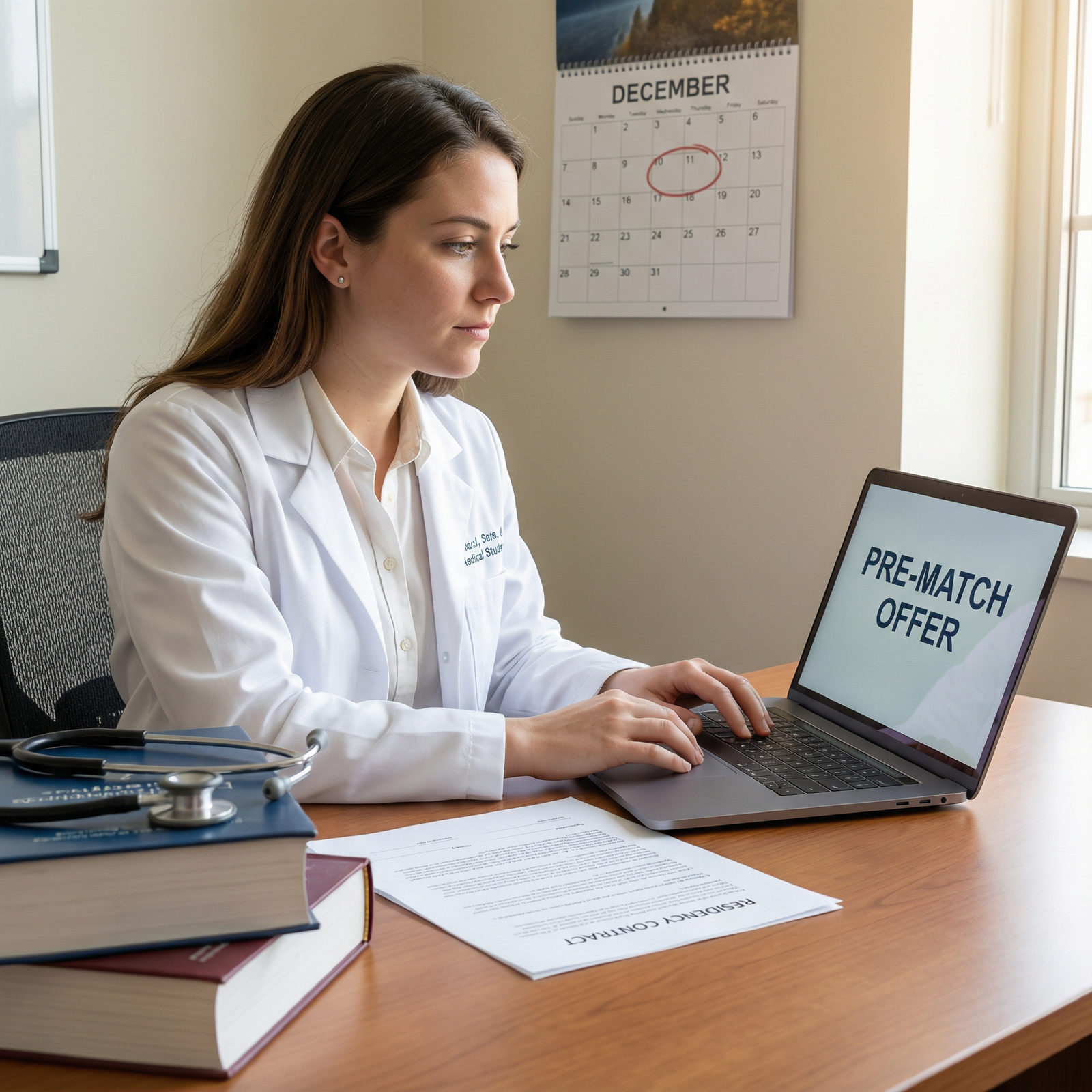
Understanding Pre-Match Communication in Family Medicine
Pre-match communication has become one of the most confusing—and anxiety-provoking—parts of applying to a family medicine residency. Between mixed messages on social media, formal NRMP rules, and real-life stories of pre-match offers and “early commitment” emails, it can be hard to know what is appropriate, what helps, and what could quietly hurt your chances in the FM match.
In family medicine, where programs often emphasize fit, mission, and long-term relationships with communities, communication before Match Day can feel even more personal. This guide breaks down how to navigate pre-match communication ethically, strategically, and confidently.
We’ll focus specifically on:
- What “pre-match communication” actually means
- Which practices are allowed vs. prohibited
- How pre-match offers and early commitment work (and where they still exist)
- Practical strategies for communicating with programs
- Sample emails you can adapt
- How to avoid common pitfalls that can jeopardize your application
Throughout, keep one principle in mind: the primary goal of pre-match communication is to clarify interest and fit—not to game the system or pressure anyone into commitments that violate NRMP rules or your own comfort.
1. What Counts as Pre-Match Communication?
Before getting tactical, it’s important to define the term clearly.
1.1. Core definition
Pre-match communication refers to any interaction between an applicant and a residency program that happens:
- After your application is submitted
- Before the release of Match results
This includes:
- Email exchanges
- Phone calls or video calls
- In-person discussions (on interview day, second looks, conferences, away rotations)
- Messages via recruitment events (virtual open houses, webinars, recruitment fairs)
In family medicine, pre-match communication is especially common because:
- Many programs are community-based and value strong interpersonal connections
- Programs often recruit with a mission focus (underserved care, rural medicine, academic FM, etc.) and want to gauge how well you align with that mission
- Many applicants are genuinely interested in clarifying questions about curriculum, location, or fit
1.2. Types of pre-match communication
You’ll encounter several common categories:
Informational communication
- You asking about curriculum, call schedules, research, or community health initiatives
- Clarifying how they support OB training, geriatrics, or procedural skills
- Learning about visa sponsorship or couples match logistics
Relationship-building communication
- Thank-you emails after interviews
- Follow-up messages updating programs on new accomplishments
- Correspondence with program coordinators about logistics
Preference signaling & interest expression
- Letting a program know you are “very interested” or “highly ranking” them
- (Where allowed) communicating that they are your top choice
Pre-match offers or early commitment (where applicable)
- Direct offers of a position outside the NRMP Match in certain states or settings
- Early acceptance agreements, often for non-NRMP programs or specific state pre-match systems
Family medicine residency is heavily centralized in the NRMP Match, so formal pre-match offers are less common than in some other specialties—but they still exist in certain regions or systems, especially where non-NRMP programs or state-specific processes are involved.

2. The Rules: What’s Allowed, What’s Not (NRMP & Ethics)
You cannot navigate pre-match communication safely without understanding the NRMP (National Resident Matching Program) rules, which apply to most family medicine residency programs in the United States.
2.1. The NRMP Match Participation Agreement
When you register for the NRMP Match, you sign the Match Participation Agreement. It essentially says:
- You will submit a rank order list in good faith
- You will accept and honor the position where you match
- You will not engage in behavior that undermines the fairness of the Match
Many family medicine programs also sign similar agreements as NRMP-participating institutions.
2.2. Key rules relevant to pre-match communication
Here are the main principles you must respect:
No guaranteed ranking or outcomes
- Programs cannot require you to disclose how you will rank them.
- You cannot ask a program to tell you how they will rank you.
- Programs cannot make statements that imply a guarantee, e.g.,
- “You will definitely match here if you rank us first.”
- “We promise to rank you to match.”
- These types of statements should not be requested by you nor offered by them.
No contracts or commitments contingent on Match outcome
- You cannot sign agreements that say you must rank a program in a certain position.
- They cannot ask you to withdraw from the Match to accept a position that is supposed to be filled through NRMP.
Program communication before Match is allowed—but must be non-coercive
- Programs may tell you:
- “You are a competitive candidate.”
- “We are very interested in you.”
- They should not pressure you to state ranking order or make promises in writing.
- Programs may tell you:
You are free to express interest—but never obligated
- You may tell a program they are your top choice or that you will rank them highly.
- You are not required to do so, and programs cannot demand it.
Honesty is expected
- While the NRMP does not specifically “police” whether you meant “top choice” literally, it does expect that participants behave ethically and in good faith.
- Dishonest communication can damage your reputation and is strongly discouraged.
2.3. Are pre-match offers allowed in family medicine?
In the context of the standard NRMP Match, no—programs that participate in the Match are not allowed to “pre-match” applicants with binding offers that bypass the process.
However, you might still encounter:
- Non-NRMP programs (some community or military programs, or those in special pathways) that truly pre-match outside NRMP
- State-specific pre-match systems (rare, but still existing in some regions, historically seen more often in Texas or for certain specialties)
- Informal “early commitment” pressure, where a program signals that if you promise them rank #1, they may rank you aggressively
Your safest approach:
- Always ask:
- “Is this position being filled through the NRMP Match, or outside the Match?”
- If it is an NRMP-participating family medicine residency, they should not be offering you a binding pre-match position.
- If it is outside NRMP, understand that accepting an offer may make you ineligible or obligated differently in the standard Match, depending on the contract.
3. Pre-Match Offers and Early Commitment: How to Respond
Even in family medicine, some applicants encounter pre-match offers or strong “early commitment” signals. These can be exciting but also stressful.
3.1. Clarify what kind of offer it is
If a program reaches out and says something like:
- “We’d like to offer you a spot here if you commit to us,” or
- “We would like you to withdraw from the Match and sign with us”
You should clarify immediately:
- Is this program in the NRMP Match?
- Is this an official contract (outside NRMP), or just informal interest?
- Would accepting this offer require me to withdraw from the NRMP Match?
Ask these questions explicitly, preferably in writing (email), so you have documentation.
3.2. Pros and cons of accepting a pre-match offer (non-NRMP)
If the offer is outside NRMP and legitimate:
Pros
- Guaranteed position—removes the uncertainty of the Match
- Early clarity on where you will train
- Potentially strong institutional or geographic fit if it’s your ideal setting (e.g., a community FM program in your hometown)
Cons
- You may forfeit the chance to match at other programs that might be a better fit or more competitive
- Less time to compare curricula, culture, and training environments
- If circumstances change, it may be hard or impossible to back out ethically or legally
In family medicine, where many applicants value geographic flexibility and mission fit, giving up the ability to compare multiple programs can be a major decision.
3.3. What if a program pressures you to declare ranking?
You might see language like:
- “We’d like to know if you will rank us #1.”
- “We really need a sense of your commitment before we rank you highly.”
Legally, they should not require this, but it still happens.
Your options:
Neutral but appreciative response
- Emphasize your strong interest without stating an exact rank order.
- Example:
“Thank you for your message and for considering my application. I remain very enthusiastic about your program and can confidently say that I will rank [Program Name] highly. I appreciate the opportunity to interview and to learn more about your commitment to [specific aspect].”
If they truly are your top choice
- You may choose to say so directly, ethically and honestly (more on wording in Section 4).
If they are not your top choice
- Do not misrepresent your intentions.
- You can still express strong interest, but avoid promising rank order that is not true.

4. How to Communicate with Programs Before the Match
Most of your pre-match communication in family medicine residency will be routine: thank-you emails, updates, and clarifying questions. Handled well, these can strengthen your candidacy and help programs remember you positively.
4.1. Thank-you emails
Timing: Within 24–72 hours after your interview.
Goals:
- Express appreciation
- Reflect genuine interest
- Reinforce specific aspects of fit
Example template:
Subject: Thank You – [Your Name], [Interview Date]
Dear Dr. [Last Name],
Thank you for the opportunity to interview at the [Program Name] Family Medicine Residency on [date]. I appreciated learning more about your commitment to [e.g., community health, OB training, rural rotations, behavioral health integration].
I was particularly impressed by [specific example: resident camaraderie, longitudinal clinic model, global health track, etc.]. As someone who hopes to practice [your career goals], I feel that your program’s strengths in [X, Y, Z] align closely with my interests and values.
I remain very interested in your program and would be excited to train as a family physician at [Institution Name].
Sincerely,
[Full Name]
AAMC ID: [Number]
4.2. Updates (post-interview)
You can send brief updates if:
- You have a new publication, award, or leadership role
- You have completed an FM sub-internship or community rotation
- You have a meaningful connection to the program’s region that you want to reiterate
Frequency: 1–2 meaningful updates per program after interviews is plenty.
Example update:
Subject: Application Update – [Your Name], [Your School]
Dear Dr. [Last Name],
I hope you are doing well. I wanted to share a brief update since my interview at [Program Name] on [date].
I recently [e.g., presented a poster on diabetes management in underserved communities at the state AFP conference] and [was selected as co-leader of our Family Medicine Interest Group]. These experiences have further reinforced my commitment to a career in family medicine focused on [specific passion].
I remain very enthusiastic about the possibility of training at [Program Name], particularly given your program’s strengths in [related feature].
Thank you again for considering my application.
Best regards,
[Full Name]
AAMC ID: [Number]
4.3. Expressing interest versus declaring a “top choice”
You might decide to signal a program as your top choice, especially in a competitive FM match cycle. This can be done once to a single program if you are absolutely sure.
Ethical guideline:
- Only tell one program they are your “top choice” or “will be ranked #1.”
- Do not send this message to multiple programs.
Example “top choice” email:
Subject: Continued Interest – [Your Name]
Dear Dr. [Last Name],
I am writing to express my sincere gratitude again for the opportunity to interview with the [Program Name] Family Medicine Residency. After completing all of my interviews and reflecting carefully on program fit, I wanted to let you know that [Program Name] is my top choice, and I will be ranking your program #1.
The combination of strong training in [e.g., full-spectrum family medicine], your commitment to [underserved communities/rural care/academic primary care], and the supportive culture I observed among residents and faculty makes your program the ideal place for my training.
Thank you again for your time and consideration. I would be honored to join your team and contribute to the mission of [Hospital/System Name].
Sincerely,
[Full Name]
AAMC ID: [Number]
If you are interested but not ready to commit to ranking them #1, you can soften the language:
- “I will rank your program very highly.”
- “Your program remains one of my top choices.”
4.4. Communication with program coordinators
Program coordinators are critical allies. It is appropriate to email them about:
- Scheduling conflicts or rescheduling interviews
- Technical issues with virtual interview links
- Questions about second looks, housing, or logistics
Keep communication:
- Polite
- Concise
- Professional
Remember that coordinators often informally share impressions with the program leadership.
5. Strategic Considerations: Using Pre-Match Communication Wisely
Pre-match communication can strengthen your position in the FM match if used thoughtfully. It cannot rescue a fundamentally weak application from every outcome, but it can:
- Distinguish you from similar applicants
- Clarify your fit and motivation
- Build rapport with programs you genuinely like
5.1. Prioritize your energy
Given limited time, focus communication on:
- Programs at the top of your realistic preference list
- Programs where you have a strong geographic or mission fit (e.g., wanting to serve your home community)
- Programs where specific aspects of training (OB, procedures, rural, academic) align with your career goals
You do not need to send elaborate messages to every program.
5.2. Authenticity over over-strategizing
Program directors in family medicine read hundreds of emails each year. They quickly recognize:
- Generic, copy-paste language
- Overly effusive praise without substance
- Conflicting signals (e.g., multiple applicants “assuring” them they are #1 in obviously scripted language)
Focus on:
- Specific reasons you like the program
- Clear, simple statements of interest
- Genuine connection to their mission
5.3. Program communication before Match: How to interpret their messages
Programs may send:
- “We really enjoyed meeting you and think you would be a great fit.”
- “You are a strong candidate, and we hope to see you in July.”
- “We will be ranking you highly.”
Interpret these as:
- Signals of interest, not guarantees.
- Encouraging but non-binding.
Do not rely on any single email or conversation as proof you will match there. Continue to create a balanced rank list, including a range of programs where you would be happy training.
5.4. Common mistakes to avoid
Over-communicating
- Sending frequent, minor updates or repeated “checking in” emails can backfire.
Dishonesty
- Telling multiple programs they are your “top choice.”
- Exaggerating accomplishments that are easy to verify.
Aggressive negotiation
- Asking: “If I rank you #1, will you guarantee a spot?”
- Trying to leverage one program’s interest to pressure another.
Ignoring NRMP rules
- Agreeing verbally or in writing to rank a program in a specific position in exchange for “promises.”
In family medicine, where relationships and reputation in the community matter, maintaining integrity in your communication is especially important.
6. Putting It All Together: A Framework for Pre-Match Communication in FM
To navigate pre-match communication effectively in the family medicine residency landscape, you can follow this stepwise framework:
6.1. Before interviews
- Learn the basics of NRMP policies about communication and commitments.
- Create a tracking system (spreadsheet or document) to note:
- Programs you applied to
- Interview dates
- Key people you met
- Features you liked
- Whether you plan to send a “top choice” or “high interest” email
6.2. During the interview season
- Send timely thank-you emails (especially to the PD and any faculty who spent substantial time with you).
- Take notes immediately after each interview about:
- Program strengths
- Culture and fit
- Red flags
These notes will help inform any later pre-match communication.
6.3. After completing interviews
- Rank programs based on:
- Training quality
- Fit with your goals and values
- Geographic and personal considerations
- Identify:
- A single top choice (if you have one)
- A small group of highly preferred programs
Plan your communication accordingly:
- Top choice: Consider sending a clear, honest “top choice” email.
- High interest programs: Send targeted emails expressing strong interest and reiterating why you are a good fit.
- Others: Limited or no additional communication is acceptable.
6.4. As Match Day approaches
- Avoid last-minute, panicked outreach that feels desperate.
- Make sure your rank list reflects your true preferences, independent of perceived program interest.
- Trust the algorithm: ranking programs honestly in order of preference is the best strategy statistically and ethically.
Frequently Asked Questions (FAQ)
1. Can I tell more than one family medicine residency program they are my “top choice”?
You should not. While the NRMP does not explicitly track this, telling multiple programs they are your #1 is dishonest and unprofessional. It can damage your reputation if discovered and undermines the trust-based nature of pre-match communication. You may tell multiple programs that you are “very interested” or that you will “rank them highly,” but reserve “top choice” or “#1” for a single program, if any.
2. Do I have to send thank-you emails for every family medicine residency interview?
No, it is not a formal requirement, and some program directors place little emphasis on them. However, sending a short, sincere thank-you is considered good professional etiquette and can help reinforce your interest and fit. It rarely hurts you, and occasionally helps—particularly in family medicine, where communication, empathy, and professionalism are core values.
3. Are programs allowed to tell me where I stand on their rank list?
Programs may give you general feedback like “We will rank you highly” or “You are a competitive candidate,” but they should not give precise rank positions or guarantees. Even if someone informally hints that you are “near the top,” this is not binding and can change as the program finalizes its list. You should never base your rank order list solely on presumed program interest.
4. How should I respond if a program offers me a pre-match position outside the NRMP?
First, clarify whether the offer is truly outside the NRMP Match and whether accepting it would require you to withdraw from the Match or other applications. Consider:
- How strongly you want that specific program compared to others
- The legal and ethical obligations of any contract you sign
- The potential loss of flexibility in the standard FM match
If in doubt, discuss the situation with:
- Your medical school’s dean or advisor
- A trusted faculty mentor in family medicine
- Your institution’s GME or legal counsel (if available)
Do not rush into a decision based on pressure or flattery; make sure you understand all consequences before committing.
Navigating pre-match communication in the family medicine residency process does not have to be mysterious or manipulative. When you understand the rules, stay honest, and use communication to clarify fit rather than to bargain for positions, you can move through the FM match with professionalism, integrity, and confidence.